Book prices went from how much to how much?
Book prices from 1359 to 1398 (1980–2020) increased a great deal; 2,870 times. At first they rose by 10 tomans and 20 tomans, and then they also experienced thousand-toman increases. In recent years, too, 1,000 tomans is nothing, and in 1399 (2020/21) the average book price increased by 10 thousand tomans.
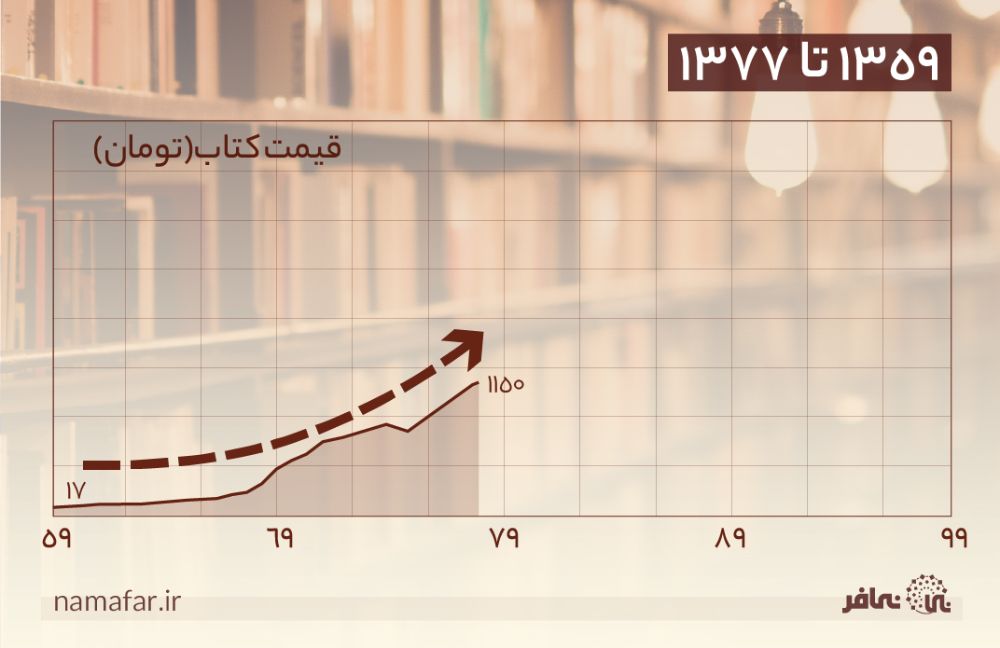
The years 1359 to 1377 (1980–1999) are a period of sharp price increase. The book price in 1359 (1980/81) was only 17 tomans. 18 years later, in 77, the book price finally broke the 1,000-toman resistance and reached 1,150 tomans. Today with 1,150 tomans one cannot even buy a ballpoint pen, but the 1,150-toman average means the book price multiplied by 67 in those years.
The calm period of 1378 to 1389 (1999–2011)
The book price in 1381 (2002/03) reached 1,800 tomans. Card-reader devices did not yet exist, and the 2-thousand-toman banknote was also first printed in 1382 (2003/04). As a result one had to give the seller 2 one-thousand-toman notes and also get 200 tomans in change. It is cheap. In these same cheap years the book price reached 4,680 tomans in 1389 (2010/11); 4 times for this 12-year period, which is much better than 67 times.

The decade of marking over the cover price with a marker
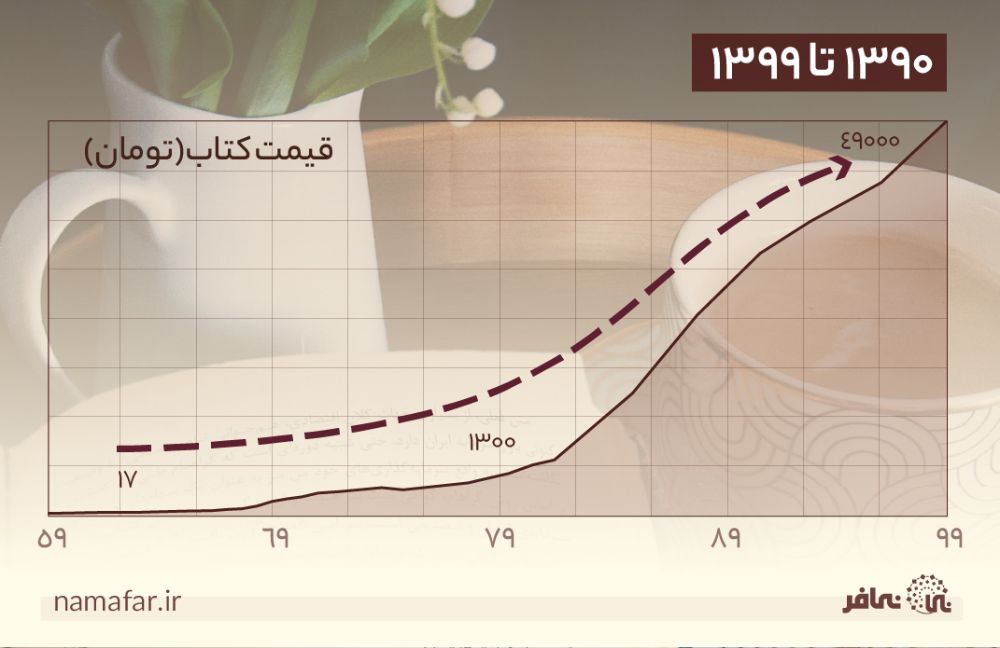
In these years a wartime situation prevailed in the book market. In this period when books were getting more expensive day by day, publishers, instead of a new printing, marker in hand, took the prices in hand. The price in 1390 (2011/12) was only 5,100 tomans and in 1399 (2020/21) reached 49 thousand tomans. Perhaps its becoming 10 times is seen, but with this figure in 1359 (1980/81) one could buy 2,800 books! The foresight of printing the 50-thousand-toman banknote in 1387 (2008/09) showed itself at the end of the 90s, otherwise with 10-thousand-toman banknotes one could at most buy books until 1392 (2013/14)!
What is publishers' heartfelt word after all this inflation?
If you tell publishers about the book price becoming 2,870 times, they say it must get more expensive still. As if everything is normal. Their point, too, is that everything has gotten more expensive. Inflation is certainly a relative phenomenon and a criterion for expensiveness must be defined. What better than the coin, which is the backing of the rial. So in what follows we compare the value of the book with the value of the coin and show that in different years, by having a thousand books, how many coins one could buy.
Is knowledge more expensive, or wealth?
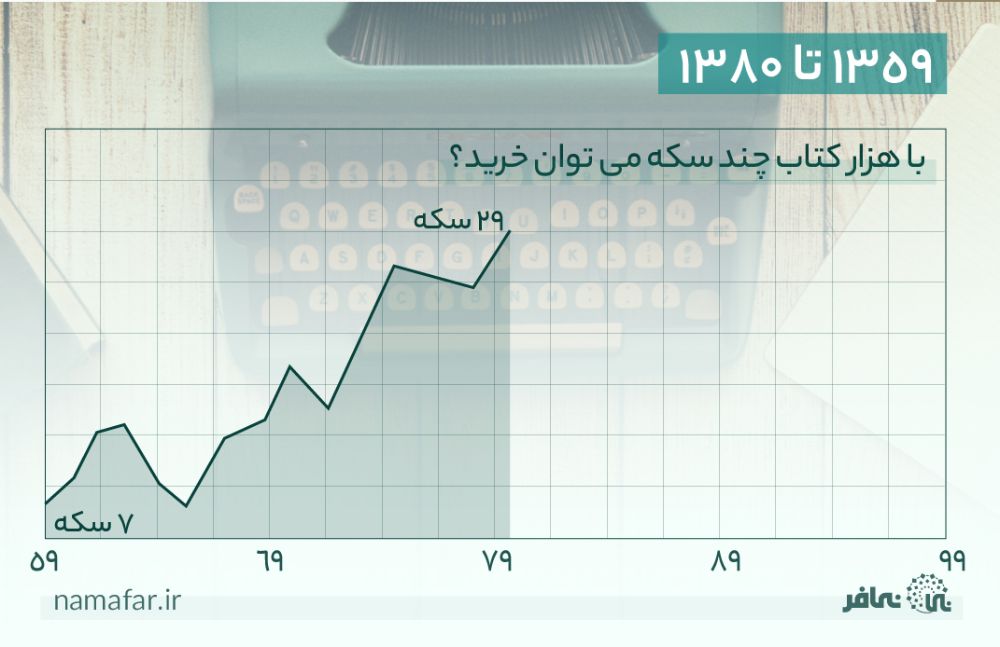
The book price for 20 years became more and more expensive. In 1359 (1980/81) with 1,000 books one could buy 7 coins, and in 1380 (2001/02) the value of the book against the coin had become so great that with 1,000 books one could buy 29 coins; that is, the relative value of the book became 4 times! But the story does not end here, and the coin, fully armed, at the end of the century returns for revenge.
The value of the book from 1380 to 1395 (2001–2017) declined slowly until the inflation tsunami began from 1396 (2017/18) and took the book price from 15 to 50 thousand tomans in 1399 (2020/21). What an increase! The coin does not lag behind either, and against the roughly 4-fold jump in the book price it became more than 10 times more expensive, so that today the value of a thousand books equals only 3 coins; that is, less than half of 1359 (1980/81).
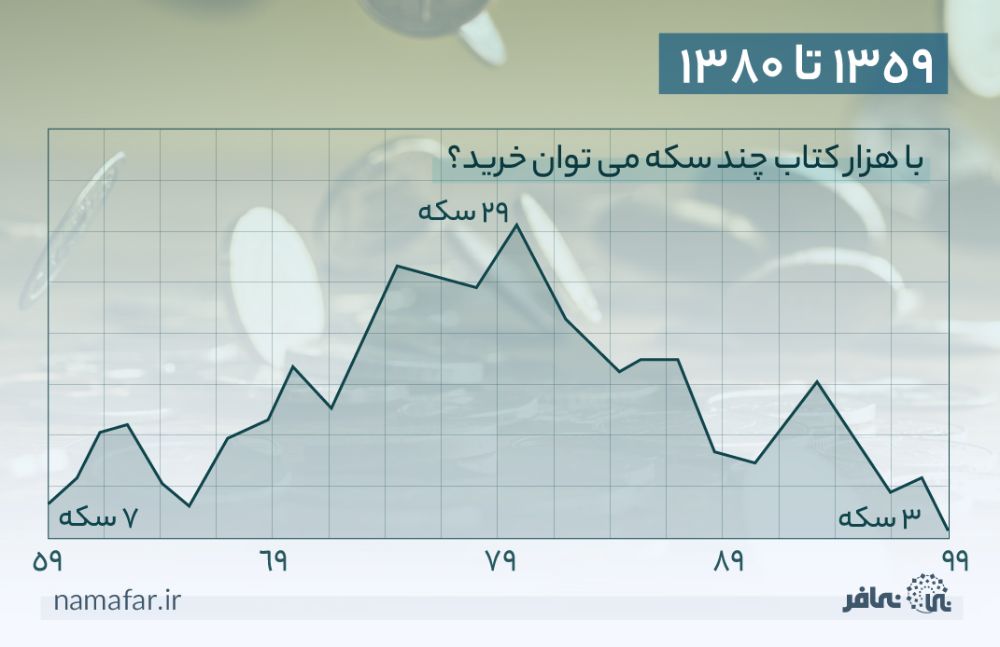
The best description of the book's present state is perhaps that the book in these years has become more expensive but is still not expensive! From 1359 to 1399 (1980–2021) the book price went from 17 tomans to 50 thousand tomans; the coin too from 2,400 tomans to 11 million tomans. Which one has become more expensive? It is clear; the coin! In fact the coin has become 4,500 times and the book only 2,800 times. So the relative value of the book in these 40 years has even decreased; that is, if we ask veteran booksellers how they are, they answer:
"Like a compass we ran bewildered all our lives....at last we arrived at the same point where we were"
Finally let us also say that even if the book is expensive, that does not mean not buying and not reading! Even if we read the book as expensive, it will probably help us preserve our wealth.
Write the bitter and sweet memories of your book-buying right below. On the website, Instagram and LinkedIn of Namafar you can also access the latest statistics of the book industry.
Postscript:
Author: Mohammad Maleki
Data compilation: Sajjad Shomali
Machine-translated from Persian by Namafar; the Persian original is authoritative. Read the original in Persian