Examining the impact of the war on Iran's domestic tourism
When war begins, travel ends. Families or individuals may go from one city to another, but this kind of movement and migration is not "travel"; war ruthlessly strips from them the meaning and identity of travel and the traveler. The occurrence of the 12-day Iran-Israel war, in addition to shutting down international travel and ending the presence of foreign tourists during the war, has also affected domestic travel. The special security and political conditions arising from the war have caused a marked decline in the level of people's attention to travel. In this same vein, the Namafar Center for Policy Research and Data Analysis, by examining Google Trends data in two similar time periods in 1403 (2024/25) and 1404 (2025/26) and crossing them with the days of the war, has sought to extract and analyze the effect of the war on Iranians' summer travel through the lens of data.
The boom in Iranians' domestic travel in the hot summer of 1403 (2024/25)
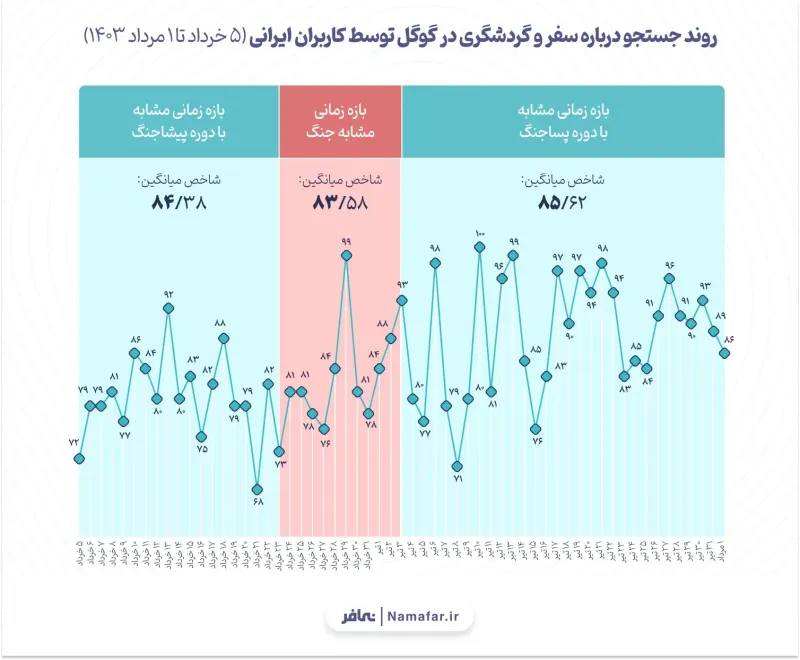
Every year, coinciding with the end of the academic year and the start of summer holidays, Iranians' summer travel begins in the last days of spring. So that from late Khordad (May–June) to the end of Tir (June–July), the travel fever in Iran is high. In this same vein, examining the trend of searches about travel and tourism on Google by Iranian users last year, from 5 Khordad 1403 (2024/25) to 1 Mordad (July–August) 1403 (2024/25), shows that from 23 Khordad searches about tourism and travel had a noticeable increase and rose from an average index of 79 to 89 by early Mordad. This is while from 23 Khordad to 1 Mordad the lowest index recorded for searches about travel and tourism was the index 71. Examining the trend of searches about travel and tourism on Google by Iranians in 1403 (2024/25) indicates two prominent points; in the first place, the level of people's attention and searches on Google from the third decade of Khordad was increasing and without a particular drop until 1 Mordad. Also, 23 Khordad was the starting point of the increasing trend of attention to travel. For a better understanding and comparison of the changes in the trend of people's attention to travel and tourism at the peak of summer travel in 1403 (2024/25) and 1404 (2025/26), the classification of time periods in 1403 (2024/25), given the days of the war in 1404 (2025/26), has been analogized and presented separately in 3 sections: pre-war, during the war, and post-war.
The heavy shadow of the 12-day war on Iranians' summer travel
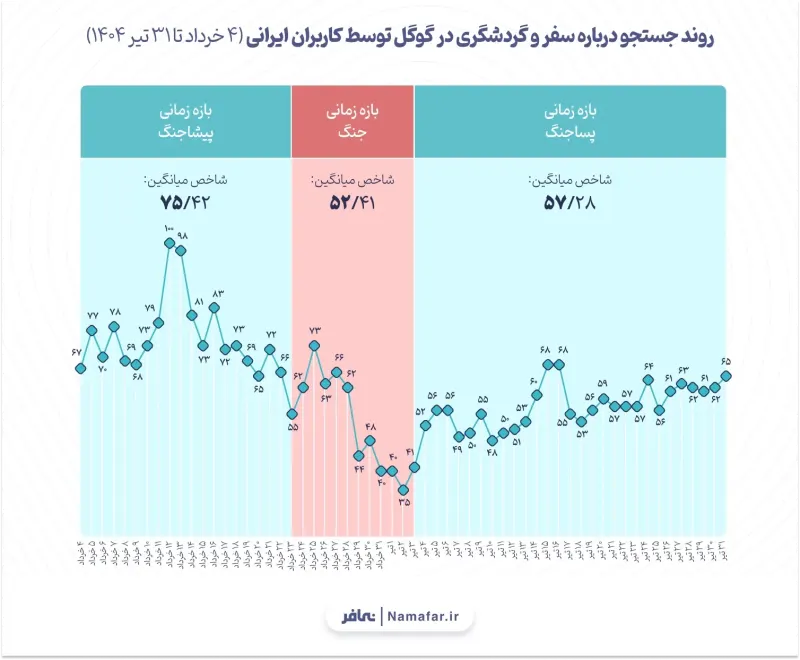
The start of the imposed 12-day war from 23 Khordad 1404 (2025/26) and its continuation until 3 Tir 1404 (2025/26) has affected Iranians' summer travel in 1404 (2025/26). Examining the trend of searches about travel and tourism on Google by Iranian users in 1404 (2025/26), from 4 Khordad 1404 (2025/26) to 31 Tir 1404 (2025/26), shows that from 23 Khordad and the start of the war, searches about tourism and travel had a noticeable decrease and fell from an average index of 76 in the pre-war days to 55 by the end of Tir. This is while from 23 Khordad to 31 Tir, the lowest index recorded for searches about travel and tourism was the index 35 and was during the days of the war. Breaking down Google searches about travel and tourism in 1404 (2025/26) into 3 sections—pre-war, during the war, and post-war—and comparing them with the similar time period in 1403 (2024/25) well shows that the 12-day war has caused a decline in people's attention to travel and domestic trips. However, a look at the level of searches about travel and tourism on Google by Iranians in the final days of Tir 1404 (2025/26) indicates a relative growth in people's searches about travel and tourism and an improvement in their attention to domestic travel.
Decline in job opportunities in the tourism field after the war
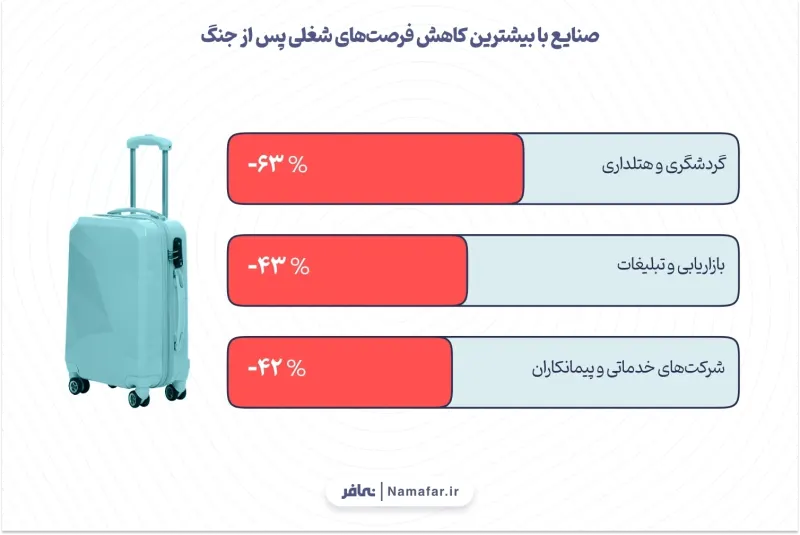
The economy and income of industries and businesses are among the most prominent and most tangible concerns of people and business actors during the war and after the war. The tourism industry is one of the most vulnerable fields, whose market and jobs are severely affected by war. Based on the results of the report "Examining the state of the labor market; under the impact of the 12-day war" "published by JobVision," in the days after the war, the "tourism and hospitality" industries, with a 63 percent decline in job opportunities, had the largest decline in job opportunities. This is while a possible continuation of the decline in domestic travel by travelers will also intensify the decline in job opportunities and even a reduction in existing jobs in the tourism field.
Final word
A data-driven examination of the level of people's attention and searches about travel and tourism indicates a marked drop in people's summer travel and the heavy shadow of the 12-day war on domestic tourism. It is as if tourism has been confined within the siege of war and Iranians' summer travel has been disrupted. This matter has caused businesses and jobs related to and benefiting from tourism to also face a challenge, so that in the days after the war, the "tourism and hospitality" industries, with a 63 percent decline in job opportunities, had the largest decline in job opportunities. However, with the official weekend holidays at the end of Tir 1404 (2025/26) in most of the country's provinces—due to the rise in temperature and in order to save energy—we have witnessed a relative growth and improvement in people's attention to domestic travel and an increase in trips. This same matter caused the announcement of the possibility of a Tehran holiday in the second decade of Mordad 1404 (2025/26) to raise the expectation of an increase in domestic travel. But the news of the government's opposition to these possible holidays, in recent days, largely ruled out this optimistic scenario. On this basis it seems that, until mid-Mordad 1404 (2025/26) and the arrival of the days of the Arbaeen walk, no serious change will occur in Iranians' domestic travel.
Machine-translated from Persian by Namafar; the Persian original is authoritative. Read the original in Persian