Arbaeen travel costs: from bus fares to plane and train tickets
The fire of love for Husayn is never extinguished. Although many hearts beat for Husayn ibn Ali in the first decade of Muharram in homes and heyats in their cities, villages, and neighborhoods, Arbaeen is, as it were, another arena; a place where the longing to meet demands the will to take steps, and the loving soul pulls the weary body along with it. Many people in Iran, if in Muharram they are regulars at rawda gatherings, in Arbaeen they set their hearts on a journey that begins in Najaf and ends in Karbala on foot, along a path known as Tariq al-Husayn. The Arbaeen journey, in addition to its spiritual dimensions, also has a special place among pilgrimage trips in material terms. Because a large share of its costs, such as lodging and food, is provided by volunteer servants of Imam Husayn (peace be upon him), and this very fact lightens the financial burden of the journey for pilgrims. As a result, the most important and perhaps the main cost that pilgrims must plan for is the cost of transportation from various cities of Iran to Iraq's borders, and then from the border to the pilgrimage cities of the Atabat Aliyat.
The route to the border is not a single route. Several land borders such as Mehran, Shalamcheh, Chazabeh, Khosravi, and others are each a gateway for pilgrims to cross. On the other hand, air travel is also a serious option for some pilgrims who have greater financial means or who set out from more distant cities. Naturally, the cost of each of these routes is different. In this note, we examine Arbaeen travel costs in the transportation segment: from the ticket prices of various buses from Tehran to the border, to the prices of Arbaeen flight tickets and the fares of vehicles from the borders to Najaf and Karbala. We also review the price trend of recent years so that a clear picture of the economic dimensions of this great journey is drawn and pilgrims of Aba Abdillah are helped in choosing their best route.
Overland to the border: the most popular route for Arbaeen pilgrims
Although for travel to Iraq and participation in the great Arbaeen walk, air and rail routes are also available to pilgrims, land routes have always been more popular among the general public because of the abundance of vehicles, lower costs, and easier access. The millions of Iranians who every year set out to visit the shrine of Imam Husayn (AS) often choose land borders as their travel route. Along its western borders with Iraq, Iran has several border terminals, among the most important of which one can mention Mehran, Shalamcheh, Chazabeh, Khosravi, Bashmaq, and Tamarchin. These terminals differ in terms of age, facilities, and service provision; some have for years received huge crowds of pilgrims, and some have recently been built or equipped in response to the striking increase in Arbaeen pilgrims.
Among these terminals, "Mehran border" located in Ilam Province is the most famous and the most popular. This terminal, known as the Shahid Qasem Soleimani terminal, has suitable welfare infrastructure, extensive parking lots, and round-the-clock service mawkibs. The relatively short distance of this border to Iraq's important pilgrimage cities, especially Najaf (about 305 kilometers) and Karbala (about 280 kilometers), has made Mehran the first option of many pilgrims for travel to the Atabat Aliyat. After Mehran, the Shalamcheh terminal in Khuzestan Province is also considered the second most heavily trafficked border for Iranian pilgrims. Although the distance of this terminal to Najaf and Karbala is greater than Mehran's (about 460 and 540 kilometers, respectively), the relatively level route and good, suitable welfare facilities on both sides of the border have meant that Shalamcheh, especially among pilgrims who set out for Karbala from the country's southern provinces, has many supporters.
Chazabeh border is also another of Khuzestan Province's borders that has for years received Arbaeen pilgrims. Although Chazabeh is not as crowded in traffic as Mehran and Shalamcheh, with facilities that are being expanded, being relatively less crowded, and a similar route in terms of distance to the Atabat Aliyat, it receives the attention of a group of pilgrims. Khosravi border in Kermanshah Province is one of Iran's oldest borders with Iraq, which in recent years, after a period of closure, has been reopened for pilgrims' traffic. Khosravi, with suitable facilities, a suitable road route, and cooler weather relative to other borders in summer, is a desirable option for some pilgrims. The distance of this border to the city of Karbala is about 320 kilometers and to Najaf about 380 kilometers. Bashmaq in Kurdistan Province and Tamarchin in West Azerbaijan Province are newly established borders for serving Arbaeen pilgrims. These two terminals, because they are new, have not yet reached the fame of Mehran or Shalamcheh, but they are rapidly developing their facilities. The greater distance of these borders to the cities of Najaf and Karbala (around 500 to 600 kilometers) has meant that these borders are still less welcomed than other terminals, but in recent years travelers from the country's northwestern and western provinces have been using these terminals more than before.
Overall, because of the shortness of the route, the long track record, desirable services, and suitable infrastructure on both sides of the border, "Mehran border" still has far greater popularity than other terminals and has always been, and is, the first option for the passage of millions of Iranian pilgrims in the Arbaeen period. After becoming familiar with the borders and their features, in the next section we will turn to a precise examination of travel costs from various cities of Iran to these land borders.
Bus ticket prices from Tehran to Iraq's borders in Arbaeen 1404 (2025/26)
An examination of the official intercity bus fare rates during the Arbaeen period shows that the cost of travel from Tehran to Iraq's border terminals has increased noticeably, especially on lower-capacity buses. In 1404 (2025/26), 22- to 25-passenger buses (which are usually also known as VIP) are the most expensive option, while 40- to 44-passenger buses, with far lower fares, are considered a more economical option for pilgrims. An examination of bus fares from Tehran to the Arbaeen borders by bus type and border shows that the most expensive route was the Shalamcheh border at a rate of 1,737,000 tomans on small buses, and the cheapest route was the Bashmaq border at a fare of 729,000 tomans on 44-passenger buses. It was also seen that the fare on the Tehran-to-Mehran route, as the country's most heavily trafficked border, reaches 1,462,000 tomans on a 25-passenger bus, while the same route on larger buses (44-passenger) costs only 871,000 tomans. These price differences indicate an important point: the type of bus chosen has a direct effect on travel cost. Smaller buses, because of more comfortable space, VIP service, and lie-flat seats, have a higher fare. But for pilgrims who intend to save on cost, using 33- to 44-passenger buses is a more suitable option, although some of these buses, in terms of time, will have a longer travel duration until they reach the border.
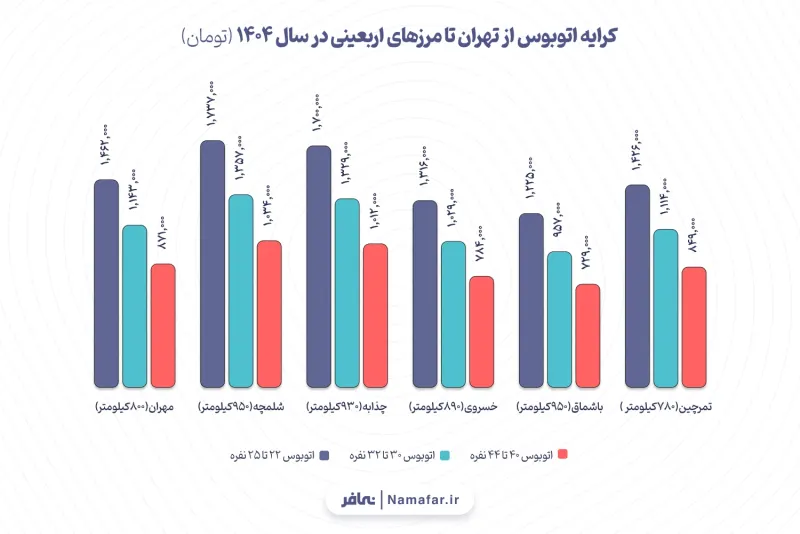
The rise in Arbaeen bus ticket prices, beyond inflation and concerning
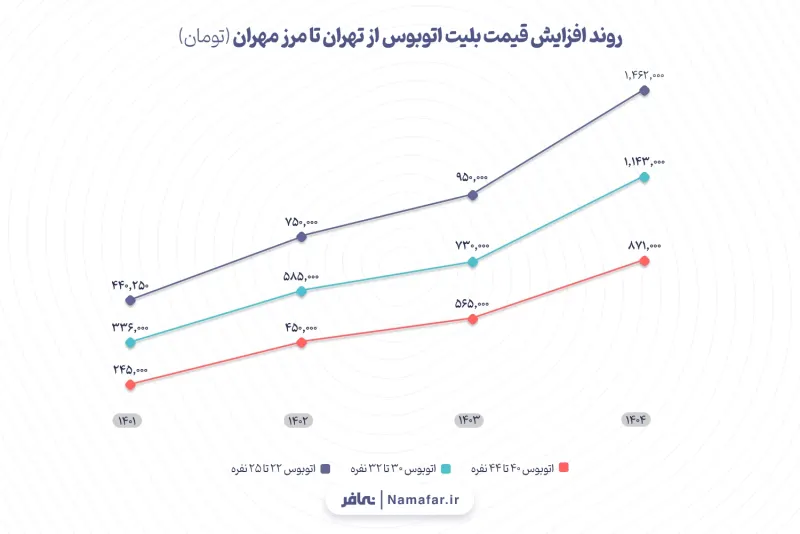
In a closer look at the charts of bus ticket prices from Tehran to the Mehran and Shalamcheh borders over the past four years, what draws attention more than anything else is the concerning and continuous increase in these rates. Growths that in some cases have even gone beyond the country's official inflation rate; an issue that has placed a heavy financial burden on pilgrims, especially low-income groups. An analysis of the trend of the increase in the Tehran-to-Mehran ticket price by bus type from 1401 to 1404 (2022–2026) shows that for the Mehran border, the price of a 25-passenger bus ticket in 1401 (2022/23) was equivalent to 440 thousand tomans. This figure in 1402 (2023/24) reached 750 thousand tomans. In 1403 (2024/25) this rate increased to 950 thousand tomans, and finally in the current year (1404 (2025/26)) it has reached one million and 462 thousand tomans. That is:
- Increase relative to 1403 (2024/25): about 512 thousand tomans, equivalent to a 54 percent price increase
- Increase from 1401 to 1404 (2022–2026): more than one million tomans, equivalent to a 232 percent price increase
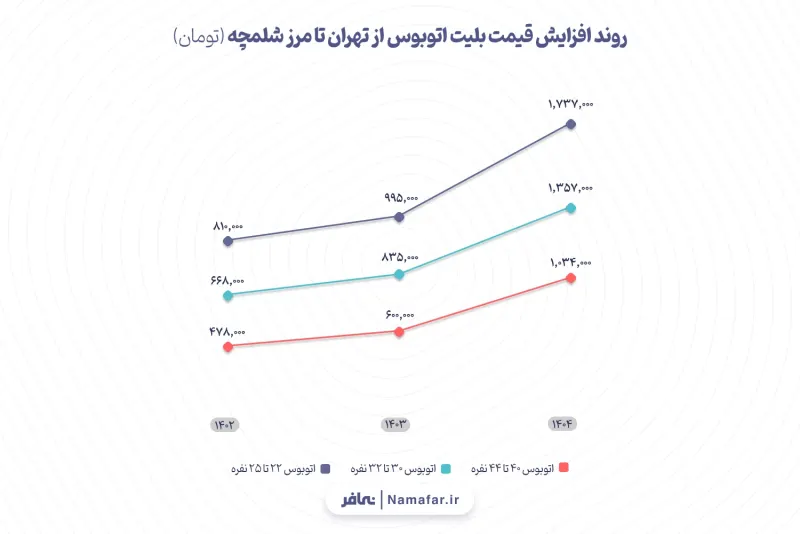
At the Shalamcheh border too, the same pattern of a price jump is observed. In 1402 (2023/24) the price of a 25-passenger bus ticket from Tehran to Shalamcheh was 810 thousand tomans. In 1403 (2024/25) this rate reached 995 thousand tomans, and in the current year (1404 (2025/26)) it has jumped to one million and 737 thousand tomans. That is:
- Increase relative to 1403 (2024/25): about 742 thousand tomans, equivalent to a 74 percent price increase
- Increase from 1402 to 1404 (2023–2026): about 927 thousand tomans, equivalent to a 114 percent price increase
This is while the country's annual inflation rate in the interval of these years has usually fluctuated between 30 and 40 percent. Therefore the annual increase in bus tickets has in some cases been up to two times greater than the country's general inflation. Such an increase, especially in the case of public transport tickets which in Arbaeen trips are considered almost the only costly part of the journey, has imposed heavy pressure on the middle and lower strata of society. Pilgrims who, out of devotion, even with not particularly high financial means, set foot on this path, have now been faced with a choice among severe economizing, debt, or withdrawing from the journey. To control this situation, the government and the institutions in charge of pilgrimage travel, including the Arbaeen Headquarters and the Ministry of Roads, must enter the field and provide for supportive or subsidy mechanisms for the transportation segment in the Arbaeen period. Otherwise, in future years, this rapid trend of price increases may threaten public participation in the largest religious gathering in the Islamic world.
Transportation costs from Iran's borders to Iraq's pilgrimage cities
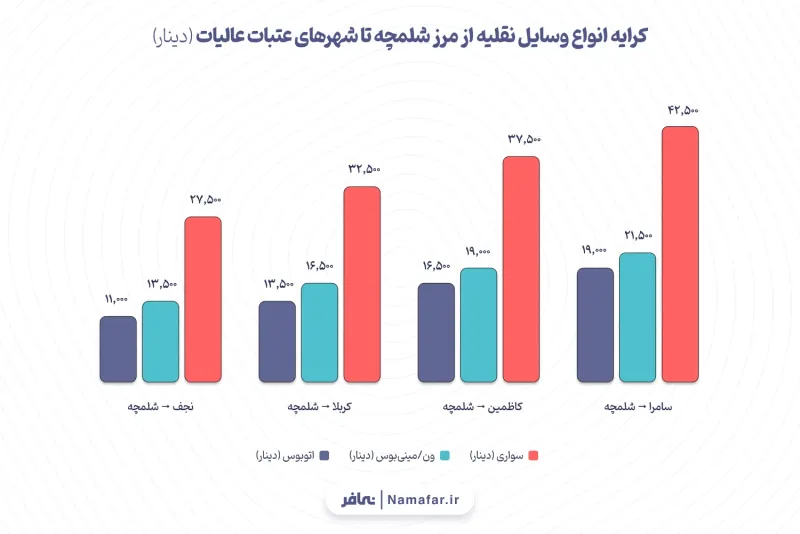
With crossing the border and entering Iraqi territory, the second stage of pilgrims' journey begins; a stage that, although it is shorter relative to the Iran route, because of currency conversion and the difference in the purchasing power of the two countries' national currencies, at times plays a prominent share in pilgrims' final costs. An examination of vehicle fare rates from the two heavily trafficked borders of Mehran and Shalamcheh to the pilgrimage cities shows that the diversity of prices based on vehicle type and destination is striking. An examination of vehicle fare rates from Mehran and Shalamcheh borders to Iraq's four pilgrimage destinations, namely Najaf, Karbala, Kazimayn, and Samarra, shows that in comparison among vehicles, buses are the cheapest option for movement, while passenger cars account for the highest cost. This difference at times even reaches two times. For example, from Mehran to Karbala, the bus price is 10 thousand dinars, while by passenger car the same route costs 25 thousand dinars. Pilgrims who intend to save on costs are advised to use a bus or van as much as possible for travel from the border toward the pilgrimage cities. On the other hand, among destinations, Najaf and Karbala are cheaper than Kazimayn and Samarra, which is naturally because of their shorter distance from the border.
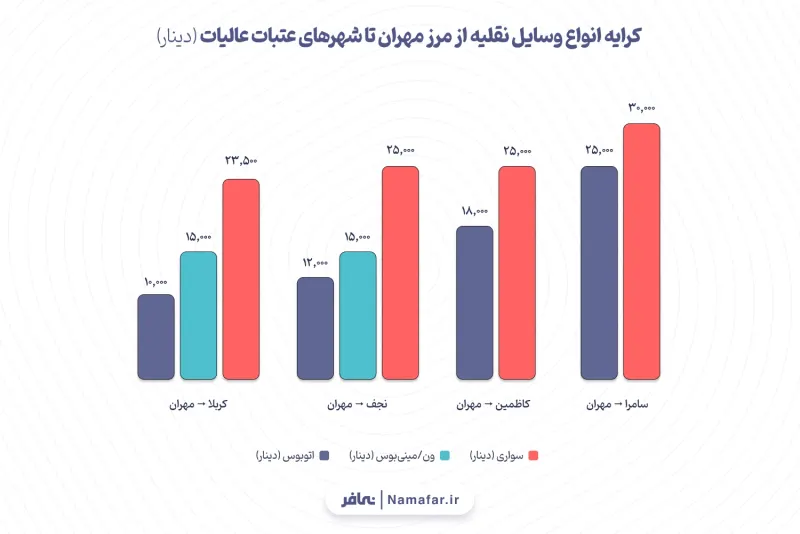
Stability of the dinar rate, but an increase in the rial cost
The important and noteworthy point is that public reports and field evidence over the past few years show that the fare rates of transport vehicles in Iraq in dinars have remained almost stable. Drivers often charge the same prices of 5 to 6 years ago, and we have rarely witnessed a jump in rates. But what has complicated the equation for Iranian pilgrims is the continuous decline of the rial's value against the Iraqi dinar. In other words, a pilgrim who in past years could cover the entire route from the border to Karbala by passenger car with 400 thousand tomans must now at times pay more than one million tomans, without any change having occurred in the dinar rate. The increase in domestic bus ticket rates in Iran, alongside this fall in the national currency's value, has caused Arbaeen travel costs for Iranian families to become heavier year by year. Given this situation, it appears that one of the effective solutions for reducing financial pressure is coordination by the government and popular institutions with the Iraqi side for advance purchase of services, preferential foreign exchange for pilgrims, or the creation of subsidized transportation systems; because experience has shown that people's interest in this journey has not diminished, but financial means are under threat.
Rail travel to Karbala: a combined, safe, and affordable route, but somewhat long
The rail route from Iran to Karbala has in recent years become one of the attractive options for Arbaeen pilgrims; especially for those who are looking for a safe, low-cost, and relatively comfortable journey. This journey includes two main sections: the first stage from various origins such as Tehran, Qom, Kermanshah, Hamedan, or Ahvaz to the final destination of Khorramshahr and then the Shalamcheh border station. In this section, extra and regular trains have been provided, and in 1404 (2025/26), according to an announcement by the Islamic Republic of Iran Railways, the capacity of these trains has increased 19 percent relative to last year and has reached 450 thousand person-seats. Also, through the first ten days of Mordad (July–August) this year, 70 percent of this capacity has been sold, and timely ticket purchase has gained doubled importance.
Continuing the route from Khorramshahr to the Shalamcheh border, railbuses with a speed of 120 kilometers per hour operate around the clock and transfer pilgrims. To facilitate travel, suburban trains between Ahvaz and Khorramshahr, and also a free return fleet from Andimeshk and Kermanshah stations to Tehran, have also been provided. But the route from Shalamcheh onward, that is, in Iraqi territory, is still a combined route. The Shalamcheh–Basra railway project has not yet been fully brought into operation, and as a result pilgrims, after entering Iraqi territory, must cover about 30 kilometers by bus until they reach the Iraqi train station. From there the rail route continues toward Karbala.
The entire journey, including movement from Tehran, intermediate stops, the border stop, and the Iraqi section, takes between 26 and 28 hours. The ticket price of this combined journey in 1404 (2025/26), depending on the type of wagon and its amenities, also varies between 960 thousand tomans and one million and 400 thousand tomans. This price difference is mainly related to the type of wagons used in the Iraqi section and the amount of welfare services (bus-type wagons, VIP, or four-berth compartments). In terms of advantages, rail travel is noteworthy from several angles: first, that relative to road routes it has higher safety and the possibility of rest and comfort in the wagons is provided. Second, that it prevents the fatigue caused by driving and delays in border traffic. The train's suitable ventilation and relatively calm space, especially in the summer heat, is very desirable for elderly pilgrims or families.
Nevertheless, there are also challenges in this type of journey. The duration of movement on the rail route for Arbaeen is longer than the land and air routes. Also, the border stop at Shalamcheh may, because of passport formalities and international coordination, be time-consuming. In addition, the incomplete completion of the Shalamcheh–Basra railway means that part of the route requires a change of vehicle, which may seem tiring or uncoordinated for some pilgrims. Overall, rail travel to Karbala is a combined, reliable, and economical option for pilgrims. Especially for families, the elderly, or those who want a calm and low-stress journey, this route is recommended. Although the need to develop infrastructure in the Iraqi section is still felt, the increased capacity, the new fleet, and special attention to facilitating transportation show that the future of Arbaeen rail travel can be brighter than in the past.
The air route, high-speed but high-cost
The air route for travel to the Atabat Aliyat has always been known as one of the fast, low-fatigue options suitable for groups such as the elderly, people with physical limitations, or pilgrims with limited time. In the Arbaeen period too, despite the higher cost relative to other methods, flying is still the main choice of many pilgrims. Ticket sales for Arbaeen 1404 (2025/26) flights began on Wednesday morning, the 8th of Mordad (July–August). According to Mehdi Ramezani, spokesperson of the Civil Aviation Organization, this organization, in order to prevent market disorder and increase transparency, has published the list of authorized sales channels. On this basis, ticket purchase is possible only through the official websites of airline companies, reputable online offices, and licensed agencies, and sales on other platforms or unofficially have been declared unauthorized.
Ticket prices in 1404 (2025/26)
According to the official circular of the Civil Aviation Organization, the ticket rates of Arbaeen flights for the period 17 to 26 Mordad (July–August) 1404 (2025/26) have been set as a ceiling, which you see in the chart below.
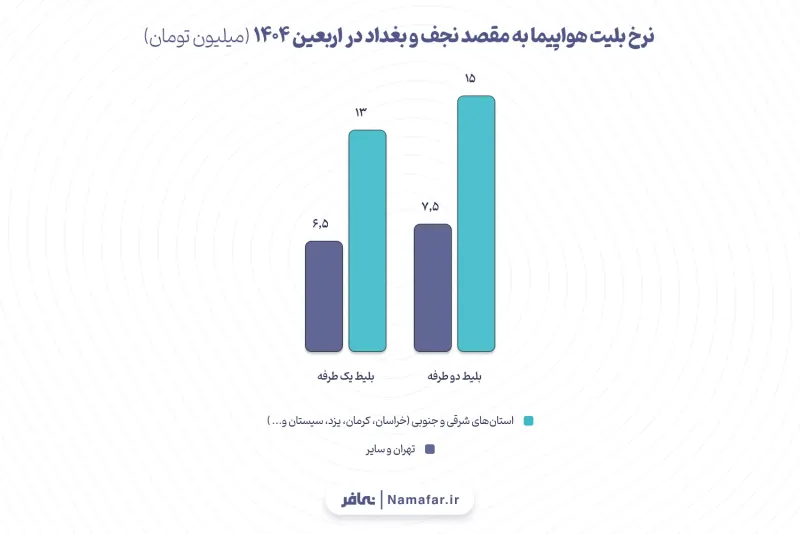
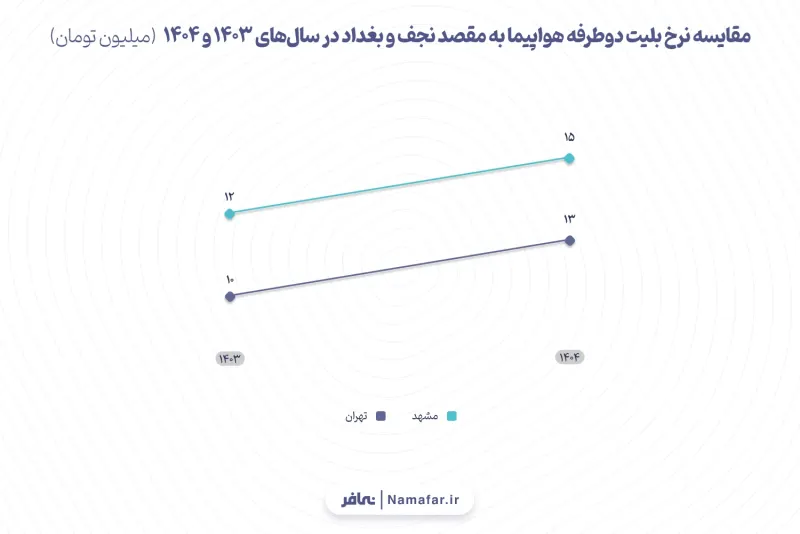
These rates have increased between 25 and 30 percent relative to last year; in 1403 (2024/25) the round-trip rate of the Tehran–Najaf flight was about 10 million tomans, while this year it has reached 13 million tomans (a 30 percent increase), and the Mashhad–Najaf flight too has increased from 12 million tomans to 15 (a 25 percent increase). In the chart below you see the trend of this price increase from last year. This increase is almost on a par with the country's general inflation rate, which according to official statistics has been reported between 30 and 40 percent. Therefore, it can be said that air travel in 1404 (2025/26) has had a smaller price increase than the land route, although this price growth is still striking.
Regulatory policies for controlling the market
To prevent speculation and violations, the Civil Aviation Organization has officially communicated the following items:
- Ticket sales must be at the passenger's choice (outbound, return, or round-trip) and forced two-way ticket sales are banned.
- The ticket price for children and adults is the same.
- Group sales for more than 9 people have been banned.
- Charter ticket sales for Arbaeen flights have been declared banned.
- Only 19 domestic airlines are permitted to sell Arbaeen flights; including Iran Air, Aseman, Mahan, Kish Air, Qeshm Air, Meraj, Taban, ATA, and Iran Airtour.
These measures, alongside setting a price ceiling, have been designed with the aim of creating fair access for pilgrims; however, given the increase in demand and the limited capacity of the air fleet, it is expected that cheaper tickets will sell out sooner and the black market or intermediation will reappear; a matter that has every year been the main concern of regulatory organizations.
In the end it must be said that flying is a fast and comfortable option for Arbaeen travel, but its high cost has turned this route into a particular choice for affluent groups. Although this year's pricing has been accompanied by an official ceiling and sales are conducted through authorized platforms, comparison with last year shows that the financial burden of this journey has increased sharply. For pilgrims who are looking for comfort and have suitable financial means, air travel is still the best option, but for the middle and lower strata, precise planning, early action, and examining alternative options (such as train and bus) are essential.
The sea route to Iraq: a new and attractive option for people of southern Iran
With the start of operation of the Khorramshahr–Basra sea line on Friday, 10 Mordad (July–August), the first sea journey of Arbaeen pilgrims in 1404 (2025/26) took place. This passenger line, with the ship "Borlian," which is domestically built and has a capacity of 235 people, was launched by the Islamic Republic of Iran Shipping Lines with the aim of providing safe and regular traffic. The Khorramshahr-to-Basra route is about 17 nautical miles and the travel time has been announced as between one and a half and two hours; this is while covering the land route from the same point may take several times as long. The ticket rate for Iranian pilgrims has been set at 600 thousand tomans; an amount that, given the relatively short time and the sea experience, even appears affordable for travelers from the south of the country. If this route meets sufficient reception, the possibility of increasing the number of journeys to four round trips a day has been provided, and continuation of the sea route in future years is also on the agenda of the responsible institutions.
Benefits of the sea route: facilitating travel and reducing congestion at land borders
Development of the sea route, alongside the advantage of transferring pilgrims from Khorramshahr to Basra, also has other strategic benefits. First, that it brings a reduction of pressure and congestion at land borders, especially Mehran and Shalamcheh, where every year hundreds of thousands of pilgrims pass. Also, for the people of Kurdistan and the southern regions of the country for whom land travel to the border is long or difficult, the sea option is considered a safer, faster, and more comfortable experience. In addition, the experience of sea travel between two neighboring countries on a direct and short route (17 miles), with amenities including equipped halls, a cooling and heating system, spiritual and cultural services inside the ship, and the calming space of sea travel, can be a different memory for pilgrims.
Final comparison among the various Arbaeen routes
In the Arbaeen period, travel to the Atabat Aliyat has various options that, depending on each pilgrim's circumstances and budget, can be chosen. The three main methods of travel include land, air, and sea, each of which has its own particular features and advantages.
Land travel is still the most popular option for most pilgrims. The ticket cost of 22- to 44-passenger buses from Tehran to Iraq's various borders, in 1404 (2025/26), varies respectively from 729,000 tomans to 1,737,000 tomans. This journey, especially for those who are looking to save on cost, is a suitable option, although the longer travel time and traffic problems at the borders may create a tiring experience for some pilgrims. Also, various routes such as Mehran, Shalamcheh, and Chazabeh provide different services.
Air travel is the fastest option but has much higher costs. One-way tickets from Tehran to Najaf and Baghdad for 1404 (2025/26) are 6.5 million tomans and for a round-trip ticket 13 million tomans. This option is more suitable for those who have limited time or want greater comfort, but for low-income groups these costs can create a great deal of economic pressure. Unlike other methods, air travel has had a smaller price increase relative to past years.
Rail travel is a combined and affordable option that in recent years, especially for families and people who are looking for a more comfortable journey, has become popular. Rail travel from Tehran to Khorramshahr and then Shalamcheh and finally continues by Iraqi bus or train to Karbala. This route, with a duration of 26 to 28 hours and a ticket cost of 960 thousand tomans to 1,400,000 tomans depending on wagon type, compared with flying is a more economical option. This option provides higher safety relative to the road and comfort throughout the journey.
Sea travel has also been introduced as a new option in 1404 (2025/26), which is conducted from Khorramshahr port to Basra. This route, especially for pilgrims from the south of the country because of the shorter time (1.5 to 2 hours) and the price of 600,000 tomans, is an affordable and comfortable option. With greater reception, the possibility of increasing the number of sea journeys and developing this option in future years exists.
Recommendations for saving time and money:
- To save on costs, pilgrims can use 40- to 44-passenger buses, which are cheaper than VIP buses.
- Early purchase of tickets for flights and trains can help you avoid high ticket prices.
- For pilgrims from the south of the country, sea travel is an affordable and fast option that, in addition to comfort, helps reduce pressure on land borders.
- Elderly pilgrims and families can benefit from air or train options in order to have a more comfortable journey.
- In choosing the route, special attention must be paid to travel time and cost so that an optimal experience of the Arbaeen journey is realized.
Closing remarks
Statistics show that the population participating in the Arbaeen walk grows greater every year than the year before, and pilgrims with even greater eagerness reach Karbala by land, air, and sea to pay their respects to Imam Husayn (AS) and his loyal companions and to take part in the Arbaeen ceremony. This immense solidarity, which is a manifestation of love for the Ahl al-Bayt (AS), has great importance not only in the spiritual dimension but also in social and cultural dimensions. But in the meantime, the duty of the relevant officials is to make undertaking this journey, and its costs and time, less and easier for pilgrims. It may well be that by reducing financial pressure and facilitating the travel process, they can lessen pilgrims' worries and provide more opportunity for worship and pilgrimage. This responsibility is not only a religious and sharia duty, but a social and executive obligation in the direction of serving the people.
Machine-translated from Persian by Namafar; the Persian original is authoritative. Read the original in Persian