Average lodging cost; the start of the analysis, not the end of the story
In the literature of tourism economics, one of the first questions is always "how much does lodging typically cost in a destination?". The answer to this question is presented in the form of the average price of accommodations; a simple but widely used indicator that allows policymakers, market actors, and even tourists to obtain an initial picture of the overall level of costs. However, the average is not merely a dry number, but a reflection of the structure of supply and demand; the greater the share of luxury accommodations, large villas, and premium coastal or urban units, the more the average tends toward higher levels, and conversely, a concentration on ecolodges or simple guesthouses pushes the average toward lower levels. In other words, the average price is a function not only of the quantity of accommodations, but also reflects the quality of services and their level of luxury. For this reason, although the average can be a suitable starting point for entering the discussion, it is not sufficient; because what matters for a scientific analysis of the market is not only the average level, but the dispersion and deviation of prices among provinces and within each market. It is worth noting that this analysis has been conducted on the basis of data from the Jabama platform.
Average accommodation prices in Iran's provinces; why is the cost of lodging not the same across provinces?
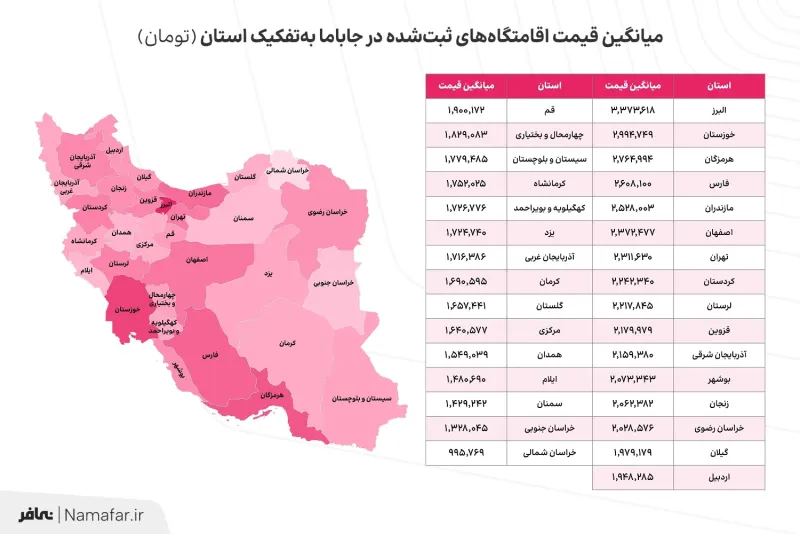
An examination of the average lodging price in Iran's various provinces shows that the distribution of costs across the country is by no means uniform. The chart reveals that provinces such as Alborz, Khuzestan, and Hormozgan sit at the top of the spectrum, while provinces such as North Khorasan, South Khorasan, and Semnan have recorded far lower averages. This heterogeneity can be interpreted from two aspects: the intensity and pattern of demand, and the quality and composition of supply.
Intensity and pattern of demand
For example, Alborz's proximity to Tehran or Hormozgan's coastal location causes the pressure of tourism demand and short trips to raise the level of prices; by contrast, provinces with a smaller market and more limited travel flows, such as North Khorasan or Semnan, do not have much ability to keep prices high.
Quality and composition of supply
Provinces that have a higher share of hotels and luxury accommodations in their structure naturally record a higher average, whereas provinces dominated by ecolodges or simple guesthouses present a different picture. Therefore the chart is not only a numerical ranking, but a sign of structural differences in the provincial lodging market; a difference that, for a better understanding of it, requires attention also to indicators such as the standard deviation so that the extent of dispersion and the intensity of price fluctuation become clearer.
A diverse or uniform lodging market; what does the dispersion of accommodation prices say?
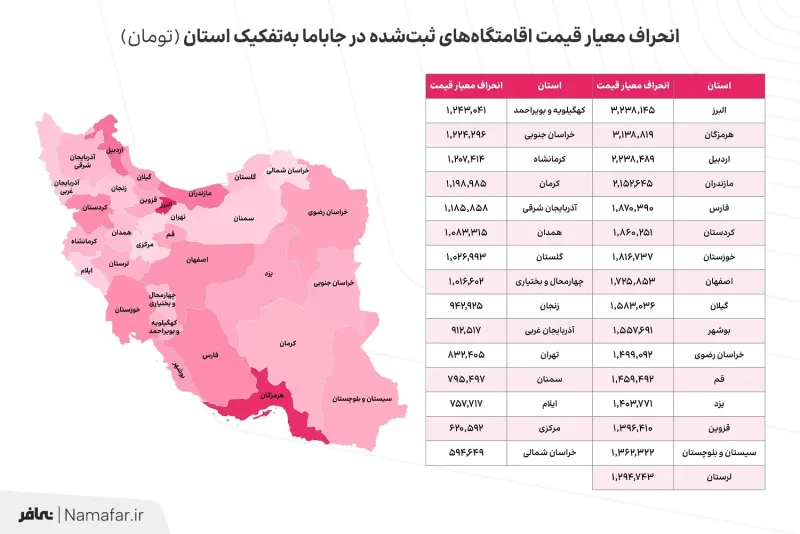
Since the average alone is not able to display the heterogeneity of the accommodation market, measuring the standard deviation as a complementary indicator becomes important. This indicator shows how far prices in a province are dispersed around the average and, as a result, better reveals the diversity and fluctuation of the market. Simply put, the larger the standard deviation, the more accommodation prices in that province are dispersed at a greater distance from the average value. The chart indicates that provinces such as Alborz, Hormozgan, and Ardabil experience the largest standard deviation; a situation that indicates the simultaneous presence of luxury and budget accommodations as well as susceptibility to seasonal fluctuations in demand. At the opposite point, provinces such as North Khorasan, Ilam, and Semnan have little price dispersion, meaning that their market is mainly uniform and reliant on mid-range or budget accommodations. Therefore, in addition to completing the picture of the average, the standard deviation is a sign of the degree of diversity in the supply structure and the intensity of demand pressure in each province. However, it should be noted that this indicator is sensitive to the absolute level of prices; so that more expensive provinces naturally also show a higher standard deviation. This very limitation raises the need to use more relative indicators such as the coefficient of variation (CV).
Which provinces' lodging markets are more heterogeneous?
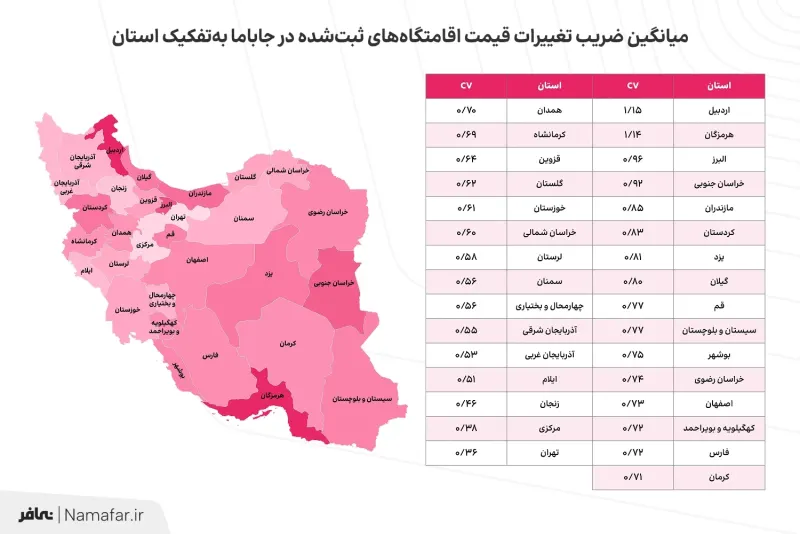
The coefficient of variation (CV) makes it possible to measure the relative heterogeneity of provincial markets without the absolute level of prices intervening in the interpretation of the results. In fact the coefficient of variation is obtained by dividing the standard deviation by the average, so it is a unitless indicator that makes it possible to compare the dispersion of accommodation prices among different provinces, independent of the average price level. The chart shows that provinces such as Ardabil and Hormozgan sit at the top; that is, even if the average price level in these areas is relatively high or moderate, the diversity and price distance among their accommodations is very intense. This can stem from a particular composition of supply (from villas and luxury hotels to simple local accommodations) as well as strongly seasonal demand. Alongside them, the high position of South Khorasan is noteworthy. Compared with coastal or metropolitan destinations this province does not have a particularly large market, but a high coefficient of variation shows that even that limited market suffers from considerable heterogeneity. Such a pattern is probably a reflection of a duality in the demand structure; on the one hand pilgrimage and family trips with a tendency toward low-cost accommodations, and on the other a share of luxury tourism in the form of four- and five-star hotels. By contrast, provinces such as East Azerbaijan, West Azerbaijan, and Tehran have a low coefficient of variation; meaning that their market is more uniform and the relative difference in prices takes shape within a limited frame. As a result, changes in the "coefficient of variation" among provinces are not merely a reflection of absolute price differences, but a sign of diverse demand structures and the manner of distributing supply in each region; a matter that can be the basis for a deeper analysis based on more robust indicators such as the interquartile price range.
Interquartile price range and focus on the middle of the market; hidden competition or a lack of diversity?
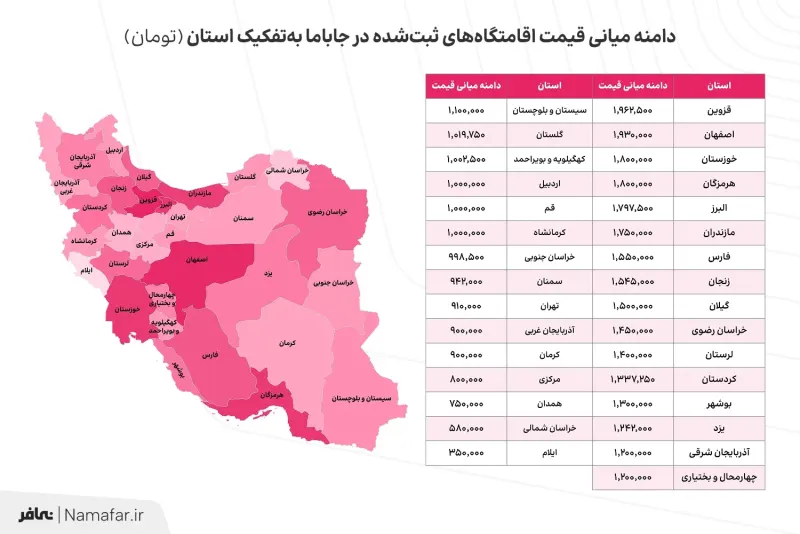
The use of the interquartile price range indicator yields a different view of price heterogeneity, because instead of focusing on the entire dispersion it focuses on the middle 50 percent of the market; that is, where the majority of consumers' decision-making takes shape. In other words, the interquartile price range covers the distance between the first and third quartiles and shows price changes in the middle of the accommodation market. The results reveal that provinces such as Alborz, Mazandaran, and Hormozgan experience a wide range of prices even in this middle segment of the market, which indicates the presence of hidden competition between budget and luxury accommodations to attract diverse demand.
Conversely, provinces such as South Khorasan or West Azerbaijan show limited diversity even in their middle market; a pattern that can be a sign of weakness in product diversity and the absence of real market segmentation. In this way, the interquartile price range not only neutralizes outlier data, but also raises a more fundamental question: in which provinces is "consumer choice" truly broad, and in which provinces does it remain limited to a few similar options? This angle of view makes it possible to move beyond purely numerical analyses and toward a strategic understanding of the accommodation market; an understanding that is vitally important for designing targeted development and investment policies.
Closing remarks
Regional solutions instead of a single prescription
In this way, once the market's real heterogeneity has been identified on the basis of a robust indicator such as the interquartile price range, the next step at the policymaking level becomes clearer. Provinces with high dispersion in the middle segment of the market, such as Alborz and Mazandaran, more than anything need regulatory frameworks and tools for managing price balance so that a wide choice is not interpreted as market disorder. For example, applying price-ceiling guidelines in peak seasons or strengthening oversight of pricing violations can prevent disorder. By contrast, for provinces with a more uniform market such as South Khorasan or West Azerbaijan, the priority is not price control but creating diversity in supply and stimulating new demand. Therefore, the initial question about the "average cost of lodging" is translated into a useful decision for the policymaker only when heterogeneity, diversity, and the pattern of price distribution are also seen at the same time; an approach that moves beyond general and uniform prescriptions and makes intervention tailored to each province's conditions possible for the development of tourism in Iran.
Machine-translated from Persian by Namafar; the Persian original is authoritative. Read the original in Persian