We have probably seen sellers or buyers who run a hand over an item and, with a kind of praise, declare: It's handmade! Or we have tasted the pleasure of running a hand over a handwoven carpet and stepping on it. Handmade, for many goods, means authenticity, delicacy and quality. Technology, with all its strange advances, has still not been able to take the place of human taste and delicacy. Perhaps that is why, in the modern age, handicrafts have become even more valuable than in the past. So much so that after oil and gas exports and some industrial goods and agricultural items, handicrafts exports are a very profitable trade. This means that profitable exports are not possible only through large industrial factories. Small handicrafts workshops, too, can have customers in all parts of the world. According to World Trade Organization figures, the global value of exports in the field of handicrafts in 2019 was about 20 billion dollars. Of course this figure includes only official trade.
Volume of handicrafts exports in different countries
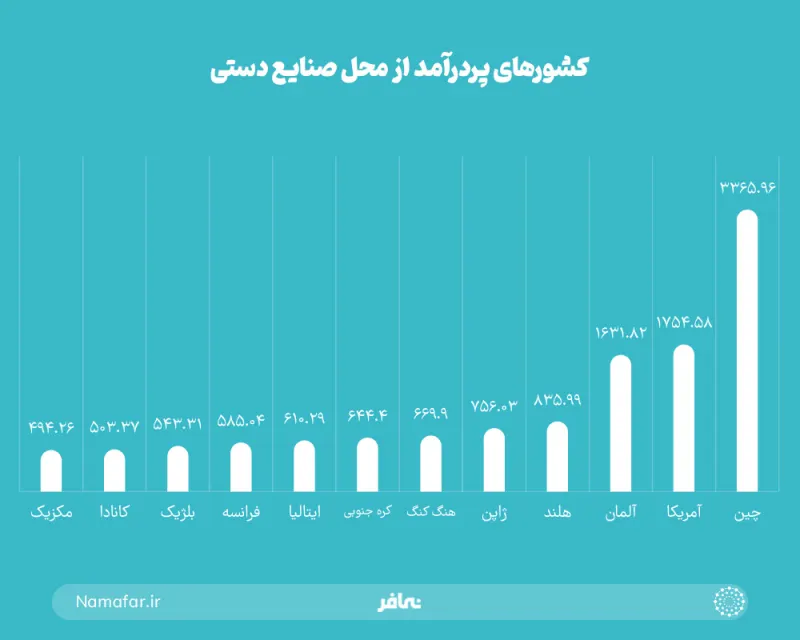
China ranks first among all the world's countries in income from handicrafts exports. In 2021 this country was able to earn about 3363 billion dollars from this industry. This country has a several-thousand-year civilization, and its rich culture and art have produced an unmatched diversity of handicrafts. The existence of a very large population, a high percentage of whom are also rural, has facilitated handicrafts production in this country. In its development strategy China has paid attention to rural industries and has also taken seriously the effect of handicrafts on tourism. This country's National Arts and Crafts Import and Export Corporation is responsible for exporting these products. China is also one of Iran's most important rivals in carpet weaving. This country, as the cradle of silk, also has capable textile handicrafts.
The United States and Germany are the next countries in exports of this industry. The chart below shows the income of handicrafts-exporting countries in 2021 in the field of handicrafts and ornamental goods:
A review of handicrafts exports in India
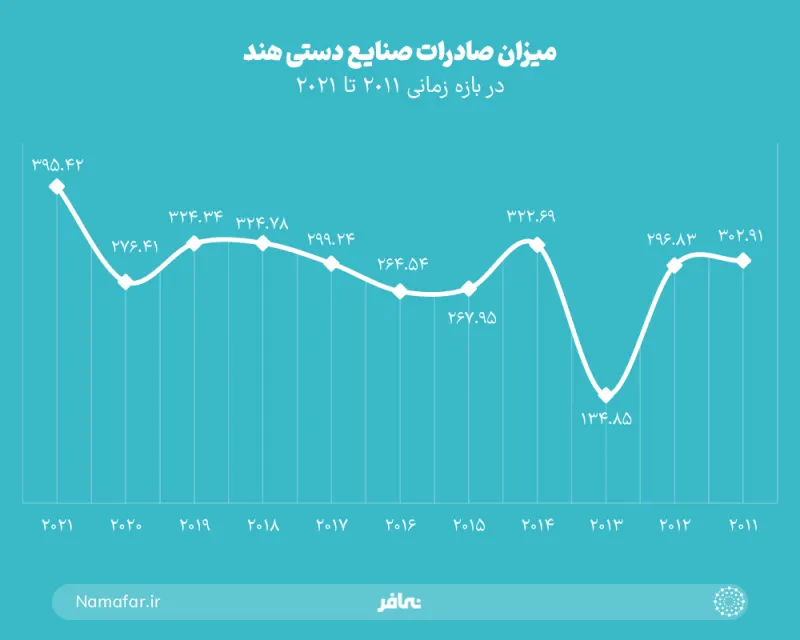
India, with its vast area and one-and-a-half-billion population, is a medley of cultures. Each of its states has its own language and dress. But the cultural diversity of these regions and states is not limited to language and dress. Geographic, climatic, cultural and religious diversity is also visible in people's use of various tools and goods. Therefore the diversity of the subcontinent's handicrafts is very high. In 2021 India succeeded in earning something on the order of 396 billion dollars from exports of goods in the handicrafts field. The charts below show this country's income on a billion-dollar scale from 2011 to 2021 in the handicrafts field. According to this chart, the trend of this country's handicrafts exports is increasing with a very gentle and slow slope. The negative effect of the COVID pandemic, which was very severe in India, is also clear in this chart.
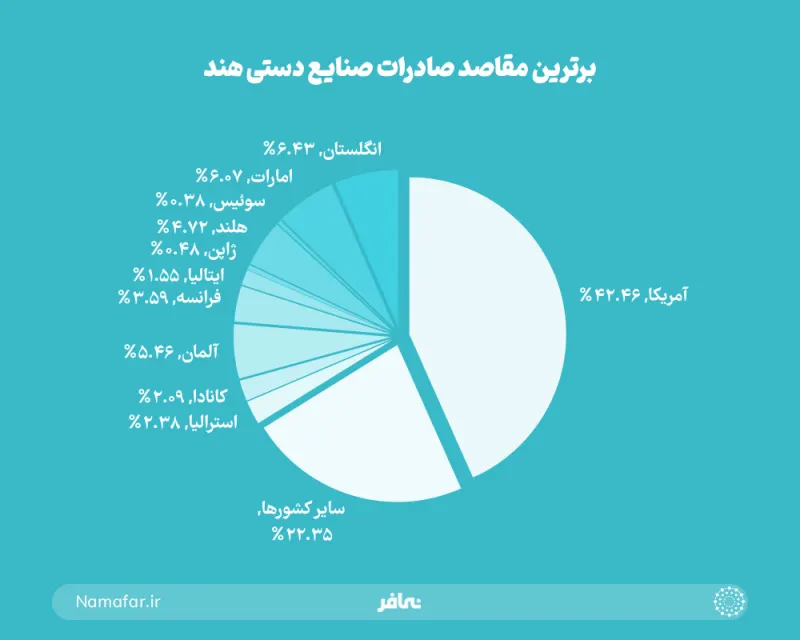
Among these, India has the highest volume of exports to the United States. About 43 percent of India's export share in handicrafts and Indian goods belongs to the United States. Among the handicrafts in India, handmade products and handicrafts related to the Indian art of crochet are highly popular in the United States. Among India's handicrafts, the Indian shawl, as an important part of this country's dress that is also strongly interwoven with India's culture, has had the highest exports to the United Arab Emirates. 73 percent of the volume of these shawls is exported to this country. After the UAE, Germany and the United States, with 10 and 5 percent respectively, are the second and third countries for importing this shawl into their territory. The chart below shows each country's share in the volume of handicrafts imports from India.
Iran's handicrafts exports
According to the Handicrafts Organization, there are 370 handicrafts fields in Iran, which fall into 24 categories. Among the country's leading handicrafts that have attracted international attention, handwoven carpets can be cited, which represent Iran's cultural and artistic substance in the world. One of the notable phenomena of recent years is the growing trend of globalization. Iran, too, in this direction, in order to expand non-oil exports and be present in world markets, has sought to join the World Trade Organization (WTO) and is at present an observer member of this organization.
One of Iran's most important handicrafts is the handwoven carpet. The export competitiveness index of the 65-raj silk handwoven carpet of Isfahan is equal to 88/0 and indicates that the 65-raj silk handwoven carpet of Isfahan Province currently has competitive capacity in world markets. The comparative advantage index is also equal to 79/0 and indicates this province's comparative advantage in producing the said carpet.
Iranian carpet exports
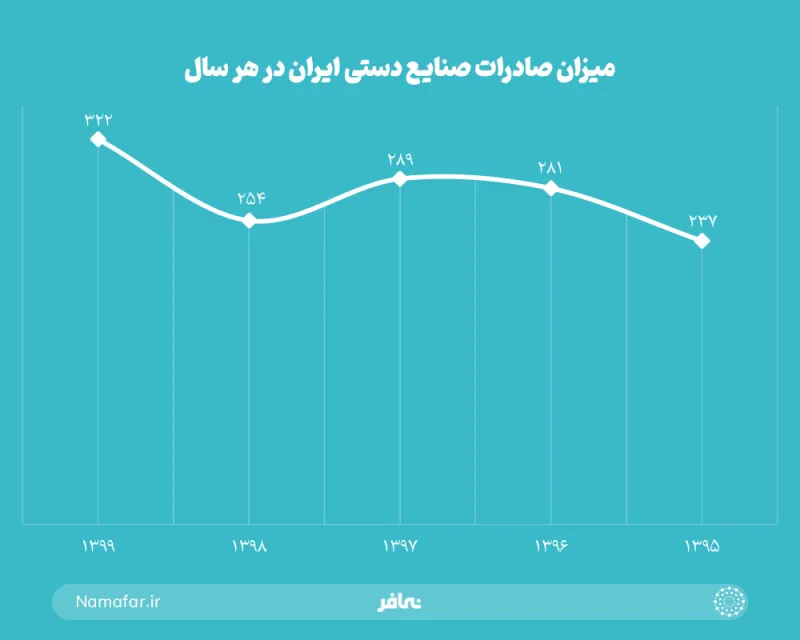
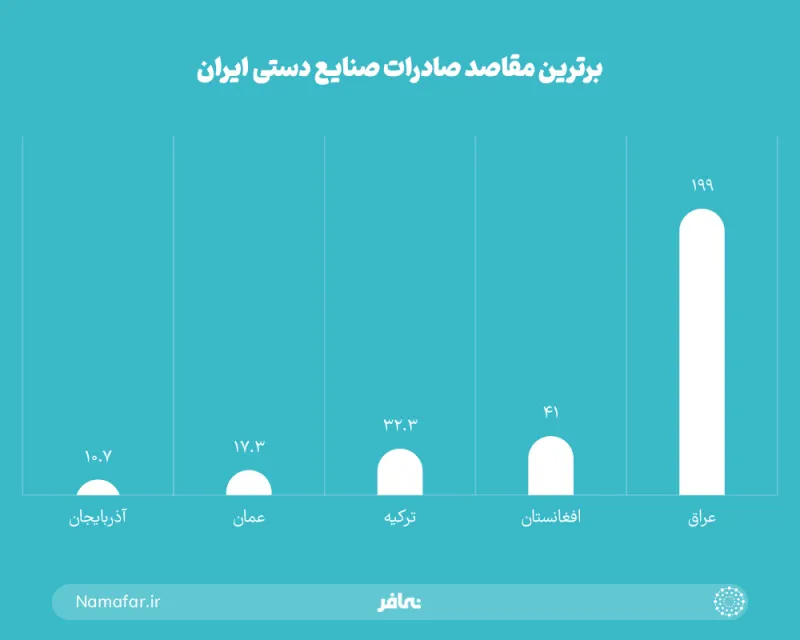
At present China is one of the largest importers of Iranian machine-made carpet, but besides that, Iranian carpet is also exported to Turkey, India, Iraq, Afghanistan, Canada, Australia, Japan and some European countries. Other well-known Iranian works that fall in the handicrafts field include: kilim, carpet, gabbeh, qalamzani (engraving), glassblowing, monabbat (woodcarving), minakari (enamelwork), pottery, wood, khatam (inlay) and malileh embroidery. In 1399 (2020/21) Iran was able to earn 322 million dollars from handicrafts exports. 112.554 tons was also the weight of all Iran's exported goods in this field. Iran's highest volume of exports in this field has been to Iraq. Handicrafts exports to Iraq brought 199 million dollars in earnings for Iran. Afghanistan and Turkey have taken second and third place respectively.
Ways to grow handicrafts exports in Iran
The growth and prosperity of handicrafts does not require large-scale economic investment. Handicrafts, by creating production centers in cities and villages and relying on domestic and local raw materials, help countries' economic development. This industry, besides having a cultural load, also has high value-added compared with other cultural industries. Iran has high potential in the field of handicrafts. The following measures can help increase handicrafts exports in Iran:- Attention to the sales market in the online world and using numerous platforms
- Holding various domestic and international exhibitions in the handicrafts field
- Creating handicrafts booths and introducing this industry at international exhibitions
- Choosing suitable advertising methods to introduce and attract domestic and foreign buyers
- Direct government attention to this field of handicrafts
- Support for small traditional workshops in cities and villages
- Creating suitable grounds for training in the field of handicrafts
- Selecting a comprehensive, precise and suitable program for selling handicrafts in the international arena
- Useful and effective interaction between producers and policymakers
Conclusion
The handicrafts industry, besides economic returns for each country, also has the ability to export countries' culture. Looking at Iran's export destinations in the handicrafts field, we see restriction and perhaps prohibition of exports to European countries. Iran's exports are often limited to neighboring countries. Whereas finding a market for Iran's handicrafts among European countries too could both bring very high profit for Iran and introduce this country's culture to the world. This is while Iran has very high capacity for producing handicrafts because of the existence of various ethnic groups and also the richness of Iranian culture. On the other hand, it also has good experience of earning income among neighboring countries, which can greatly help to clarify the path.
Sources
Statistical Yearbook of the Ministry of Cultural Heritage, Tourism and Handicrafts. Year 1399 (2020/21).
Machine-translated from Persian by Namafar; the Persian original is authoritative. Read the original in Persian