With the efforts of Namafar's policy research and data mining group, the booklet "Handicrafts in cyberspace data brief" has been published. In this product, types of handicrafts in cyberspace, their geographic distribution, and also handicrafts practitioners in cyberspace have been examined. We review the trend analysis of handicrafts in Iran and the world, identification of the most important platforms in promoting and selling handicrafts, and getting to know the top handicrafts practitioners and actors in cyberspace. Identifying the most-followed fields of handicrafts, examining the geographic dispersion of businesses related to handicrafts, and identifying the most important handicrafts cities and their most important products are among the aims of this study. The results of this research can be useful for policymakers, businesses active in handicrafts, and also people who intend to enter the handicrafts field, and can open new horizons before them.
1. A review of handicrafts fields in cyberspace
In the first section, by examining five platforms—Digikala, Instagram, Basalam, Aparat and Wikipedia—the diversity of Iran's handicrafts products and the level of audience attention to them have been assessed.
Handicrafts on Digikala
To examine handicrafts on Digikala, the number of products in each category has been taken as the basis of assessment. That is because a high number of products in a category can indicate greater diversity and customer interest in that category, as well as how competitive that segment is. On this basis, the tilework category stands at the top of the categories. Handwovens, rudozi (embroidery), leather products and hand-sewn goods are among the other categories that have accounted for the largest number of products.
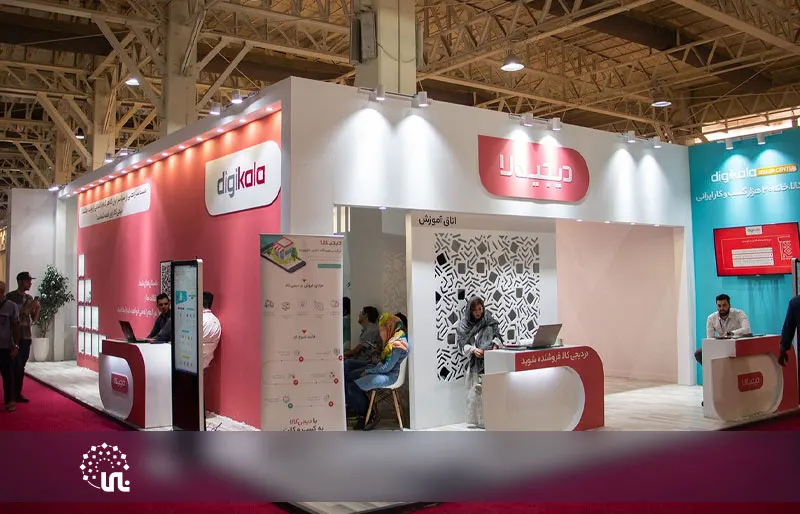
Another criterion is the number of audience votes for each of the Iranian handicrafts products, and on this basis gift boxes, tools and supplies, and keychains have the larger share of users' votes for handmade arts. In contrast, the fewest votes belong to the fields of turquoise inlay, filigree, marquetry, types of needlework, and enamelwork.
Iran's handicrafts on Instagram
On the Instagram social network, 110 thousand posts with the handicrafts hashtag (#handicrafts) have been data-mined. Other hashtags written in these posts alongside the main hashtag have also been analyzed. In this way, after spam was removed, the posts were separated into 17 main clusters on the basis of the similarity of the hashtags under them. Among these, the gift, handmade, dowry, pateh embroidery, clothing and knitwear cluster has the largest number of posts on Instagram.
Impact (number of likes + 3 times the number of comments) has been set as another criterion for examining handicrafts on Instagram. On this basis, given the clustering performed, the gift cluster has the highest total impact. The average impact of each post by cluster has also been examined, and the Nowruz and Haft-Seen, dowry and pateh embroidery, and clothing and knitwear clusters have been identified as the top clusters. In contrast, the decor, jewelry and metalwork, and candle and resin clusters have the lowest average impact. This means they have attracted less favor among the audience for Iran's handicrafts on Instagram.
Handicrafts on Aparat
Keywords with the most content have been set as the criterion for examining handicrafts on Aparat. On this basis, knitwear handicrafts, leatherwork, pottery, woodturning, macramé and tilework stand at the top of the handicrafts fields, a result that is to some extent due to Aparat's educational nature.
Handicrafts on Basalam
In the Basalam store, as on Digikala, the number of products in each category has been taken as the examination criterion. On this basis, knitwear handicrafts products have the largest share of product diversity on Basalam. After that come pottery vessels, tricot knitting and brass products. In contrast, filigree, beadwork, copper vessels and qalamkari have the smallest share of Iran's handicrafts on Basalam.
Handicrafts on Wikipedia
The number of visits to Iranian handicrafts pages has been set as a measure for assessing handicrafts on the Wikipedia site. On this basis, the fields under fibers and leatherwork have received more audience attention than the others. Handmade arts with paper and ceramics are in the next ranks. In contrast, types of glass, metal and wooden handicrafts have accounted for the fewest visits on Wikipedia.
2. Geographic distribution of Iran's handicrafts
In the second section of the product, to better understand the role of geography in the development of handicrafts products, the geographic cut of handicrafts on location-based services has been examined. Google Trends, Google Maps and the Neshan app, Instagram, and Basalam are the four services examined in this section.
Handicrafts search statistics using Google Trends
First, topics related to the handicrafts field over a five-year period have been examined using Google Trends. The results show that the trend of searching for handicrafts in Iran over the past 4 years has been almost constant. The highest level of Google search in the handicrafts field has also been recorded in the months of Azar (November–December), Dey (December–January) and Bahman (January–February). By location, however, South Khorasan province stands at the top of searches related to handmade arts. The provinces of Hormozgan, Zanjan, Isfahan, Yazd and Gilan are in the next ranks.
Global search for handicrafts has also been examined, and as a result a downward trend has been observed. The highest level of global search each year has been in the month of November, which can be due to the Black Friday event and falling on the eve of Christmas. By location, however, the countries of South America and Brazil have accounted for the highest level of search. After that come Central America, East Asia, the Middle East and Western Europe.
Handicrafts businesses registered on Google Maps and Neshan
In this section, the number of businesses registered on the Google Maps and Neshan app platforms has been set as the examination criterion. On this basis, the provinces of Isfahan, Razavi Khorasan, Tehran, Mazandaran and Gilan have registered the most businesses related to Iran's handicrafts. Of the 1,132 registered places, most of them belong to markets and stores selling handicrafts. In the Neshan application, however, the share of government offices is greater than on Google Maps.
Handicrafts sales pages on Instagram
Based on the dispersion of content registered on Instagram, the handicrafts sales market in the provinces of Tehran, Mazandaran and Gilan has the largest share. This result confirms the geographic-distribution examinations of businesses on Google Maps and Neshan. Active points outside Iran are also observed that relate to the sale of handicrafts of neighboring countries such as Afghanistan, Kuwait, Iraq and the UAE. Overall, a similar pattern has been assessed for local businesses on Instagram and Google Maps.
Handicrafts sales on Basalam
In the Basalam app, to arrive at a correct estimate of each province's handicrafts products, the products of all handmade-arts stores have been examined. For example, the results show that the most frequent handicrafts category in Tehran relates to homemade brass and pottery handmade products.
3. Handicrafts practitioners and actors in cyberspace
In this section, active businesses related to handicrafts on four platforms—Aparat, Basalam, Digikala and Instagram—have been examined.
The Aparat platform
The number of published items of content has been set as the criterion for analyzing handicrafts pages on Aparat, and on this basis the most active pages over the past six months have been identified. The channels Afarinesh, Baftani-ye Samadi Narges, Baftaniya, Najjar-e Kuchak, Donyaye Man and iHediyeh are among them. Next, for a more precise analysis of the status of Aparat channels, the average number of views of each video has also been examined, and the result is presented in this subsection.
The Basalam app and site
In the Basalam app and site, the number of creative handmade products of each booth has been examined. The results show that the Bronz-e Novin booth, Novin Handicrafts Gallery and Triko Shik Show are the largest handicrafts booths on Basalam. The number of votes registered for each booth's products has also not been overlooked, and in the continuation of these examinations, handicrafts sellers with a number of votes above the average have been classified as prominent sellers and sellers with a number of votes below the average as ordinary sellers.

The Digikala online store
In examining the Digikala online store, one of the most important indicators is customers' rating of the seller. The average of this rating equals the sum of (overall score, no-return score, on-time fulfillment score, shipping-commitment score) divided by 4. Taking this indicator together with the number of products of each seller, the best active sellers of Iran's handicrafts on Digikala have been identified and the results have been presented visually in this subsection.
The Instagram social network
On the Instagram social network, from among 2.4 million posts with the handicrafts hashtag, about 120 thousand recent posts have been examined. Pages have also been assessed in terms of the number of posts in the intended time period, total impact, and the average impact of each post. In the end, the top handicrafts sales pages on Instagram have been identified and are introduced in this subsection.

Summing up
In this piece, the status of Iran's handicrafts has been examined from three angles:
In the first section, from the standpoint of handicrafts fields in cyberspace, five platforms—Digikala, Instagram, Basalam, Aparat and Wikipedia—have been data-mined. The results show that handmade knitwear products and metal and stone handicrafts have greater supply on the two platforms Digikala and Basalam. Tools related to handicrafts, handmade gift boxes, keychains, and knitwear and pottery products also receive more audience attention. Sales of traditional handicrafts such as filigree, metal chasing, marquetry and khatam have accounted for the smallest share of supply and demand in cyberspace.
Gift, handmade and pateh embroidery are also among the most important content clusters on Instagram, and most of the buying and selling of handicrafts on Instagram is sold as gifts. On Aparat, hand-knit knitwear products, leatherwork, pottery, macramé and woodturning have the largest share of handicrafts content. On Wikipedia, however, fibers, leather and ceramics receive more attention.
In the second section, from the standpoint of the geographic distribution of Iranian handicrafts, four location-based services—Google Trends, Google Maps and Neshan, Instagram and Basalam—have been examined. The results show that the provinces of Isfahan, Razavi Khorasan, Gilan, Tehran and Mazandaran have the largest number of local and official businesses in the handicrafts field on Google Maps and Instagram. But based on Google Trends data from Google search statistics for handicrafts, the provinces of South Khorasan, Hormozgan, Isfahan, Yazd and Gilan have a more prominent share.
Among countries, too, South America and Central America are considered the most important cradle of handicrafts. Overall, over the past 4 years the trend of attention to handicrafts has been constant in Iran and downward in the world.
In the third section, in order to identify the top practitioners in the handicrafts field in cyberspace, four apps—Aparat, Basalam, Digikala and Instagram—have been examined.
Machine-translated from Persian by Namafar; the Persian original is authoritative. Read the original in Persian