The scent of faith and tradition in life; the spirit of authentic and respected beauties in the everyday, a new look at the past: these are Mahed's offerings. An institute that has set as its goal the entry of Islamic and Iranian concepts into people's lifestyles. Also the creation of products that well display the authentic style of Iranian Islamic art and bring about a good feeling drawn from the Islamic-Iranian heritage in people's everyday lives. Mahed considers itself responsible for preserving and promoting authentic Islamic and Iranian culture. These are part of the remarks of Morteza Alaie, CEO of the Mahed technology company, who since 1390 (2011/12) has begun his activity in the field of cultural jihad with an approach of producing applied products in the lifestyle domain. In what follows, read the full text of this interview:
The birth of a brand
Toward what goals was Mahed formed?
The idea of this brand started when in Bahman (January–February) 1390 (2011/12) I was working on a social transformation plan and in the course of the work realized that in the government system a correct cultural outlook does not prevail and that we need a popular current in the context of culture and living conditions. For this reason I decided to launch Mahed. In other words, we believe that today's modern life gradually fades our identity and authenticity, so actions are required to prevent cultural and identity decay. Mahed too has been formed in line with those same goals and strives to produce products that address the preservation of a nation's cultural assets. The organizers of Mahed say that in the new world too one can live authentically, be rooted and have identity, and keep pace with these rapid social changes.
Have you registered your brand?
The Mahed brand was registered in 1395 (2016/17). The company Barqeh Honar Eslami operates in the field of product design and production under the Mahed commercial brand. Mahed is one of the divine names and means the expander and spreader.
What do Mahed's products include?
The design and production of products in the Iranian Islamic lifestyle domain in the form of consumer products widely used in people's lives.
In what areas are the products that Mahed offers?
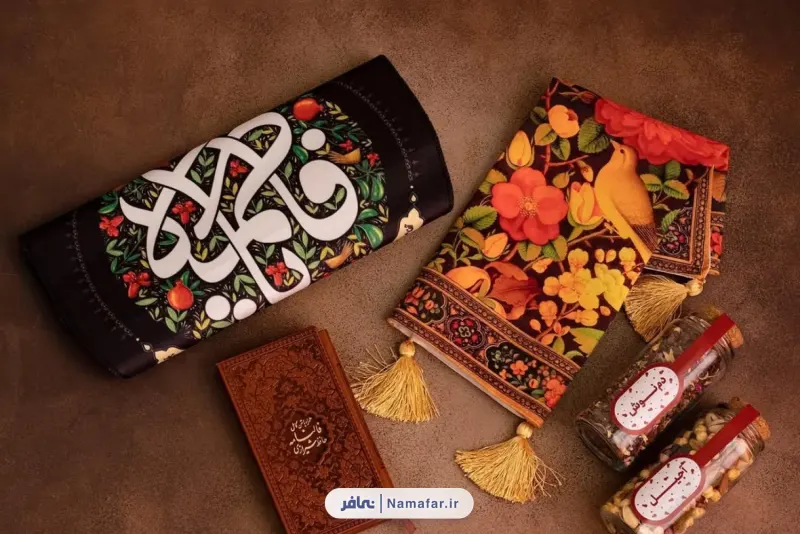
The principles we have defined in connection with entering the market encompass religious culture and identity, Iranian art and authenticity, innovation and technology, industry, production, and the economy. Observing all of these principles leads to the production of products that are distinctive, beautiful, practical, aligned with the market, and competitive. Essentially, all of Mahed's products are produced with the Iranian Islamic lifestyle as their axis. Among these products is Mahed's gifts and souvenirs room, which recalls a color and scent of our traditions and deep-rooted cultural identity. There is also the hey'at and resistance room for performing religious rites, and the book-related accessories room, which offers the tools that readers need.
The Mahya room is the hey'at and resistance room of Mahed House. Mahya's goal is to revive authentic identity in the performance of religious rites and to bring today's life together with real national and religious heroes.
The Chanteh room is the souvenirs and gifts room in Mahed House. This room's role in Mahed House is very prominent. The Chanteh people produce authentic goods for all aspects of today's life that spread the color and scent of authenticity in our homes.
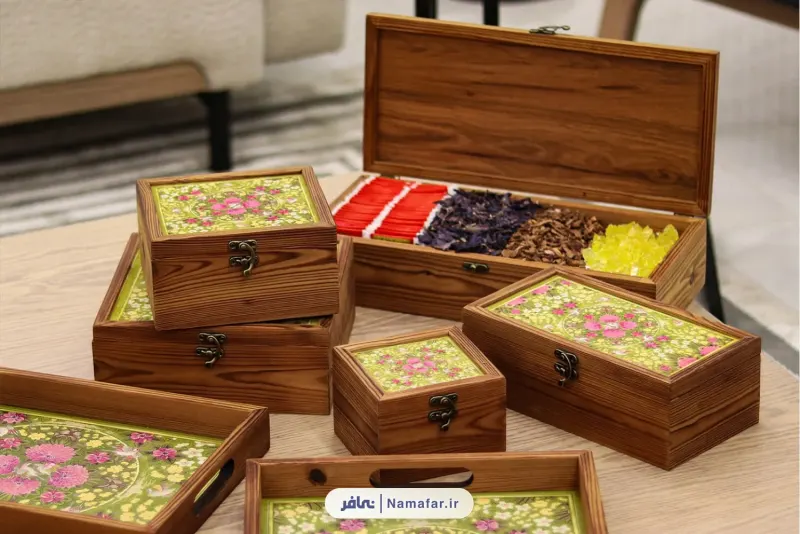
The Choq room is another room in Mahed House that works on book accessories and reading. Book lovers are the people of this room. Everything needed for the comfort and greater enjoyment of a reader's hours is produced in this room. Reading itself is authenticity, so Choq's artists support this authentic behavior.
From 1392 (2013/14) Mahed moved to Qom to expand its activities and, in its workshop, designed and produced special hey'at goods, jewelry, and entirely Iranian and indigenous frames. Of course, Mahed's scope of activity is not confined to Qom and it has audiences and customers across the country.
Our outlook in product design is attention to authentic Iranian-Islamic art and the use of the capacities of the youth of this land. After years of experience in producing and offering hey'at goods and jewelry and becoming familiar with the needs and tastes of audiences, they have brought the "SAZ" brand (authentic lifestyle) to the market.
With which producers in which cities do you collaborate?
Mahed collaborates with various producers in more than 10 cities in Iran and overall operates with a factory-less production structure. This has led to the establishment of more than 50 production workshops to carry out service and production work, and in this way substantial employment has been provided, which is a cause of great satisfaction.
How can interested people go about obtaining Mahed products?
The audience community grows with the growth of the business, or in some cases becomes more limited. At present, Mahed's audience is young people who are interested in the Iranian-Islamic lifestyle. Mahed products are offered in reputable stores inside and outside the country, and customers can obtain the products they want through social tools such as social networks, digital marketing, and by visiting stores that have contracts with Mahed, including Mahed House in Qom, the Mahed website, Digikala, Basalam, Rabie, and numerous other sites.
Which of Mahed's products have so far met with greater reception?
Products related to holding mourning ceremonies for Sayyid al-Shuhada, pilgrims' souvenirs, and cloth sofrehs have been well received.
What is your value proposition for customers?
Creativity and innovation are Mahed's most important value proposition. Three important features matter in the design and production of Mahed products, which are: being up to date, original, and authentic. Mahed has created a revolution in the industry of designing and producing banners, inscriptions, and flags in Iran and about 10 years ago moved away from the copied designs that were produced everywhere for the Ahl al-Bayt and mostly on various occasions, and by combining Iranian art, color, painting, miniature, diverse fabrics, and creative designs transformed this market.
With which characteristic has Mahed found a place in the creative industries?
Mahed is known in the creative industries with a view to producing artistic products, because in most cases productions are artistically weak, and even if they have been desirable they have not grown, perhaps because cultural and artistic structures have mainly been distant from economic and industrial platforms and have been offered to the market in a case-by-case and limited way.
What successes have you achieved in the domestic or foreign market?
Overall, in the domain of cultural products, the volume of sales that Mahed has in the domestic market is unique. It should be noted that we have operated in a very limited way in the foreign market, and for that same reason we do not call it a success, but we offer our products in about 5 countries, which even this amount is considerable in cultural productions.
Where is the Mahed company based?
From 1392 (2013/14), when we moved to Qom to expand our activities, Qom Science and Technology Park opened its arms to us and itself proposed that we be based there, and the park was the most important supporter that conferred identity on Mahed.
What actions can the Ministry of Science, as the authority responsible for science and technology parks, take for the creative industries?
The main issue from the perspective of a developed creative company and not a nascent creative company is that at present the creative industries are still not taken as seriously as they should be. For example, the Mahed institute currently has more than 40 direct staff, and they say the entire facilities in the technology funds that are allocated to a creative company are 500 million tomans, and if they want to allocate a very high figure, which happens every three or four years, they pay one-billion facilities. This one billion tomans is equivalent to half of Mahed's monthly expenses. Because the total of Mahed's salaries and current costs equals two billion tomans. How, with fifty percent inflation, are we supposed to be able to increase our resources every year?
The main challenge is that those in charge have not thought about who should support the creative industries once they have grown. There are no support headings for the creative industries. Whereas the support heading in the digital industries has figures of several tens of billions and in the Vice Presidency for Science and Technology it is at the level of a large and extensive deputy office. But in the creative industries it is at the level of a task force. Now, how can a task force whose entire budget is one hundred billion provide support against the 24 billion in current costs of the Mahed technology company?
What recommendation do you have for science and technology parks regarding the admission of creative companies?
Today in science and technology parks, supports exist only at the incubator level. The opportunity that the creative industries have for turnover is much greater than that of other industries. In content production, cinema and animation and other creative industries, all costs are software-based and there is no need to import raw materials and subjects. That is, they only generate income and are not cost-intensive and have the property of generating foreign exchange. Such that in some creative industries a software product, an animation, and content production, without regard to distance, generate income in the United States and Russia.
The creative industries have a high capacity and opportunity for job creation. The question is what percentage of employment digital and technical and large industries can create for female heads of household, whereas the creative industries can do this well and can well involve the body of the people in income generation and employment. But unfortunately the creative industries are not given the attention they should be given
Mahed's job creation
More than 40 people work at Mahed's headquarters. The workshops that work outside Mahed have created indirect employment for more than five hundred people. These workshops are based in various cities. Mahed is a platform in which the product is designed, and all these 40 people only manage this cycle. All production is carried out by people employed outside the office, and no production work is done in the Mahed office except packaging, quality control, logistics, and warehousing.
Machine-translated from Persian by Namafar; the Persian original is authoritative. Read the original in Persian