The handwoven carpet is considered one of the most distinctive symbols of Iranian art and culture, which over many decades has had an eminent place in global markets. This product has not only been noteworthy from an aesthetic and artistic perspective; but as a good with high economic value, it has always played an important role in the country's non-oil exports.
However, in recent decades, the global handwoven-carpet market has undergone fundamental changes. Factors such as transformations in the global economy, the emergence of new competitors, a change in consumers' taste, and the expansion of machine-made products have confronted the traditional structure of this market with challenges. In such a space, a realistic analysis of the current place of Iran's handwoven carpet and an examination of the opportunities and threats ahead can be a valuable basis for revisiting policymaking and adopting strategic decisions at the national and international level.
The growth outlook of the global carpet market
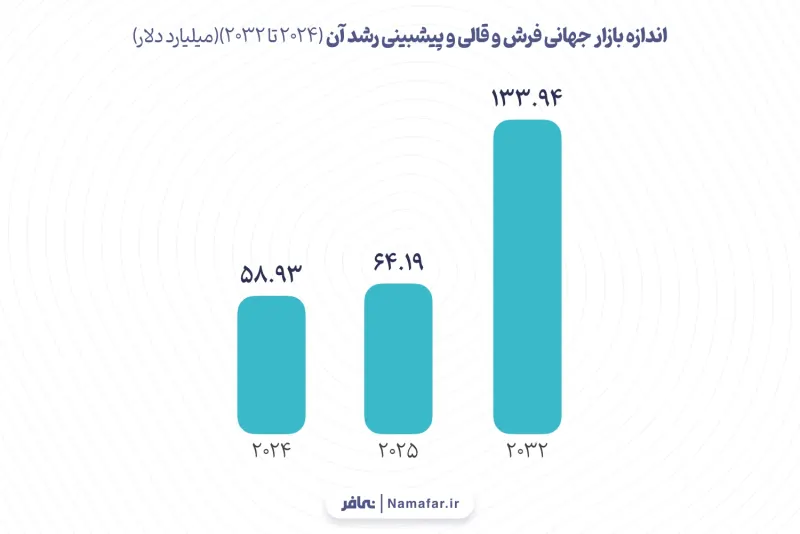
Based on the "Fortune Business Insights" report, the size of the global carpet and rug market in 2024 has been valued at about 59 billion dollars, and it is predicted that by 2032 it will even surpass 133 billion dollars. This increase indicates a compound annual growth rate (CAGR) equivalent to 11.08 percent in this time span; a figure that has been higher than the average growth of many consumer industries and speaks of the dynamism and high capacity of this market.
The handwoven carpet; a living heritage in the arena of global competition
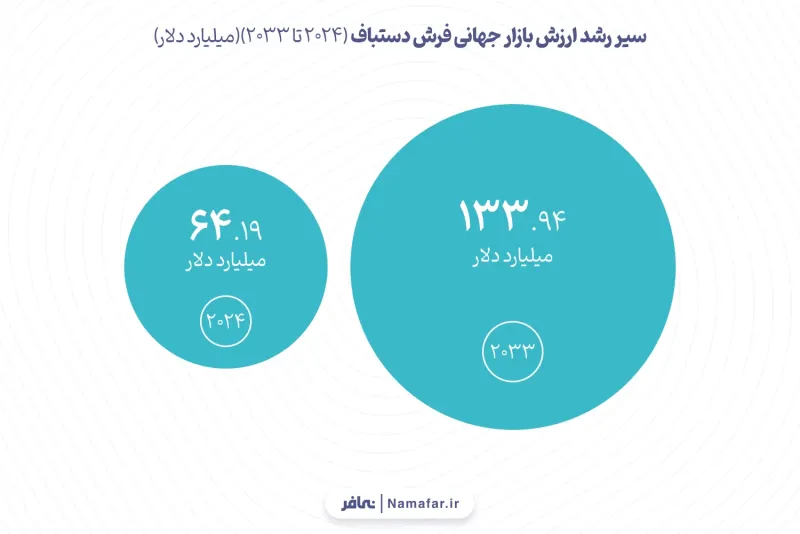
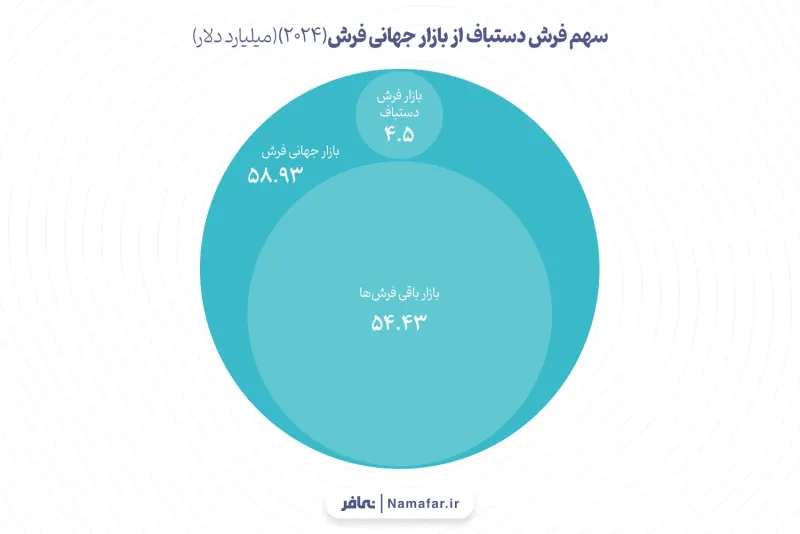
The global handwoven-carpet market, in the recent decade, has gradually transformed from a traditional and local industry into a part of the global market for artistic, cultural, and luxury goods. The value of this market in 2024 has been estimated at about 4.5 billion dollars, and it is predicted that by 2033, at a compound annual growth rate of 6.5 percent, it will reach 7.2 billion dollars. This growth is mainly due to increased demand for authentic, custom, and sustainable products.
Handwoven carpets, by virtue of features such as natural materials, handmade structure, and the preservation of traditional weaving techniques, have found a special place among consumers who both attach importance to quality and beauty and pay attention to the cultural and ethical meaning behind a good. Especially in high-income markets, these kinds of carpets are considered not only a decorative good, but a kind of cultural capital and a sign of social status.
The main players in global handwoven-carpet exports; from leading India to authentic Iran
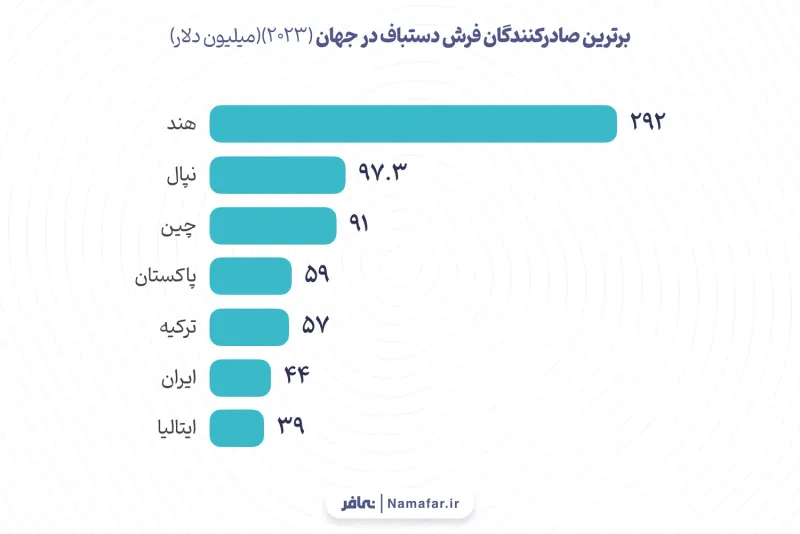
In 2023, India, with exports of more than 292 million dollars, was able to become the leader of the global handwoven-carpet market. The secret of this country's success is in combining extensive production with diverse design and rapid responsiveness to the taste of Western customers. Indian carpets have been well aligned with today's need not only in color and design, but also in the manner of marketing.
The next place, with about 97 million dollars of exports, belongs to Nepal. This small country, relying on high quality, minimal designs, and the use of natural fibers, has opened a place in the heart of particular and luxury markets. China, Pakistan, Turkey, and Italy too, each with a different approach—from mass production to contemporary design—have a share of the global market.
Iran too, with 44 million dollars of exports, is still one of the recognized names in this industry. The Iranian carpet, with a backing of art, history, and authenticity, has its loyal customers in markets such as Europe and the Persian Gulf region; although export challenges still remain.
The structure of demand in the global handwoven-carpet market; the United States the most important export destination
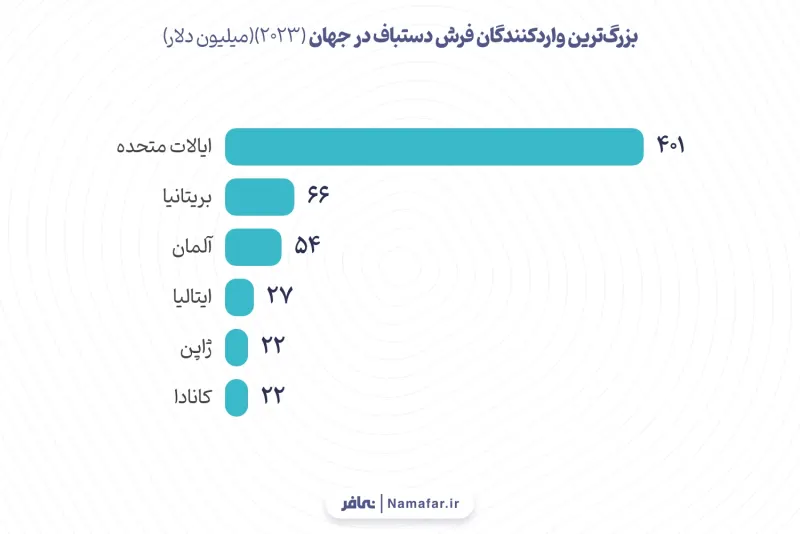
The United States is still the world's largest buyer of handwoven carpets and in 2023 imported more than 401 million dollars of carpets. A large share of these imports has been supplied from India, Nepal, and Pakistan. American customers are looking for carpets that are both beautiful, have a story, and have been produced from natural and sustainable materials.
On the green continent, Britain and Germany play a prominent role in imports. These countries are not only direct buyers, but also act as distribution centers for other European markets. In these markets, a certificate of authenticity, artistic design, and a well-known brand matter a great deal. Countries such as Italy, Japan, and Canada too are particular markets with more precise and more luxury tastes.
Overall, today's consumer does not look only at weave and color. The narrative behind each carpet, the ethical quality of production, beautiful packaging, and alignment with a modern lifestyle all play a role in their final decision. Any exporter who understands these subtleties will be more successful in this highly competitive global market.
From rise to fall: an analysis of the ten-year trend of Iran's handwoven-carpet exports
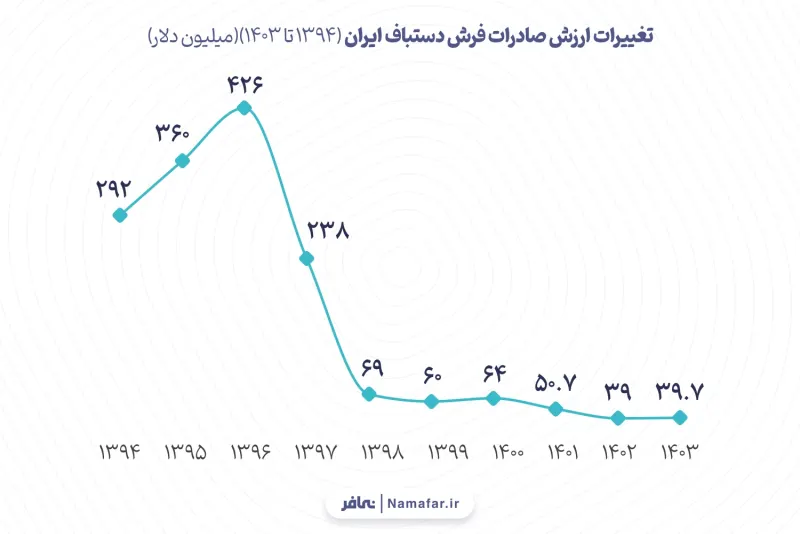
In the past decade, Iran's handwoven carpet has gone through many ups and downs and, overall, has followed a downward trend. In 1394 (2015/16), this industry's exports reached more than 290 million dollars and signs of stability in the market were seen. The peak of this period was 1396 (2017/18), in which the striking figure of 426 million dollars was recorded. But this success did not last, and international conditions, especially the return of sanctions and the weakening of export infrastructure, laid the ground for a severe decline in later years.
From 1397 (2018/19) onward, the Iranian carpet industry faced more serious challenges. The drop in demand in traditional markets and increased competition from neighboring countries caused exports in 1400 (2021/22) to decline to about 64 million dollars. In 1402 (2023/24) this figure even went below the 40 million dollar mark. However, 1403 (2024/25) brought, albeit limited, signs of a halt to this downward trend. Reports indicate growth of about 3 to 4 percent relative to last year, and export figures have been estimated between 39.7 and 41.7 million dollars.
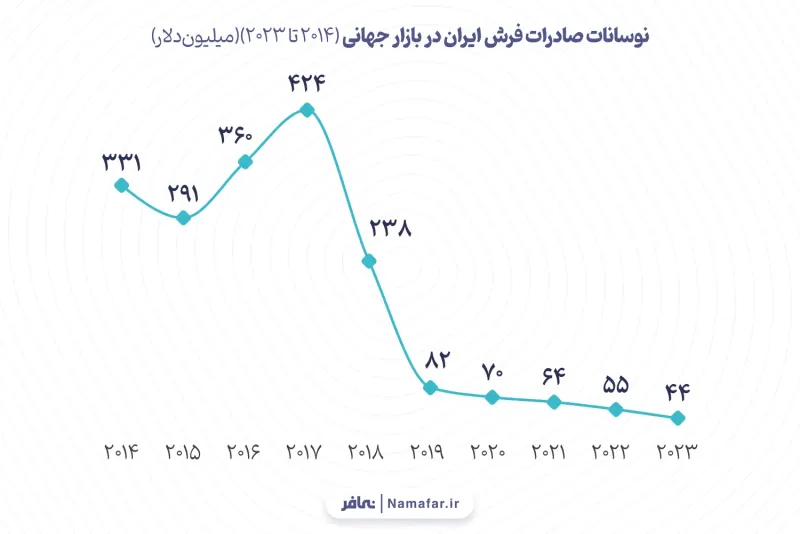
These developments have also been reflected in international statistics. According to global data, Iran's carpet exports, which in 2017 CE had reached the highest level of the recent decade, collapsed in later years and in 2023 were reported at about 44 million dollars. A number that, although it has a large distance from a brilliant past, compared with the conditions of recent years, reports a relative return to stability and the emergence of the first signs of growth.
A warning bell for Iran's place: a decline in share of the global handwoven-carpet market
Iran's share of the global handwoven-carpet market in the past decade has declined in a worrying way; a subject that even has more importance than the drop in exports. Iran in the 1370s and the early 1380s solar (the 1990s and the early 2000s CE) was the main player in this market; to the point that in 2003 it reached a record of 43.3 percent. But from around 2011 CE, the downward trend accelerated and its share from around 30 percent (in some estimates 25.5 percent) reached about 7 percent in 2022 and finally 6.5 percent in 2023. The decline in share from more than one-fourth of the market to less than one-tenth is not merely an ordinary drop; rather it is a sign of a direct competitive displacement.
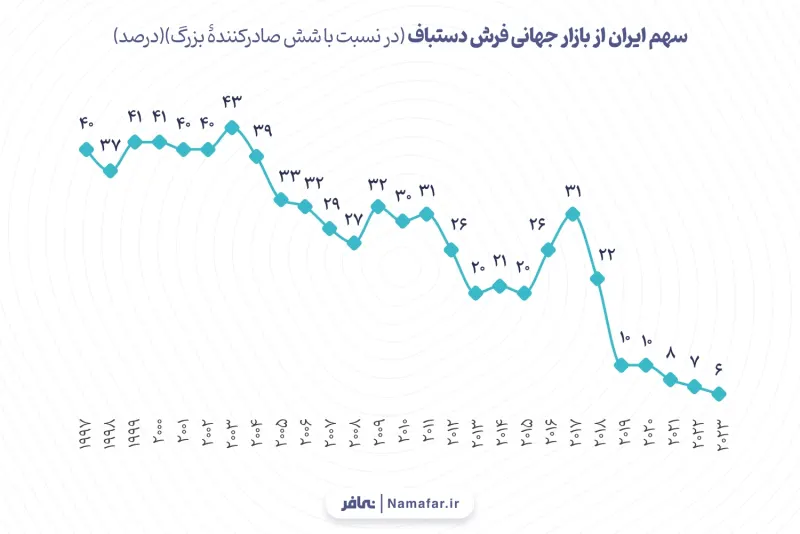
While our country was entangled with challenges such as sanctions, inefficient policymaking, and rising costs, regional competitors rapidly filled the vacuum. They raised production capacities, improved export infrastructure, and innovated in marketing. It can clearly be seen that their growth has to a large extent been because of Iran's retreat. Now Iran no longer competes from a position of historical power; rather it must re-enter the field from a weak position. Any strategy for return must recognize this competitive reality and focus on recovering the lost place through aggressive and innovative approaches; not merely an effort to return to past methods. The market has changed and new leaders have emerged.
Iran's handwoven-carpet exports, on a path of revival?
After about two decades of continuous decline, Iran's handwoven-carpet market has finally shown signs of improvement. Last year this sector's exports experienced growth of about 4 percent. This occurrence, although it seems moderate and limited, after years of stagnation can be regarded as a turning point.
Some experts consider this improvement the direct result of the removal or revision of some restrictive regulations and the supportive measures of the Iran National Carpet Center. The start of new cooperation between the Ministry of Industry, Mine and Trade and this center also indicates a renewed focus on elevating the global place of this industry. In particular, planning for synergy among monetary and banking policies and supportive organizations has been regarded as an encouraging action toward removing exporters' financial and logistical obstacles.
Despite these advances, structural challenges still remain. Some of this industry's actors emphasize the necessity of removing domestic restrictions such as the foreign-exchange commitment policy and consider it as harmful as external sanctions. Also, although the customs tariff on carpets is low, the ease of smuggling is still one of the serious concerns.
These developments show that policy reforms are not just a theoretical idea, but a practical tool for saving and reconstructing the carpet industry. The path of revival requires a continuous will, policies aligned with the real needs of the market, and attention to the cultural roots of this national art-industry.
Machine-translated from Persian by Namafar; the Persian original is authoritative. Read the original in Persian