One of the main pastimes of people in Iran and the world, especially after the COVID-19 lockdown, is video games. The turnover of the game industry in Iran is also growing strongly. Today video games have found many fans among Iranians. So that in 1401 (2022/23) there are roughly 41 million Iranian gamers, of whom 35 million play mobile games. Evidence for this claim is the sometimes older people who on the metro play brick-breaker ( swipe brick breaker ) or Amirza on their phones. Likewise children who cannot yet speak but know where their favorite mobile game is on their parents' phones. Iranian gamers mostly play foreign games.
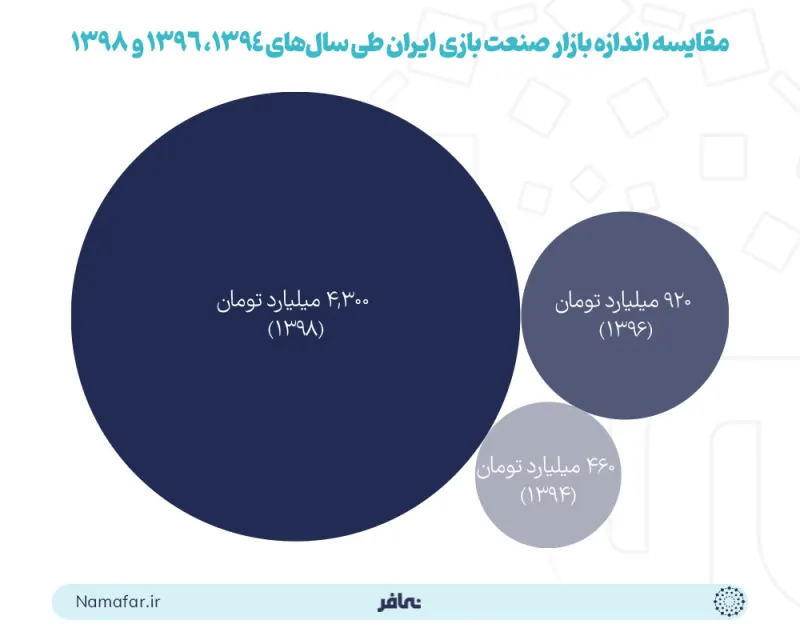
The number of Iranian gamers is rising, and this has created the ground for making money by building games and offering them to gamers around the world. The turnover of the gaming industry in Iran has gone from 460 billion tomans in 94 (1394/2015–16) to 4.300 billion tomans in 98 (1398/2019–20). That is, it has achieved 10-fold growth in four years. Even so, this volume of turnover relates more to gaming hardware and especially game consoles. In 98 (1398/2019–20) the turnover of foreign game consoles and accessories in Iran alone was 2 billion and 700 million tomans. This market should receive special attention not only because of its very high revenue, but also in light of cultural necessities. According to statistics for 1400 (2021/22) the size of the hardware market was 16 billion and 700 million tomans. Of this, 14 billion and 313 million tomans belonged to console devices.
Game development in Iran
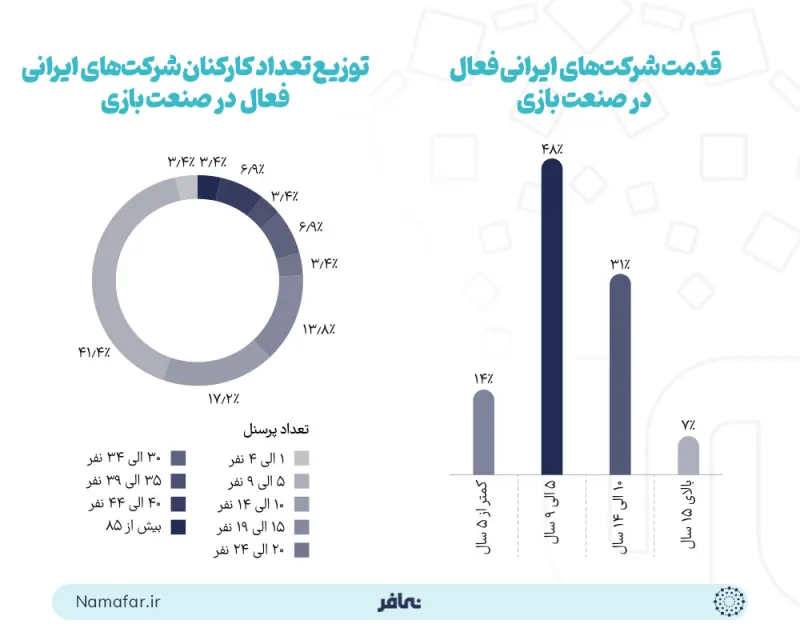
Game development in Iran, like a toddler, has a long way to go before it can be called an industry. Most game companies in Iran are inexperienced and small. Based on the statistics obtained, about 45 percent of these companies have fewer than 10 employees and 62 percent of them are less than 10 years old. In total only 7 percent of them are more than 15 years old. The lack of strong government support, outdated technology, distribution problems, and the inability to compete with foreign game companies are some of the reasons for the slower progress of the game development industry in Iran. In what follows, with an introduction to the history of game-making in Iran, we introduce several companies and studios among Iran's best game companies.
The first game development studios and companies in Iran began their work in the mid-1370s (1990s), but this activity took official shape with the establishment of the Iran Computer and Video Games Foundation (IRCG). At first many game developers, because of the difficulty of distribution and the high cost and time of production, were placed in very hard conditions. This was more pronounced for computer games, and because smartphones were not yet so widely available, games were mostly made for computers. For this reason most game development companies and studios either shut down, emigrated, or continued their path with difficulty.
The role of smartphones in Iranian game development
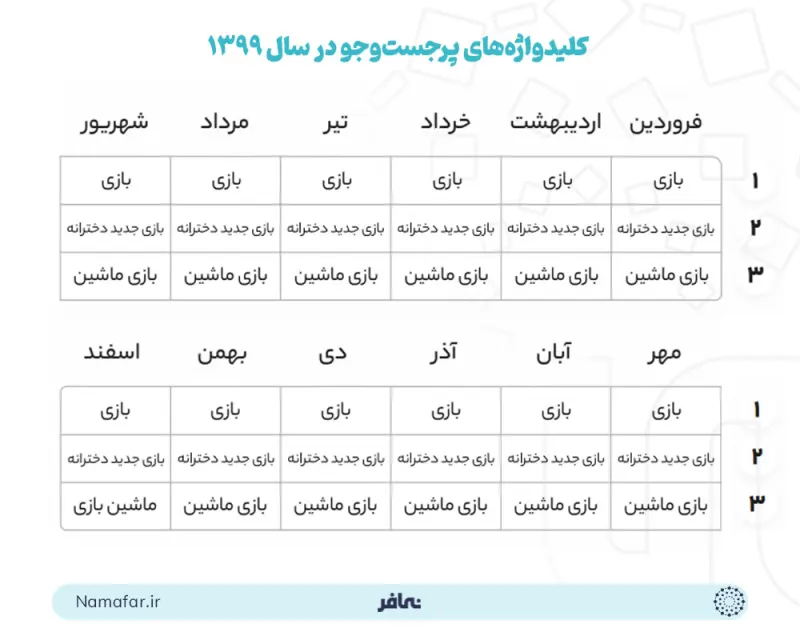
With the spread of smartphones the playing field changed, and because of the low cost of making games and the high profit of the mobile platform, most game developers entered this platform. Cafe Bazaar, a media store, also helped a great deal in publishing Android and iPhone mobile games. The word "game" had the highest number of searches on Cafe Bazaar in 99 (1399/2020–21).
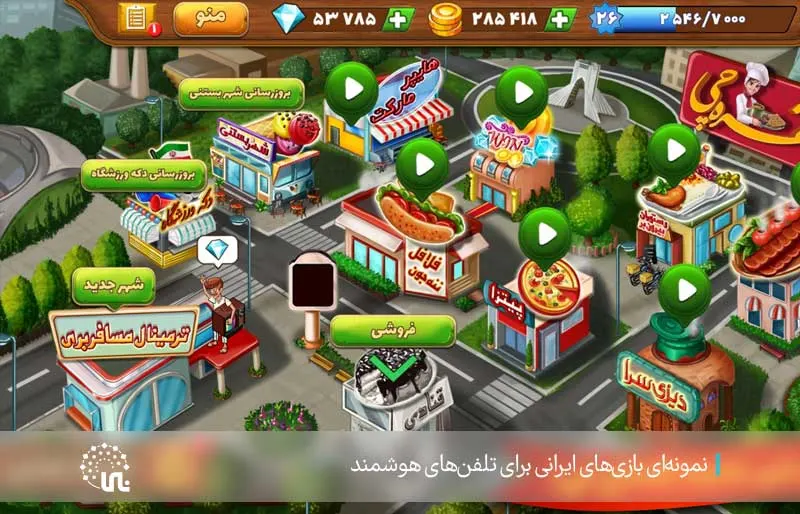
To date the quality of Iranian mobile games has seen good progress. To the point that some of these products can compete with some foreign games. According to statistics, the founding of game companies in the 1390s (2010s), that is, the decade of the spread of smartphones, saw a jump. So that in 96 (1396/2017–18), six Iranian game companies were founded, which counts as a record.
But the making of computer games and console games by game studios still faces a minimal volume. Because in this arena the ability to compete with similar foreign works still does not exist, and the game distribution platform, both at home and abroad, is not easily available to producers. Distributing games abroad is difficult for national game developers because of sanctions, and distributing them inside the country also lacks the necessary infrastructure. Apart from sanctions, what undermines the ability of domestic games to compete with foreign games is the price of foreign games and their quality. A foreign game that costs over 50 dollars can be downloaded for free from numerous game-download sites, but a domestic game that is at best a second-rate work must be obtained at a price of 50 to 100 thousand tomans.
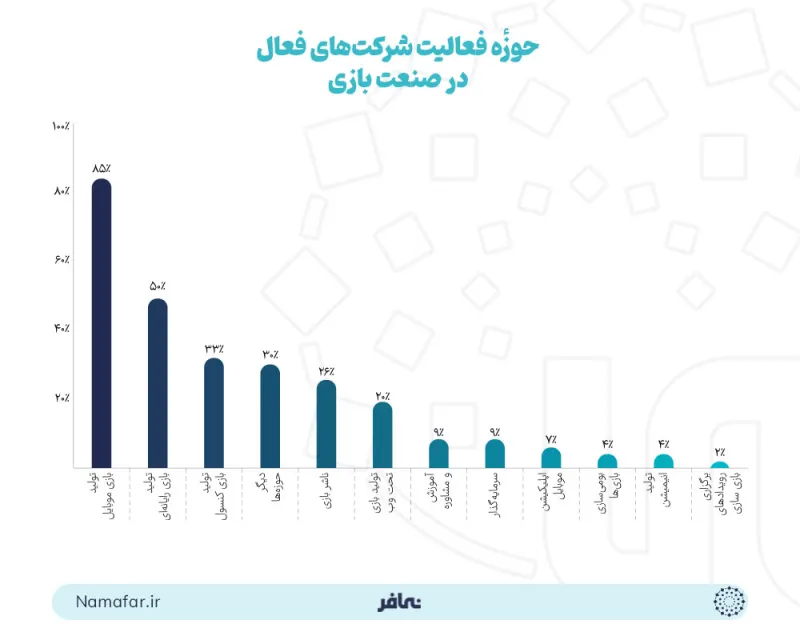
This is how we better understand why game developers and the Iran Computer and Video Games Foundation (IRCG) focus on the mobile platform. Naturally most of the Iranian games that people play are also mobile. 85 percent of the activity of all companies active in the game industry relates to producing mobile games. But there are still companies and studios that take risks and step onto the path of making console games. With this introduction we turn to introducing the best-known Iranian game development studios.
Rasana Shokouh Kavir
This Iranian game company began its work in 1385 (2006/07) and from the same time has been known for producing prominent titles for personal computers. Such as Ghatl dar Kuchehaye Tehran, Sheytanathaye Alimardan Khan and Safir-e Eshgh. In recent years this studio, with the release of the game Safir-e Eshgh, has made itself more talked about than ever. According to Mehdi Jafari Jowzani, the game's producer, Safir-e Eshgh, in the first 5 months of release and in conditions where the physical distribution of computer games in Iran had been almost destroyed, passed the 100 thousand copies sales mark.
Mehdi Fanaei
A one-man army! Mehdi Fanaei is the maker of the game 41148, one of the best-known and most popular games on Cafe Bazaar. The work was so appealing to audiences that many similar games were released on the market, but none of them could be as good as 41148. This maker's new game is 1:011, which is in the style of 41148.
Monadiyan-e Basirat
Monadiyan Cultural Institute began its work with the aim of reviving the video game ecosystem and boosting the animation economy. So far this institute has produced six video games and more than a thousand minutes of animation. Works released by this group include "Mokhtar: Fasl-e Qiyam" and "Farmandeh-ye Moqavemat; Nabard-e Amerli", which are considered among the best Iranian games produced.
Heyula
Heyula is not a game company, but its existence is vital for all game studios. Heyula is a platform for online buying, selling and downloading Iranian games. Like Steam and Epic Games and GOG, which offer every kind of game for sale. But Heyula is only for games whose publishers are Iranian.
Paeezan Studio
The Paeezan game company, with a mix of young people and veterans of the well-known Raspina team, was founded in 1393 (2014/15) after producing "Artesh-haye Farazamini", with 6 years of experience in game production. This game studio in Iran began its work with the game "Megnis" and in later years, with the production of games such as "Pesar-khandeh" and "Bagh-e Negar", became widely talked about and turned into one of the best-known Iranian game companies.
Fan-Afzar Sharif game company
This studio is the maker of one of the best-known Iranian games, namely the game Garshasp. But unfortunately it emigrated and changed its name to Dead Mage. The latest work of this game company is entirely in English.
Raspina Studio
Raspina Studio was registered in Farvardin (March–April) 1391 (2012/13) through the efforts of a group of software computer engineering graduates and was able to become one of the most successful Iranian game companies. This company's best-known Iranian game is Artesh-haye Farazamini, which one can say is the largest Iranian game. Despite its good graphics at the time of release, this work did not perform well financially and caused many people to leave the team. An event that, of course, led to the emergence of another game company.
Nardeban-e Andisheh-ye Farda cultural and artistic institute
This institute, by releasing "Baghlava" and "Amirza", was able to become one of Iran's most prominent game developers. The game Amirza is the most popular Iranian game on Cafe Bazaar and one of the most popular on Google Play. This game was released in 96 (1396/2017–18) and in 97 (1397/2018–19), with 5 million active installs (the game present on the user's phone), was the most popular Iranian mobile game.
Glim Games
Glim Games is another Iranian game studio that, by producing numerous works such as the games Taxi, Motori, Mehmani-ye Asghar Agha and many other titles, has made itself well known among Iranian gamers. This game company, by producing roughly twenty mobile game titles, is considered one of the most active Iranian game developers.
Modrik game studio
The knowledge-based company Bazi Gostaran-e Derik ( Modrik ) is at present one of the largest publishers and developers in Iran's game industry, with more than 15 games made and 50 games published in its record. Among this game company's best-known games one can point to Khorus-e Jangi, Sefr ta Sad, Shahrzad, Gol-e Morad, Shahr-e Bakhtakha and Footcardia.
Surena Games game company
Surena Games studio was founded in 1384 (2005/06) and began its work by making and producing Iranian games such as the game "Siavash". This company has produced various games for computers and Android and iPhone mobile and has also had notable achievements in game publishing. Among this company's best-known games one can point to the game "Zula", which enjoys great popularity among Iranian gamers.
Final word
The video game industry is a leading and growing industry in Iran and the world. 41 million of Iran's population play games and 35 million of them play on mobile. This statistic shows the Iranian people's strong interest in computer games. Even so, game production in the country is in a rudimentary and unfavorable state. Most game companies are small and inexperienced and operate only in mobile games. In Iranians' video game consumption basket, foreign games are mostly what one sees. One of the difficulties of game development in Iran is the impossibility of marketing it abroad because of sanctions. Inside Iran, too, distribution facilities are not well provided. Also, because of the possibility of downloading foreign games for free, buying expensive domestic games is not cost-effective.
One of Iran's leading game developers is the Nardeban-e Andisheh-ye Farda cultural and artistic institute. This company achieved great success by making the mobile games "Baghlava" and "Amirza". Also, the institute "Monadiyan-e Basirat", by making noteworthy games such as "Mokhtar: Fasl-e Qiyam" and "Farmandeh-ye Moqavemat: Nabard-e Amerli", is one of Iran's prominent game studios.
Machine-translated from Persian by Namafar; the Persian original is authoritative. Read the original in Persian