About two thousand five hundred years have passed since this prayer of Darius I, "God protect this country from the enemy, from drought and from falsehood," which is carved on an inscription at Persepolis. But Iranians still fear drought. Water, in all times and places, religions, cultures and civilizations, has been respected and loved by human beings. But people's relationship with water in the world's dry regions is different. In these regions water, more than in other parts of the world, means death and life. The inhabitants of these areas have long offered sacrifices for rain, said prayers and saved water. The importance of access to water drove people such as Iran's desert-dwellers to dig qanats. These regions also have a particular relationship with the sun. A sun that burns their skin and heat that gives them no ease. Can this be the reason for their eagerness to travel to the north and to coastal areas?
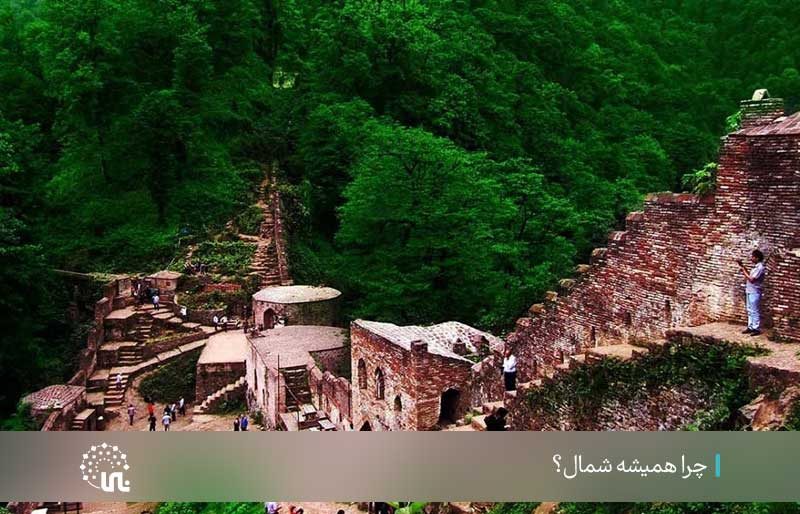
Why is the north always the travel destination?
Travel to the country's northern provinces, especially Gilan and Mazandaran, has today become a mental cliche. To the point that it has even found its way into popular songs. People have the north in mind as a default for their travel destination. That is, travel to the north takes place without their having thought well about this choice or having another choice in mind at all. When it comes to leisure travel, the first choice is the cities of northern Iran. Witness this Nowruz this year, when Mazandaran and Gilan were at the top of the country's provinces with the most travelers. According to the Statistical Centre of Iran, Mazandaran in 1400 (2021/22), which was still under the effect of the coronavirus, had the most traveler arrivals. At Nowruz 1401 (2022/23) too, the provinces of Mazandaran and Gilan were, respectively, first and third on the list of the country's provinces with the most travelers, and had Iran's busiest cities at Nowruz. It is true that travel to the north has become a predetermined plan, but this mental cliche has roots. When we think about why this constant and wide attraction of travelers and tourists to the north, first the same opening paragraph of the text comes to mind: a liking for water, greenery, rain, humid air and distance from a dry climate.
Mazandaran's tourist attractions
To find travelers' motives for travel to an area one must, at root, consider the features of that area. Next, the most important factor is the feature of the traveler's origin. If we know where people travel from to a region, why they travel becomes clearer. Mazandaran is a coastal province and this is the most important justification for the flood of travelers who head toward it. Seas throughout the world boost tourism and, besides natural rivers, also draw a river of people to themselves. For example Mazandaran, although it also has historical and cultural phenomena, draws travelers with its seas and forests. According to the tourism deputy of the General Directorate of Cultural Heritage, of 13 million travelers who went to this province by the seventh of Farvardin (March–April) this year, 6 million of them visited Mazandaran's official tourist attractions. 5 million of these visits were focused only on natural phenomena such as seas and forests and the untouched places of Mazandaran province. It is obvious that this is only the official statistic. This same statistic makes clear what a prominent role scenic natural attractions have in drawing tourists to Mazandaran province. Overall this province at Nowruz 1402 (2023/24) had about 20 million travelers.
Also about 12 million people traveled to Gilan province. Nowruz travelers to the north are in fact Iranian families who often travel by private vehicle to the most beautiful city in northern Iran. They have a set plan for traveling to the north by private car. They also do not match the usual definitions of the word tourist. This means these travelers cannot be considered active tourists who would use the various tourist facilities of northern Iran's cities. They are mainly drawn to a single tourist-attracting element.
Origin of travelers to Iran's northern cities
To examine the state of travelers to the north of the country, they must be divided into two groups, domestic tourists and inbound tourists. A domestic tourist is travelers who travel inside the country, and an inbound tourist is travelers who come from outside the country. According to the head of the Roads Management office of Mazandaran's General Directorate of Road Maintenance, the most domestic tourists and northbound travelers who have traveled to Mazandaran have been from the provinces of Tehran, Alborz, Golestan, Razavi Khorasan, Fars and Isfahan. These five provinces have several main features relative to Mazandaran. They are provinces with large, crowded and populous centers. They are close to Mazandaran, or they are hot and water-poor provinces. For example Tehran and Alborz are provinces caught up in the hardships and problems of urban life. The cities of Tehran and Karaj are the centers of industrial provinces whose residents suffer from air and noise pollution, traffic, a mechanized life, long working hours and the like. The urban lifestyle has ills that make the need for the most beautiful and best place in the north for travel and a space away from the clamor more necessary. Besides this, Tehran and Alborz are very close to Mazandaran.
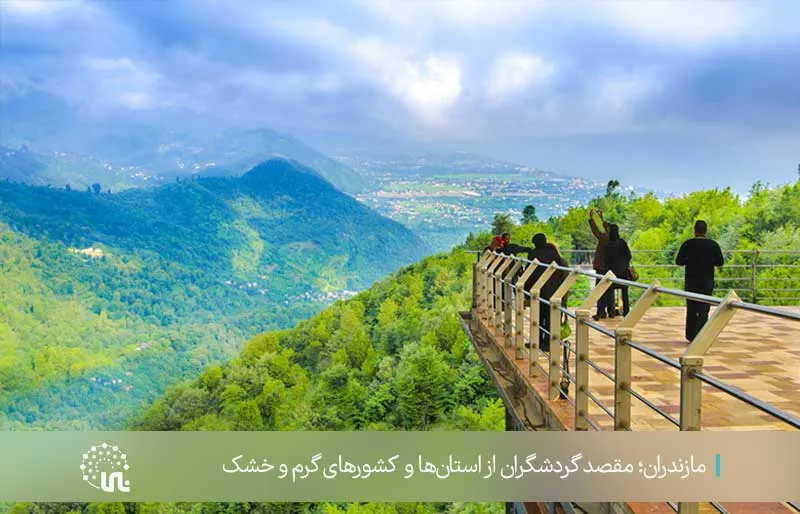
Golestanis traveling to Mazandaran as tourists
The interesting point is that Golestan province is also on the list of provinces with the most travelers to Mazandaran. Golestan itself is a northern province and has coast and forested highlands. But the greater part of this province too is dry and desert and is made up of vast deserts. The people of Golestan can, to change climate, not leave the borders of their own province; but that no longer has the meaning of travel. Also this province's coast, compared with Mazandaran's long coast, is very small. Besides this, tourism facilities arise where more travelers and tourists come and go. From this angle Golestan, although it has some of Mazandaran's natural features, the recreational and tourist facilities that arise over the years are without doubt greater in Mazandaran. Also this province's shared border and closeness play an important role in the high number of Nowruz trips by its people to Mazandaran.
Razavi Khorasan, Fars and Isfahan are far from Mazandaran. But they are both desert-like and have large, crowded provincial capitals. Residents of metropolises, besides being caught up in the hardships of urban life, are generally of the middle class and have more financial means to go to the best place in the north for travel and leisure. All three of these provinces count among Iran's tourism provinces. Razavi Khorasan is Iran's hub of religious tourism and Isfahan and Fars are Iran's hub of historical and cultural tourism.
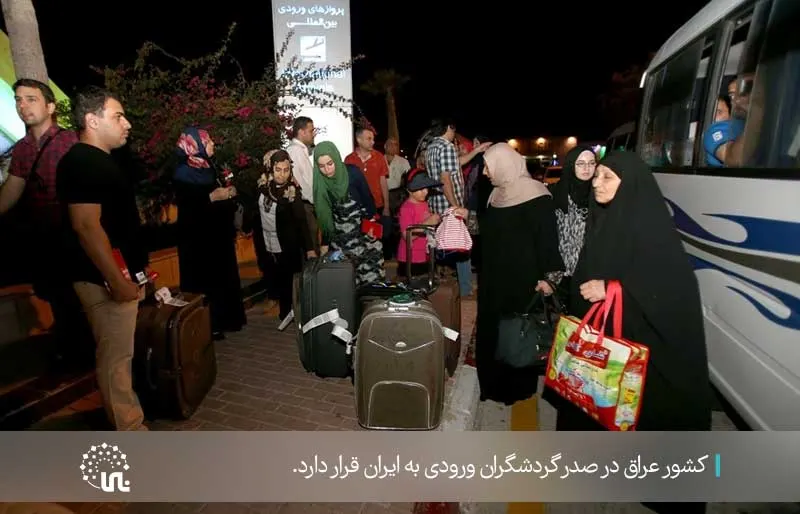
Foreign tourists in northern Iran
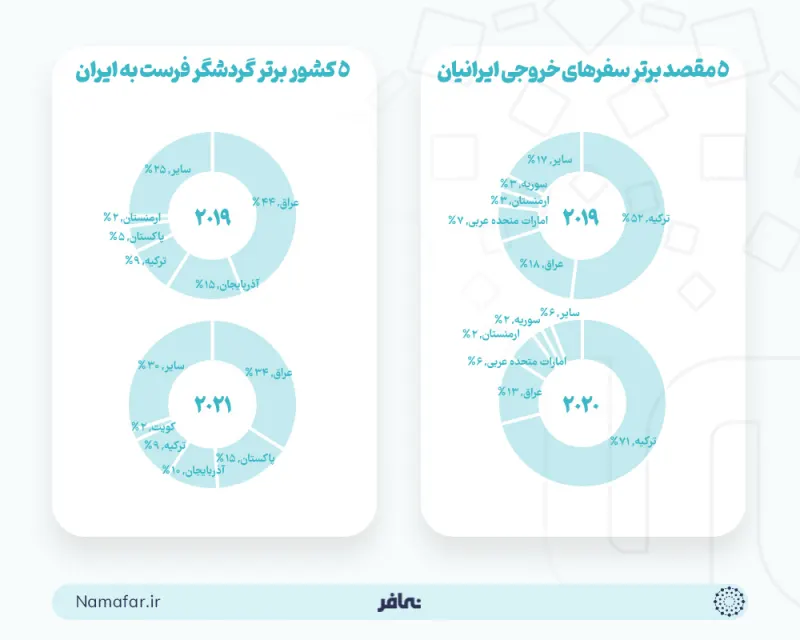
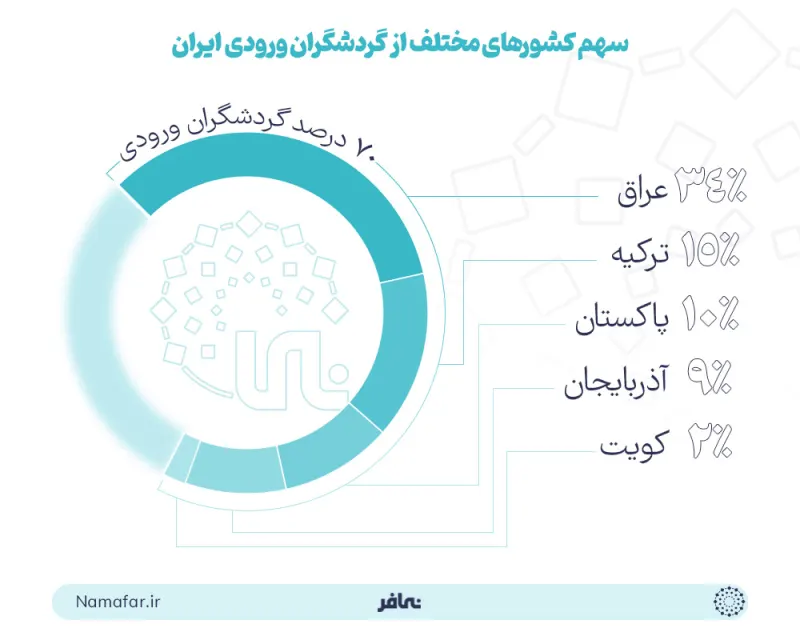
Among inbound tourists too, hot and dry countries are in view. According to the World Tourism Organization's 2022 report, in that year 4.1 million people traveled to Iran. This figure is 6 percent of the travelers who traveled to West Asia that year. In July of that year, which coincides with Tir (June–July) and Mordad (July–August), the record for foreign travel arrivals to Iran was broken. According to the Tourism Deputy of the Ministry of Cultural Heritage, Tourism and Handicrafts, Iraq in the first quarter of 1401 (2022/23) stood at the top in the number of tourists in Iran. Turkey, the Republic of Azerbaijan, Afghanistan and Pakistan are in the next ranks. In 2021 too, 70 percent of foreign tourists in Iran were from Iraq, Turkey, the Republic of Azerbaijan and Kuwait.
In the first half of 97 (1397 / 2018/19) a total of 105 thousand inbound tourists came to Mazandaran. It is said that Iraqis' reasons for travel to Iran are, in order, pilgrimage, medical tourism and leisure. Besides pilgrimage to the Eighth Imam (peace be upon him), Iran's therapeutic and leisure attractions are very appealing for a country with Iraq's unkind geography. In the first half of 98 (1398 / 2019/20) it was said that one hundred Iraqis a day enter northern Iran.
In the West Asia region, whose air is dry and harsh, the mild climate of northern Iran and the Caspian areas is like an elixir. Even the tourist countries of the Persian Gulf littoral are deprived of the blessing of a mild, green climate. Northern Iran has more capacity to attract foreign tourists in Iran. But the reality is that with a lack of proper oversight and strong management, the body of Mazandaran and Gilan is weary and wounded even with this level of tourists and foreign travelers in the tourist cities of northern Iran. Green, mild nature is naturally more fragile. The negative effects of destructive tourism on the environment can deprive Iran of the blessing of a God-given paradise and of the tourist attractions that lie in the north of the country.
Interest in ecolodges
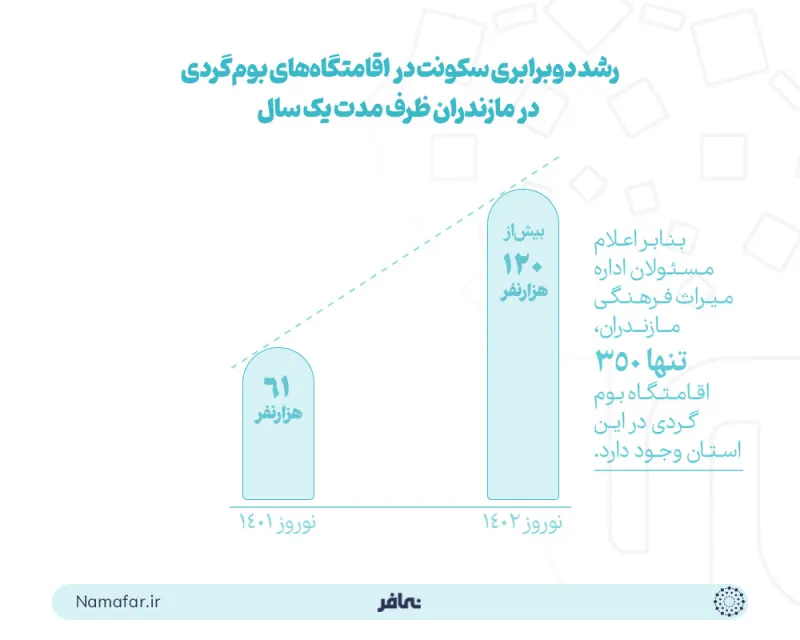
In recent years the interest and desire of tourist travelers and nature-goers for local settings and traditional lodgings has grown. A liking for nostalgia and weariness with the repetition of modern settings have made traditional attractions and sights such as adobe walls, blue wooden doors and traditional wooden roofs steal the hearts of travelers to the north's cities. To the point that, according to Mazandaran's General Directorate of Cultural Heritage, Handicrafts and Tourism, at Nowruz 1402 (2023/24) more than 25 percent of inbound travelers to the north stayed in Mazandaran's villages. Mazandaran has more than 3000 villages and more than half the province's population lives in villages. This means an important tourism capacity. Also, interest in traditional sights and tourism places in northern Iran has grown the use of ecolodges in the northern provinces. So that in this same Nowruz 1402 (2023/24) period more than 120 thousand travelers stayed in Mazandaran's ecolodges. This figure in the same period of the previous year was 61 thousand people. On this basis, stays in ecolodges doubled within one year. According to officials of Mazandaran's Cultural Heritage office, there are only 350 ecolodges in this province. Of course the growth of ecolodges has precise cultural considerations, and inattention to them does not lead to sustainable development.
Mazandaran's best shopping centers
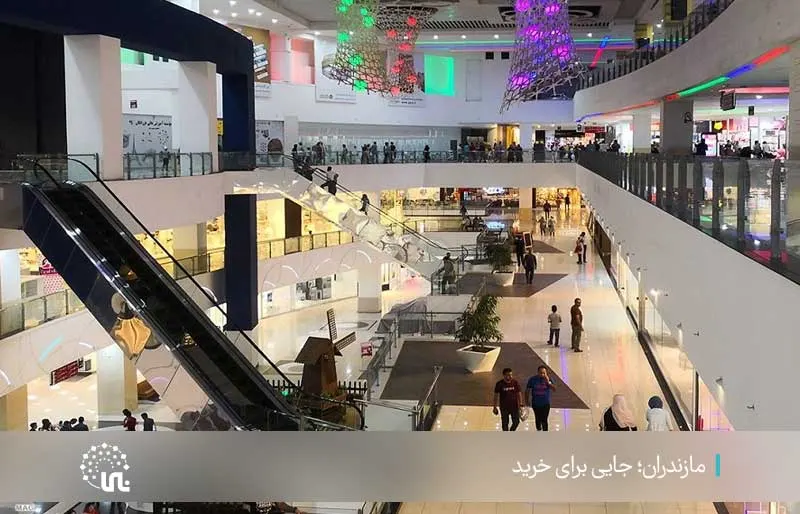
Shopping on a trip is a constant extra in Iranians' travel. Iran's northern provinces and especially Mazandaran are also full of large shopping centers. Some of these centers are Mazandaran brand stores that are specific to brands found only in the north. One of these brands is "Iran Katan". This brand was founded from the start in Mazandaran and now has numerous branches only in this same province. Though in 97 (1397 / 2018/19), by founding its own online store, it increased access to its products in other parts of the country. Another well-known shopping center is the Motel Ghoo complex in Mazandaran. Motel Ghoo is in Salman Shahr near Chalus and Nowshahr and is itself a set of tourist attractions. The beach and several large shopping centers such as "Almas Motel Ghoo" and "Almas Ghoo Middle East" draw many travelers and foreign tourists. Large stores of this kind in the north are plentiful throughout Mazandaran. Apart from shopping centers and Mazandaran brand stores, the north's organic products are also a motive for some travelers and foreign tourists to travel to this area.
Final word
Iran's northern tourism provinces, especially Gilan and Mazandaran, have been and are the constant hub of travel and tourism in Iran. By examining the figures on Nowruz travelers to the north at Nowruz 1402 (2023/24), we find that most of Mazandaran's travelers have been from Tehran, Alborz, Golestan, Razavi Khorasan, Fars and Isfahan. With a little reflection one can see that these provinces have several shared features. Either they have metropolis city centers, or a desert climate. Metropolises hold a middle-class demographic fabric that, more than other groups, has the possibility of travel to the north by private car or without a car. Also the residents of these cities are caught up in the challenges of urban life and travel to the north is a chance for them to breathe. A province such as Golestan too, because of dry air and closeness to Mazandaran, is on the list of the highest number of travelers to Mazandaran.
Iran's northern cities, with their temperate Caspian climate, also count as a unique climate in the West Asia region. Most of the foreign tourists to northern Iran who travel to Mazandaran are from Iraq. The western cities of Mazandaran are more attractive to foreign tourists than other areas of this province. Ecolodges and shopping centers in the north are also important factors in attracting tourists to the north, and especially to Mazandaran.
Machine-translated from Persian by Namafar; the Persian original is authoritative. Read the original in Persian