The most important feature of crises is that they are unexpected, which leaves decision-makers in a state of confusion and anxiety. The global coronavirus crisis has appeared in various domains, and given the absence of a similar experience, it has endangered not only governments and the medical and treatment industry, but also most organizational sectors, especially service sectors, including the hotel and tourism industry. Travel and tourism are among the sectors that have suffered the most in this period. The damage of COVID to tourism has been very great. The decline in the number of trips in the first three months of 2020 compared with last year clearly shows COVID's role in the devastation of the tourism industry. Available data show a 22 percent decline in trips in the first quarter of 2020 and a 57 percent decline in trips in March (Esfand (February–March) 98 and Farvardin (March–April) 99). This has caused a decline of 67 million international trips and about 80 billion dollars in damage to export revenues from international tourism.
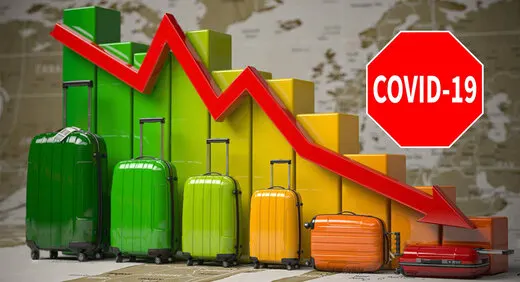
Effects of quarantine: COVID-19 has quarantined the whole world!
For the first time in history, in response to a pandemic, restrictions have been set on international travel; complete closure of borders to tourists and the suspension of international flights are among these restrictions.
As COVID-19 spread further in different countries, travel restrictions also increased more and more. With the declaration of a Public Health Emergency of International Concern (PHEIC) on 30 January 2020 (10 Bahman (January–February) 1398 (2019/20)), 11 tourist destinations immediately imposed restrictions on tourists who had come from China. The declaration of the start of a global pandemic on 11 March 2020 led to the imposition of travel restrictions in 85 tourist destinations. Two weeks after the pandemic was declared, the number of tourist destinations that imposed travel restrictions more than doubled, from 85 destinations to 181 destinations. From 24 March to 20 April 2020 (5 Farvardin 1399 (2020/21) to 1 Ordibehesht (April–May)), tourism restrictions were imposed in all 217 countries of the world.
At present, 25 percent of the world's tourist destinations have had travel restrictions for at least a 3-month period and about 40 percent of destinations have had them for at least a 2-month period. At present, there are 156 tourist destinations around the world that have completely closed their borders to international tourists. From 27 April 2020 (8 Ordibehesht 1399 (2020/21)), some countries began to open borders and end quarantine, but none of the countries has yet lifted or reduced international travel restrictions.

COVID damage to tourism in the world and Iran:
If we want to examine this issue region by region, the greatest COVID damage to tourism has been in Asia and the Pacific countries. Tourist arrivals to these continents during the first quarter of 2020 fell by 35 percent. Europe, with a 19 percent decline, is the second region to have suffered the most from this phenomenon; then the Americas faced a 15 percent decline, Africa a 12 percent decline and the Middle East an 11 percent decline. Existing evidence points to a 58 to 78 percent decline in international trips in 2020; the exact figure depends on prevention of the pandemic, the duration of tourism restrictions and the reopening of countries' borders; although the outlook ahead remains highly uncertain.
All the evidence reports a decline of 850 million to 1/1 billion international trips and damage of 860 billion to 1/2 trillion dollars in export revenue from tourism. This event is considered the greatest collapse of the tourism industry in history. The collapse of the tourism industry puts about 100 to 120 million direct tourism jobs at risk.
This event is considered the greatest collapse of the tourism industry in history. The collapse of the tourism industry puts about 100 to 120 million direct tourism jobs at risk.
Read about the world's highest-earning countries in the tourism industry in this article.
Compensating COVID's damage to the country's tourism
A member of the Cultural Commission of Parliament (Majlis), emphasizing that by organizing holidays we must make the best use of them economically, in terms of belief and spiritually, added: Iran has abundant recreational, scientific and religious tourism destinations; in this regard COVID inflicted a great deal of damage on the country's tourism and shut down the tourism industry, so the relevant officials must, in cooperation with other agencies, have appropriate and coherent planning to revive the tourism industry and improve its situation in the post-COVID period.
The representative of the people of Tabriz, Azarshahr and Osku in Parliament (Majlis) recalled: Organizing holidays was raised twice in Parliament (Majlis) but met with different reactions; of course, proper definitions of organizing holidays were not presented in society and part of the country's media space also pushed it toward politicization, and in the end we did not reach a conclusion; it is expected that the Eleventh Parliament (Majlis) will put organizing holidays on its agenda.
By visiting the article on a report on domestic tourism in Iran on Namafar you can view domestic statistics.

Mapping the state of Iran's tourism during the crisis as told by the World Travel and Tourism Council
According to the World Travel and Tourism Council report, tourism's share of the country's economy, that is the contribution of tourism to the country's gross domestic product, has declined by about 48 percent. Employment in tourism has also, according to the figures presented, been damaged under the impact of this crisis. To the point that the figures indicate the loss of about 307 thousand jobs in this industry. The volume of revenues from inbound tourists to the country from 916,277 billion rials to 002,37
billion rials; that is, after the outbreak of COVID-19, revenues from foreign tourists in the country have fallen by about 86 percent. Meanwhile, although there have been changes in the ranking of arrivals, Iran's top five tourist-sending countries are still its neighbors. Notably, Iraq, both before and during COVID, has held first place among those bringing tourism into the country.
ICAO data show a sharp 38 percent decline in international passenger seat capacity. According to ICAO forecasts, the number of international passengers in 2020 will face a decline of 44 to 80 percent.

Historic decline in all tourism industry indicators:
The COVID-19 pandemic has inflicted great damage on the air passenger industry; this can be seen in flight cancellations, the grounding of aircraft and the collapse of energy-carrier prices under financial pressures. In February, the international air passenger market, overshadowed by the performance of Asia and the Pacific countries and also with the closing of borders around the world and the imposition of travel restrictions in March (Farvardin 1399 (2020/21)), collapsed.
ICAO data show a sharp 38 percent decline in international passenger seat capacity. According to ICAO forecasts, the number of international passengers in 2020 will face a decline of 44 to 80 percent. IATA shows a 22 percent decline in international passenger demand, measured by the "revenue passenger-kilometer" (RPK) criterion, in January–March and a 56 percent drop in March; which is similar to the decline in the number of international tourists. According to IATA's forecast, by the end of 2020 demand for air travel in the world will face a 48 percent decline.
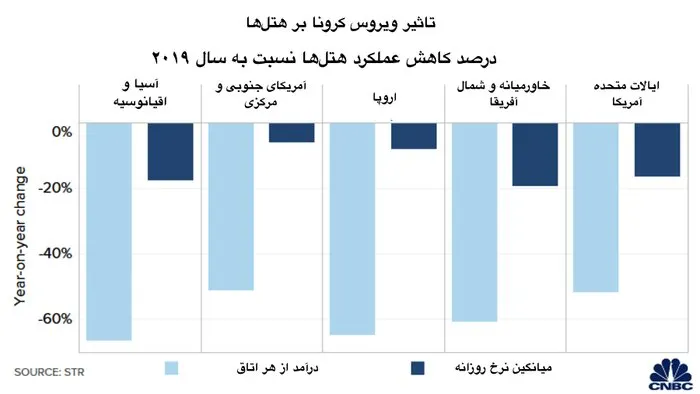
According to ForwardKeys statistics, air travel bookings worldwide in the first quarter of 2020 faced a sharp 80 percent decline. Meanwhile, Asia and the Pacific countries, with a 98 percent drop, have suffered the greatest damage; the decline in bookings in these countries, with the start of travel restrictions in China, began earlier than in other regions. Air travel bookings in the first quarter of 2020 in Europe (with a 76 percent decline), the Americas (a 67 percent decline) and Africa and the Middle East (a 65 percent decline) were accompanied by a sharp drop. STR has announced that the global hotel industry in March 2020 suffered a double-digit drop in revenue per available room (RevPAR). Meanwhile, Asia (with a 66.7 percent decline) and Europe (with a 61.6 percent decline) have had the greatest declines.
Closing remarks
A disaster is unfolding! A 60 to 80 percent decline in tourists
Since the start of the pandemic, the 2020 outlook has repeatedly worsened. The COVID pandemic is an end to the sustained growth of tourism after the economic crisis of 2008 and 2009. COVID's damage to tourism is unprecedented since World War II, and the drop in demand for international travel causes a decline of 850 million to 1.1 billion international tourists and also 910 billion to 1.2 trillion dollars in damage in the export revenues from tourism. As a result, 100 to 120 direct tourism jobs will be at risk. Since about 80 percent of tourism businesses are in fact small and medium-sized enterprises (SMEs), this situation is considered highly critical.

Not knowing when the pandemic will end has confronted the world economy with a crisis.
Given the outlook for the travel and tourism sector, it is forecast that the global economy in 2020 will face a sharp 3 percent decline; although according to International Monetary Fund (IMF) statistics it is expected that this situation will improve in 2021 (World Economic Outlook, April 2020). On the basis of previous crises, it is expected that leisure trips, especially travel to visit friends and relatives, will regain prevalence sooner than business trips. Countries around the world are implementing various measures to reduce the impact of the COVID-19 outbreak and accelerate the recovery of the tourism sector.
By visiting the tourism section on Namafar you can view domestic and global statistics for this industry.

Machine-translated from Persian by Namafar; the Persian original is authoritative. Read the original in Persian