Domestic tourism has a special place in the national economic cycle. In circumstances where, because of relentless sanctions and disordered economic conditions, the conditions for foreign trips are not available to the general public. Domestic tourism in Iran can help revive the local economy and the welfare of this country's indigenous communities. What is meant by domestic tourism is travel within the borders of a country.
Unique geographic and natural diversity, rich and colorful culture and traditions, and the existence of diverse pilgrimage and historical destinations have given Iranians various motives for traveling. Apart from this, travel in today's life is counted as a vital necessity. From long ago journeying and travel has been raised as an important leisure and an occasion for gaining experience and trade; but in these times travel for many people is an opportunity to breathe. Polluted large industrial cities, monotonous and anxiety-inducing jobs, and individualistic lives that take from people the possibility of connecting with neighbors and other citizens and cause loneliness, have turned travel into a synonym for life. A synonym that of course is very short.
But how much do Iranians usually travel? What is their motive for touring? Which cities do they choose for travel? Stay with us so that together we take a look at the results of the national tourists survey that was published in 1400 (2021/22) by the Statistical Centre of Iran.
What is domestic tourism?
According to the definition of the Statistical Centre of Iran, tourism is the set of activities that a person or persons carry out during travel to a place outside their usual living environment, for a maximum consecutive period of one year with the aim of leisure, trade and so on, provided that they do not receive wages and salaries from the place visited (the destination).
Our focus in this note is on domestic tourism in Iran as one of the important types of tourism. What is meant by domestic tourism is the tourism of resident and non-resident people in the country being visited and it includes indigenous (intra-regional) tourism and inbound tourism. In this definition the tourism of resident and non-resident people of a country within the borders of that same country is examined.
Domestic tourism in Iran
According to the report of the National Statistical Centre, in 1400 (2021/22) of about 26 million Iranian households, only close to eight million households, that is 30 percent, have gone on a trip. Now consider that in this statistic, households of which even one person has gone on a trip only once in the year have been counted. Taking this into account, we realize this important issue that the state of domestic tourism in Iran is very poor. Perhaps problems arising from inflation or the spread of COVID in 1400 (2021/22) can be counted among the reasons for these conditions.
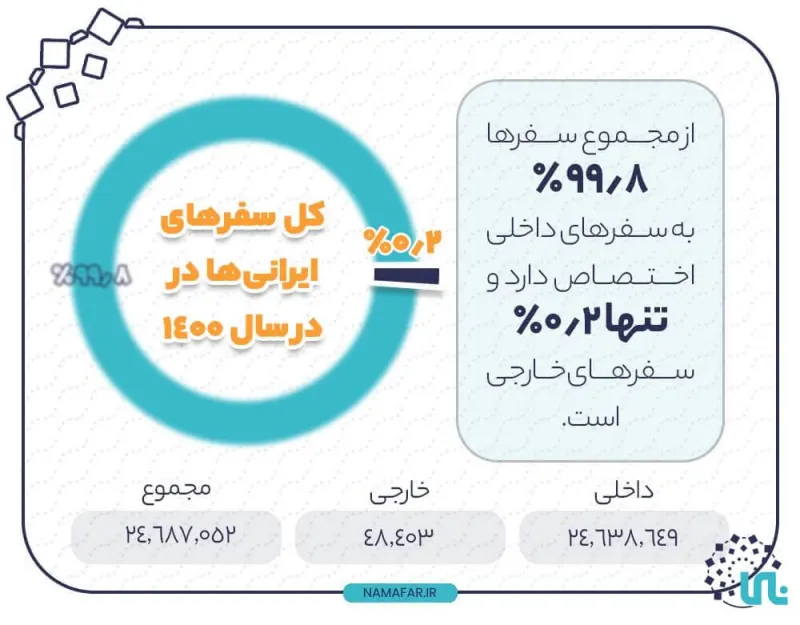
If we want to compare domestic and international tourism statistics we see that close to 100 percent of Iranians' trips have been domestic. In the meantime only two percent of Iranian tourists have gone abroad.
Domestic tourism destinations in Iran
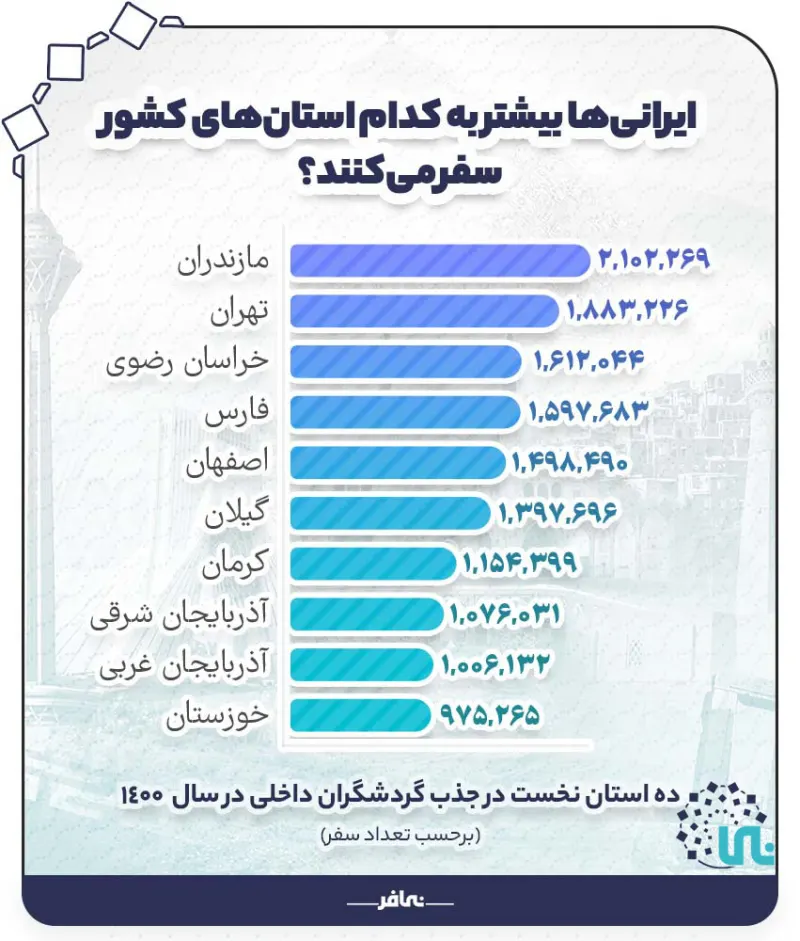
Mazandaran and Tehran are the most tourist-receiving provinces in Iran. But how much travel is there to these two provinces? What are people's reasons for going to these two provinces? To know the answers to these questions stay with us in what follows.
Mazandaran, Iranians' most popular tourism destination
To get out of the space of large cities and everyday lives, Iranians take refuge in the sea. Travel to the north of the country has become part of people's lifestyle and culture. In fact the north is a cliché that is registered in people's minds as a place for leisure. This statement is confirmed by the statistics on tourist attraction of Mazandaran Province. Of a total of about 25 million domestic tourists, more than 2 million households travel to Mazandaran Province. This figure makes Mazandaran the leader of Iran's tourism destinations. The most important motive that can be listed for travel to this province is touring and leisure. Apart from this, many people may go to this province because of visiting their relatives.
Tehran, Iranians' second tourism destination
After Mazandaran, Tehran with close to 2 million travelers is a tourist-receiving province. Tehran has many attractions. Important universities, advanced medical centers, large and diverse shopping centers and abundant opportunities for earning income have made Tehran the second important destination of domestic tourism in Iran.
Khorasan among the top 10 domestic tourism destinations
After Tehran too stands Razavi Khorasan, which is the most important destination for Iranians' pilgrimage trips. The Tehran-to-Mashhad route and vice versa is the best-selling at many online ticket-sales agencies. The provinces of Fars and Isfahan stand in the next ranks. The large number of trips to these two provinces indicates that historical, cultural and handicrafts attractions count among important factors for attracting domestic tourists. Gilan, Kerman, the Azerbaijans and Khuzestan stand in the next ranks of the top 10 domestic tourism destinations. More than 10 million trips are also destined for other provinces.
If we examine the most important destinations of domestic tourists by city and not province, then the cities of Tehran, Mashhad and Isfahan will stand in ranks one to three.
Motives for domestic tourism in Iran
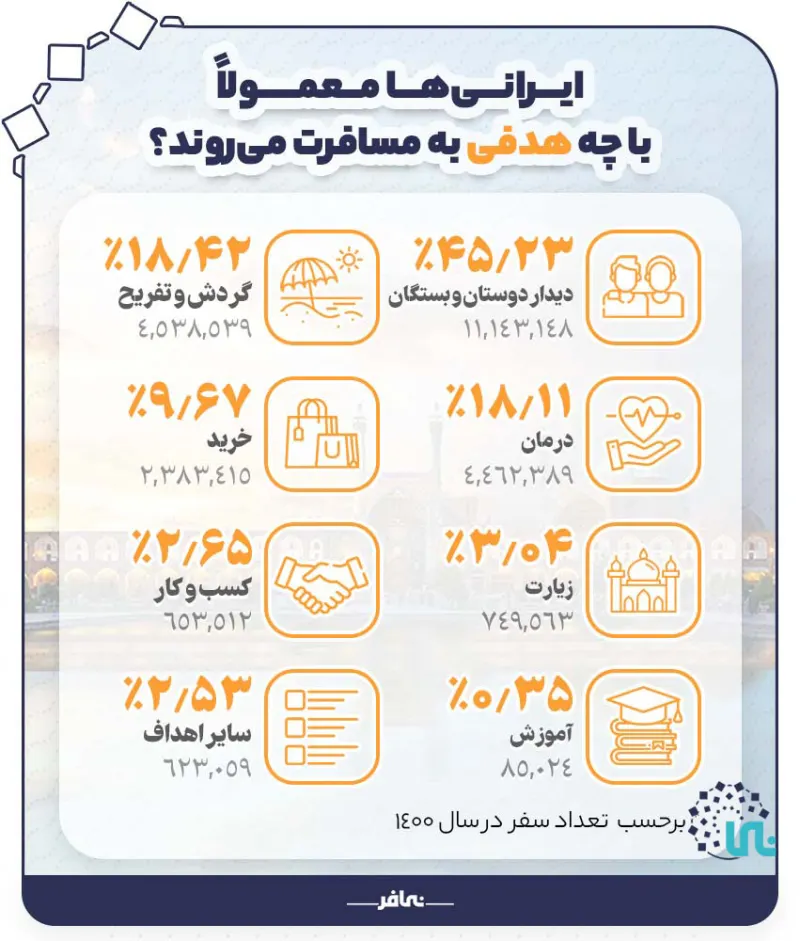
In Iran many motives for travel are found; at the top of these reasons and motives stands visiting friends and relatives. 11 million trips of a total of 24 million have been made with the aim of visiting friends and relatives. If we want to think about the reasons for it we can say that in recent decades, many Iranians from villages or small cities have migrated to a few large industrial cities. Iranian tourists have to meet a large number of their relatives and kin in their birthplaces; for the same reason too 76 percent of travelers stay in the homes of relatives and acquaintances. After this factor, touring and leisure is the most important motive for domestic trips. Diverse natural, cultural and historical tourist attractions well answer people's need for leisure.
Travel for treatment
Treatment is the third important factor in domestic trips. Besides Tehran, which is the center of concentration of medical facilities, many other provincial capitals also have unique medical facilities. For example Shiraz is one of the country's cancer-treatment hubs. Also, hot springs in the Azerbaijans turn it into a health-tourism destination inside the country.
Travel for shopping
After treatment, the shopping factor has a strong presence among the factors attracting domestic tourists. Many people travel for shopping to cities or provinces that have high variety and quality and also a lower price relative to the origin. Also some products and especially handicrafts products are native to a series of particular regions and buying them in those regions is much more economical. Such as Kashan which is known for rosewater and herbal distillates, and Yazd and Meybod which for termeh and farshineh, and Lalejin of Hamadan which for pottery and enamel, and Isfahan which for khatam and wood carving, and Mahallat which for flowers and plants, and Malayer which for the wood industry, and Zanjan which for knives and blades.
Travel for pilgrimage
Pilgrimage is the fifth important motive for travel for Iranians. Cities such as Mashhad and Qom are Iran's most important pilgrimage destinations. Mashhad is a city that on various occasions such as religious occasions or the Nowruz holidays breaks the record for receiving travelers. Perhaps it is the existence of Mashhad and the shrine of the Eighth Imam, peace be upon him, that has turned pilgrimage into one of the most important motives of domestic tourism. After pilgrimage, business and education are other important driving factors for setting out on a trip.
Iranians' means of transport in domestic tourism
Most Iranians use their own vehicle for travel; something on the order of 16 million trips are made by car. Having a vehicle is an important component for Iranians going on a trip. Only 20 percent of people who do not have a car go on a trip. This statistic in the case of car-owners is 35 percent. The high price of air travel makes travel by private car more economical. In principle with the existing inflation, it is natural that travelers reduce the cost of their trip in every possible way. After a private vehicle, hired cars and a private vehicle belonging to others are the most popular way of coming and going for Iranian travelers.

After the airplane, the train is another popular vehicle. Besides the length of the distance, numerous road hazards and limited road facilities are other motives for using airplane and train. The existence of popular destinations such as the islands of Kish and Qeshm also raises the use of vessels such as lenj boats and ships for indigenous trips.
Conclusion
In 1400 (2021/22) about 55 million Iranians did not even have a single one-day trip in the year. This figure constitutes 70 percent of Iran's population. Now that we have almost passed the highly tense days of the spread of COVID we can pay attention to solutions for expanding domestic tourism.
As we said, domestic tourism is a national strategy for developing the country's economy. There are many solutions for encouraging people toward Iran-touring. Given present economic conditions, creating a tourism development fund by related organizations, launching inclusive tours for young people and retirees, paying travel loans with easy terms by banks, and appropriate advertising are among the solutions for expanding domestic tourism in Iran.
Related material
If you want more complete information about the socioeconomic base of Iranian tourists, you can by clicking on the link below go to the results of the national tourists survey in the Namafar knowledge base.
Results of the national tourists survey, spring 1398 (2019/20)
To access older information about the state of domestic tourism in Iran you can also refer to the results of the national tourists survey in 1396 (2017/18).
Results of the national tourists survey, spring 1396 (2017/18)
Source: National Tourists Report, spring 1400 (2021/22), Statistical Centre of Iran.
Machine-translated from Persian by Namafar; the Persian original is authoritative. Read the original in Persian