China is among the countries that have not only placed the economies of every country in the world under the influence of the expansion of its territory and reach; its cultural and creative industries have also swept through global markets. Among them one may point to this country's cinema, which in the first four months of 2024 grossed 2.83 (83/2) billion dollars (20 billion yuan). Cinema box office revenue in this year crossed the 20 billion yuan mark earlier than last year. In these 4 months more than 4.53 (53/4) billion tickets were sold and films went onto cinema screens more than 49.47 (47/49) million times.
In this connection the question arises of what factors have brought about the global dominance of China's cinema market (even at a distance from Hollywood). According to researchers' forecasts, how long will this upward trend last, and what factors will lead to its decline and collapse? In this note we try both to look at the growth trend of China's cinemas in the 2024-2023 period and to scrutinize the reasons that have caused this industry to grow further in global markets. In addition, given the points that will be mentioned, we will also analyze a brief profile of the future of China's cinema market.
 The vitality and renewed growth of China's cinema in 2024-2023

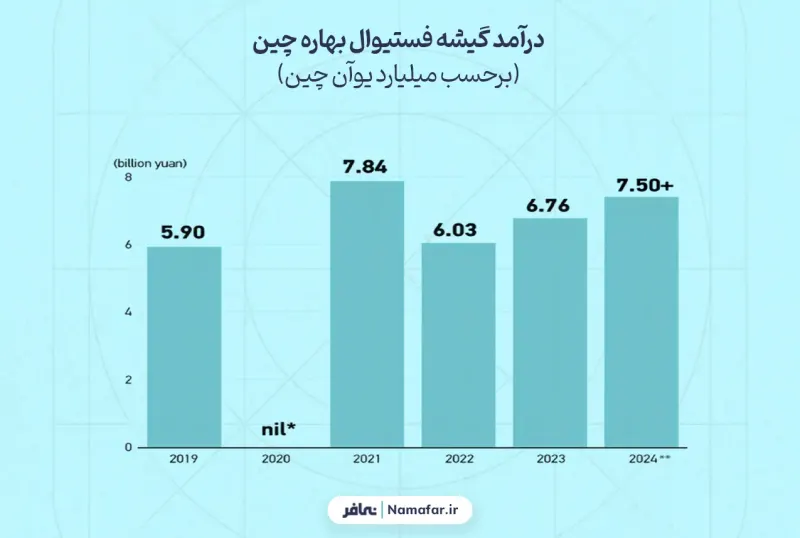
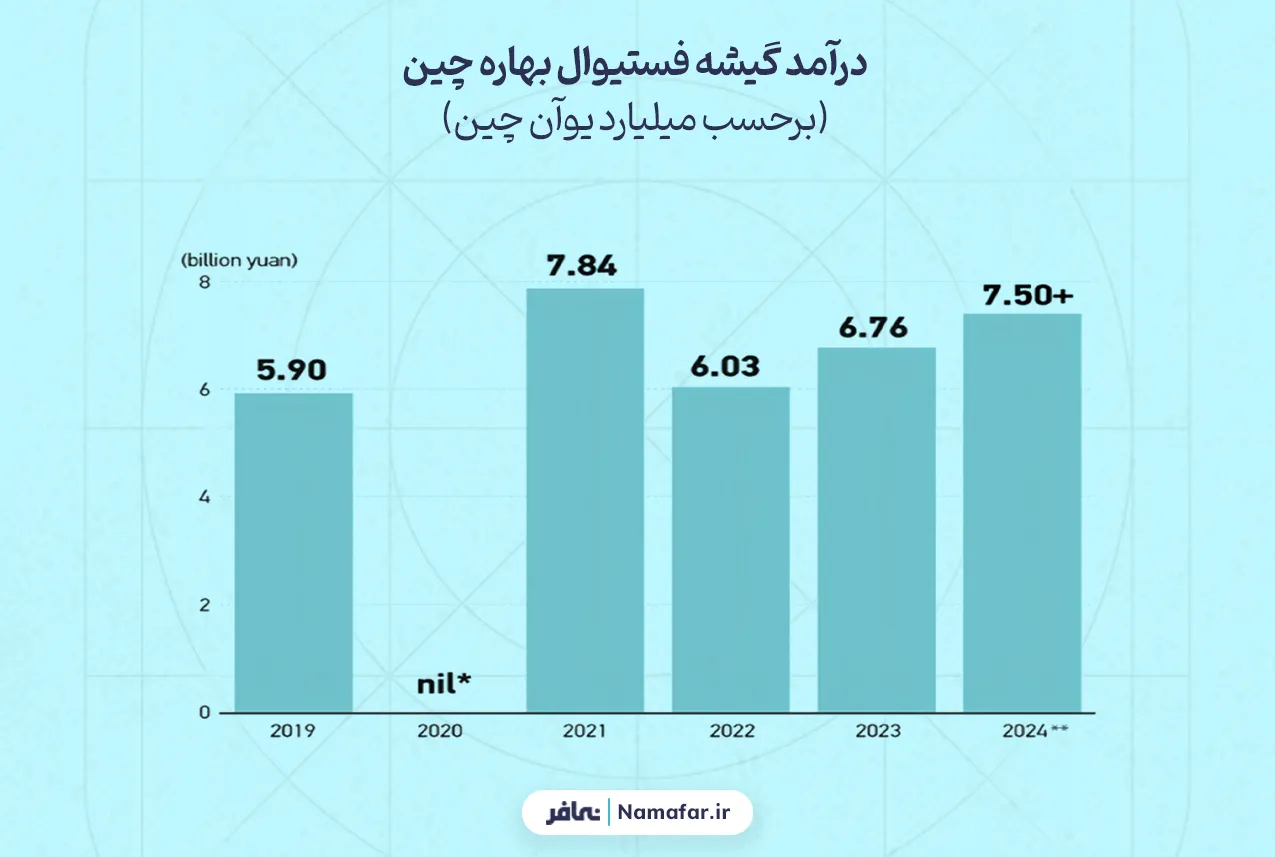
With the end of the lockdowns caused by the coronavirus pandemic, China's cinema market regained the vitality and energy of the pre-pandemic era. So that cinema box office revenue in this country in 2023 reached 54.9 (9/54) billion yuan (7.61 (61/7) billion dollars) and about 1.3 (3/1) billion dollars in tickets were sold. This is while this country's cinema revenue in 2020 was only 20.41 (41/20) billion yuan (2.83 (83/2) billion dollars). China Film Administration statistics show that after the slump of the pandemic years, Spring Festival film sales in 2023 and 2024 reached 6.7 (7/6) and 7.5 (5/7) billion yuan respectively. Although this figure has been lower than the 7.8 (8/7) billion yuan in sales in 2019, it still shows an upward trend relative to the 6.03 (03/6) billion yuan in revenue in 2022 and the cancellation of all films in 2020 because of COVID-19 conditions.
 Why is China's cinema market more prosperous than Hollywood cinema?
The evidence points to the growing dominance of China's cinema market in the world. In 2019, this country's cinema market, with revenue of 9.2 (2/9) billion dollars, overtook Hollywood and remains more prosperous. Various factors have played a role in this boom in China's cinema. One of the key factors in this success is the continuous improvement in the quality of China's domestic cinema productions. Increased investment in the development and production of domestic films has brought with it the making of higher-quality content that connects well with audiences. It is therefore no surprise that all 10 of the highest-grossing films of the first 4 months of 2024 are Chinese. China Film Administration has reported that of all films screened, 84 percent of them are domestic products of the country.
Another reason for this boom has been the diversity of films across different genres, from thrillers and drama to comedy films and animation; audiences appear hungrier than ever for new content. This opened both new opportunities for young filmmakers and a path into the mainstream of China's cinema for art-house directors such as Wei Shujun, a three-time selectee of France's Cannes Film Festival.
Researchers believe that another reason for the boom in China's cinema, especially in the first four months of 2024, has been the high sales of films at the Spring Festival and its substantial discounts, which made it possible for all social groups to buy tickets. For example, cinema tickets in Beijing, China, at the start of the new year sold for 19.9 (9/19) yuan, whereas the usual price had been 50 yuan. China's cinema box office revenue in the first three days of the 2024 Spring Festival passed 3.5 (5/3) billion yuan (492.7 (7/492) million dollars). The first highest-grossing film of this festival, the comedy-drama YOLO, grossed 1.3 (3/1) billion yuan; the second film, the comedy Pegasus 2, 1.2 (2/1) billion yuan; and the third highest-grossing film, the animation Boonie Bears: Time Twist, 714 million yuan.
Scholars believe that China's rich history and culture is itself another reason that can provide favorable ground for creating original works and high film sales and even attract audiences from around the world. The Chinese government has also played an important role in improving and strengthening this country's cinema market. Policies such as expanding the foreign-film quota in 2012 and forming the China Film Group Company provided the ground for greater cooperation between Chinese and international filmmakers and led to a greater exchange of knowledge, resources and experience.
 The outlook for China's cinema market in the future
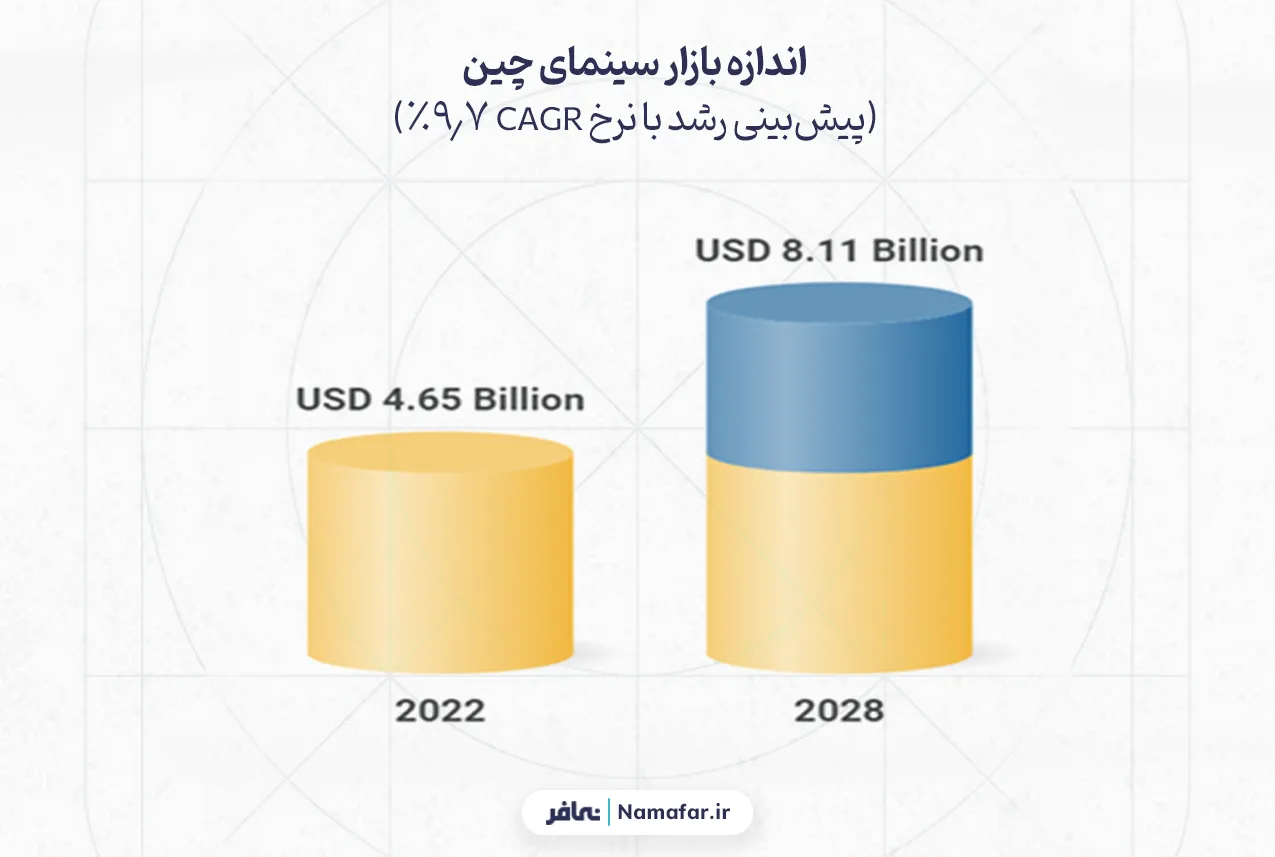
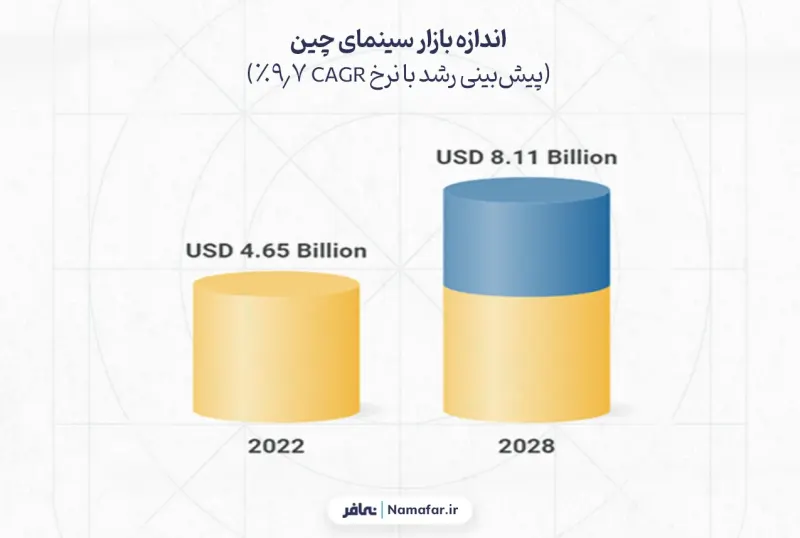
Given the points that have been explained, the question may arise of how long the boom and growing dominance of China's cinema in global markets will continue. The latest Renub report, titled "China Cinema Market, Size, Forecast 2028-2022, Industry Trends, Share, Growth and Company Analysis," shows that China's cinema market will gross 8.11 (11/8) billion dollars (58.6 (6/58) billion yuan) by 2028.
Extensive discounts and facilities by online ticket-purchase platforms, changes in young people's lifestyles, the acceleration of urbanization, the penetration of cinema facilities into less-developed regions, and the expansion of the number of cinemas screening three-dimensional films (60 thousand 3D films in 2018 compared with 82 thousand films in 2021) are among the factors that guarantee the continued boom of China's cinema market through 2028. According to researchers, revenue from film sales has itself helped expand film-distribution infrastructure in China. The major and key actors in this process, in order of impact, have been the following seven companies:
- IMAX China Holding
- Alibaba Pictures Group Limited
- HuayiTencent Entertainment Company Limited
- Perfect World
- China Film Company Ltd
- Beijing Enlight Media Wanda Film Holding Co Ltd

Finally, and as noted, the expansion of infrastructure to cities and less-developed regions, thanks to favorable government policies, population growth, higher household incomes and greater consumerism, will triple the cultural industry of small cities by 2030. With this trend it is forecast that China's cinema market will overtake North America and, with a reduction in censorship and regulatory interference, will even become a favorable environment for global film producers.
Conclusion
China's cinema market has had a high degree of dominance over the global market, and day by day its boom and growth are increasing. It has been forecast that by the end of calendar year 2024, this country's cinema will gross 16.92 (92/16) billion dollars, equivalent to 7.36 (36/7) percent growth relative to previous years. We therefore expect that if unforeseen natural events of the kind that occurred in the COVID-19 crisis period do not take place, China's cinema will seize global markets and, thanks to its cultural diversity and genres, will even attract audiences from around the world. Even so, and given the expansion of globalization and countries opening their doors more to one another, it appears necessary for the government to provide measures for a further reduction of censorship of the content of produced films and also for the distribution and release of foreign cinema. This would open the way for a two-way entry and exchange of experiences and content between countries and, while introducing other countries' cultural products to Chinese audiences, would also find China's cinema market a broader audience around the world.
Niloofar Saghabashi
Machine-translated from Persian by Namafar; the Persian original is authoritative. Read the original in Persian