If tourist-receiving cities and tourist attractions were human they would certainly eat only one thing as food, and that would be the tourist! These cities have an insatiable appetite for tourists to enter them. For a country's tourism industry, what could be better than this? But old sages and scholars have a fine sentence that says anything that exceeds its limit turns into its opposite, even if it is a good thing! The tourism industry has such enormous capacity that it sometimes causes trouble for tourist countries and tourist-receiving countries. That is, just as some countries are seeking to increase their tourists, some countries too have grown weary of the rush of a huge crowd of tourists to their famous cities. Tourism can expand to the point that it produces a challenging phenomenon called "overtourism."
What is overtourism?
Overtourism is said to be the excessive crowding of the tourist population that reduces the quality of life of residents and locals or has a significant negative impact on the quality of tourists' own tourism experience. This concept is sometimes mistaken for the concept of mass tourism (mass Tourism). Mass tourism is said to be the travel of tourists in large numbers to a specified destination, which is often arranged by travel institutions and agencies. In most views mass tourism was a factor that developed tourism and turned it into an industry in the modern world. Mass tourism is not equal to overtourism but it can be one of its most important factors. Confronting mass tourism because of the problems it creates for tourist cities began from the 1990s, but the term and concept of overtourism has become common from 2015 onward.
For example in Iran, the coastal provinces of the Caspian Sea, which people call the North for short, have been subject to mass tourism. But in these same regions there are points that are subject to overtourism.
Historical examples
Although overtourism is a recent concept it is not a new phenomenon. For example the roots of this issue can be followed historically in the matter of fishing in the city of Brighton in England. In the early nineteenth century the city of Brighton was a popular city for wealthy tourists who came from London for recreation to this coastal city. After the emergence of the railway, travelers came to this city for short recreational trips and were moved by recreational boats. With the expansion of tourism in Brighton some of the investors in this field raised local fishermen as a factor of discomfort for tourists, because from their view fishing nets were an obstacle to tourism on the beach. In the end clashes between the city police and the fishermen intensified, which led to protests and riots that in the end were also suppressed, and the local fishing industry was confined below the cliffs, a place where it could not be considered an obstacle for the city's tourism industry.
It was stated earlier that overtourism not only harms the city's residents but also damages tourists' experience of their own trip, and a historical case that can be examined in this regard is Niagara Falls. Almost at the same time as the Brighton city affair in England, in America too Niagara Falls had become one of this country's most important tourist attractions. The pouring of tourists into this city has caused tourists' protests from the 1830s onward, because they considered the large number of shops, photographers, and aggressive guides beside this waterfall to be the cause of ruining their travel experience.
Overtourism on a global scale
With the unprecedented increase in tourism at the global level from the beginning of the twenty-first century, overtourism too has become a serious issue. People's global desire for international tourism in these twenty years has been such that the SARS virus (SARS) epidemic in 2002 and the economic crisis of 2008 could not prevent the sharp growth of this trend. Although the coronavirus pandemic inflicted serious damage on the tourism industry in the short term, after the lifting of restrictions tourists traveled in a rush toward popular destinations. Forecasts indicate that by the end of 2024 we will reach 1.5 billion global tourists, which is even more than the 2019 record in the pre-COVID period. Also, tourism statistical centers monitor and forecast the figure of 1.8 billion global tourists out to the 2030 horizon. You see these statistics in the chart below.
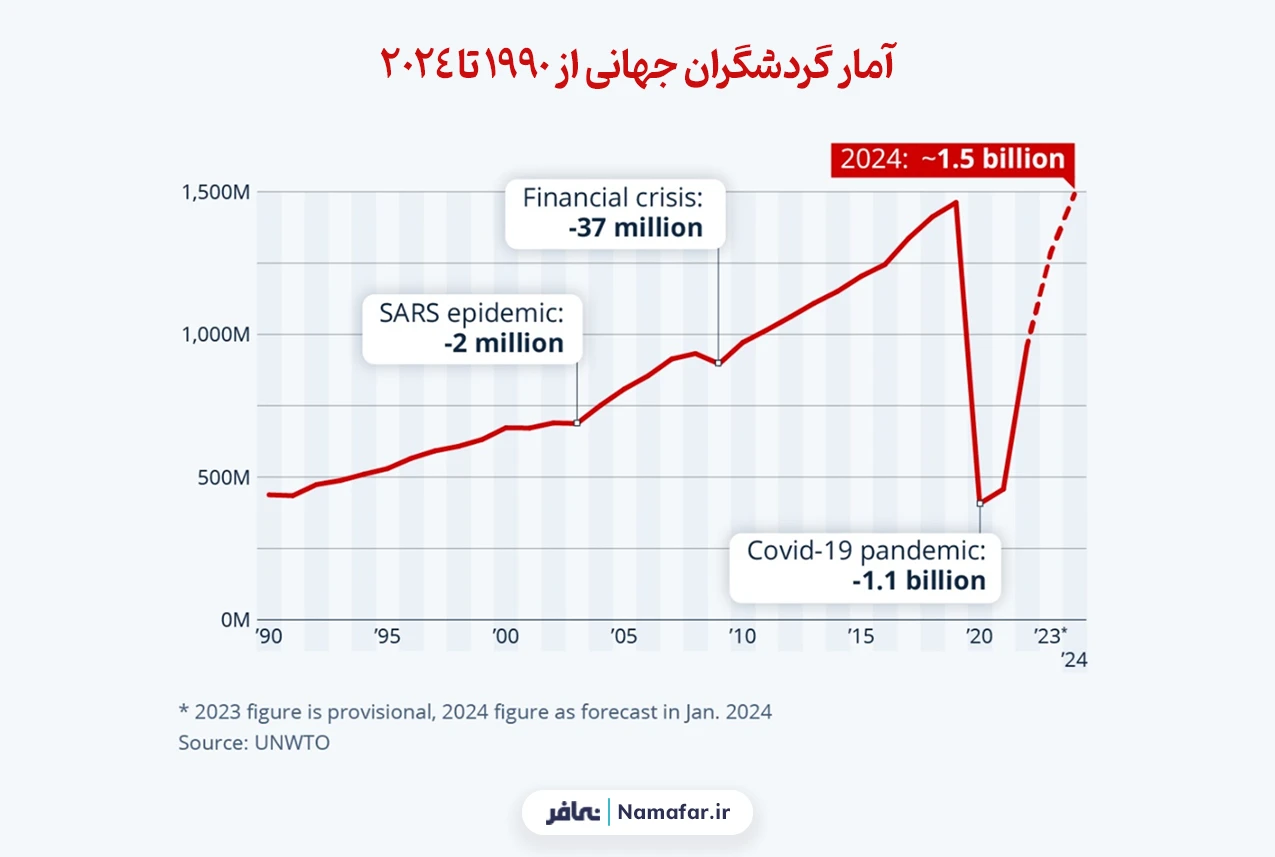
Figure 1 global tourist statistics from 1990 to 2024
The global map of overtourism
As noted earlier, overtourism has become a global phenomenon that has spread across the entire globe and is no longer limited to a few popular European destinations. By putting together the cities in which overtourism has been reported online we arrive at the map below. You see that across this entire earthly globe, from America to Europe and even Oceania, more than 90 destinations and over 60 countries have become involved in this destructive phenomenon. Although the real figure is higher than this, because many tourist-friendly villages and small areas in corners of the world, if they have become involved in overtourism, because of incomplete access to the media naturally cannot make the voice of their protest heard properly by others. It should also be noted that this figure is increasing every day.
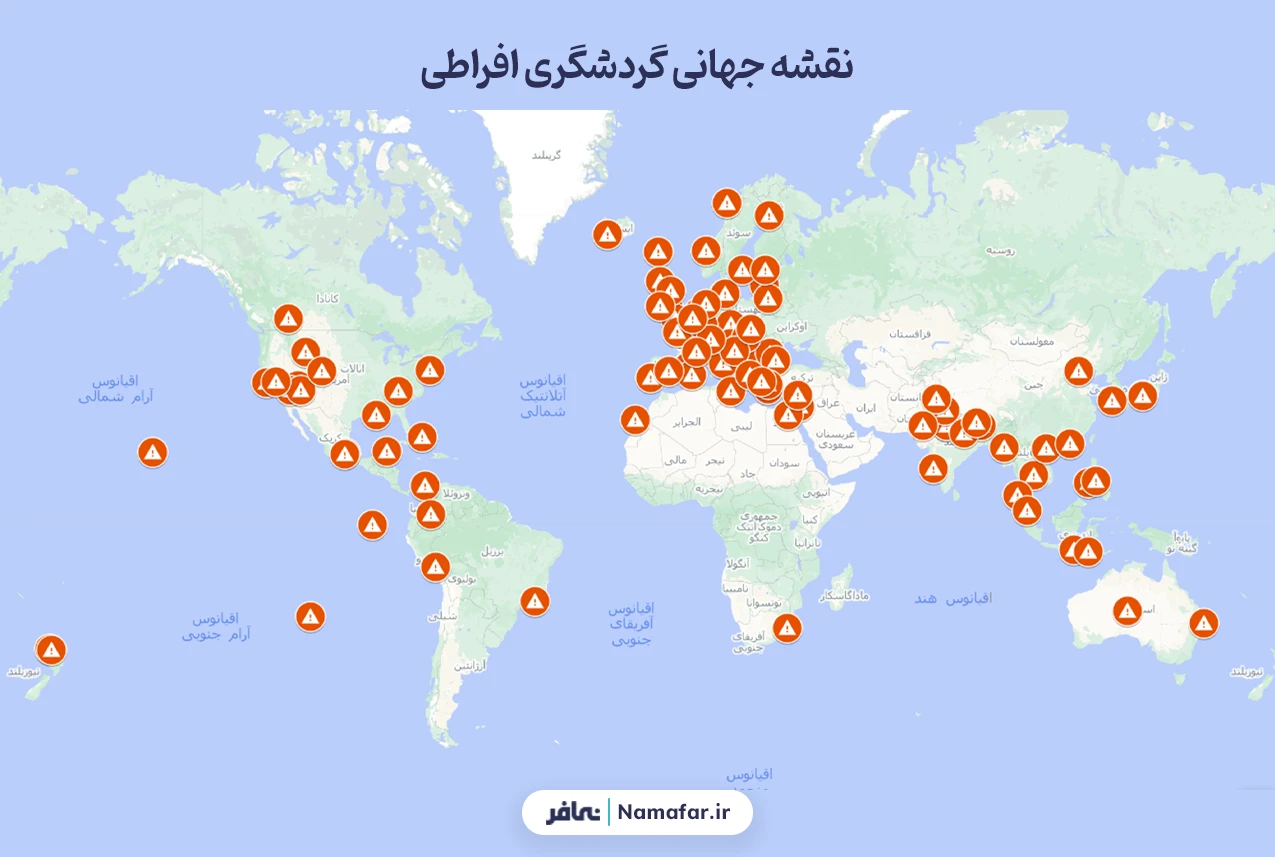
Figure 2 the global map of overtourism
Finding the causes of the overtourism phenomenon
On paper the cause of this phenomenon is very simple: the travel of a very large tourist population to only a handful of popular destinations. According to reported statistics, about 80 percent of global tourists travel to only 10 percent of tourist destinations, and this leads to overtourism. But when we look more closely at this issue we arrive at the question of how a very large population goes only to a limited number of destinations. The answer of most analysts here goes back to the issue of government governance in the field of tourism. Governments are always seeking the economic prosperity of their country, and tourism in this regard is a leading industry, so they draw on tourism for greater economic prosperity. The criterion of success of the tourism industry has always been the number of inbound tourists, the amount of foreign currency brought into the country, and ultimately the country's overall income from the arrival of foreign tourists. The problem is that none of these criteria include the benefit or harm of local people or even the environment. So governments, without regard to the problems created by tourism for local people or the environment, continue to develop it.
In the same vein, governments in fact help tourists enter their country, including by indirectly subsidizing airlines to create very cheap air travel, and also by not restricting sea travel with recreational-tourist ships (cruise ships). You may ask how very cheap air travel is possible. The global aviation industry in 1944 signed an agreement under the title of the Chicago Convention that gave them a tax exemption for aviation fuel. The results of this agreement have continued in such a way that in Britain, given the government's lack of follow-up and the absence of value-added tax, this agreement in practice leads to the government subsidizing these companies. In addition to untaxed fuel, there are claims that some governments, in order to attract more tourists, pay airlines to land in their countries.
Another factor in the rise of overtourism is the expansion of sea travel with recreational tourist ships known as cruise ships. These ships consume one of the cheapest and also most polluting diesel fuels, dubbed "bunker fuel". The use of this type of fuel is banned on land because of the pollution it creates for human health and the environment. Pollution standards for the automotive industry are very strict, but surprisingly in the cruise-ship industry it seems another standard governs. This situation helps the cruise shipping industry keep costs to a minimum and build more ships to attract tourists.
Given cultural and communications developments over the past ten years, analysts also list another cause for this phenomenon: the influence of new social media. Until twenty years ago there was no internet, but with the spread of the internet the sharing of news, photos and videos among all people became common, and this more than ever led to the introduction of tourist destinations and attractions to global tourists. Also, the spread of internet use meant that many of the arrangements for tourist trips could be made online and remotely with greater speed and ease, which has itself automatically helped the spread of tourism considerably.
European cities at the center of overtourism
Although overtourism is a global issue, this issue is more serious in some tourist-friendly regions such as Europe than in other parts of the world. The cities of Dubrovnik in Croatia, Venice in Italy, Bruges in Belgium and Barcelona in Spain are among the most important cities that suffer from the problem of overtourism. In the chart below you see the number of tourists per local resident, and this means that, for example, for every local resident in the city of Dubrovnik, 36 tourists have visited that city annually!
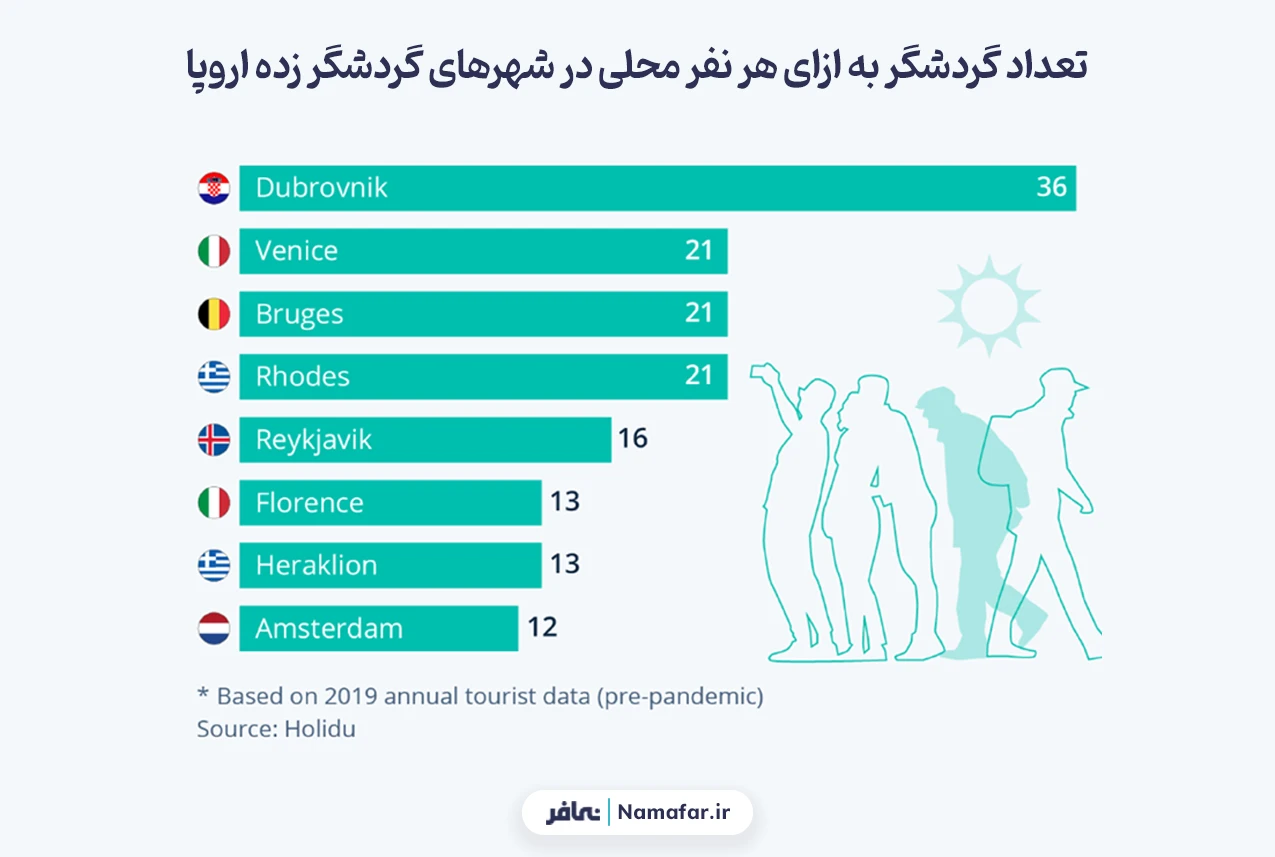
Figure 3 Number of tourists per local resident in overtouristed European cities
The two ugly and beautiful faces of film tourism for the city of Dubrovnik
As mentioned, the city of Dubrovnik is one of the most overtouristed European cities. A beautiful coastal city located in Croatia, famous for its historic castles and coherent ancient fabric. The growth of this city's tourism from the beginning of the twenty-first century had an upward slope, but one event multiplied this slope several times: the filming of a considerable portion of the popular series Game of Thrones in this city. Most of the open-location sequences of the royal seat (the King's Landing) were filmed in this city and made the best use of the fabric of its historic castles. This event, after the broadcast of the second season of this series in 2012, attracted a large volume of tourists to this city. As you see in the chart below, the rate of tourist growth in the five-year period of this series' broadcast compared with the previous similar period is more than five times greater.
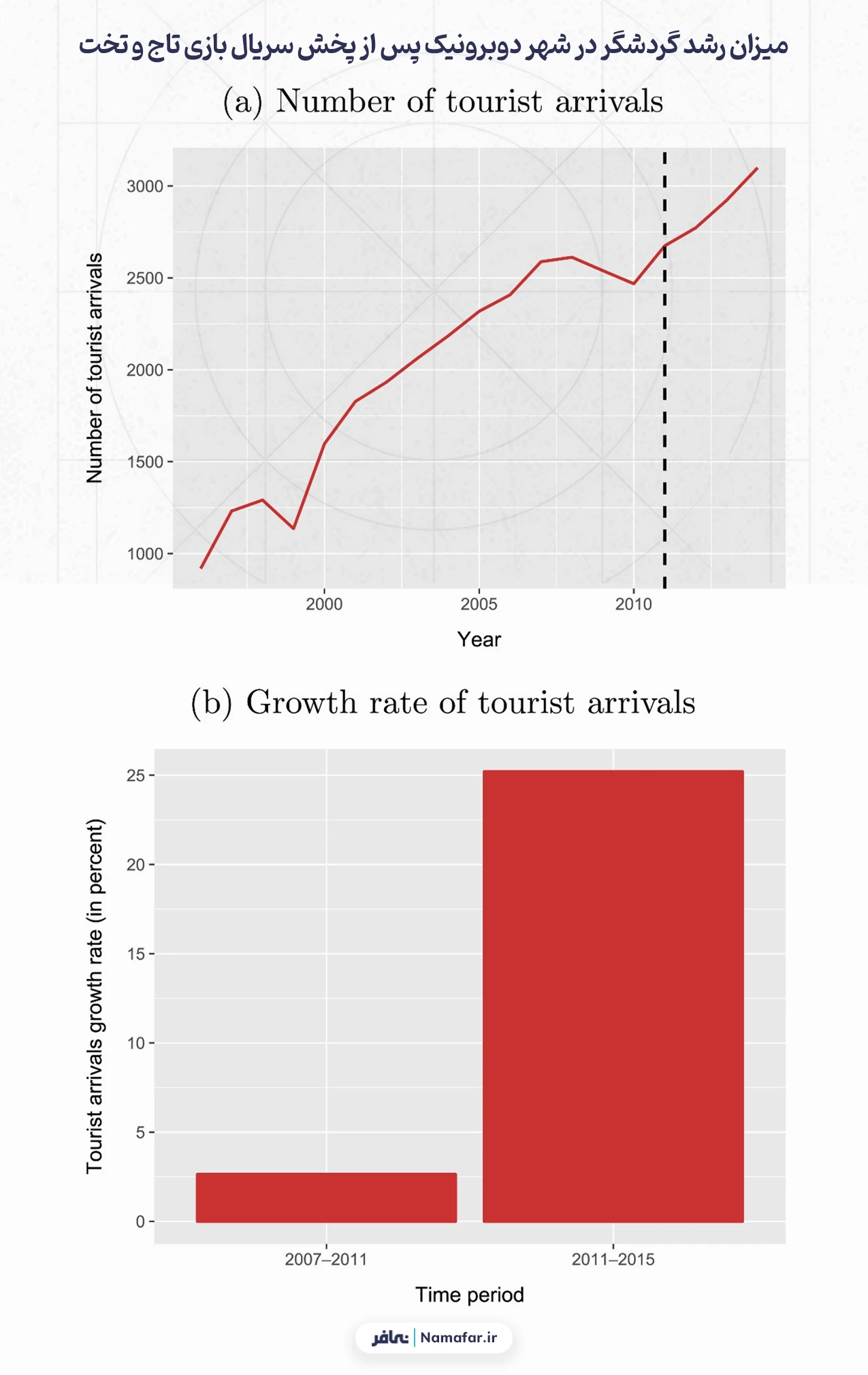
Figure 4 Rate of tourist growth in the city of Dubrovnik after the broadcast of the series Game of Thrones
At first, although this exponential growth of tourists was to the benefit of this city's economy and the country of Croatia, as this trend continued the city of Dubrovnik suffered from the problem of overtourism. In August 2016 more than ten thousand visitors bought tickets for walking on the famous walls of the city of Dubrovnik in a single day! This issue became so serious that UNESCO threatened to remove this city from World Heritage if tourism was not restricted, and fortunately since then policymaking for this city's tourism has had slow but fundamental changes. Analysts consider the main culprit of this situation to be the same two factors mentioned, namely very cheap air tickets that make travel to this city very easy, and also the frequent sea travel of cruise ships to this tourist-friendly city. Later in this note we will refer to the Croatian government's measures to control the tourist population.
The anger of Barcelona's Catalans at overtourism
Barcelona, with its excellent Mediterranean climate, a beautiful coastline along with abundant palm trees, cobblestone streets and its magnificent architecture, seems an excellent destination for tourists from Europe and around the world, perhaps too excellent. Barcelona's fame in tourism is not particularly old, because the tourism industry in this city only began its work in the 60s and 70s CE. It was hosting the Olympic Games in 1992 that turned this city into one of the main tourist destinations. Barcelona's tourist-attraction trend continued at great speed until little by little it reached the problem of overtourism.
Barcelona has the largest Mediterranean port within it, and this has led to the attraction of cruise ships to this city. In 1990 only 115 thousand passengers entered this port by cruise ship, which by 2017 had reached the astronomical figure of 2.7 million people. In 2019, because of the frequency of passage of this type of ship and the pollution resulting from them, Barcelona together with the port of Palma were labeled the most polluting European ports. Another problem with these passengers is that because they are traveling by cruise ship they stop in this city for one day or less, and because of their short presence they do not have much profitability for local residents and this city's economy. Also, because of tourists' abundant demand for hotel rooms in both legal and illegal hotels, house prices and rents in this city have risen and have caused serious problems for local residents.
But what has made overtourism in Barcelona a more serious problem than in other tourist-overrun destinations is nothing other than the intense and harsh reaction of the Catalans to this development. Catalans are not known as people who stay behind their front doors; they go into the streets and express their feeling. In many of this city's alleys signs of this discontent are seen, writings that tell tourists "go home" and "this is not tourism this is an invasion", giving Barcelona the label of a prison, and of course insulting wall writings including calling tourists terrorists or bastards. In 2017 masked protesters attacked a tourist bus and slashed its tires and wrote on it with spray: "Tourism kills the city and the neighborhood". Of course it must be said that the target of their protest is not tourists but the local government and its policies. In the chart below you see an opinion-survey of Barcelona's local residents. You see that over time those in favor of attracting more tourists have turned into opponents of it. The government of Catalonia, given the problems of overtourism and also public-opinion opposition, has programs underway to control tourists.
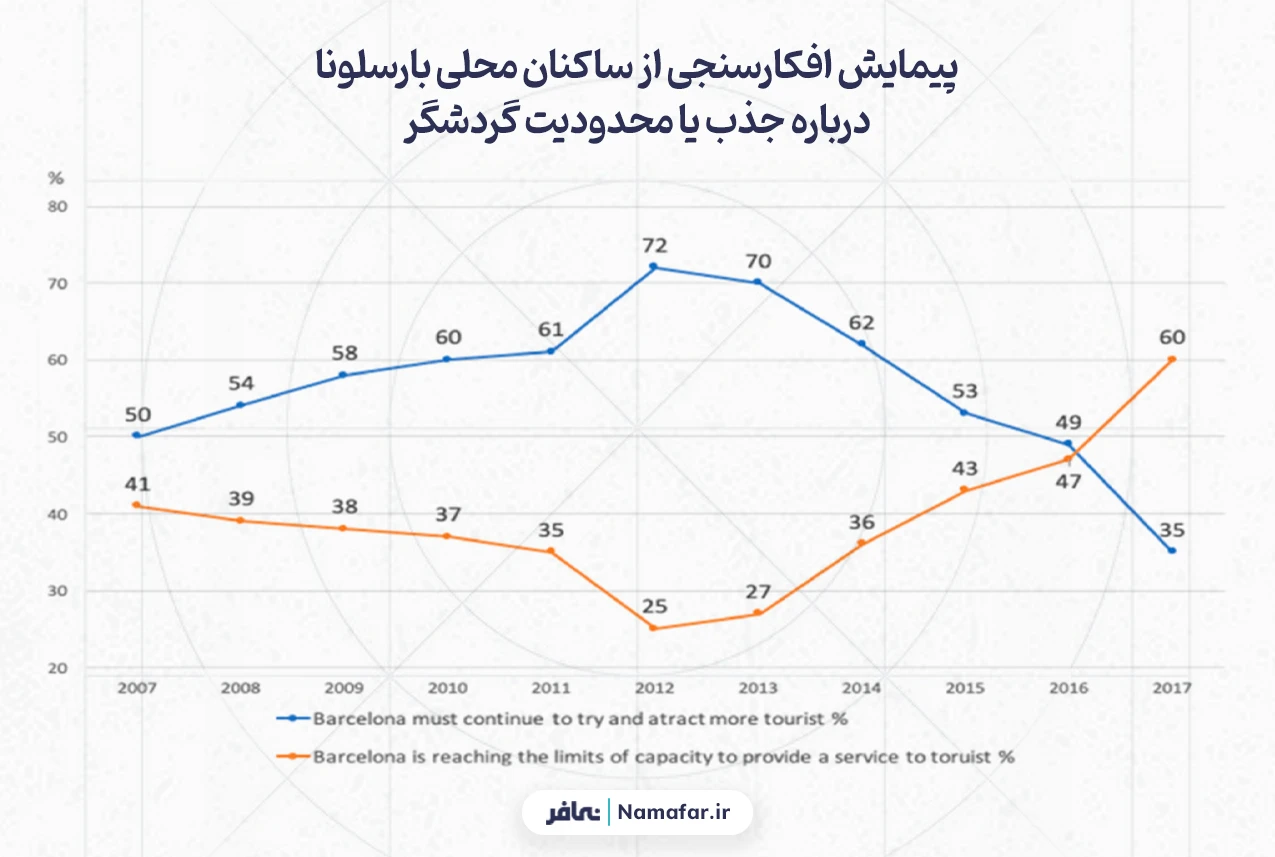
Figure 5 Opinion-survey of Barcelona's local residents on attracting or restricting tourists
Measures to prevent the phenomenon of overtourism
Given the exponential growth of global tourism, the destructive phenomenon of overtourism more than at any other time threatens tourist destinations; for this reason the World Tourism Organization (UNWTO) in its report on this phenomenon has proposed various solutions for moving toward solving this problem, the most important of which are: expanding tourism in the uncrowded times of the year, encouraging tourists to visit lesser-known tourist areas, reviewing and improving laws related to crowding and traffic, ensuring that local residents gain benefit from the arrival of foreign tourists, and educating tourists to travel responsibly.
In the same vein, governments in tourist-overrun countries have begun serious measures to counter overtourism: in the case of the city of Dubrovnik, which was examined above, after UNESCO's warning that this city's historical heritage was at risk and this organization's proposal for a limit of up to 8 thousand tourists on the city walls, the then mayor of Dubrovnik proceeded to install 116 surveillance cameras to count tourists at this location. Also, in order to reduce the population of cruise ships to one-fifth, their anchorage was restricted in terms of time and also a passenger ceiling of at most 5 thousand people.
In the city of Barcelona the former mayor carried out fundamental measures to curb overtourism, such as: limiting the number of permitted hotel beds in the city, banning the opening of new hotels in the historic center, and opposing the expansion of Josep Tarradellas Barcelona-El Prat Airport, which if carried out would raise the city's air arrivals from 50 to 80 million. Recently this city has imposed a tax on cruise-ship passengers that must be paid in addition to the overnight-presence tax of each tourist in this city. These tax revenues are directed toward local projects. In March 2023 it was announced that 5 million euros in proceeds from the tourism tax had been invested in 39 urban projects.
Among other measures taken in this direction over the past year, further cases can be mentioned such as: a ban on cruise ships by the municipality of Amsterdam, raising the tourism tax in this city to 12.5 percent (that is, the tourist must pay this much more than local people for hotels and other tourism services), the imposition of a ten-dollar tax by the government of Indonesia on tourists to Bali, and the approval of a five-pound tax in Venice for tourists who want to stay in a hotel.
Conclusion
The tourism industry is one of the fastest-growing sectors of the creative industries, but anything if it grows beyond its capacity causes disruption, and this is what is happening for some tourist destinations. In this note we have tried to acquaint you with the different angles of the overtourism phenomenon and to speak of it from its history to its problems. This phenomenon, although it is itself considered negative, has a positive origin. If the necessary preventions are undertaken by all parties, this problem is treatable. But if a city becomes involved in it it should not fear it, because this issue is controllable in the short term and solvable in the long term, but this outcome requires a collective effort from governors to local residents and also tourists.
Author: Ali Rezasoltani
Short link: nmfr.ir/2gw
Machine-translated from Persian by Namafar; the Persian original is authoritative. Read the original in Persian