In order to carry out a comprehensive analysis of the economic impact of the video game industry in the United States in 2023, the Entertainment Software Association (ESA), in cooperation with TEConomy, has prepared a comprehensive analytical report on the video game industry and its megatrends in the world and the United States in the past calendar year [1]. Most of the present note is a translation and summary of the explanations, figures, and specified megatrends of that report. The video game industry has experienced remarkable growth in recent years. This upward trend not only continued in 2023, but according to forecasts, in the period from 2024 to 2027 it will also continue to grow at an average annual rate of 8.7 percent. Given this substantial growth rate, total industry revenue is expected to reach the striking figure of $363 billion by 2027. It is worth noting that this growth rate is far higher than the forecast growth rate for the overall entertainment sector (2.8 percent) over the same period.
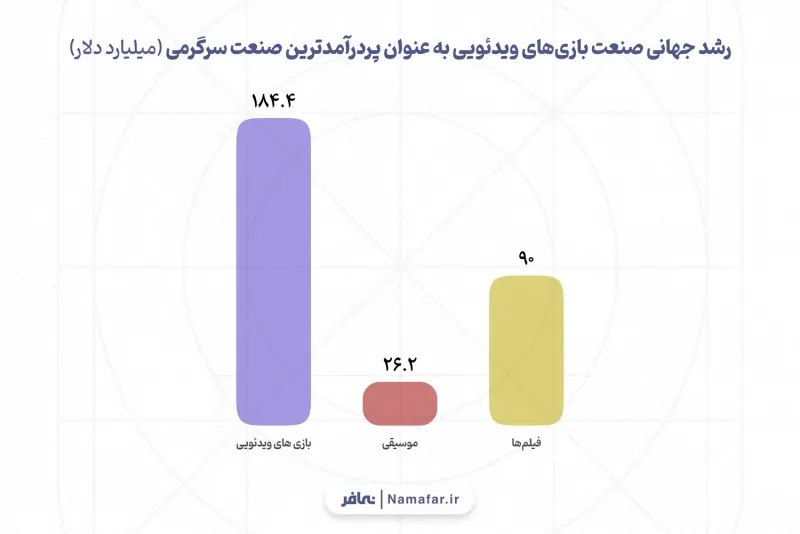
The globalization of trade and extensive facilities in the field of international trade have brought about dramatic changes in the video game industry. One of the most important results of these changes has been the remarkable expansion of this industry's user base and service recipients around the world. The substantial increase in demand for video games has made this industry the highest-earning sector of the entertainment industry, such that its revenue has surpassed the combined revenues of the music and film industries. An examination of statistical data shows that video game industry revenue has grown extraordinarily over the past half-century and has almost tripled. This industry, which in the 1980s had revenue of $59 billion, reached revenue of about $184 billion at the end of 2023.
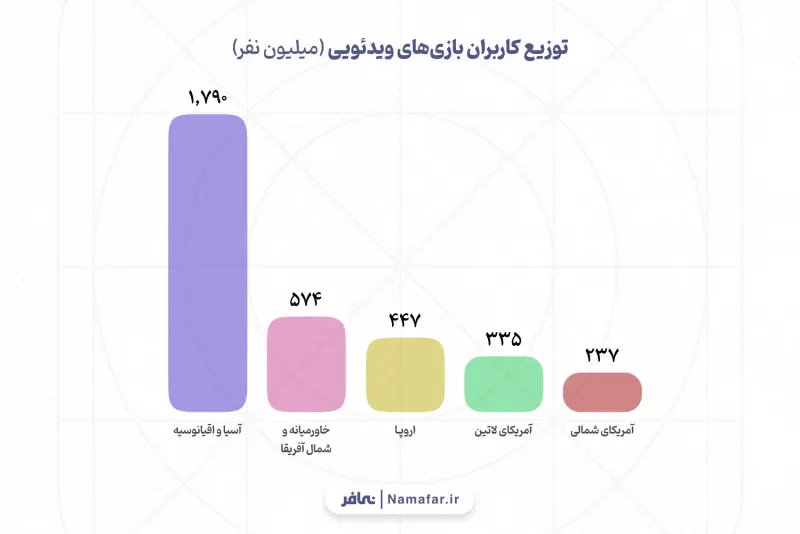
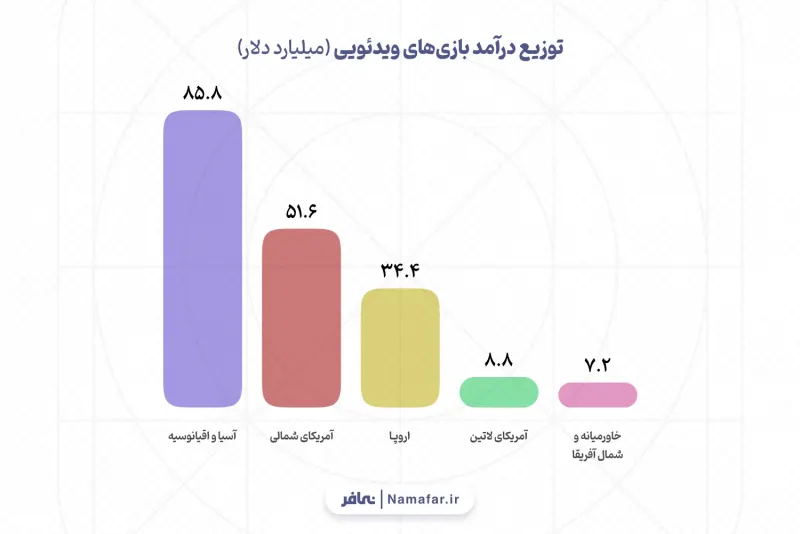
In the global distribution of video game audiences, according to the latest 2023 statistics, the Asia-Pacific region, with 46 percent of global video game industry revenue (worth $85.8 billion), is still recognized as the largest market for this industry. After Asia-Pacific come, respectively, North America with 27 percent ($51.6 billion), Europe with 18 percent ($34.4 billion), Latin America with 5 percent ($8.8 billion), and the Middle East and North Africa with 4 percent ($7.2 billion). Another noteworthy point is the Asia-Pacific region's dominance of more than half (53 percent) of the world's total video game audience, with 1.79 billion players. In a striking development, the Middle East and North Africa region, with 17 percent of the market share (574 million users), has been recognized as the second-largest region in terms of the number of players. This region has been able to overtake traditional game markets such as Europe with 13 percent (447 million users), Latin America with 10 percent (335 million users), and North America with 7 percent (237 million users).
The video game production industry in the United States
In June 2024, the Entertainment Software Association reported that 190.6 million Americans aged 5 to 90 are engaged with video games, and 61% of the US population spend at least 1 hour a week on video games. The video game industry, with such a growing increase in the number of users, has brought extensive economic effects alongside the development of new technologies. The US video game industry, as an economic engine, has had a substantial share in job creation and economic growth in that country in past years. According to the latest statistics, this industry has created more than 350 thousand direct and indirect jobs and has injected more than $101 billion into the US economy. This high-value-added industry has added nearly $66 billion to US GDP, which indicates its central role in economic prosperity and sustainable development; in other words, every dollar invested in this industry has returned several times over to the national economy. The national employment impact multiplier of this industry has also been estimated at 3.36, which indicates its considerable effect on job creation at various levels of the economy. The average annual income of those employed in this industry is a substantial figure, equivalent to $168 thousand. Of course this figure differs across different parts of the industry and ranges from $67 thousand and 500 in the retail sector to $197 thousand in the software sector. The economic effects of the video game industry have extended to the entire United States, including Washington, D.C., and Puerto Rico. This shows that the video game industry plays an important role not only in major technology centers, but also in various regions of the country.The video game industry of the United States of America plays an undeniable role in job creation and wealth production in that country. Studies show that the direct creation of 104,080 jobs in the US video game industry in 2023 had a considerable multiplier effect on employment growth in the national economy. In other words, this industry has acted as a driving engine and has also led to job growth in other sectors of the economy. Accordingly, each direct job in this industry has on average led to the creation of 2.36 additional jobs in other sectors of the economy. This multiplier effect is mainly due to the extensive supply chain of the video game industry, the need for support services such as marketing and advertising, and also increased demand for leisure-related goods and services. For example, developing a new video game requires a wide range of specialties including programming, graphic design, music, and sound, each of which leads to the creation of new jobs. Also, the success of a video game can lead to increased sales of game hardware, accessories, and other related products, which in turn leads to job creation in the production and distribution sectors. From a GDP perspective, each dollar produced in the video game industry has on average added $1.17 to the country's total GDP. These findings indicate that the video game industry plays an important role in strengthening the US economy.

The dominance of smartphone-based games
Forecasts show that the number of video game players in the world in 2026 will reach the substantial figure of 3.79 billion people. This striking growth indicates the ever-increasing popularity of video games around the world. Mobile games continue to be recognized as the most popular gaming platform and have accounted for 84.4 percent of market share. By contrast, PC games and game consoles stand in the next ranks with 26.3 percent and 18.6 percent of market share, respectively. Studies show that the share of mobile games in total game industry revenues in 2023 increased substantially and reached 72 percent. This finding indicates that mobile games continue to live on as one of the profitable and popular segments of the games market. Studies conducted show that the industry under review, in the period from 2022 to 2023, experienced considerable growth in its key performance indicators. A 44 percent increase in sales and a 22 percent increase in the number of users indicate that this industry has been able to adapt successfully to changing market conditions and continue on its path of sustainable growth.The digital platform for video game distribution
The number of game customers and paying users of video games will also see considerable growth. According to forecasts, this number in 2023 will reach 1.47 billion people, which indicates a 7.3 percent increase relative to the previous year. It is also expected that by 2026, the number of customers will increase to 1.66 billion people, which indicates a compound annual growth rate (CAGR) of 4.7 percent. The video game industry, under the influence of technological transformations and government policymaking, is experiencing accelerated changes. The COVID-19 pandemic, while it confronted many industries with challenges, provided an unmatched opportunity for the video game industry. This industry was not only resilient in the face of restrictions arising from the pandemic, but also experienced considerable growth with a striking increase in digital game sales. Video games, as an attractive alternative for entertainment during lockdown, were widely welcomed, and as a result, user participation through mobile phones increased substantially.A comparative comparison of the video game industry and e-commerce during the global pandemic shows considerable similarities in the growth and development trends of these two fields. The striking expansion of technology adoption in both industries has led to an unprecedented increase in the volume of digital payments. While e-commerce, by creating major transformations in facilitating transaction processes, has played a substantial role in shaping the digital economy, the mobile game industry, relying on in-app payment models that were already embedded in it, has continued its ongoing growth. Forecasts indicate that by 2027, about 28 percent of all electronic financial transactions worldwide will be carried out instantly. This indicates considerable annual growth equivalent to 63 percent in this field. The PIX digital payment system can be introduced as a successful example of a low-cost and efficient QR code-based payment system in this industry.

With the spread of e-commerce, the distribution of video games has also been transformed. As with other goods and services, the shift to a digital platform has facilitated the global distribution of video games and produced striking growth in this industry. The emergence of online stores and digital marketplaces has removed existing barriers in the international trade of game software and made it easier for users around the world to access new games. By eliminating limitations such as dependence on physical media, high transportation costs, and the imposition of regional locks on games, limiting software theft and the illegal use of video games, digital markets have made easier, more inclusive, and faster access for gamers to new products possible. As a result, considerable growth is observed in the global trade of video games, which has been to the benefit of producers, distributors, and especially users.
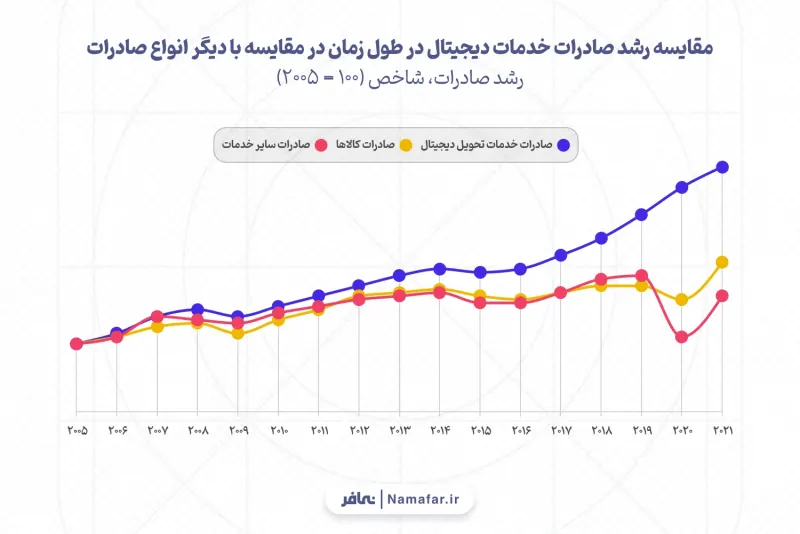
Exports of digital services have in recent years grown faster than other exports. The chart below was created to compare the growth of digital services exports with other types of exports over time. This chart shows the export growth index. The number 100 is taken as the base in 2005. Any number higher than 100 indicates export growth relative to 2005. If the line related to digital services exports has a steeper slope than the other lines, it shows that this type of export has experienced faster growth; this difference results from greater growth in digital services exports compared with other types of exports [2].
The video game-based content production chain
With the ever-increasing expansion of the video game industry at the global level and the increase in its number of users, demand for content related to video games has also grown strikingly. The emergence of phenomena such as streaming, content production, games journalism, and especially esports has added to this growth. Popular games such as Fortnite and League of Legends have attracted a huge fan base that, in addition to the game experience, also enjoys watching professional matches. This interest has led to the holding of large esports events that meet with unmatched audience reception. For example, the latest League of Legends world championship, by attracting more than 6.4 million concurrent viewers, has set a new record in the history of esports. This event shows that esports has become a large and influential industry and has been able to attract a wide audience around the world.Popular events in the field of video games and the live broadcast of matches create substantial sources of revenue through sponsorship, advertising sales, tickets, and image rights. This has led to the formation of the esports industry, which enables professional players to earn a living from this activity as a full-time job. With the striking increase in cash prizes in various tournaments, which have at times reached $30 million a year, esports has become a competitive and profitable arena. Players who succeed in joining professional teams and appearing in reputable leagues can benefit from considerable financial advantages.
The rapid growth and globalization of the video game industry have provided a suitable platform for the development of esports. In other words, the broad and integrated video game market has created a dynamic cycle in which revenues from competitions have led to higher quality and greater attractiveness of these events and, as a result, bring more income for professional users. Also, content-sharing platforms, because of the existence of a broad audience interested in video games at the global level, are able to offer lucrative contracts to content creators. These creators act as an important source of revenue for the platforms and make possible the sale of targeted and efficient advertising as well as earning income through paid subscriptions. An analysis of data related to the 25 top channels on the Twitch streaming platform in 2023 shows that channels focused on video game content have gained the greatest popularity among this platform's audience. Also, these channels have had striking cultural diversity and include representatives from a wide range of different nationalities and languages of the world [4].
Also, a study conducted by the Pew Research Center [5] shows that online platforms, especially Discord and Twitch, play a central role in adolescents' social interactions around video games. The findings of this research indicate that 44 percent of adolescents who are interested in video games actively use the Discord platform. This figure is substantially higher than for other age groups and people who show no interest in video games. In fact, about 28 percent of all adolescents in the statistical population under review use Discord as a communication platform. Also, 30 percent of adolescents interested in video games have said that they use the Twitch platform. This is while this figure for other age groups is far lower, at about 17 percent. These results clearly show that Discord and Twitch are used as the two main platforms for adolescents interested in video games to communicate, exchange information, and create online communities around video games.

Remote work by production personnel employed in the video game production industry
One of the growing trends in the video game production industry is the increase in remote work by those employed in it. 18,000 people (17 percent of total employment in this industry in the United States) in 2023 worked in a hybrid manner or fully remotely. This indicates companies' growing inclination to adopt more flexible work models and employees' adaptation to this new way of working. After the lifting of communication restrictions affected by the coronavirus pandemic, despite the return of many companies to the traditional on-site way of working, a substantial part of the video game industry has turned to more flexible work models. These models include a combination of in-person work and remote work, or fully remote work. In the remote-work model, employees work full-time or almost full-time from their place of residence and do not necessarily need to be physically present at the company's headquarters or studios. Studies conducted on the US video game industry database show that a considerable number of small companies in this industry operate fully virtually and without having a physical office. This indicates a striking transformation in how business is organized and managed in the video game industry.Artificial intelligence and the trend ahead for the video game industry
The integration of artificial intelligence into the game-making industry is also accompanied by complex challenges; among them, one can point to the need to create a balance among technical innovations, ethical requirements, and commercial interests. While the value of this industry reaches about $200 billion, widespread workforce reductions have been witnessed in recent years. This has created concerns about the impact of artificial intelligence on employment in this sector. Although under US laws related to intellectual property rights, every produced work must have at least one human agent in order to be covered by intellectual property rights, news coming out of large game-making studios indicates the dismissal of a group of art designers and concept artists employed at those companies. According to estimates, in 2023 about 10,500 people in the video game industry lost their jobs. This trend has also continued in the current year, and so far 11,000 more people have also been laid off [6]. Companies such as Microsoft have also moved to close game-making studios. The growth of generative AI systems has created concerns about the replacement of human jobs in various industries. The game industry is no exception to this rule. The economic power of this industry, a similar and at times identical technological base, and the absence of a strong union representing its labor force have made this sector an attractive option for the penetration of artificial intelligence. Recent studies show that content production by artificial intelligence has made the boundaries of intellectual property more ambiguous and has made the necessity of drafting clear legal and ethical frameworks more evident than ever. As a result, regulators in this field and the managers of developer companies are obliged, by drafting precise and comprehensive strategies, to manage these challenges effectively so that they also clear this industry's path of economic growth in the future of challenges and facilitate it.Author: Mohammadreza Qata
Sources:
| [1] | M. Grueber and D. Yetter, "VIDEO GAMES IN THE 21ST CENTURY: The 2024 Economic Impact Report," TEConomy Partners, LLC, The Entertainment Software Association, 2024. |
| [2] | . Available: https://www.cato.org/publications/how-global-markets-helped-video-game-industry#global-digital-goods-markets-made-video-games-easier-acquire. |
| [3] | "Global Trade Outlook and Statistics," World Trade Organization, 2023. |
| [4] | " Most Watched Twitch Channels—Stats and Analytics," 27 03 2023. . Available: https://sullygnome.com/channels/2023/watched. |
| [5] | . Available: https://www.pewresearch.org/internet/2024/05/09/teens-and-video-games-today/. |
| [6] | . Available: https://www.wired.com/story/ai-is-already-taking-jobs-in-the-video-game-industry/. |
Machine-translated from Persian by Namafar; the Persian original is authoritative. Read the original in Persian