Distinctive features of travel and stays in Iran’s provinces
Tourism cannot be defined merely as the movement of people from one destination to another; it must be regarded as a multilayered phenomenon that has a complex entanglement with the economy, geography, climate, culture, social structures, and even politics. A region’s capacity to host tourists is not measured only by the number of accommodations or natural attractions; it takes shape in connection with everyday ways of life, leisure consumption patterns, physical structures, and even macro management decisions. For that reason, studying tourism at the provincial level requires a view that moves beyond raw statistics and shows how each province’s distinctive features, in interaction with economic and social conditions, produce different patterns of travel and stays. In this regard, the present note, with a data-driven approach, has examined different patterns of travel and stays in the provinces of Isfahan, Alborz, Tehran, Mazandaran, and Gilan.
Diversity of accommodations and lodging infrastructure in Isfahan: from caravanserai to hostel
One of the fundamental indicators in leading tourism destinations is the range of choice in lodging, because differences in travelers’ financial means and preferences require that a diverse basket of accommodation services be provided. Isfahan Province is a prominent example in this regard, and statistics show that at least ten different types of accommodation are active there. Traditional accommodations, with 639 units, and apartments, with 447 units, have taken the largest share, while ecolodges, villas, and suites also have a notable share, and more particular types such as caravanserais and cabins complete this mix. This wide spectrum indicates that Isfahan’s lodging infrastructure has been able to adapt itself to diverse patterns of demand. Therefore, the structural diversity of accommodations in this province is not a side feature, but a reflection of the mutual link between the growth of tourist demand and the capacity to consume lodging services.
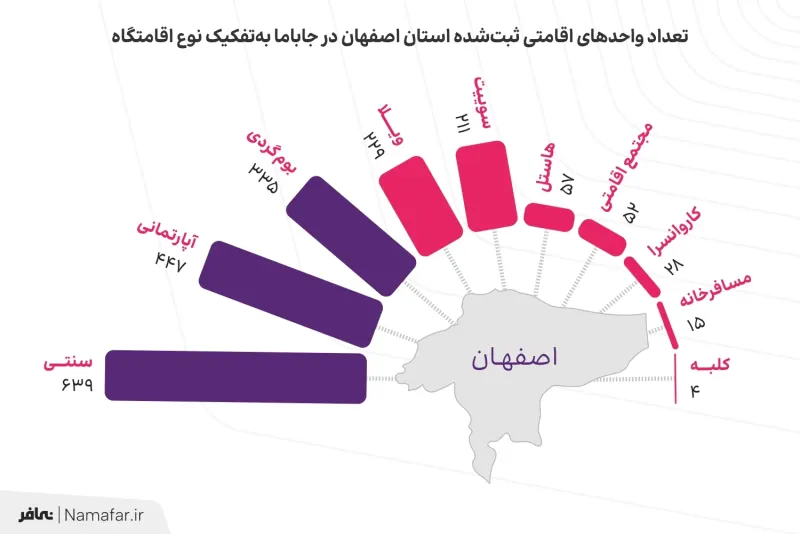
Another important dimension in examining lodging infrastructure is the pattern of their geographic distribution at the provincial level. The data show that 42 cities in Isfahan have accommodations registered on the Jabama platform, and in this respect Isfahan Province ranks third after Gilan and Mazandaran, a fact that well traces the spatial span of tourism services. Although the main concentration, with about 875 units, has taken shape in the city of Isfahan, other cities have also been able to actualize a share of their capacities and have an effective presence in the supply of lodging services. Such a pattern, compared with many of the country’s provinces, indicates a more favorable situation, because the network of accommodations in Isfahan has gone beyond sole centrality of the provincial capital and has taken on provincial dimensions.
Why is Alborz one of Iran’s most important tourism destinations?
Unlike provinces such as Isfahan that encompass every kind of accommodation and tourism function, Alborz Province is used mainly for a particular kind of experience. The data show that more than 92 percent of registered accommodations in this province are villas, and nearly 70 percent of them are also located in rural settings. This intense concentration indicates that Alborz’s main function is not in providing a diverse set of tourism services, but takes on meaning in providing a setting for short-term weekend leisure in the form of a villa stay. In this way, the weekend pattern in Alborz is a combination of seeking seclusion, intimate togetherness, and quick access to surrounding nature; a pattern that shows leisure consumption in this province occurs mainly as a “short escape from the city” in the form of a rural villa.
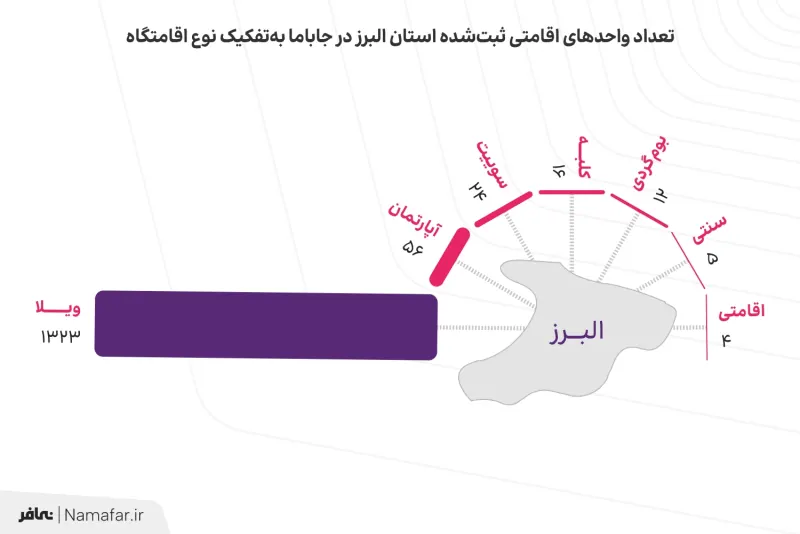
This predominance of villas is rooted in a set of sociological factors. First, the time compression of leisure in neighboring metropolises (fast-paced living and work) directs demand toward short-range trips; Alborz’s rural villas fit exactly with this time constraint. Second, the norm of privacy and a preference for less-supervised spaces for family/friend groups makes the villa more attractive than public accommodations and makes “domestic rituals” (get-togethers, cooking, music) possible. Third, a shared-cost economy creates a decisive advantage; when the cost of one unit is divided among people, quality leisure is experienced at a more bearable price. Fourth, the symbolic meaning of nearby nature, especially in green and quiet rural settings, is consumed as a counter-image of urban everyday life and forms part of the lifestyle distinction of the middle-income classes. Fifth, the structural supply of villas (garden houses and second homes that have entered short-term tourism) has been turned into a coherent market by booking platforms and has been consolidated by a feedback cycle of reviews and ratings. Therefore, the predominance of the rural villa in Alborz is not merely the product of taste; it is the simultaneous result of time constraints, privacy norms, group economic logic, and the configuration of supply, and it is this entanglement of supply and demand that defines the weekend leisure pattern in this province.
Tehran’s accommodations: a temporary place for work, administrative, and medical affairs
The configuration of lodging supply in Tehran shows that the dominant function of this market is “temporary stays for work, administrative, and medical affairs,” not recreational family travel. In the data, about 82 percent of registered units are of the apartment type and the average capacity is 2.4 people; a combination that, instead of family groups, responds to single-person or two-person demand and is consistent with the pattern of short-term stops, proximity to service centers, and flexibility in scheduling. In other words, Tehran’s lodging market, more than being experience-based and recreational, is “service-based” and plays an infrastructural role in meeting the overnight needs of urban visitors.
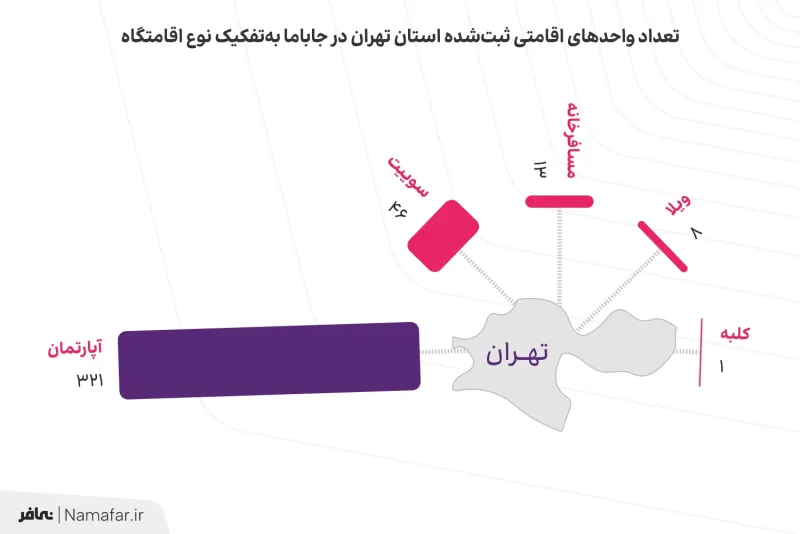
This same service-based nature is rooted in Tehran’s low pull for recreational tourism. The concentration of administrative and economic roles, the time costs of movement and traffic, unstable environmental quality, and the constraints of the night-time economy raise the “cost of experience” for the tourist and reduce the desirability of staying. In contrast, surrounding provinces (Alborz, Mazandaran), with quick access to nature and leisure facilities, become destinations for weekend escapes. The result is that Tehran, more than being an “entertainment destination,” remains a “functional destination”; an occurrence that mutually reinforces both the demand side (a preference for short and small stays) and the supply side (the predominance of low-capacity apartments).
The north’s full lodging basket: villa, cabin, apartment, suite, and more
A statistical review of accommodations in Gilan and Mazandaran provinces shows that these two provinces are nationwide leaders both in number and in lodging diversity. Villas, with more than 2,600 units in each province, have formed the main pillar of the north’s lodging infrastructure, but the share of other types is also notable: in Mazandaran, 866 cabins and 701 apartments have been registered, and in Gilan, 702 cabins and 559 suites. The presence of ecolodges, accommodation complexes, and even traditional units and inns shows that the north’s lodging basket fully covers different ranges of demand. This quantitative and qualitative span has made the north of the country the only area that simultaneously has both the capacity for short-term weekend trips and the possibility of longer and more diverse stays.
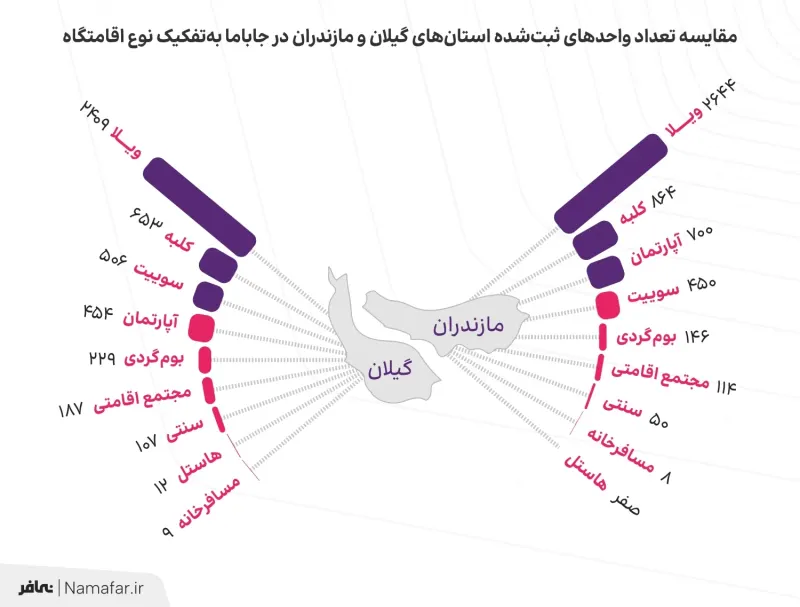
The tourism features of Gilan and Mazandaran must be analyzed in the relation among nature, leisure culture, and the structure of demand. Climatic diversity from coast to forest and mountain, together with geographic proximity to metropolises such as Tehran, has turned these two provinces into the main destination of weekend trips. At the same time, the high capacity of villas and family accommodations also makes longer stays possible for tourists who are looking for deeper experiences. From a sociological perspective, the leisure pattern in the north rests on two axes: first, a “quick escape” to nature for urban middle classes who need distance from the pressures of everyday life; second, “longer stays” for groups who choose travel as part of a lifestyle or as a symbol of consumption distinction. Therefore, the tourism structure of these provinces has been well able to accommodate the dual demand for short-term and long-term stays.
From a policymaking perspective, the place of Gilan and Mazandaran in the country’s tourism brings both opportunity and challenge. The opportunity is that the existence of a diverse and extensive network of accommodations has turned these two provinces into a driving engine of the domestic tourism industry; but the challenge lies in the point that excessive concentration of tourists in limited coastal and forest areas puts considerable pressure on natural resources and urban infrastructure. In these conditions the policymaker, instead of relying on purely quantitative growth, must attend to managing the spatial and temporal distribution of tourists, standardizing lodging services, and supporting sustainable ecolodge patterns. Only in that case can the high capacity of the north’s accommodations lead, instead of to the erosion of resources, to balanced and sustainable development of the country’s tourism.
Iran’s lodging market: a multicenter network and a feedback of supply and demand
The upshot of the data shows that Iran’s lodging market is a “multi-type system” that takes shape on three axes: the purpose of travel (experience-based recreation versus service-based function), the time horizon (short-term escapes versus longer stays), and the level of privacy/capacity of the unit (group villa spaces versus low-capacity apartments). In this system, some destinations, with high diversity of types, have reached structural maturity and build a comprehensive basket for different ranges of demand; others, with the predominance of one type (for example villas), become “specialized leisure destinations” for the weekend; a group of places, by way of small, low-capacity units, play the role of “passing service nodes”; and a category also, in a two-sided way, covers both short trips and long stays. These patterns are the simultaneous product of proximity to metropolises and limited leisure time, privacy norms and group consumption, physical stock and the possibility of platformizing supply, and also environmental and transport constraints. In this way, the country’s tourism is not a set of isolated points, but a multicenter network with supply–demand feedback loops in which a change in one of the axes—purpose, time, or privacy—quickly transforms the makeup and mix of accommodations at the destination.
Final word
On this basis, efficient policymaking in tourism must distance itself from the logic of national one-size-fits-all and move toward governance based on destination type and sensitive to time and place. In this framework, several key axes can be put forward.
- Official classification of destinations by function (comprehensive, specialized, service, or two-sided) and tying permits and incentives to this ranking.
- Managing short-term peak travel with tools such as scheduling, peak pricing, and distributing the tourist load across different zones
- Standardizing quality and safety in villas and low-capacity apartments through minimum protocols, an insurance system, and complaint-handling mechanisms
- Regulating platforms and establishing data governance with a requirement to share anonymized demand data, issuing dynamic permits, and designing a fair tax system
- Protecting the environment and managing carrying capacity through lodging zoning, a cap on development, and control of resources such as water and waste
- Empowering local communities with training in hospitality skills, providing microloans for upgrading and safety, and creating mechanisms for participation in benefits. Such a package can put economic, social, and environmental benefits on a par and make the country’s tourism network more sustainable, more balanced, and more responsive.
Machine-translated from Persian by Namafar; the Persian original is authoritative. Read the original in Persian