Britain is renowned worldwide for its vibrant creative industries; blockbuster films and television shows, popular music, video games and more have made Britain one of the leading players in the world's creative industries. The creative industries, generating more than 100 billion pounds in revenue and more than 2 million jobs annually, are one of the main drivers of economic growth in Britain. In these circumstances, the British government has unveiled an ambitious new strategy for achieving greater growth in the creative industries over the next decade, called "Britain's Vision 2030 for the creative industries."
High growth of the creative industries compared with other industries
Britain's creative industries have grown 32 percent in recent years and, between 2010 and 2019, grew more than 1.5 times the British economy's 20 percent growth rate. Thanks to government support measures such as 1.57 billion pounds of support from the Culture Recovery Fund, this sector weathered the storm of the COVID-19 pandemic. With activity in most creative fields returning to pre-coronavirus pandemic levels, the conditions are now in place to realize these industries' full growth potential in the future, and Britain's Creative Industries Vision 2030 has been presented as a strategy to answer this need.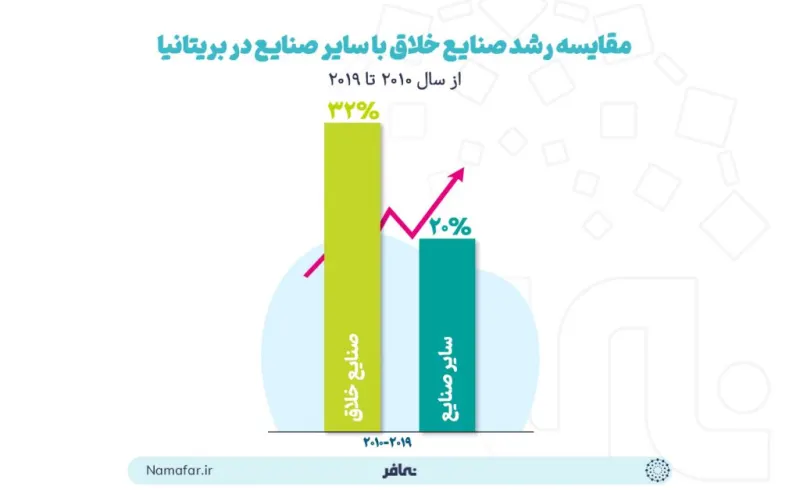
Britain's creative economy by occupation
The number of people employed in the various sectors of Britain's creative economy is 3.5 million, which includes 1.19 million non-creative jobs in the creative industries, 1.02 million creative jobs in the creative industries and 1.02 million creative jobs in non-creative industries. The creative industries act as a hub for creative effort; in these industries, a mix of creative and non-creative jobs exists in a coordinated way that creates a unique environment and drives economic growth. As a result, the breakdown of employment in the creative economy emphasizes the coordination between creative and non-creative roles. The collaborative nature of the workforce, together with its abundance and specificity, displays the dynamism of creative jobs.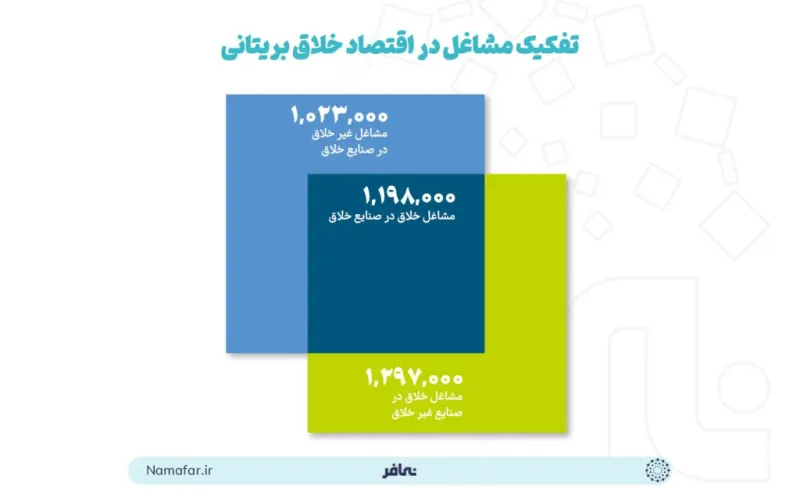
Gross value added of the creative industries
A look at the share of gross value added of the creative industries shows that information technology, software and computer services, with 6.44 million pounds, account for the largest share. This indicates the importance of digital technology skills in the creative industries. The film, television, radio and photography cluster, with 4.17 million pounds, has been the second-largest creative sector and has significant cultural, economic and employment effects. Advertising and marketing with 19.7 million pounds, music, performance and visual arts with 8.3 million pounds, and the publishing industry with 11.4 million pounds occupy the subsequent places.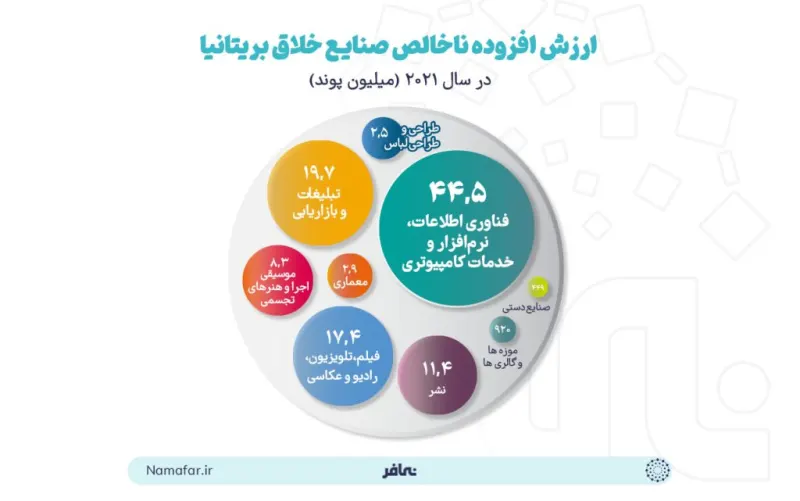
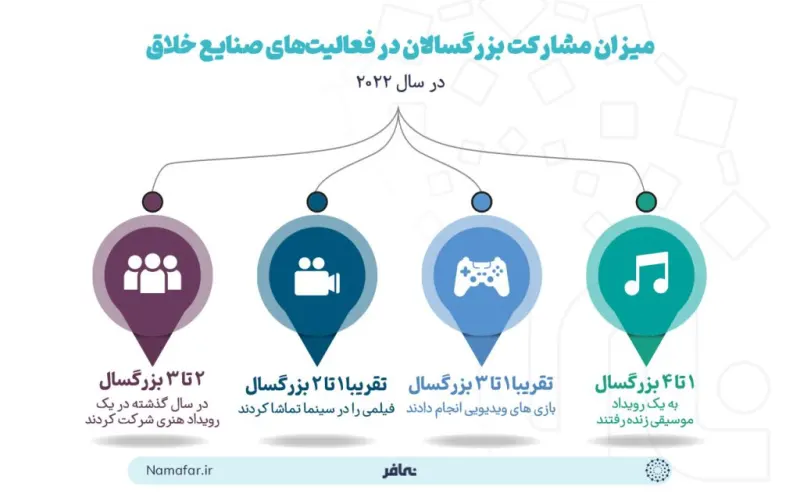
Britons' reception of creative industries programs
An examination of adults' participation in various creative activities in 2022 indicates that about 33 percent of adults in this period watched a film in a cinema. 25 percent played video games and 50 percent of them attended an arts event in 2022. Also, 67 percent of adults took part in a live music event. As is clear, live music and arts events had the highest participation rates among adults for creative activities. Such that one in three adults attended a music event. Although film and video games have had lower participation rates, the reception of them is still striking and notable.
Orientation of fiscal policies toward priority goals
A comparison of spending commitments in 2021 and 2023 indicates a strategic focus on priority areas such as innovation, access to finance, exports, skills and so on. In this regard, a 57.6 million pound investment in the research and development program for the convergence of screen technologies emphasizes innovation. Other investments include 10.9 million pounds for growth programs, 5 million pounds for the UK Games Fund, 5 million pounds for grassroots music venues, and 3.2 million pounds to double the budget of the Music Export Growth Scheme (support for emerging artists).Strategic goals of Britain's Vision 2030 for the creative industries
The report on Britain's Vision 2030 for the creative industries has set out goals and actions designed around three strategic objectives to address specific requirements while also creating broader transformation.Goal one: growing the creative industries market
Adding 50 billion pounds to the creative industries market and turning it into a strength and a highlight of the British economy is the first goal. This goal includes strengthening innovation by directing more than 250 million pounds into new research and development partnerships, projects and facilities across the country. In addition, access to finance for growth is improved through better connection with public funds and programs such as the regional investment funds (1.6 billion pounds) and the development of industry oversight.Goal two: supporting 1 million more jobs across Britain
Given that this sector is expected to move toward higher-skilled roles, the focus here is on growing talent and skills at all ages. Strategies include improving creative education programs in schools and institutions across the country. These strategies encompass initiatives to enrich early education through support for more than 1,800 university courses in creative disciplines. However, commitments to building broader infrastructure, such as implementing a 5 billion pound broadband project, are also emphasized. In addition, recommendations have been offered to address data and measurement gaps, and these recommendations help targeted development.Goal three: maximizing the impact of the creative industries
The third goal is maximizing the cultural, social and environmental benefits of creativity and covers areas such as health and well-being, support for environmental sustainability, and strengthening Britain's global reputation and soft power. In this section, the necessary actions, including funding local creative projects, reducing greenhouse gas emissions, and showcasing the excellence of Britain's creative industries at the international level, have been given attention.
Funding commitments; from the public budget to the private sector
Significant financial commitments emphasize accelerating growth through investment and not merely policies. The picture of the public budget includes coordinated measures such as allocating 250 million pounds to create networks of facilities, jobs and talent in the region, earmarking 170 million pounds for skills and technical training from primary schools to higher education, and allocating more than 100 million pounds to help with exports, market access, business programs and promotion. In the private sector, too, commitments are underway such as the British Business Bank's 1.6 billion pounds of regional financing for creative investments, a forecast of 700 million pounds of new BBC regional investment by 2027, and 63 million pounds of joint industry investment in the immersive laboratory studios network.
Commitment to eliminating discrimination and protecting the environment
In the Vision 2030 program, there are commitments to strengthen diversity and inclusion in the creative workforce. Because at present, only 12 percent of job positions in the music, film, television and publishing industries are held by ethnic minority groups, and of every five roles, only one role in museums and galleries belongs to disabled people. The present program has outlined strategic initiatives for both industry and government; so that fair pay, reasonable working hours and the elimination of discriminatory practices are achieved. The aim of this work is to provide improved support networks that address aspects such as professional development, financial stability and mental well-being. In terms of environmental sustainability, too, analyses show that attention to environmental sustainability in the construction of cinema auditoriums can reduce carbon emissions by a considerable 6,500 tons per year, a figure equivalent to 9,700 round-trip flights to New York.
If Vision 2030 is realized, what will Britain's face look like?
Overall it can be said that Britain, in the creative industries Vision 2030 program, is pursuing 5 goals of achieving 165 billion pounds of economic output per year through the creative industries, employment of 2.7 million people in creative jobs, creating more than 1,000 creative businesses with annual revenue of more than 100 million pounds, reaching 60 billion pounds of exports of creative products and services, and establishing Britain's reputation as a global creative hub.
Conclusion
Britain's backing for these ambitions in the Vision 2030 program is the recognition that demand for creative content, goods and services on digital platforms and technologies is rising. Also, Vision 2030 proposes that regulations should be modernized in areas such as online safety, copyright frameworks and competition policies; so as to support innovation in how creative works are made, distributed and paid for.In our country, too, sound and targeted policymaking and financing in the field of creative industries is essential. Because, as we have seen, this field has high potential both in job creation and in wealth generation. But is our target market also as broad as the British? Answering this question is not simple. But given the regional environment and neighbors, the presence of Iranian ethnic groups in various countries (the civilizational sphere of Greater Iran) and the special regard of the world's Shia for Iran, one can be hopeful about the effectiveness of investment in this field.
Machine-translated from Persian by Namafar; the Persian original is authoritative. Read the original in Persian