If someone is interested in the art of carpets, Iran is a good place for them; because in every house of it an effort has been made to have the most beautiful Iranian carpets and carpet designs before the eyes of the people of the house. If someone is a lover of poetry, Iran is the best home for them; because in every library of it, whether it is a corner of a niche or among a shelf, the collected works of a legendary poet named Hafez are found, and the collected works of other greats such as Saadi and Rumi are also easily accessible. If someone is interested in travel, Iran too has been created for them; because in Iran they can, with only a few hours of travel, experience entirely different geographic and cultural climates. But what if someone is in love with cinema? By cinema we do not mean only film. Rather we mean that same dark, comfortable, and quiet hall in which one can for an hour take refuge in a world of imagination and illusion. Is Iran a suitable country for those who are people of watching films in the cinema? It seems the speed of development of filmmaking in Iran is faster than the speed of development of cinema infrastructure such as cinema halls. This is a danger that threatens the future of Iranian cinema: filmmakers' war over screening halls.

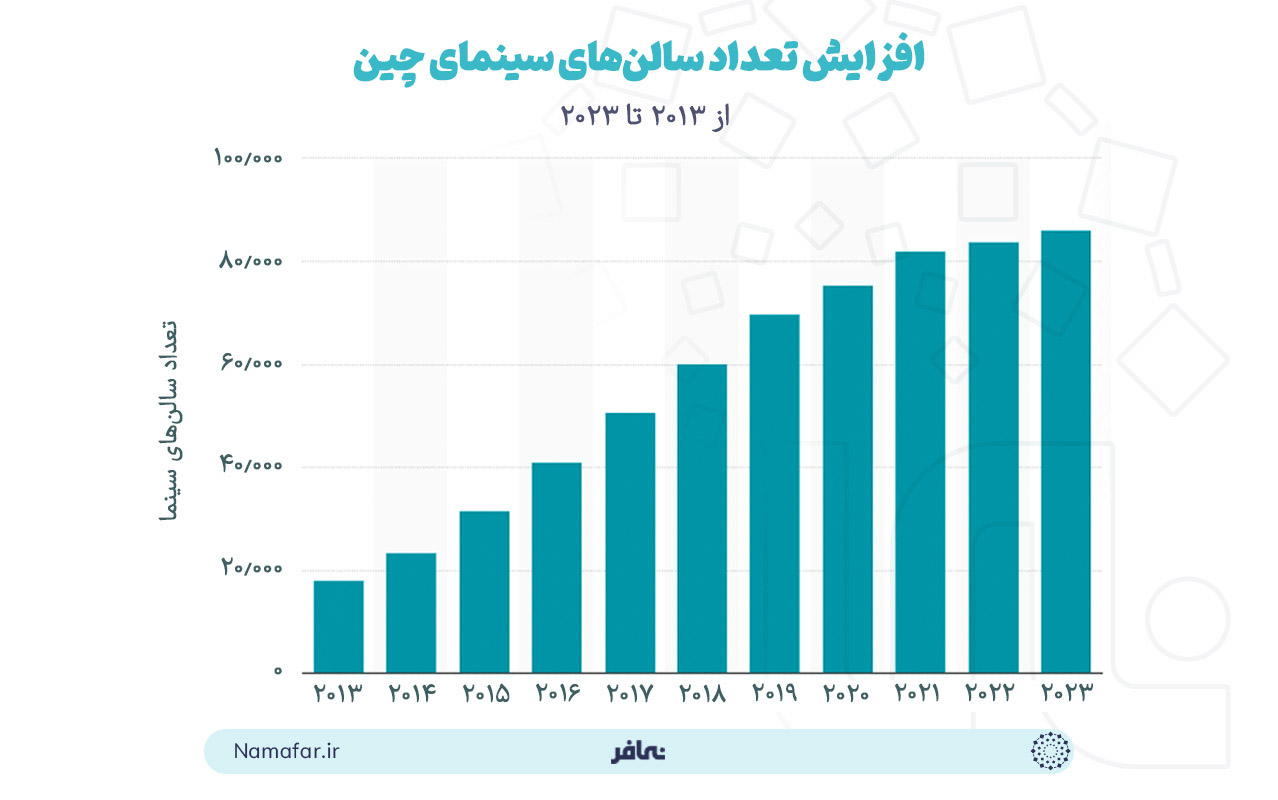
The development of cinema halls is one of the most important measures for the overall development of a country's cinema industry. The cinema industry's revenue generation depends on the existence of a sufficient number of cinema halls in the country and also on their fair and proportionate distribution. For example, China, in developing its cinema industry, over a 10-year period increased the number of cinema halls in that country by as much as 4 times and took it from about 20 thousand halls to about 80 thousand halls.
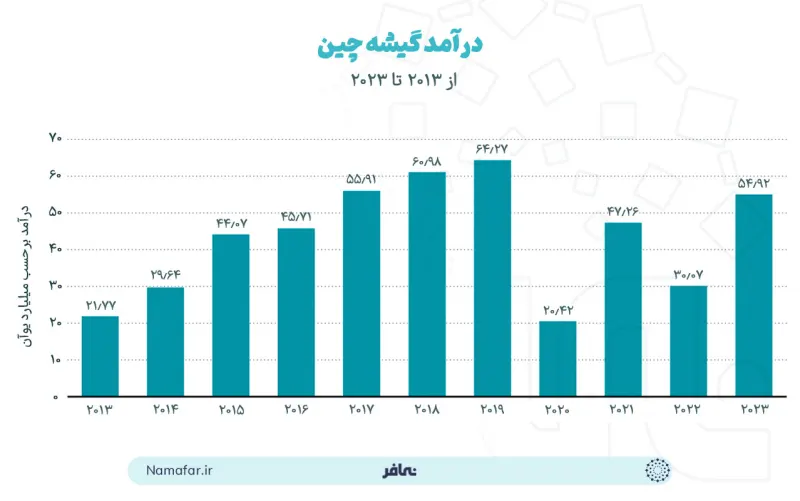
At the same time as the growth in the number of cinema halls, China's cinema box office revenue also began to increase. An increase one of whose components is the growth of cinema halls. This country's cinema box office revenue went from 21 billion yuan in 2013 to 64 billion yuan in 2018 and, after hitting COVID-19, finally in 2023 is about 55 billion yuan.
One cinema hall for one Azadi Stadium!
Iran is a vast and populous country. It also has a large young population, and young people are the main audience of the seventh art. Iranian society has always shown interest in cinema, and the history of cinema in our country has never been empty of works, directors, and actors who have been popular among the people and have succeeded in winning international awards. All these facts tell us that the cinema industry has a considerable place in the cultural life of the Iranian people, and the number and distribution of cinemas is a subject worthy of attention.To know how far society is empowered in access to cinema or faces a problem, we must measure the ratio of cinema halls to the country's population. Overall in Iran there are 270 cinemas whose total number of halls reaches 639. In these halls a total of 113.029 seats have also been installed. These figures are not proportionate to Iran's population; such that every 133.020 Iranians have only one cinema hall at their disposal, and the share of every 739 people is only one seat. According to the global standard, every 10 thousand people need 1 cinema hall. That is, if we want to act in accordance with global standards, there should be 8,500 cinema halls in Iran.
Although Mohammad Mehdi Esmaeili, the Minister of Culture and Islamic Guidance, on 23 Esfand (February–March) 1402 (2023/24), announced that the number of cinema halls in the 13th government had reached 900. This increase, although very welcome, does not create a serious difference in the ratio of cinema halls to Iran's population.
Cinema through the lens of discrimination
The statistic of the ratio of cinema halls to population does not have a good message at first encounter, and criticism and complaint about the low per capita of cinema halls relative to population has always been very frequent and high in frequency in the press. These complaints have been more from the body of producers and filmmakers and not from audiences or cinema owners themselves. Before we reflect a little more on the statistics above and draw an inference from them, it is necessary to examine the per capita of cinema halls relative to population also by province. According to statistics for 1400 (2021/22), Tehran has 60 cinemas and 233 halls. To understand Tehran's distance from other provinces, it is enough to know that the next highest number of cinema halls after Tehran belongs to Khorasan Razavi, with 64 halls. It is true that Tehran's population also has a distance from other provinces, but this statistic, even taking population into account, shows the same wide gap. While in Tehran there is one cinema hall for every 41.076 people, in Khorasan Razavi there is one hall for every 100.539 people. 17 of the country's provinces have fewer than ten halls, and the hall-to-population ratio of 28 of the country's provinces is above 100.000 people.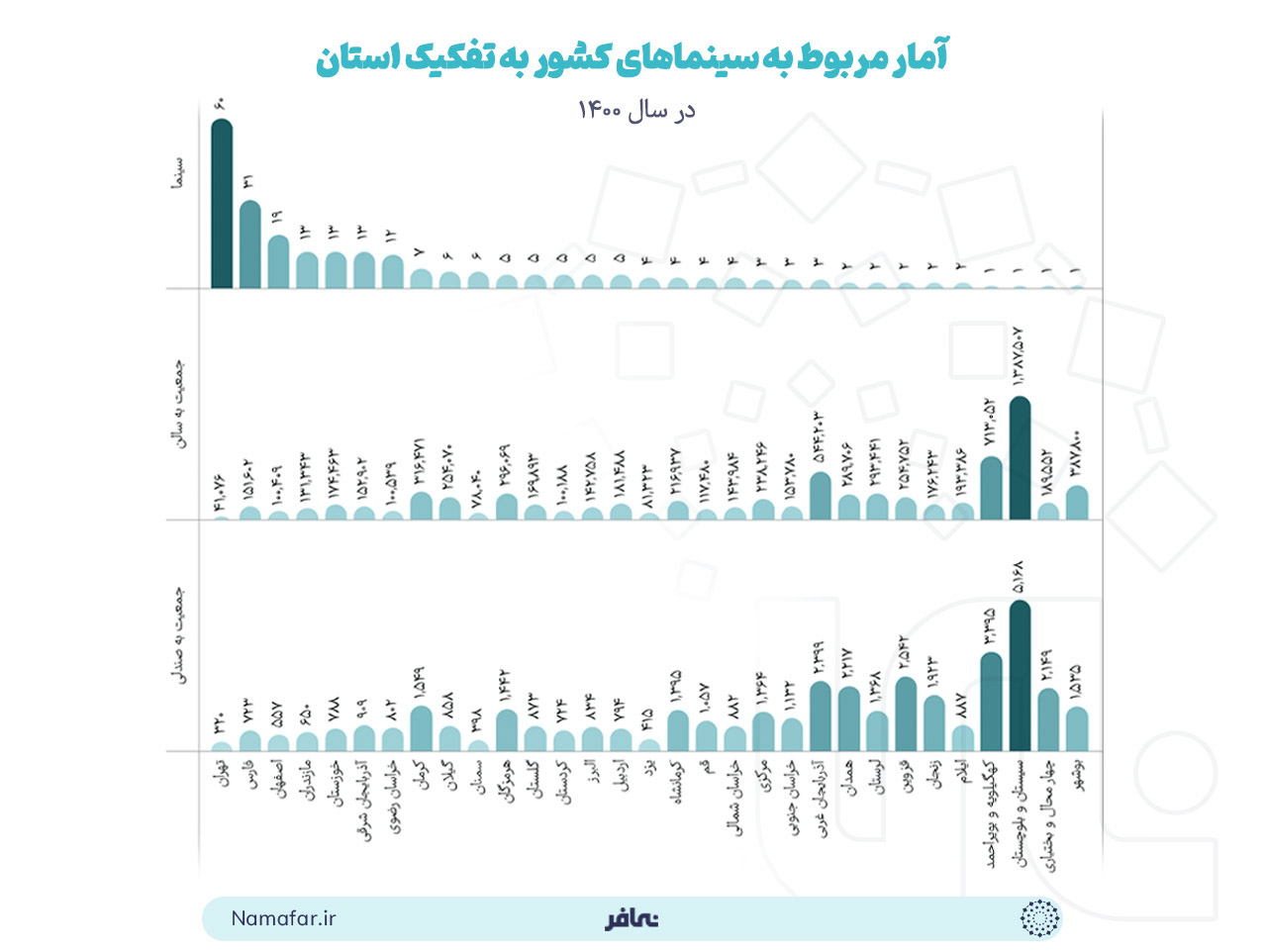
Meanwhile the hall-to-population ratio of one province is above one million people: Sistan and Baluchestan; a province that, with a population of about two million seven hundred thousand, has only two cinema halls. Only three provinces have more than fifty halls, and only Tehran's hall-to-population ratio is below fifty thousand people. That is, at first glance not only do we have few cinemas and cinema halls in Iran, but this same number has also been distributed in an extremely unfair and discriminatory way.
Sistan and Baluchestan, Kohgiluyeh and Boyer-Ahmad, and Qazvin have the lowest number of available seats in the country's cinemas. Fars Province, despite having more cinemas, has fewer seats in its halls. The provinces of Tehran, Isfahan, and Khorasan Razavi have the most seats, and the volume of film screenings in these three provinces is also higher than in other regions of Iran. So it can be said that one of the fundamental causes of the decline in cinema admissions figures is the lack of screening venues and hall capacity.
The number of cinema admissions in Iran has been on a declining trend from the 60s to today, but given population growth since the 60s, the number of cinema halls has not grown in line with the increase in population.
The ratio of halls to provincial distances
This statistic relates only to population, but there are other components that, when taken into account, increase the depth of this discrimination; such as the extent of area. For example, this same Sistan and Baluchestan has an area of about 180.000 square kilometers. Or Kerman, with ten cinema halls, has the same area. That is, many residents of Sistan and Baluchestan or Kerman need a full one-day journey to reach a cinema. Meanwhile, Tehran Province, with the largest number of cinema halls, has an area of only about 12,000 square meters.
Number of audiences: cause or effect?
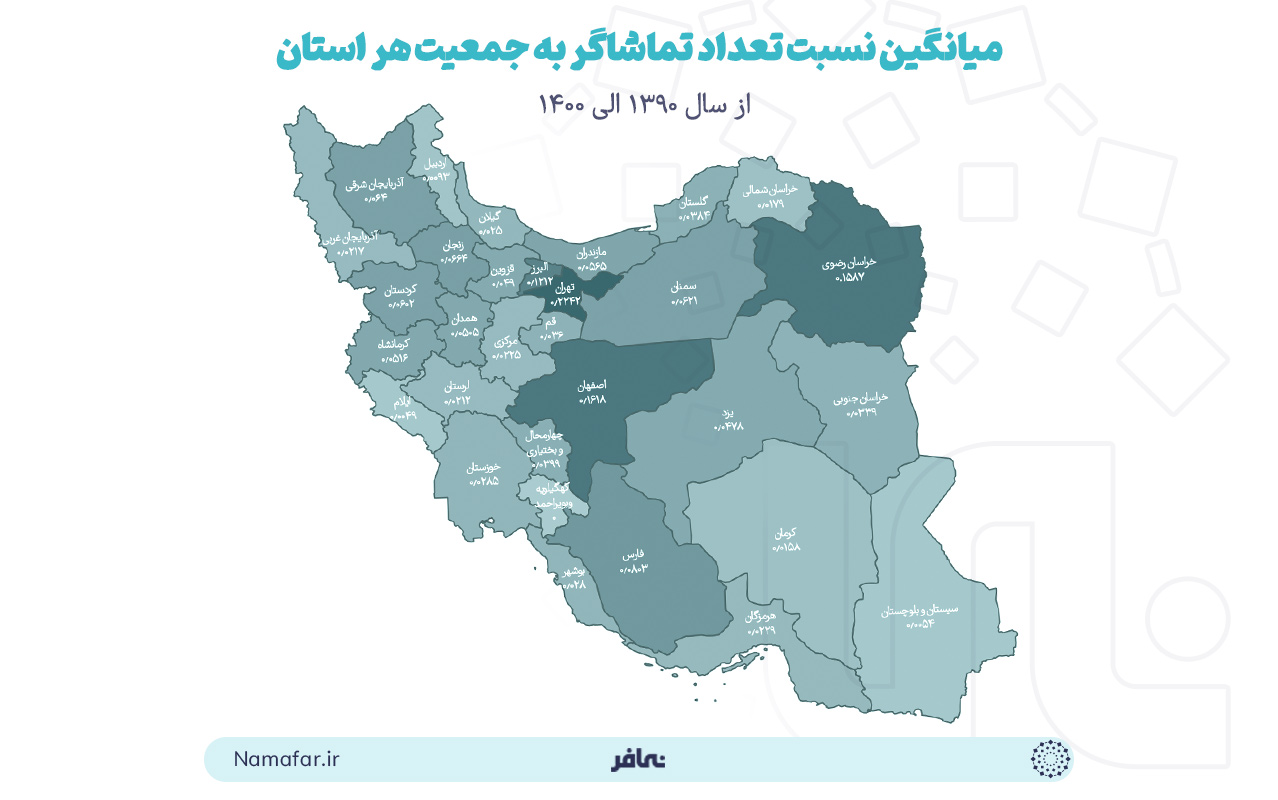
This is not the end of the story. Perhaps if we were dealing with another country such as France, which is considered the cradle of drama, art, and cinema, this statistic could indicate a shortage of cinemas and their discriminatory distribution, and we would not need additional analysis. But in Iran there is evidence that shows that besides population, other components must also be taken into account so that we understand exactly how much cinema we lack and why we lack cinema. Also how much the real extent of provincial discrimination in cinema is and what its nature essentially is. An important component that this evidence points to is the size of the audience for Iranian cinema.It must be determined how much demand cinema has in Iran and how this indicator is by province. One piece of evidence that makes the audience issue serious for us is that cinema in some provinces has a smaller audience even though in terms of the hall-to-population ratio it is higher than some other provinces in which the cinema audience is estimated to be larger. According to one statistical datum, the provinces of Tehran, Yazd, and Semnan are the only three provinces whose hall-to-population ratio index is less than 100.000 people and are in a better situation; but the provinces in which cinema has a larger audience are Tehran, Khorasan Razavi, and Isfahan. That is, three industrial provinces with provincial capitals each of which is a metropolis; tourism is thriving in them and overall urban and modernist culture is seen more in them.
The place of cinema in the culture of the Iranian people
An old report on the situation of cinemas in Alborz Province is interesting. Although this province today, in terms of cinema-related statistics, has become completely different from the time of this report, the report contains facts that are still applicable to today. Mehr News Agency in this report, which relates to the year 90 (2011/12), writes: "Alborz Province, with a population of nearly three million people, currently has 3 cinema halls; that is, for every one million population there is one cinema hall in this province. Halls that are empty most of the time and only at particular times of the year see an audience. This is while cultural officials of the province still cite cinema per capita in Alborz Province as low relative to other places." Therefore it can be said that the high or low number of cinema audiences in many provinces is, more than being the effect of the low number of halls, the cause of it.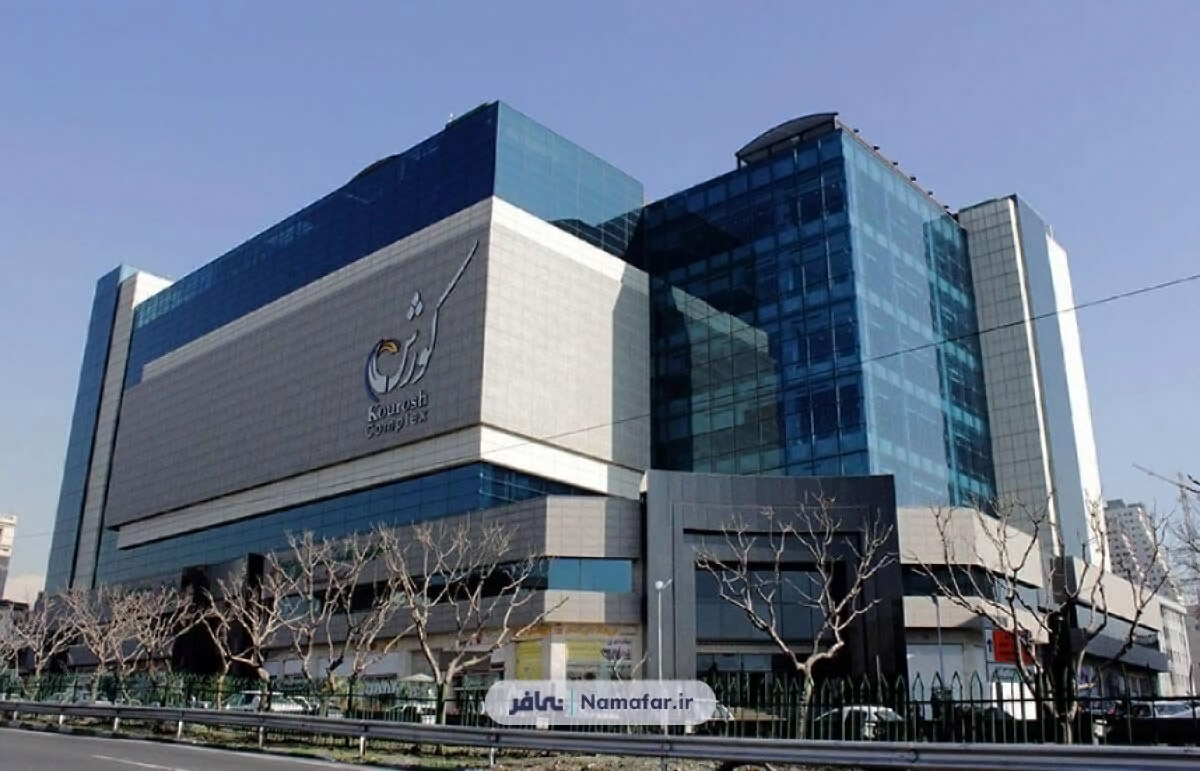
In addition, by measuring the place of cinema in Iranians' culture and lifestyle, one can grasp how much they are people of going to the cinema, and whether if the number of cinema halls were greater they would also go to the cinema more or not. According to statistics, people's encounter with cinematic works is, in the first stage, by assessing its genre. Such that a film's genre being liked is the most important factor in choosing it. This statistic may at first glance have no connection to our discussion, but when we look closely we realize that the superiority of the genre criterion over other criteria means that Iranian cinema audiences' encounter with works is a content-centered and theme-centered encounter, and in it form, art, and cinema are not of first-degree importance. In other words, the Iranian cinema audience is not seeking cinema itself from cinema, and cinema is a secondary and subordinate matter; the audience has other goals that are realized in genre. Such as laughing and experiencing a recreation that is merely cheerful and not necessarily artistic. According to statistics, the comedy genre has more fans among audiences than other genres. When genre is the main criterion, other recreations are easily substitutable for cinema; because cinema is not the only thing that can make us laugh. Other criteria also indicate that Iranians are not professional and persistent audiences for the seventh art. After the film's genre, categories such as having innovation, a famous actor, and crossing red lines, in that order, are what matter to audiences. Only after these do the truly important criteria, such as the director and the quality of the story and even the ticket price, come up. According to another survey, the main reason audiences go to the cinema is entertainment, and interest in cinema ranks next.
After the comedy genre, the social genre and after that the comedy-social genre have been chosen by cinema audiences more than other genres. Genres that often do not require particular visual facilities and that one can also not see on the cinema's wide, long screen.
Conclusion
Although a shortage of cinema halls is visible in Iran and this issue can in the future confront filmmakers more with a shortage of halls for screening their films, what we truly feel the shortage of is not cinema itself, but the culture of going to the cinema. Interest in cinema, and having a proper interest in cinema, is a poverty that is more visible than the shortage of cinema halls. Part of the reasons for this issue can also be due to the type of productions of Iranian cinema and their not matching the individual and collective temperament and needs that a story can fulfill. Films, in whatever genre they are, must arise from the culture of a nation and quench the thirsts unique to that nation.The reality is that a really good film has often also been successful at the box office, even if it has not reached the strange figures of not particularly decent comedy films. Also, a deeper discrimination than the difference in the number of cinema halls relative to population is underway among Iran's provinces. On the basis of the hall-to-population component, Semnan is in a better situation than Isfahan, and between these two provinces, Isfahan has been subjected to discrimination. But the issue is that perhaps people in Semnan have no inclination or culture of going to the cinema at all, or economically they do not look kindly on such recreation. Economic and cultural development has caused the people of Isfahan to have a cultural and artistic consumption basket of which cinema is also a part; but in a province such as Semnan, the very existence of this cultural basket is in question. So the main discrimination is cultural and developmental and, in the next degree, infrastructural or economic.
In the end, both a fair increase in cinema halls is necessary and an increase in cinema spending in the household consumption basket. Material and facilities shortages or discrimination can be solved more easily; but establishing or restoring the cultural edifices that have been built in the mind and psyche of society is difficult.
Javad Shamlu / Alireza Kazemi Moghaddam
Machine-translated from Persian by Namafar; the Persian original is authoritative. Read the original in Persian