A review of the effect of price on the box office in Iranian cinema
Cinema pricing in Iran, especially from the standpoint of affordability, is a matter of debate among different social groups. While some believe that cinema in Iran is very low relative to international standards and that a price increase is necessary to help the industry survive, others believe that a price increase makes cinema inaccessible for many audiences. But is cinema in Iran really considered a cheap form of entertainment? To arrive at a correct insight into the existing situation, it is necessary first to look at global cinema trends in recent years.
The state of the global box office
Cinema is one of the most popular branches of entertainment in the world, and the global film industry earns enormous revenue every year. The global box office in 2024 reached $30 billion. In the previous year it was also about $33 billion, which was a 31 percent increase relative to 2022. Although these figures indicate a recovery of the film industry, they are still a long way from the record of 2019, which had reached $42.5 billion, a gap that results from the decline in cinema audiences.
The COVID-19 pandemic was a turning point in the history of the film industry that shaped a major battle between cinema and streaming platforms. Until then, films followed a simple path. They were first released on the cinema screen and after months reached streaming services. The two played complementary roles that together could respond to different tastes. Those who wanted, on an exceptional night, alongside a crowd of the city's unfamiliar people, to eat chips and popcorn and watch the latest hit film on the big display screen. And those who wanted to watch their ideal film in privacy and away from any crowding or spending much time and money on their home sofa. And when it came to box office revenue, theatrical releases had the heavier side of the scale and were breaking records left and right. Films such as Avengers and Star Wars sold billions of dollars and cinema was experiencing its golden age.
What did COVID-19 do to cinema?
With the COVID-19 pandemic, however, a major transformation was created in the film industry. All at once screening curtains went up and the shutters of the halls were pulled down, which was a heavy blow to the body of cinema. The screening of many high-cost films was halted and audiences remained behind cinema doors. The number of cinema admissions in the world fell from 7.9 billion people in 2019 to 1.9 billion people in 2020.
On the other side of the ring, however, streaming platforms such as Hulu, Amazon Prime, Prime Video, Netflix, and Disney Plus were experiencing unprecedented growth and approaching their peak. It was in 2020 that the number of subscriptions to online video streaming services in the world suddenly reached 1.1 billion. Netflix alone found millions of new subscribers, so that it increased from 21.5 million subscribers in 2011 to 203 million subscribers.
Cinema in the recovery period
After the world's health improved and the halls reopened, cinema began its effort to revive itself. The table below shows statistics related to cinema in the United States of America in the years 2018 to 2024. In this table, respectively, the number of tickets sold, total box office, total box office adjusted for inflation, and the average price of each ticket can be seen
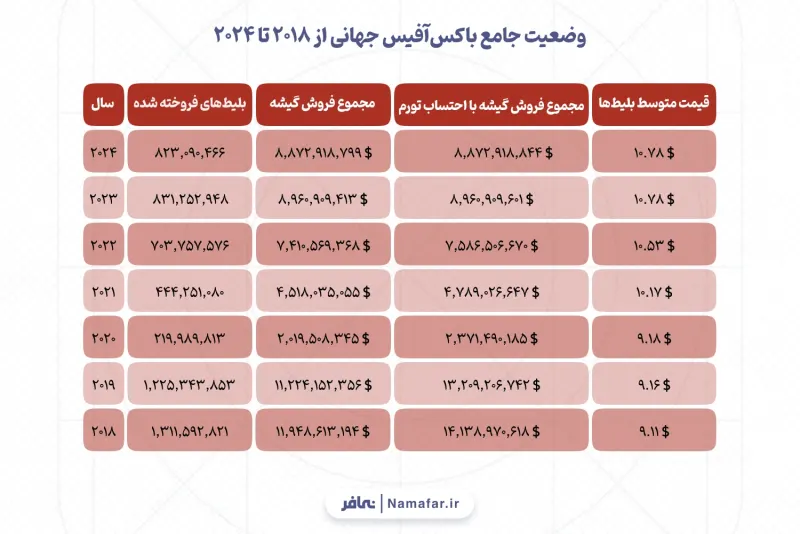
Based on the figures recorded in the table above, we see that cinema, after the sudden collapse in 2020, has recorded continuous growth for the following years. But still after four years the level of tickets sold is about 400 million apart from 2019.
While some speak of the decline of cinema, others predict that if this growth continues, cinema can in future years return to the pre-pandemic level. Regardless of which of these two hypotheses will ultimately come to pass, it must be asked: given that all health obstacles have been removed and the situation has returned to normal, what factor, after four years have passed, still prevents a considerable percentage of audiences from returning to cinema?
Is cinema an expensive form of entertainment or a cheap one?
COVID-19 created a deep transformation in the lives of the world's people. With long periods of staying at home and the flowing of all facets of life onto internet platforms, individualism and isolationism intensified among people. It is obvious that with a change in lifestyle, consumers' preferences also changed.
On the other hand, the superiority of streaming platforms in terms of the diversity of films, freedom and ease of access, and most importantly their affordability cannot be ignored. For example, the average cinema ticket in the United States of America is now $10.78. Whereas a Netflix platform subscription in the "Standard with ads" plan in this country is $7.99 per month. In fact, for an American citizen, one month of unlimited access to thousands of films in Full HD quality and the ability to download them on two devices is cheaper than watching one film in a cinema.
In general, cinema ticket prices differ across the countries of the world, influenced by factors such as the domestic economic situation, the exchange rate, and the cost-of-living level. For example in Switzerland the average ticket price is $22.07, which makes it one of the most expensive places to watch a film. Denmark with an average price of $16.76 and Saudi Arabia with $16 rank next. Of course these high prices often reflect a higher average income level in these countries and, consequently, a high cost-of-living level.
Iran, however, is distinctive because of the very low price of a cinema ticket compared with many countries of the world. In 1403 (2024/25) the average price of one ticket is 60 thousand tomans, which at peak hours reaches 80 thousand tomans. That is, even at the highest amount it is still less than $1.
Iranians' minimal uptake of cinema; is its root economic or cultural?
Nevertheless, based on the survey by the Research Institute for Culture, Art and Communications in 1399 (2020/21), 77.7 percent of people do not go to the cinema at all. Among the 22.3 percent who do go to the cinema, 27 percent go only once a year, 27.9 percent twice a year, and 45.1 percent more than twice a year.
There are also other statistics on the extent of people's attendance at the cinema that indicate much lower percentages. In any case, it is evident that the rate of attendance of Iran's people at the cinema, despite the low ticket price relative to other countries, is very low. But the question is this: does Iranians' not taking up cinema have an economic root or a cultural one?
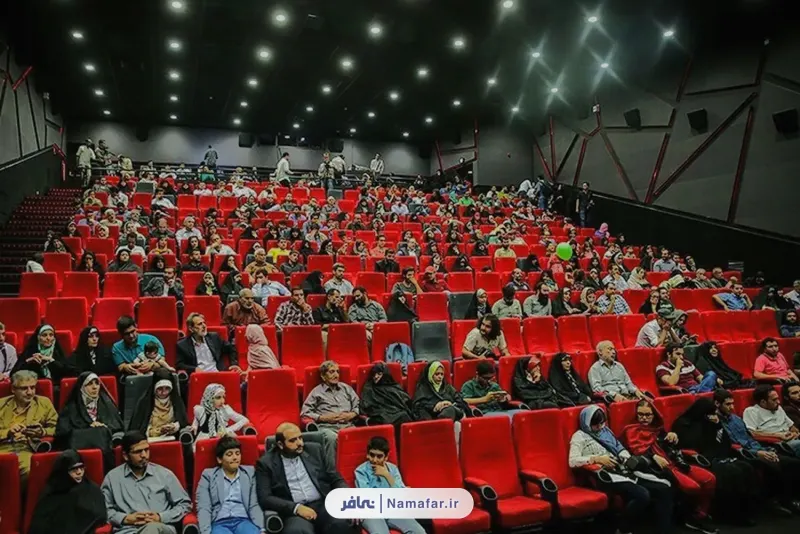
Based on Farhikhtegan's report, from Farvardin (March–April) 1403 (2024/25) to Azar (November–December) of the same year, more than 26 million people have gone to the cinema. While the share of weekend holidays in this figure is expected to be larger, total audiences on the two days of Thursday and Friday were more than 9 million, which comes to about 4.5 million people per day. Whereas this figure on Tuesdays—which include the half-price Tuesdays plan—was 7 million; that is, 1.5 times weekend holidays.
People's uptake of half-price Tuesdays shows Iranian audiences' sensitivity to price fluctuations. Although the ticket price in Iran is very low relative to other countries, for part of the audience it is still not considered a cheap leisure activity, and they cannot allocate such a share of their spending basket to cinema. In other words, according to sales data, there is a direct correlation between ticket price and the level of audience participation, and if, as rumored, the ticket price increases, Iranian cinema will face a decline in admissions more than before. In contrast, a lower pricing model can increase overall revenue by attracting audiences.
Of course we must bear in mind, as was explained at the beginning of this note, that cinema's recession in recent years is a global trend and is not exclusive to Iran. Nevertheless, the combination of economic problems with access to the internet and streaming platforms in Iran has affected people's lack of inclination toward cinema. Weakness in laws related to intellectual property rights and, consequently, the possibility of illegal downloading exacerbate this situation and make watching at home a preferable option relative to cinema.
What path lies ahead for cinema?
For cinemas to remain competitive they must offer added value beyond home video. Some cinemas have tried to increase their audiences by arranging advanced viewing experiences such as better seats, stronger sound systems, and VIP halls. However, these advantages were often accompanied by a rise in ticket price, which takes cinema out of the reach of ordinary audiences.
Some experts believe that the government should step in to subsidize the ticket price—especially for domestic films—so that the possibility of attending the cinema is provided for a wide range of social groups. Others also propose offering tax incentives to cinemas that keep prices low, and discounts for students and families.
Given economic realities, finding a pricing model that is efficient both for audiences and for cinema owners is very important. Dynamic pricing models, cinema access based on purchasing a subscription as exists in other countries, government support and incentives, upgrading the cinema experience by investing in facilities or exclusive screenings and Q&A sessions with cinema professionals, and most importantly strengthening intellectual property laws and promoting legal streams are potential solutions that can be considered.
Conclusion
In answer to the question of whether cinema in Iran is expensive or cheap, it must be said that the affordability of cinema in Iran is relative. Compared with international standards, the ticket price is low. But when it is placed alongside other components such as income level and economic challenges, it is considered expensive for many Iranians. The strong reaction to discount days shows that many potential cinema audiences do not visit the cinema regularly for economic reasons. To ensure the long-term sustainability of Iranian cinema, a balance must be created between ticket affordability and maintaining profitability for cinema owners, so that cinema remains an important cultural and entertainment branch in Iran.
Machine-translated from Persian by Namafar; the Persian original is authoritative. Read the original in Persian