The art of cinema, the seventh art and a turning point among the seven arts. The dimensions of this art are very vast and it is considered one of the most important types of art. An art that, as if a soul were breathed into lifeless images, gives them a new life on its magic screen so that it may teach you the ways of life. The history of cinema and its emergence goes back to the Lumière brothers and the year 1895. At the start of operations, making short films was more common. Also, films were shot from a single shot and without cuts. The first short film in cinema history was the film Arrival of a Train at the Station.
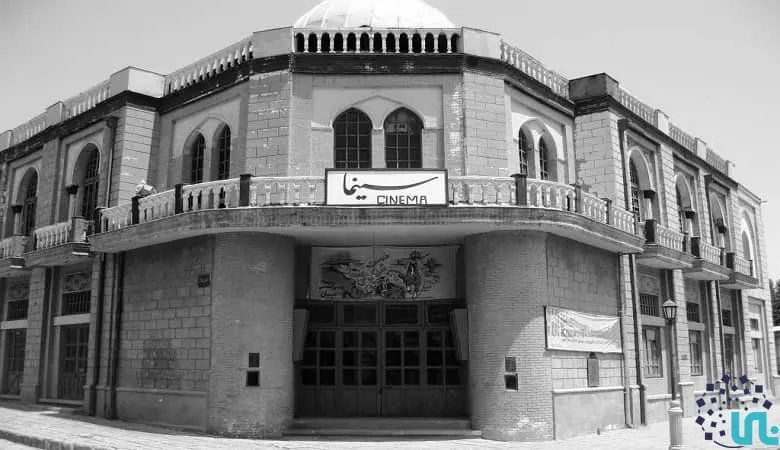
In what year was Iran's first cinema built
After 5 years had passed from the date of the invention of cinema, Iran was one of the countries that came to possess this art. The first cinema hall in Iran was Cinema Soleil Tabriz with a capacity of one hundred spectators, which was founded in 1279 by Alek Saginian. A few years after that, Armenians in Tabriz also launched Cinema 29 Bahman and Cinema Crystal in Tabriz. At first cinema did not have high acceptance among the mass of traditional old society. Years later, with the increase in the number of professional and large cinema halls with a capacity of one thousand one hundred people, the cinema industry grew remarkably to the point that the art of cinema became a revenue-generating industry. Cinema Pharos was Iran's first cinema hall that was almost similar to today's cinemas, with a capacity of three hundred to five hundred spectators and facilities such as fans, an electricity generator, a restaurant and a buffet.

Cinema's place in culture
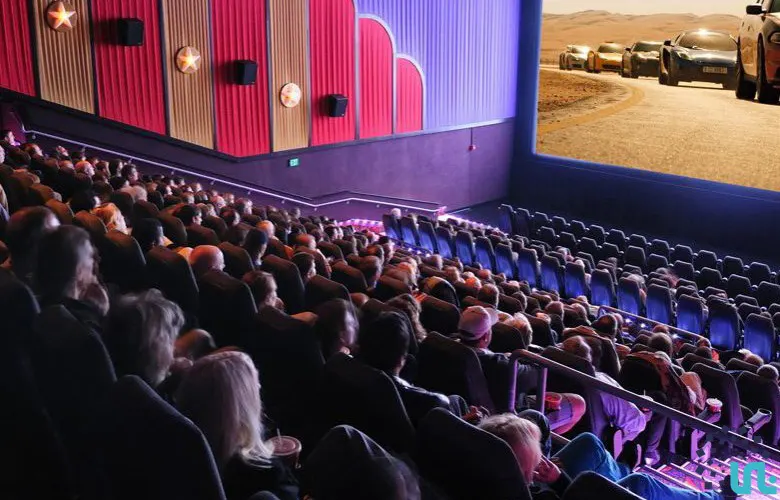
A cinema hall, besides the entertainment and artistic aspect, as a place and a lever for social communication in order to disseminate and expand culture in societies, has an essential role. The level of development of each country can be measured by the degree of progress and standing of cinema in that country. To the point that the number of cinema admissions over a one-year period is recognized as one of the main and important indicators of cultural development in UNESCO's view. An indicator that in itself requires observing standards and infrastructure, especially in the field of cinema halls.
Cinema and society
The first half of 1394 (2015/16), given the increase in cinema ticket prices, cinema box office revenue also faced growth of almost 50 percent, that is a 14 percent increase in admissions. The head of the Cinema Organization of Iran, following this trend, considered it evidence of the upward path of the art of cinema and stated that a change in people's taste and their not using worn-out and old cinema halls were among the factors related to this growth.
In 1396 (2017/18) research was conducted and based on citable statistics it was established that for 81 percent of the people of Iran, going to the cinema is not a priority in their choices at all. According to this statistic only 19 percent of people have gone to a cinema hall to watch a film. While about 30 percent of this number only once, 28 percent of them only 2 times and 42 percent of this number more than 2 times have preferred a cinema hall for watching a film. This statistic shows that of Iran's population of eighty-odd million, about 64 million people are not Iranian cinema-goers.
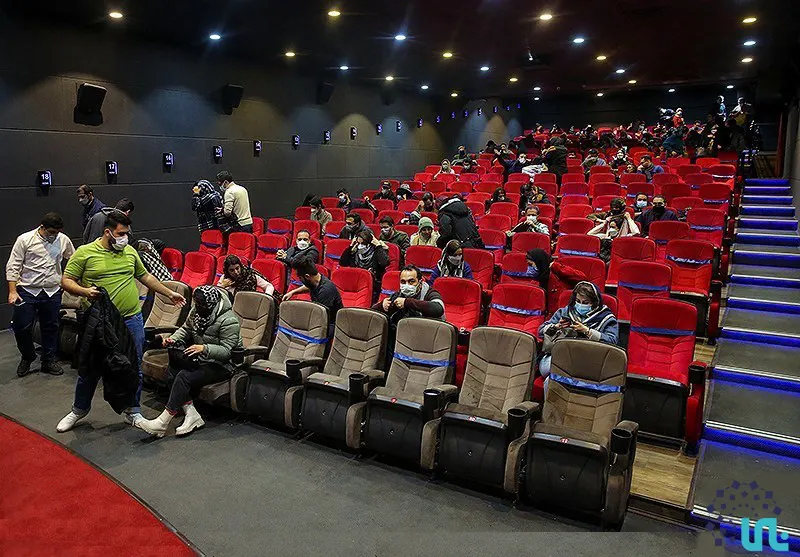
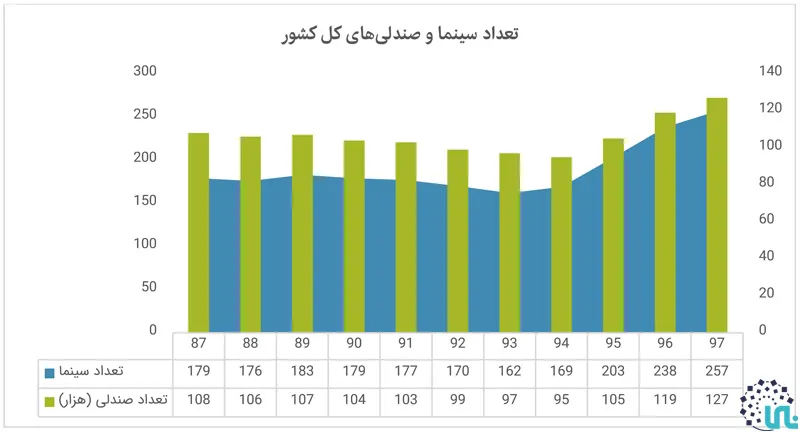
Critics and cinema activists consider among the reasons for the decline in cinema's popularity among Iranians the drop in quality of produced films and popular film genres, economic problems, the atmosphere governing today's cinema, and so on. But some other experts, including directors and film production crews, consider the shortage of cinema halls and the existence of worn-out, old and substandard halls among the reasons for this. It goes without saying that unfortunately in some provinces there is not even a single cinema hall. Also, access to cinema is not easy in all the country's cities. Tehran Province, with 190 cinema halls and 43,201 seats, provided one of the best accesses to cinema for the general public in 1397 (2018/19).
3D screening halls and their effect on sales
Science and technology have been developing and advancing at speed, and our everyday life has inevitably gone along with it. This progress has even affected the preparation and manner of screening films in cinema halls of the world. Today many people are interested in 3D cinema halls and go to special cinemas to see this kind of technology in films. 3D cinema introduces audiences to a new world.
Focus magazine, which deals with global film market practices, in its latest issue in 2020 reported a 7.6 percent decline in Iranian cinema audiences, that is about 26 million admissions. This was while in the same year the number of admissions in the European Union had reached more than 1 billion people a year. This figure was considered the best result recorded in Europe since 2004.
One of the main causes of that can be counted in the manner of screening films in accordance with advanced technological facilities, in the form of 3D and digital films in equipped 3D cinema halls. According to statistics published in this same monthly, the growth trend in the number of 3D and digital screening halls in the world over the years 2015 to 2019 has been upward, and China with growth equal to 16.2% a year, and the United States and Canada with growth equal to 1.9% a year, stand in first and second place respectively among the world's top 10 markets based on number of cinema halls.
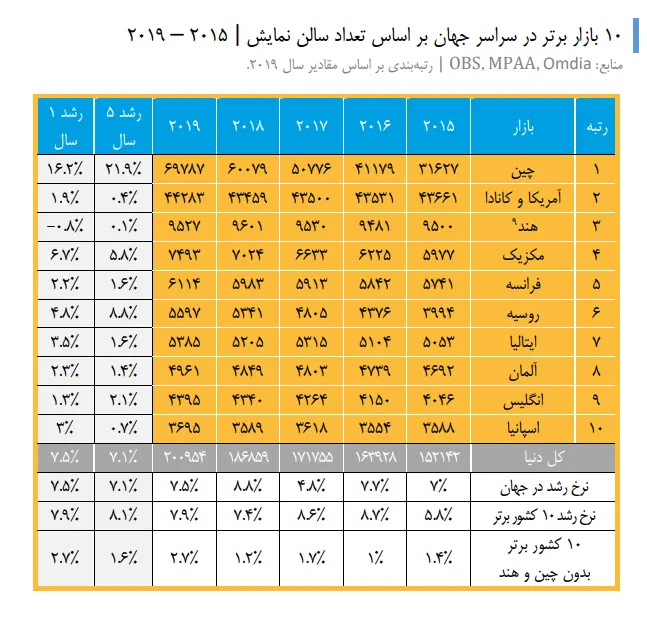
The world's largest cinema market
Chinese cinema according to this table, relative to its own past five years, has had 21.9% growth, and the cinema of the United States and Canada also 0.4%. Of course bear in mind that this growth took place in the COVID period and simultaneous with the closure of cinemas and limited film screenings.
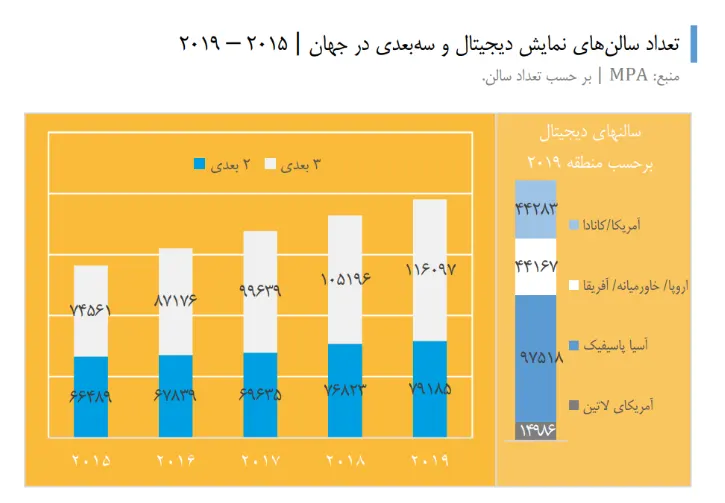
As you see, Chinese cinema has snatched the lead not only in the economic field but one can say also in the field of culture and art from the countries of the North America region (the United States and Canada) and in two consecutive years succeeds in registering the title of the world's largest cinema market in its own name. This country in 2021 succeeded in adding 6,700 new cinema halls to its cinema capacity and bringing the number of its cinema halls to 82 thousand and 248, that is for every seventeen thousand people there is one cinema hall.
Interest in going to the cinema in Iran and the world
In statistical comparisons between Iran and Germany in terms of the number of cinema halls this result is clear that in Germany the number of people interested in being present at the cinema is five times Iran. One of the reasons for this can be the sevenfold difference in the number of cinema halls in Germany. According to global standards there should be one cinema hall for every ten thousand people. But given the number of cinema halls in Iran it must be said that for every 133 thousand people there is one cinema hall.
Turkey has a population almost equal to Iran but an area half of Iran's area. Even so it has five times as many cinema halls as our country. That is, for every 35 thousand people, one cinema hall, and in total the number of Turkey's cinema halls is about 2,400 halls.
France is another country that uses all the capacities it has to build cinema halls. This country has an institution named the French National Cinema Centre ( CNC ). This center every year selects the most creative cinema halls in France and awards a prize equivalent to ten thousand euros for the best and most creative of them. This factor leads to encouraging cinema investors to build and equip France's cinema halls. At present there are more than two thousand cinema halls in France. That is, for every 32 thousand people, one cinema hall, among the most distinctive of which is a romantic cinema hall on a boat that was opened in 2008.
Conclusion
By increasing the number of cinema halls by itself one cannot give boom to the cinema industry and to increased public uptake of going to the cinema. Easy access to a cinema hall, use of developed technologies and equipment, improvement of cinema ticket buying and selling systems, effective marketing and advertising, observance of civil rights and many other factors can be among the effective factors in cultural development related to the cinema field. Matters that are of importance to a film viewer in choosing a cinema hall.
Machine-translated from Persian by Namafar; the Persian original is authoritative. Read the original in Persian