The words animation, cartoon and puyanamayi are synonymous in Iran. The animation industry in Iran is young. In the past works were made that do not match today's standards. These were often films whose audience is children; for example Kolah Ghermezi is a film that, with rarely matched delicacy, comic situations, a story suitable for children and so on, has targeted kids. Feature-length computer animation, the newborn child of Iranian cinema, has shown its capacities in these very few years. It both sells well and wins awards well. Screening animation in the cinema is certainly more attractive. Today's 24- and 25-year-olds are unlikely to remember Kolah Ghermezi on the magic box, but they remember their elementary-school class outings to the cinema where they watched Kolah Ghermezi and Sarvenaz.
The story of serial and theatrical computer animations in Iran
Computer animation is the newborn child of Iran's animation. Feature-length computer animations have been made in Iran for less than 10 years and in these years they have shone not a little. A path that began with Tehran 1500 and has seen The Elephant King and the eye-catching Princess of Rome. The Iranian newcomers appeared in international forums and also at a thriving box office. 2D serial animations too were being made in Iran from several years before. For example Puriya-ye Vali was made in 2D and in 4 seasons.
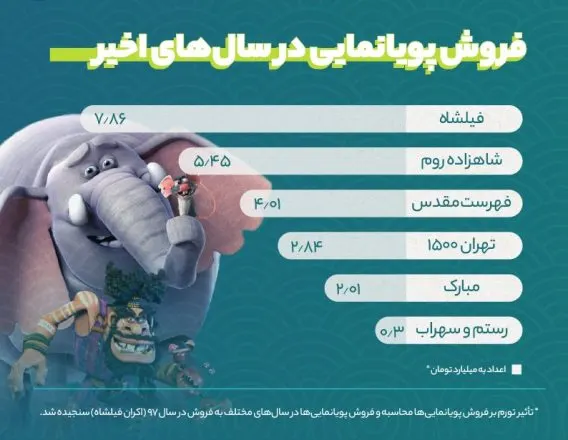
The Elephant King and Princess of Rome are the most successful theatrical animation releases at Iran's box office. Princess of Rome was released in Aban (October–November) 1394 (2015/16) and sold 5/5 billion tomans (taking inflation into account). The Elephant King at Nowruz 1397 (2018/19) hosted the gaze of big and small and moved the ceiling of animation box office in the country. Reaching billion-toman borders for an industry whose life is less than 10 years is praiseworthy. The effect of a work's quality on its box office is completely evident; but there are other factors behind the scenes that affect the box office of a theatrical animation, a serial and so on. Factors such as: 1. time of release; 2. the quality and quantity of advertising and publicity. Another important factor that is often ignored is the number of halls for screening the theatrical work. The Screening Council, according to the regulations, regulates the release of films.
Animation screening halls
There are 572 cinema halls in the country. The Screening Council is responsible for allocating these halls to animation and other films (some of these halls were built after the release of The Elephant King, which are few in number). The animation The Elephant King was screened in 173 halls and still carries the title of Iran's highest-grossing animation. If the number of halls is small, alongside a short screening time it damages the work's box office. The number of screening halls of various animations is specified in the chart below.
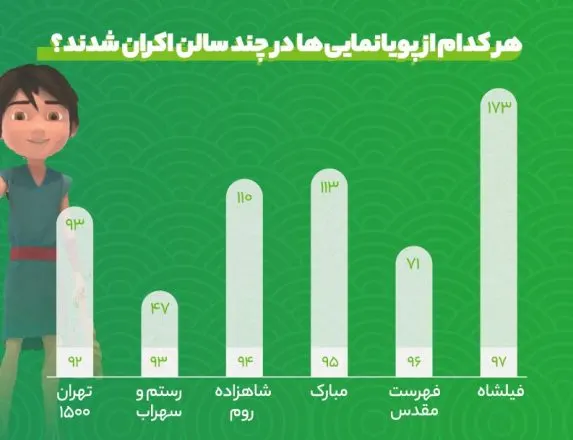
Tehran 1500, which is the first, had 93 halls at its disposal for screening. To Rostam and Sohrab, however, only 47 halls were allocated, which resulted in box office of 300 million tomans. It seems that with the passage of time the outlook of those in charge toward animation has become more positive and they consider a greater number of halls for them. It may appear that with an increase in the number of halls, box office also increases and a direct relationship exists between these 2; but it is clear that a low-quality work, even with sufficient halls at its disposal, will not have good box office.
- Read the status map of the animation industry, including a full description of the industry's components in Iran and the world, here.
Unkindness toward animation
Perhaps if they had allocated more halls to some films, their box office would have been greater. The "box office per hall" indicator is suitable for measuring an animation's box-office capacity. Higher values of this indicator show that screening in more halls to some extent helps increase box office. The relationship between box office and the number of halls, however, is not linear; for example Bahram Azimi's animation Tehran 1500 perhaps in the year 92 with more halls its box office would have been greater. The next chart shows the value of the "box office per hall" indicator for the release of various theatrical animations.
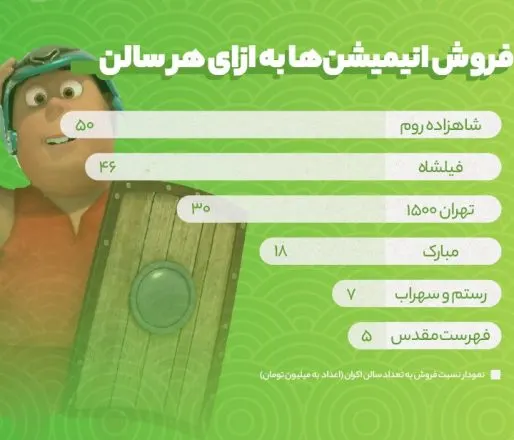
Princess of Rome, although it had lower box office than The Elephant King, has surpassed The Elephant King on the "box office per hall" indicator. In fact Princess of Rome's capacity in box office was greater than The Elephant King's capacity. Allocating more halls to such a work could have helped its greater success. Screening a theatrical animation such as Fehrest-e Moqaddas or Rostam and Sohrab in more halls would probably not have had a more positive result.
In any case a specialized examination of a cinema product's capacity before release is felt. With this work the film's capacity is specified. Neither are extra halls given to it, nor by allocating few halls is opportunity wasted.
Machine-translated from Persian by Namafar; the Persian original is authoritative. Read the original in Persian