Filimo and Namava are the most important Iranian VODs. It has been almost seven years since Filimo and Namava started operating. The peak of these platforms was when they invested in series production. With Blue Whale in 1397 (2018/19), Filimo was able to attract many viewers and continue its life alongside Namava. Namava, which at first had invested in viewers who used a particular internet service, entered the field of competition. In addition to Persian-language series and films, these two platforms also make films and series from around the world available to consumers in censored form. In what follows we compare the subscription cost of Filimo, Namava, and Netflix.
Filimo and Namava's monopolism
Monopolism is a label that opponents and critics attach to these platforms. Of course, with a brief look at the conditions of these VODs the balance of criticism will become heavier. For several years IRIB (Islamic Republic of Iran Broadcasting), despite all its efforts and heavy costs and a large budget, has lost many viewers and has cleared the road of popularity for home video networks (VOD). These networks, holding an audience in need of Persian-language content, entered a field of competition without a competitor.
Home video networks around the world must keep themselves up to date at every moment and strive with high-quality, first-rate productions to retain audiences; what is not currently observed is precisely this situation. Very weak productions, questionable capital, and dissatisfied audiences show the state of home video networks. Of course, among the weak productions, good or average products can also be seen.
From 1399 (2020/21), Filimo forced its subscribers to buy a monthly subscription to watch its exclusive series and even censored foreign-language films. After this, it claimed that users are the investors in the series and put the audience in a situation where they had no choice but to buy a subscription. But buying a subscription is not the only way to feed a platform such as Filimo. Advertising is one of the VODs' revenue sources, in such a way that before the start of each film or series a sponsor advertisement is played. Another source is income obtained through operators. In such a way that Filimo also receives a share of operators' internet traffic sales.
The point is that around the world, any app, VOD, or mobile game, if it is free for the user, plays advertisements during or before the game and film. In Iranian VODs, in addition to adding advertisements to the film or series, they receive a monthly amount that in the space of three months became three times as much. The subscription amount, given all the claims this VOD raises, is very unfair and caused widespread protests by people online.
The promise of making first-rate series and entertaining programs and increasing their number is part of these claims that they have not yet achieved, and this can be understood from the quality level of the series made and the low public reception.
Filimo and Namava subscription cost
At the end of 99 through the early months of 1400 (2021/22), Filimo's subscription became three times as much and other VODs such as Namava increased the subscription cost in proportion. With a rough calculation one can see that Filimo and Namava's monthly subscription pricing is not fair. The minimum wage in Iran is 12,000 tomans per hour and this amount means 8 hours of work a day, or the price of one working day in Iran. Netflix's monthly subscription, the world's largest VOD, is 14 dollars, and taking into account the minimum wage of 5/7 dollars, people in the United States only have to work two hours to buy a subscription!
You can see here the latest Filimo subscription cost.
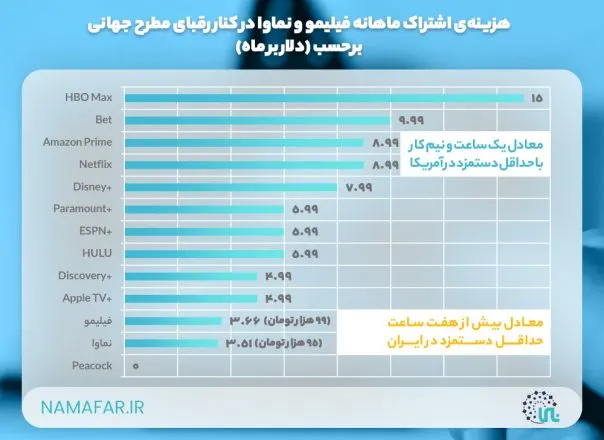
In the late 1390s (2010s), with the removal of the largest film-download site, the project of legalizing film downloads in Iran was launched. In 1398 (2019/20), the removal and blocking of film sites intensified. Today almost all unauthorized download sites have been filtered or taken out of reach. Cinema enthusiasts saw this development as the doing of platforms such as Filimo and Namava. Iranian VODs consider themselves authorized to stream foreign films and series, whereas most of the films they have used on their platform were downloaded from the sites they wanted closed.
Home video networks in Iran have not obtained foreign films and likewise foreign-language series from a specified and legal source and do not even have permission to stream them; nevertheless they earn income by using this content. In addition to the illegal use of foreign-language content, by altering the content and censoring it they change the works, which is by no means acceptable.
Monopolism is a title that Iranian audiences have given these VODs. Creating an internet network around the world faces problems. In Iran, with:
1. the severe weakness of the country's official IRIB (Islamic Republic of Iran Broadcasting) in producing quality works;
2. the removal and shutting down of film-download sites;
3. extensive advertising;
4. the lack of competition and the handful of internet networks
there is no package for the progress of Iranian VODs.
Source
Data from Namafar's cinema status map
Machine-translated from Persian by Namafar; the Persian original is authoritative. Read the original in Persian