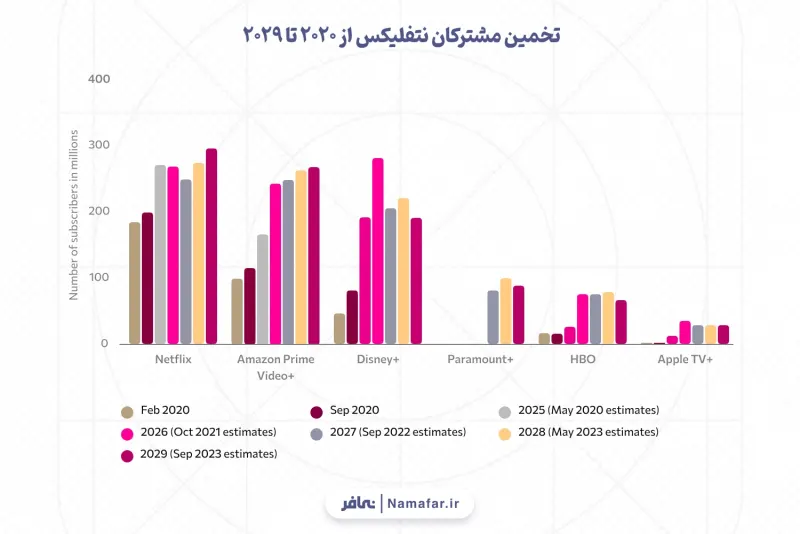
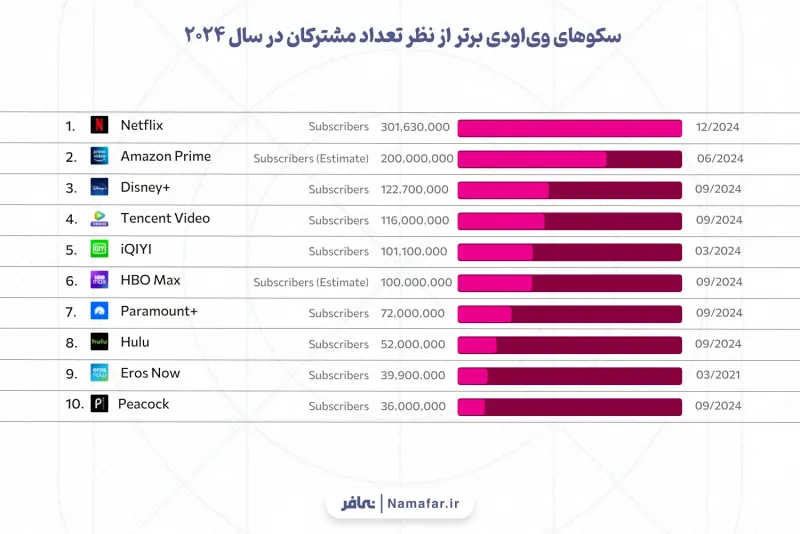
Netflix, as the first and most popular VOD, has always been like a king about whose decline and departure from the top others have speculated. A kingdom with large rivals that in recent years have repeatedly appeared close to taking its first-place position from it. But this did not happen. Netflix is still in the lead and is succeeding in attracting audiences beyond forecasts. Forecasts said Netflix would reach 300 million subscribers by 2029; but this company reached this record in the final days of 2024; five years earlier than estimates!
Netflix's revenue in the final three months of 2024 reached 10.25 billion dollars, of which 1.87 dollars was its net profit. In this magnificent year-end, Netflix executives said in a letter to shareholders: "We enter 2025 with strong momentum, after a year that was accompanied by a record 41 million new subscribers acquired and a re-acceleration of growth."
This is while this large platform, with complete confidence, is constantly raising the prices of its various subscriptions. The present note is an answer to the question of why Netflix, despite powerful rivals such as Amazon Prime, Disney+, HBO Max, and Hulu, proceeds to make itself more expensive without concern about a decline in subscribers. You can read the full translation of this note below:
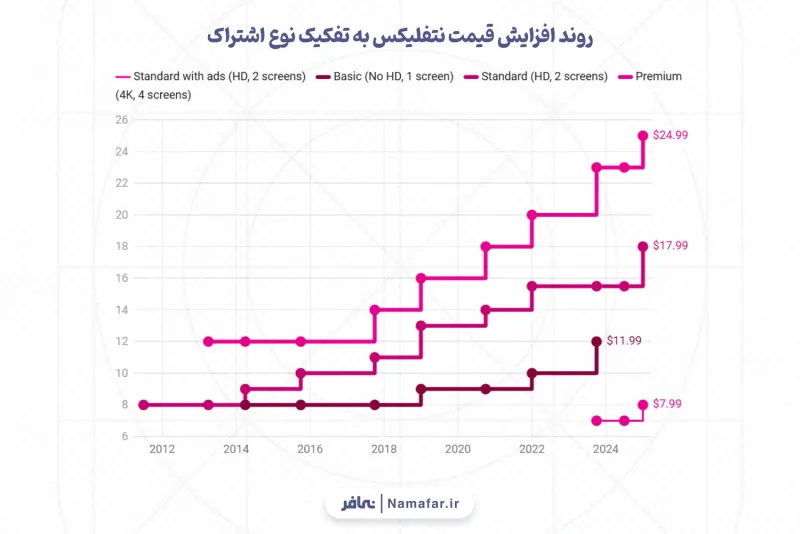
Every time Netflix raises its prices it always gives only one reason: they need more money so they can continue investing in the programs and products they offer to their 302 million subscribers. In this way, Netflix's standard monthly price without ads has risen from 7.99 dollars to 17.99 dollars over the past 13 years, which includes the recent 2.50 dollar increase in this company's earnings report as well. Of course the 7.99 dollar monthly plan still exists, but this plan includes ads and has become one dollar more expensive than last week.
Netflix: the winner of the VOD battle
Let's be honest! Do you want to know why Netflix continues to raise prices? Because it can! Because Netflix has won. The rest of the video streaming industry is competing intensely over a limited share of money, struggling with carriage disputes due to declining subscriber numbers, and panicking about the future of television. Netflix, however, is the future of television.
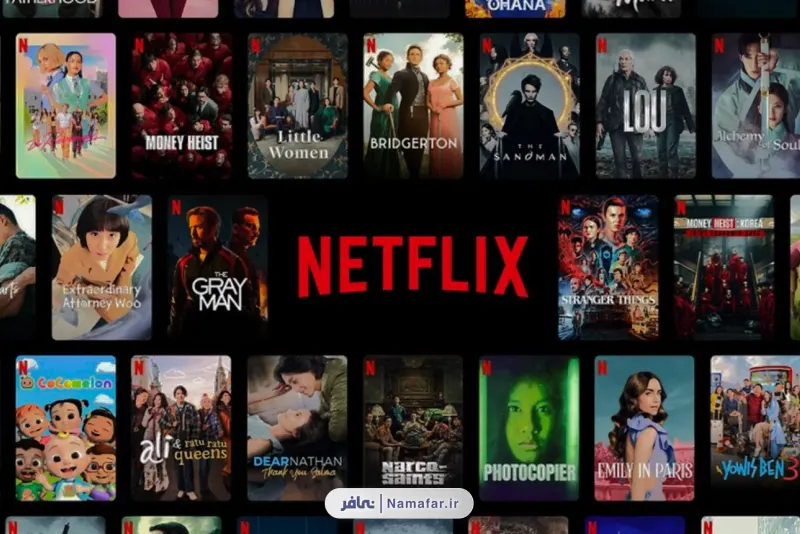
Over the past few years, Netflix has gone from an ordinary streaming service to an unavoidable and almost uncancelable part of cultural consumption. This company has produced a set of successful exclusive series such as "Stranger Things", "Wednesday", "Squid Game", and, if we want to be generous, "The Night Agent", which give it something resembling HBO's popular programming. Netflix has proven it can create cultural events almost from nothing, such as the Paul/Tyson fight and Tom Brady's comedy show. And beneath all of this it has also provided a vast library of reality shows, cooking competitions, and other television programs that fill most of our time.
A modern cable television
Now for the cost of a Netflix subscription you receive in one place a collection of expensive films, high-end television programs, sports, and low-budget reality programs. You may not want all of them, but you pay for them anyway. My friends! This is what is called a "cable bundle," and it is still the best business the entertainment industry has ever invented. (The phrase cable bundle refers to the traditional model of providing television services in which cable companies offer a set of various channels to their subscribers in the form of a package. In this model subscribers had to pay a fixed fee to have access to a set of channels, even if they were interested in only a limited number of them. These packages usually included sports, news, film, series, cartoon, and reality-show channels. In fact the writer notes with sarcasm that Netflix, which was once introduced as a modern and cheaper alternative to cable television, is now itself turning into a new cable bundle. With the difference that this time subscribers not only pay a similar (or even higher) fee, but they may also have to endure ads; something Netflix had initially promised to eliminate.)
Netflix's push to capture the entire entertainment consumption basket
The average price of a basic cable subscription in 2006, one year before Netflix started streaming content from the internet, was between 40 and 50 dollars. People watched television about four hours a day, meaning they probably saw about one hour of ads every day. Today services such as YouTube TV and Comcast's new sports and news bundle cost 70 dollars or more and only offer live programs. Meanwhile Netflix subscribers use this service two hours a day and freely browse across all categories and pay only one-tenth the price of old cable televisions. Many of them see no ads at all. (In fact the VOD audience still pays a lower cost than when they were a cable television consumer and receives a better service.)
Netflix certainly sees this as well. Greg Peters, the company's co-CEO, recently said he is optimistic about Netflix's "long-term monetization opportunity." He said: "We currently capture only 6 percent of the revenue opportunity in the countries and segments in which we operate. And as long as we continue to improve the variety and quality of our television programs and films and gradually offer newer content, we believe we can increase this share every year."
Translation: Netflix is coming for your entire entertainment diet. And your entire entertainment budget.
Peters also said that when raising prices, Netflix pays attention to signals such as engagement, customer retention, and acquisition. All of these come down to a simple question: When the price goes up, do you still use Netflix? The answer, so far, has been almost always yes. And so prices continue to rise. It really is that simple. It is clear to Netflix that it can charge more — perhaps much more — and almost no one will leave. So it is natural that it pushes the limits.
The popularity of the ad-supported subscription for Netflix
Another way to understand the details of the pricing strategy is that Netflix wants you to choose the ad-supported plan. The company has said repeatedly that from the combination of a lower monthly fee and ads, it earns more revenue than from a higher subscription fee alone. A large percentage of new subscribers also choose ads (about 55 percent in the most recent quarter) and Netflix has begun testing how much current subscribers are willing to pay to keep their Netflix without ads. It is no accident that the ad-free price has risen two and a half times more than the base price. And remember: even if all of us switch to ad-supported plans, prices may still rise. Cable television is expensive and full of ads, and Netflix definitely likes this business model.
Netflix's ambitions still have no end. Ted Sarandos, the company's other co-CEO, noted this week that after the success of the Christmas NFL games and the Paul/Tyson fight, the company is more interested in live sports broadcasting than ever. The company has also increasingly entered video games, which make up a large part of many people's entertainment budgets. Netflix has even begun using YouTube and TikTok tactics and has brought creators such as "Miss Rachel" onto its platform.
It is well known that Reed Hastings, Netflix's co-founder and former CEO, has said somewhere that Netflix's main competitor is sleep. Sleep is still a powerful market force. And of course YouTube remains an even more dominant force in people's video-watching experience. But Netflix has risen almost above everyone; even its apparent rivals now sell their programs to Netflix, because the viewers are there, and the culture is there. The streaming wars have been chaotic and are certainly not over; but Netflix has already won! The only remaining question is exactly how large the spoils of victory will be. And you had better believe that Netflix intends to find that out.
Machine-translated from Persian by Namafar; the Persian original is authoritative. Read the original in Persian