In the ups and downs of life, sometimes one must tighten the screws on certain matters and take a firm stand against some things, or, if they are to be allowed through, they must first be fully identified and examined, and only then granted passage. But in some cases, people realize that past strictness may not have been necessary and that a little leniency can bring greater benefits. The story of the visa in our time has become similar to this allegory: there was a time when we needed its serious and intense presence, but the next day it had become an obstacle to many benefits.
History of the visa
To better examine the visa, we must turn to the history of its emergence and that of its older sibling, the passport. In antiquity, travel documents were not particularly uncommon, and by referring to ancient texts such as the Bible we find that it was Artaxerxes, king of the Persians, who first issued documents to Nehemiah (one of the Jewish prophets) authorizing his passage and travel to the kingdom of Judah or former Babylon. In the Middle Ages, documents resembling today's passports were issued by local authorities for the safe travel of certain trusted individuals and were known as "letters of safe conduct" and "safe conduct." These documents laid the groundwork for the passport and visa in their modern form.At the beginning of the nineteenth century, with the consolidation of the concept of nation-state borders, rules on movement between territories as well as immigration became stricter. First the passport became a common travel document, and later, in 1855, Britain, by introducing the term and law of the "visa," added a conditional endorsement from its government to the passport, and other countries welcomed this trend and added the visa to their laws. In the twentieth century, with the development of means of transport, the number of travelers increased sharply, and this made it harder to inspect traditional passports. After World War II, because of the sensitivities that had arisen, holding both a passport and a visa was required for international travel. Gradually, however, as these security sensitivities faded, the passport became the principal travel document and the visa was relegated to a secondary document.
The trend of visa liberalization in the new post–World War II order
After World War II a new order came to govern the world, and with the easing of some restrictions in order to improve domestic economies, increase tourism, and develop regional and global cooperation, the trend of visa liberalization began. The start of this trend can be traced to the mid-1960s in the Scandinavian countries. In 1952, the Nordic Passport Union was established, allowing citizens of Denmark, Finland, Iceland, Norway, and Sweden to travel and reside in any of the Nordic countries without a passport or visa. This agreement was fully implemented in the 1960s.In the 1980s, the process of European integration began about forty years after the bloody world war among these countries. The European Economic Community (EEC), which later became the European Union (EU), began to facilitate easier travel among member states. The Schengen Agreement, signed in 1985 and implemented in 1995, was a turning point in this process. This law made it possible to abolish internal border controls among participating countries and enabled passport-free and visa-free travel within the Schengen Area.
In the 1990s we witnessed the start of the globalization current as well as increased regional cooperation. With the expansion of the European Union, the Schengen Area also expanded and encompassed more European countries, significantly increasing the number of countries with visa-free travel requirements. In the Americas, the North American Free Trade Agreement (NAFTA), which came into effect in 1994, facilitated easier travel and commercial movement among the United States, Canada, and Mexico. Similarly, the Southern Common Market (Mercosur), established in 1991, promoted freer movement among member countries in South America.

From the beginning of the new millennium to the present, the facilitation of visa-free travel has been proceeding at a faster pace. In Southeast Asia, the Association of Southeast Asian Nations (ASEAN) has taken steps toward visa-free travel for its member countries. Various bilateral agreements within ASEAN have facilitated easier travel. The Persian Gulf Cooperation Council (GCC) countries, including Bahrain, Kuwait, Oman, Qatar, Saudi Arabia, and the United Arab Emirates, have agreements that allow their citizens visa-free travel within the GCC region. Various African and Latin American countries have also pursued regional agreements to facilitate visa-free travel. For example, the Economic Community of West African States (ECOWAS) allows visa-free travel for citizens of its member countries.
Visa-free travel and passport value rankings
As noted, after World War II the visa was regarded as a secondary travel document and the passport as the primary and essential document, and for various economic and political reasons visa liberalization was placed on governments' agendas as a fundamental policy. From the mid-2000s onward, ranking each country's passport had become an important matter. Every citizen naturally wanted to know how much their country's passport was worth to other countries in the world. Such a ranking naturally required a criterion, and what criterion better than travel without the need for a visa, or visa-free travel? The lifting of visas for countries in their own region or at the global level indicated mutual trust between those two countries; this means the counterpart country has such security, political, and economic stability that a strict permit is not needed for the entry of its travelers.In this connection, Henley & Partners in 2005, by establishing the Henley Passport Index website, began ranking the passport value of the world's countries. The institute's only main indicator for assessing passport value was travel to another country without the need to obtain a visa, or visa-free travel. Its scoring method is as follows: if a country's passport holder does not need a visa to travel to another country, one point is received; conversely, for the need to obtain a visa or another permit from the origin and before traveling to another country, a score of zero is calculated. In this way, the score given to a passport is a sign of the number of countries to which the passport holder can travel without needing to obtain a visa before arriving at the destination. In the table below you see the countries with the highest and lowest scores on the Henley Passport Index.
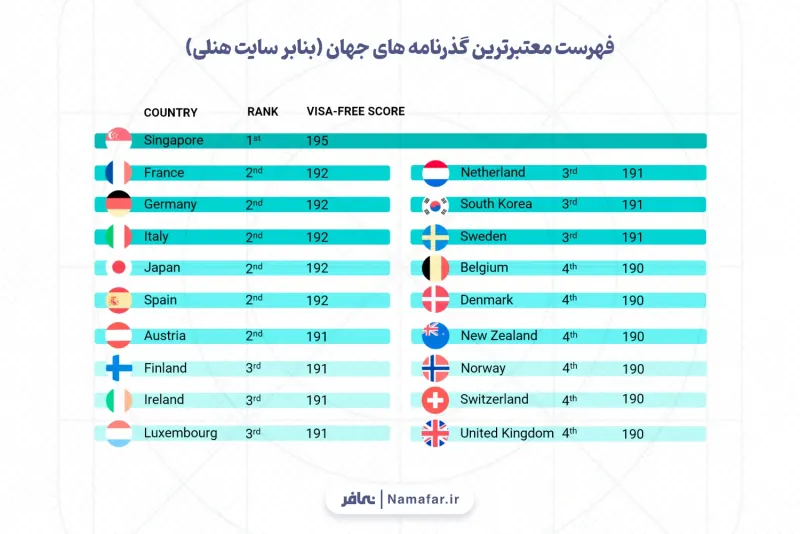
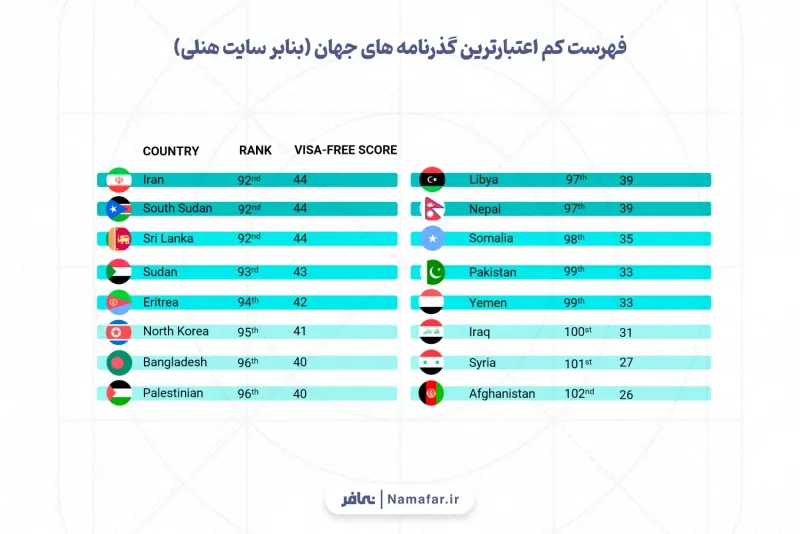
As you see in the charts above, Singapore's passport is the world's most powerful passport in 2024 according to the Henley website, meaning that with a Singaporean passport one can travel visa-free to 195 countries. When we reach the end of this long table, we come across several West Asian countries that have mainly been involved in war over the past twenty years and whose passports do not enjoy good standing. Afghanistan stands last in this ranking. Iran, together with several other countries, stands in 92nd place in this ranking, and with an Iranian passport one can travel visa-free to only 44 countries.
After the Henley Institute, other institutions took steps to rank passports, the most important output of which is the Passport Index website (passportindex.org). One of the criticisms made of the Henley ranking was its excessive oversimplification, caused by having only one criterion (visa-free travel) for valuation. The Passport Index website's valuation shares one element with the Henley Institute, namely that its basic criterion for valuation is also visa-free travel or travel without a visa. But it differs in two elements: first, that it also uses other criteria for ranking, and second, that besides examining the global standing of the passport, it also provides other classifications for the audience. The Passport Index website's four criteria for valuation are:
- Visa-free travel score (visa-free).
- Admission score: the passport identifier awards one point to every country that allows visitors to itself to enter without a visa. The country with the highest number admitted is the world's most welcoming country.
- Global free-travel score: a criterion that shows the freedom of travel among countries. This score rose from 17 904 in 2015 to 20 743 in August 2019. The maximum score for this criterion is 39 402. Because if visa-free travel among all 199 countries of the world is free, then 39 402=199×199.
- Global mobility score: a criterion for showing the degree of an individual's freedom of movement with one or more passports. A higher score indicates increased freedom of movement.
This website also has several other rankings that are calculated with high precision:
- Global passport power ranking: the world's passports are ranked based on the sum of the visa-free travel score. Countries that receive equal scores stand in the same rank.
- Individual passport power ranking: data obtained from the Human Development Index is used for greater convergence and to create a comprehensive ranking.
- Ranking of welcoming countries: the passport index ranks countries based on their admission of people from other countries.
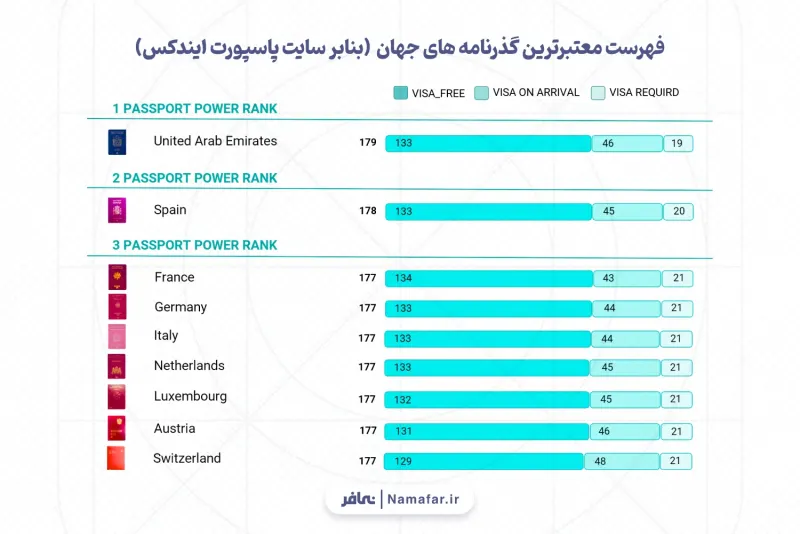
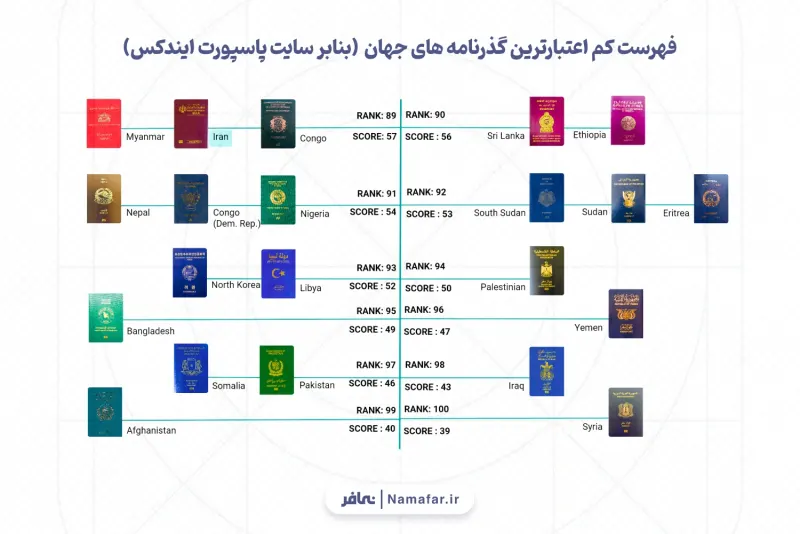
As you observe in the charts above, the UAE's passport, by obtaining the highest score according to the Passport Index website's four criteria, has been placed first among the world's most powerful passports. Russia's passport is last in the Passport Index ranking. Iran's passport situation according to these two rankings is also not favorable.
Benefits of visa-free travel for travelers and destination countries
The popularity of visa liberalization policy among governments leads us to ponder the why and the cause of this development. Naturally, there are benefits in this policy that have made it so well received. Among the benefits of visa-free travel for travelers, the following can be mentioned:- Easier trip planning: Visa-free travel eliminates tourists' need to go through complex visa application processes, reduces administrative barriers, and simplifies trip planning. Tourists visiting visa-free countries have the flexibility to change their travel plans without the constraints of visa-related commitments.
- Saving time and money: This simplicity saves tourists time and effort and allows them to focus on enjoying their travel experience instead of navigating complex administrative processes.
- Spontaneity and flexibility: Tourists can make impromptu travel decisions and explore new destinations at will, because they are not constrained by a lengthy visa approval timetable. Last-minute trips also become possible, and visa-free access can encourage tourists to extend their stay, because they do not face the restrictions and time-consuming processes associated with extending or renewing a visa. This flexibility can lead to increased tourist volumes throughout the year.
- Enhanced tourism experience: The absence of visa-related complexities allows tourists to focus on enjoying their travel experience, engaging more deeply with local culture, and creating lasting memories.
Besides the benefits of visa waiver for travelers, these policies also have multifaceted benefits for the destination country, several of which we mention:
- Increased tourism revenue: Visa-free travel often leads to increased tourist arrivals and contributes significantly to the destination's tourism revenue.
- Economic stimulus for local tourism industries: Hotels, resorts, and other accommodation providers benefit from a greater influx of tourists. Increased demand for accommodation often leads to higher room rates, occupancy rates, and overall revenue for the hospitality sector. In addition, the influx of tourists drives economic growth by creating job opportunities and boosting entrepreneurship in the tourism sector, which in turn increases demand for ancillary services such as transportation, tour guides, and local transit. This can have a significant impact on other industries such as hospitality, transportation, and retail.
- Positive image and global appeal: Destinations that offer visa-free travel are perceived as more welcoming and more open. The more positive people's image of a country is, the more the likelihood of traveling to it increases; this positive image increases the country's global attractiveness, attracts a diverse range of visitors, and strengthens international relations.
- Cultural exchanges: Visa-free travel facilitates cultural exchange and mutual understanding between tourists and local people. The easier it is to travel to a place, the more likely intercultural interaction naturally becomes.
Classification of visa-free countries for global tourists
We said earlier that many countries have adopted a visa liberalization policy, but it should be borne in mind that not all of these countries have liberalized their visas in the same way, and there are various types among them, the most important of which we mention:1. Completely visa-free countries:
Completely visa-free countries allow travelers to enter and stay in that country for a specified period without the need for a visa. These destinations are ideal for tourists who prefer direct entry without prior arrangement. Countries such as Japan, Thailand, and Brazil fall into this category.For example, Japan offers visa-free entry to tourists from more than 68 countries for stays of up to 90 days. This policy has made it an increasingly popular destination for international travelers seeking to immerse themselves in its rich cultural heritage and advanced technology. Similarly, Brazil's visa-free policy for citizens of many countries makes it an attractive destination for exploring vibrant festivals and stunning natural landscapes.
2. Countries with visa on arrival (VoA):
Countries with visa on arrival (VoA) simplify the visa process by allowing travelers to obtain their visa after arriving at the airport or border crossing. This type of visa-free travel combines the ease of not needing to apply in advance with the assurance that permission is granted. Countries such as Indonesia, Nepal, and Jordan offer these services and give tourists the flexibility to travel with minimal prior planning.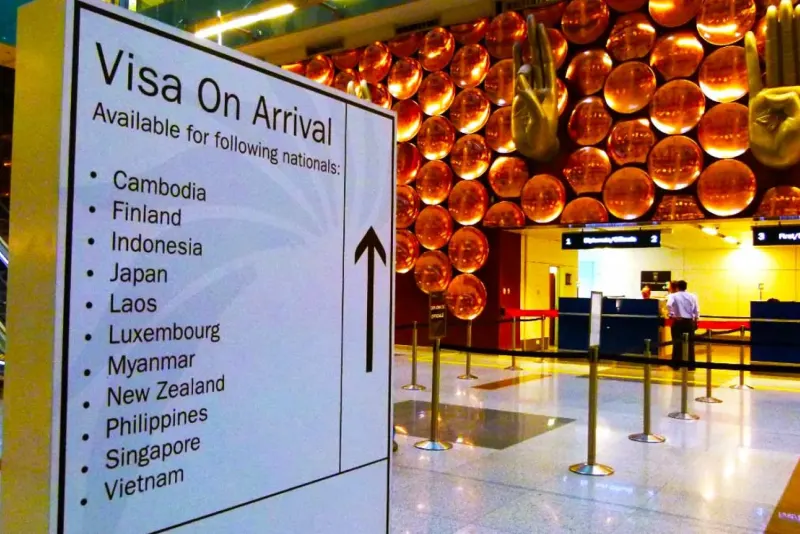
3. Countries with eVisa:
Electronic visas (eVisas) represent a modern turn on traditional visas and offer a simple online application process that can be completed before travel. This approach combines the benefits of visa-free entry with the security of having a pre-approved travel authorization. Countries such as Turkey, India, and Kenya use visa systems that make it easier for tourists to enter without visiting an embassy or consulate.4. Schengen Area countries:
The Schengen Area is a unique example of regional visa-free travel, comprising 27 European countries that have abolished internal borders and allow free and unrestricted movement for travelers within this area. Tourists who hold a Schengen visa can travel to all member countries without an additional visa.5. Countries with reciprocal visa-free agreements:
Reciprocal visa-free agreements between countries allow citizens to move freely between them without the need for a visa. These agreements often reflect strong diplomatic and economic relations. Examples include the agreement between Canada and the United States, which allows their citizens to cross the border without a visa for tourism and business purposes, and a similar agreement between Australia and New Zealand.6. Special economic and tourism zones:
There are certain zones in some countries that operate under visa rules differently from their parent countries and often allow visa-free entry to promote tourism and economic activity. Examples include Hong Kong and Macau in China, which offer visa-free entry to visitors from many countries, even if mainland China requires a visa.Diverse government measures toward visa liberalization
Visa liberalization policy aimed at improving tourism is currently among the popular policies in tourism industry policymaking in the world. This policy is implemented in different ways; for example, one of them is eliminating the visa for all of the world's tourists at once. In late 2023 Kenya eliminated the visa for entry into this country. Kenya's president, William Ruto, announced that from January 2024 foreign travelers do not need a visa to enter this country. However, the need for a permit to enter the country has not been completely eliminated. Travelers who want to enter this country must go to a digital platform and through it obtain a permit to enter this country, which eliminates the need to obtain a visa. Ruto, at the ceremony commemorating the sixtieth anniversary of this country's independence held in the United Kingdom, said: "No longer does anyone from every corner of the world have to bear the burden of obtaining a visa to enter Kenya." Kenya had previously made visa-free entry possible for residents of African countries and has now provided this possibility for all countries.Limited visa waiver in recent years is considered one of the effective measures for increasing tourists. At the beginning of this year Thailand made visas free for Indian tourists for a limited period. The duration of the visa-free scheme was until 10 May, but the very high interest from Indians led Thailand to extend this scheme for another 6 months. During the period when the visa was free for Indian tourists, the number of trips between these two countries increased by 50 percent. In May, the number of searches for Thailand on ticket and hotel booking websites had also increased by 90 percent compared with the previous year.

The government of the Islamic Republic of Iran has also not fallen behind the train of countries that are liberalizing visas and in recent years has applied these policies. The latest resolution of Iran's Ministry of Foreign Affairs providing for travel by nationals of 28 countries to Iran without the need for a visa has been in effect since 15 Bahman (January–February) 1402 (2023/24). These countries include Saudi Arabia, Qatar, the UAE, Bahrain, Kuwait, Uzbekistan, Kyrgyzstan, Tunisia, Tanzania, Mauritania, Zimbabwe, Mauritius, the Seychelles, Japan, Indonesia, Singapore, Vietnam, Cambodia, Brunei, Brazil, Mexico, Peru, Croatia, Serbia, Bosnia and Herzegovina, and Belarus. Nationals of these 28 countries can travel to Iran without a visa once every 6 months for up to 15 days. Iran had previously waived visas reciprocally with five countries, Georgia, Armenia, Turkey, Syria, Iraq, and Kazakhstan, and for nationals of Azerbaijan, China, Hong Kong and Macau, Oman, Egypt, Bolivia, Venezuela, Malaysia, and Lebanon this visa waiver had been implemented unilaterally or in airport form in past years.
If we want to examine more precisely the impact of these policies on tourism, we must note that studies by the World Tourism Organization and the World Travel and Tourism Council in 2012 showed that visa facilitation policies can lead to a 5 to 25 percent annual increase in tourist arrivals.
Countries that adopt visa-free policies usually see a significant increase in the number of tourists. For example, after the implementation of China's visa-free policy on 1 December 2023, the daily number of tourists from France, Germany, Italy, the Netherlands, Spain, and Malaysia in the first three days of that month increased by 39 percent relative to the last day of November.
The impact of visa-free policies shows a lasting effect. For example, Vietnam saw a 20 percent increase in tourists from Italy, Germany, Spain, the United Kingdom, and France over the 9 months after applying visa exemptions in 2018, and this year-on-year growth has remained steady.
Conclusion
Today we live in a crowded and tumultuous world in which humanity's international interactions take place more every day than the day before. In such a world the role of global comings and goings has become very prominent. Naturally this development requires abundant international travel carried out with various purposes. On the other hand, tourism itself has gradually become a profitable global industry, and countries have a great desire to attract tourists with diverse purposes to their country. In this regard, visa liberalization policy plays an important role in removing barriers to attracting tourists, such that at present the most important indicator of a passport's standing is the number of countries that can be traveled to visa-free with that travel document. Iran has taken important steps in visa liberalization policy, but to make Iran's passport respected for other countries of the world we have a long road ahead, and the experiences of other countries can be a guide for us.Namafar invites you to read the highest-earning countries in the tourism industry.
Machine-translated from Persian by Namafar; the Persian original is authoritative. Read the original in Persian