Staying current is vital for every business in the tourism industry, whether in hospitality, transport or entertainment. Customers and tourists expect to be offered the latest innovations. Although fashion is unstable, some travel trends set the industry's overall direction; identifying and adopting these trends is essential to remaining in the competition.
First: personalization
Personalization is currently one of the hottest travel trends, especially in marketing, where in today's data-driven world it has gradually become easier. At the same time, the topic is growing more important by the day. Personalized marketing takes data about a customer and uses those data to build and deliver ads tailored to that same customer. A simple example is the targeted ads that appear in your browser when you visit certain sites; these ads use information from your web searches and previous purchases, and thus show you products you are likely to be interested in. A frequent traveler may be offered airplane or train tickets, or useful gadgets such as an adapter, a power bank (portable charger) or noise-canceling headphones (ear protection).
A frequent traveler may be offered airplane or train tickets, or useful gadgets such as an adapter, a power bank (portable charger) or noise-canceling headphones (ear protection).
Second: business-leisure travel
Business-leisure travel is a trip taken both for work or business and for leisure. Although this type of travel is not among the newest travel trends (turning a business trip into time for leisure at the destination is as old as business travel itself), the new generation has embraced it strongly. For a budget-conscious tourist under 40, combining business and leisure is the most useful way to visit places they could not otherwise afford. The newest form of business-leisure travel is the "digital nomad" phenomenon. A "digital nomad" is someone whose life is spent traveling, who has no fixed place (home) to live, and who earns an income through the internet and technology.
Third: recognition technology
In general, the technologies used to identify people are called recognition technology. One of the best-known is facial recognition, which is used in some airports to speed up passport control, or, as another example, unlocking a mobile phone and other devices with a fingerprint.
Another example in identification technology is voice control, in which voice commands are used for control; for example, systems in hotel rooms including lighting, heating, entertainment and so on. A voice-control system can be set to respond to any speaker; it can also be limited so that only specific people can control it.
Fourth: robots
Automation is one of the main travel trends; tasks that were once done by humans are now carried out by robots. A familiar example of automation is chatbots, which are used in many industries worldwide; these bots are designed to help people find and book tours, transport and accommodation by asking a series of questions. A more complex example is "staff" robots used in hotels at reception or even to serve food and drinks. In the future, robots in the form of driverless cars will become one of the biggest travel trends.
Local food is one of the main features of many trips, and many tourists like to try these new dishes.
Fifth: ecotourism
There was a time when tourists expected to stay in their rooms while traveling, eat the same food they ate at home and socialize with their own compatriots; that time is over. No longer is the only thing that distinguishes the destination from our home a different climate and the view from the hotel balcony; today tourists want to get to know local people, their culture and their land. Local food is one of the main features of many trips, and many tourists like to try these new dishes. Local experiences are a unique selling point for trips, and modern tourists are eager to see local traditions and take part in them.
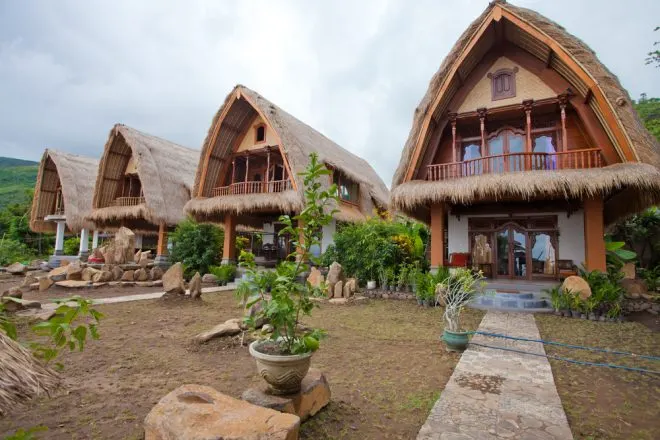 With ecotourism, one can enjoy tourism without harming the environment.
Sixth: artificial intelligence (AI)
Various forms of artificial intelligence are currently used in the tourism industry around the world. Some of the chatbots mentioned earlier use an AI system so that many sales and customer-service tasks are done automatically, simply and effectively. Because customers like to receive answers more quickly and also expect more interaction, chatbots take on this role when a human agent is not available. Although chatbots have limits in what they can do, they can provide useful information to customers. Machine learning allows these systems to learn from every interaction and improve continuously. Artificial intelligence is also currently used in data collection and analysis (an important tool for increasing productivity, security and customer satisfaction).
Seventh: the Internet of Things (IoT)
IoT has gradually moved from a scientific curiosity to one of the most important trends in the tourism industry. The use of internet-connected devices controlled by smart devices has gradually become common. IoT has now spread into every aspect of the tourism and travel industry, from iPad tablets used to provide information for museum-goers to smart hotel rooms whose lighting and HVAC systems are controlled by voice commands. Since Amazon introduced a hospitality version of Alexa, its popular virtual assistant, this trend has firmly established itself in the tourism industry. Guests can use the hospitality version of Alexa to control their room environment, book gym sessions at the hotel club or book the spa, and request services.
Air travelers are allowed, when booking a flight, to buy "carbon credits" to offset environmental impacts
Eighth: economic travel
Today, customers are more concerned about economic issues than in the past, and current trends point to the same thing. Airlines, tour operators, car-rental companies, hotels and all businesses related to the tourism industry have embraced this trend. This trend will become more and more common in the future as well. Some changes in this area have been small and relatively simple, including allowing air travelers, when booking a flight, to buy "carbon credits" to offset environmental impacts. As another example, car-rental companies now rent out electric cars, or even offer tourists only electric cars for rent. Hotels and accommodations around the world are also turning more and more to sustainable technology.
Ninth: virtual reality
Virtual reality was at first only a recreational activity, but it has gradually become a useful tool for tourists. Besides giving tourists an entertaining and impressive gaming experience, the use of VR also makes it easier to plan a trip and examine destinations before traveling there. Virtual reality can be used to enrich the process of visiting historic sites, by reconstructing ancient buildings and other surrounding structures. Virtual reality can be used for "urban marketing" to encourage potential tourists to choose a particular destination. Other uses of VR include interactive virtual maps or virtual-reality hotel tours / 360-degree virtual-reality video tours for a full visit of the hotel.
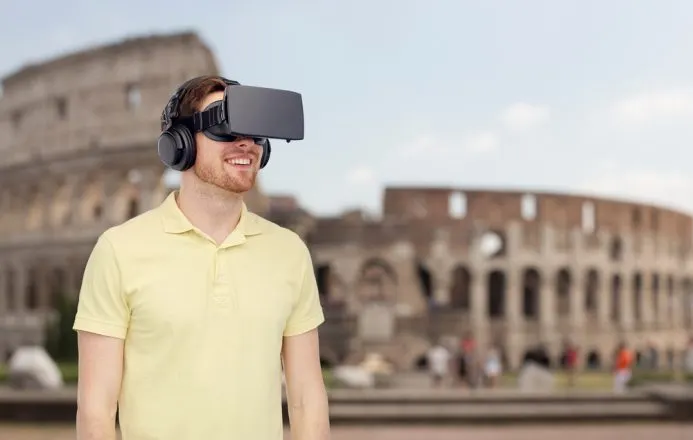 Virtual reality can create a new type of tourism.
Tenth: augmented reality
Augmented reality (AR) is very similar to virtual reality. Augmented reality is a combination of virtual elements with real-world experiences. One augmented-reality travel trend involves visiting a museum, in which visitors can see objects and structures in the real world, then view them as reconstructed and placed in their original space and structure; for example, the pyramids of Egypt with a virtual overlay of their original colors. Virtual reality can be used to provide information about the place the visitor is touring (cultural or historical data, or lists for entertainment and travel). Virtual reality can be realized easily using common devices such as smartphones, devices that will soon make these travel trends even more widespread.
Eleventh: healthy and organic food
Travel and healthy food were, in the past, mutually exclusive concepts, but that is no longer the case. Customers who care about their health are making such trends more widespread. These customers increase demand for foods linked to a particular diet. Groups such as vegetarians, vegans, and people who must avoid gluten, lactose and other common allergens are now served better than in the past. Hotels and accommodations combine travel and wellness by offering new and innovative dishes, often prepared with fresh local ingredients and regional recipes. Some accommodations also focus on specific goals such as weight loss. Food-related travel trends also emphasize organic food production.
Twelfth: customer experience
In the modern tourism industry, enriching the customer experience is vital. Customers have more choices than in the past, so it is fair to say that customer loyalty and satisfaction have gradually become important. All of the strategies and technologies mentioned play a role in creating a positive customer experience, from chatbots used to book travel, to the food that is prepared and served, smart devices in hotel rooms, and AR apps that help guests navigate their destination; all of these strategies and technologies make the customer feel better about their trip and stay. In general, when adopting a new trend, we should ask ourselves: "How can the customer experience be improved"?
The use of technology in tourism
The important uses of technology in tourism are obvious to everyone. With the help of technology, we can even bring those who stay at home along on a remarkable tourism experience. Technology helps the tourism industry offer more and more personalized experiences and, in this way, engage a larger audience. By visiting Namafar you can get familiar with up-to-date statistics on the world of tourism.
Machine-translated from Persian by Namafar; the Persian original is authoritative. Read the original in Persian