With the striking rise in demand for Muslim travel, which will reach 245 million trips by 2030, leading countries in halal tourism have invested extensively in key indicators such as "communications". In this context Iran, despite an improvement in its overall score, has fallen behind competitors because of weakness in the communications indicator—including destination marketing, communication skills, and stakeholder awareness. The result is that Iran in the 2025 ranking has obtained ninth place among Muslim-friendly destinations and in the communications indicator has also obtained a disappointing score of 75 out of 300; a considerable gap with the leading countries that turns effective tourism marketing into a serious challenge. But why has Iran fallen behind in this competition, and how can it close this gap?
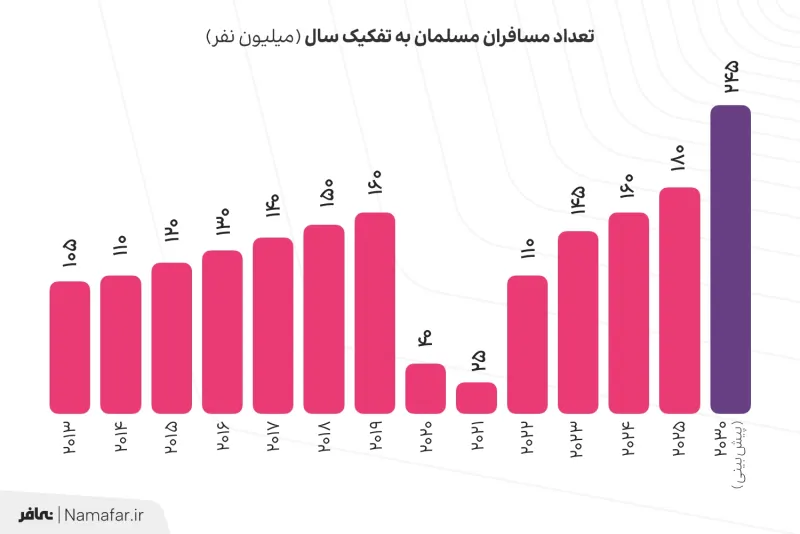
From 108 million to 245 million; growth of the Muslim travel market through 2030
The 2025 Global Muslim Travel Index (GMTI) international report has been prepared in cooperation with "Mastercard" and the "CrescentRating" institute and is considered one of the world's most authoritative sources on Muslim tourism and halal travel. According to this report, the number of Muslim tourists on international trips rose from 108 million people in 2013 to 160 million people in 2019. The COVID-19 pandemic caused a sharp drop in this figure to 42 million people in 2020, but by 2024 it has again reached 176 million people. According to forecasts, this amount will reach about 245 million trips by 2030 and total Muslim travel spending will also reach the threshold of 230 billion dollars. The rising trend of Muslim travel shows that halal tourism has found a growing share in global travel statistics. This global trend has pushed many countries to invest in facilities suitable for Muslims—from halal food to prayer rooms. Also, the strong presence of a new generation of Muslim tourists (relying on digital tools and authentic experiences) promises a bright future for Muslim tourism.
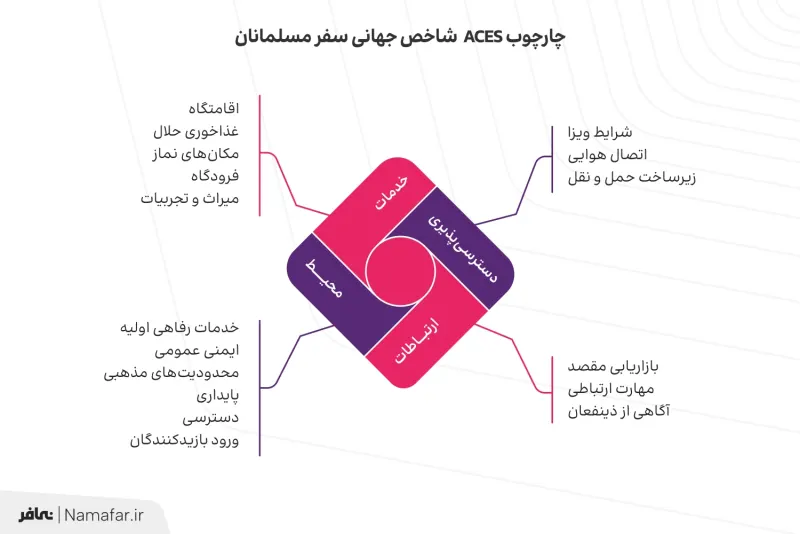
The ACES framework; four pillars of halal tourism
The ACES framework is a four-axis measure (access, communications, environment, services) in the Global Muslim Travel Index that assesses how Muslim-friendly destinations are. Today halal tourism is facing striking growth (176 million Muslim trips recorded in 2024). In such a setting, ACES has gained importance as a key tool for assessing and upgrading the travel experience of Muslims.
Access: ease of travel from origin to destination
The "access" criterion refers to how easily Muslim travelers can reach a destination. Factors such as direct and numerous flights, the quality of roads and domestic transport, and the ease of obtaining a visa are assessed in this section. Destinations that obtain a high score on this axis (for example Malaysia with a strong transport network and facilitated visas) make travel smooth and worry-free for Muslim tourists.
Communications: a bridge of interaction with Muslim travelers
"Communications" measures a destination's ability to establish effective communication with Muslim travelers. Command of languages common among Muslims (English, Arabic, Persian, and others) and the provision of comprehensive information about halal services and Muslim-friendly attractions are components of this axis. Also, local businesses' awareness of the needs of Muslim tourists creates a more welcoming environment and a more pleasant experience for travelers.
Environment: a safe and compatible space for halal travel
"Environment" addresses the destination's overall atmosphere and conditions in terms of compatibility with the cultural-religious needs of Muslim travelers. High public security and the absence of restrictions on performing religious rites (such as the lack of a ban and the freedom to observe hijab) are considered important factors in this section. Also, a high number of inbound Muslim tourists indicates the destination's acceptability, and sustainability efforts (reducing pollutants, using clean energy, preserving cultural heritage) help improve the space for halal travel.
Services: halal facilities at the destination
The "services" criterion assesses the range and quality of services specific to Muslims at the destination. The presence of enough mosques and prayer rooms, an abundance of diverse halal restaurants, Muslim-friendly facilities at airports, and accommodations compatible with Muslims' needs are among the indicators of this section. Also, access to historical and cultural attractions related to the Islamic world can enrich the travel experience of Muslim tourists.
The ACES framework ultimately helps destinations identify their strengths and shortcomings in the field of halal tourism and plan to improve them. Focusing on the four ACES axes makes the Muslim travel experience more comprehensive and more pleasant. In this way, the future of "halal tourism" will be brighter with destinations that are more Muslim-friendly, more inclusive, and more responsive to the needs of Muslim travelers.
The 10 top halal tourism destinations in 2025; tight competition and Iran's position
The Global Muslim Travel Index report, with a comprehensive analysis of 153 destinations (member countries of the Organization of Islamic Cooperation), has presented a comprehensive picture of the state of tourism and halal travel. According to the Global Muslim Travel Index report, Malaysia with a score of 79 stands at the top of the leading halal tourism destinations in 2025, and Turkey, Saudi Arabia, and the UAE with a score of 78 are jointly second. Indonesia and Qatar with a score of 76 are fifth, Oman and Kuwait with a score of 74 are seventh, and Jordan and Iran with a score of 73 are ninth. Oman and Kuwait, with a notable jump in score, have again returned to the group of 10 top destinations, while Indonesia, despite maintaining its previous score, has dropped in rank because of competitors' progress.
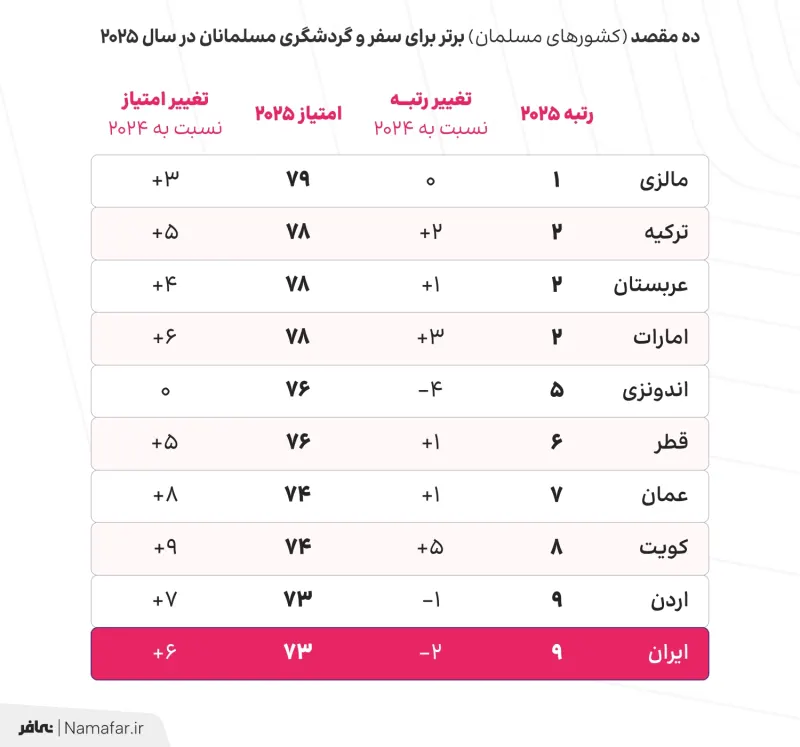
According to this report, Iran in 2024 had a score of 67 and in 2025 has reached a score of 73. But despite a 6-point increase in Muslim travel indicators, we are witnessing a 2-place drop in Iran's position in this ranking relative to last year and its placement in ninth rank jointly with Jordan. A notable increase in the average score of tourism destinations and continuous progress in providing services to Muslim travelers has been the main reason for this outcome. This is while Iran has potential in the Muslim travel and tourism market and can play a pivotal role in tourism and halal travel.
Competition among the 10 top halal tourism destinations and Iran's challenge in the communications indicator
In 2025, notable shifts occurred in the ranking of Muslim-friendly destinations. Countries that have strengthened halal tourism services and created a safer environment for Muslims have risen in the ranking, and by contrast destinations with slower progress have dropped in rank. For example, Oman and Kuwait, by improving their facilities and services, have once again entered the group of 10 top destinations; while Indonesia, despite a stable score, has fallen several places because of the rapid progress of its competitors. Each country's overall score is determined on the basis of four key indicators—access, communications, environment, and services—which shape Muslims' travel experience. Competition among countries over upgrading indicators such as services (from the provision of halal food and facilities to accommodations) and environment (security, sustainability, and cultural atmosphere) has now intensified greatly.
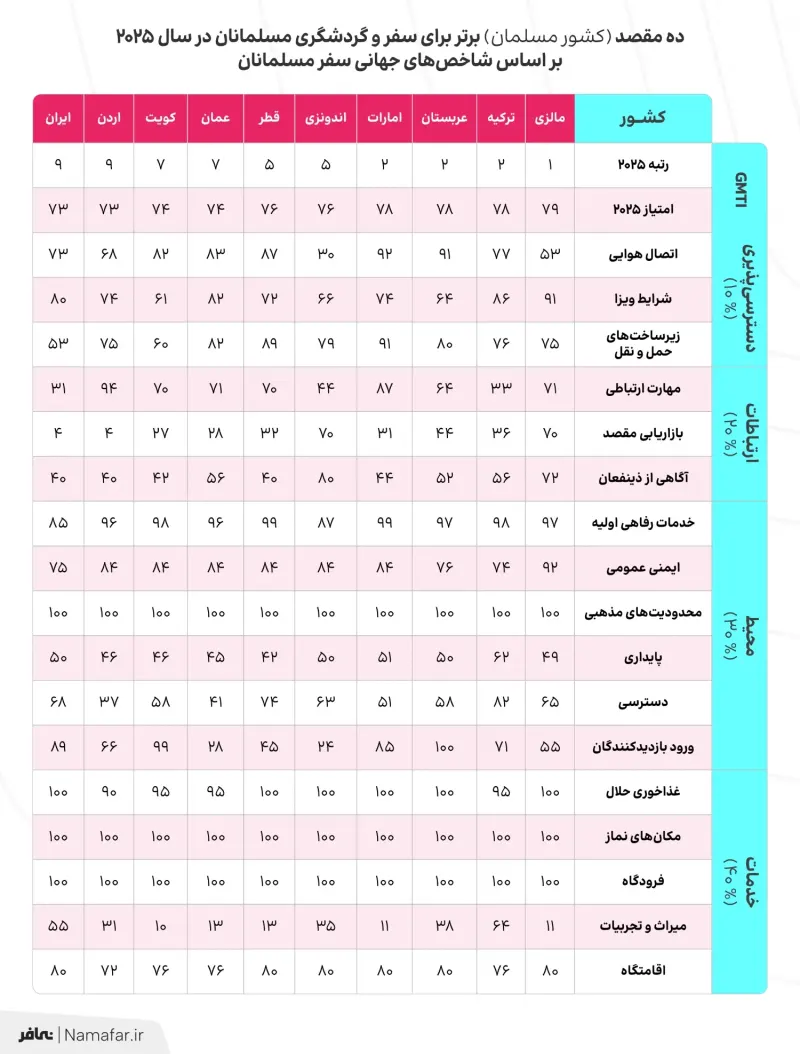
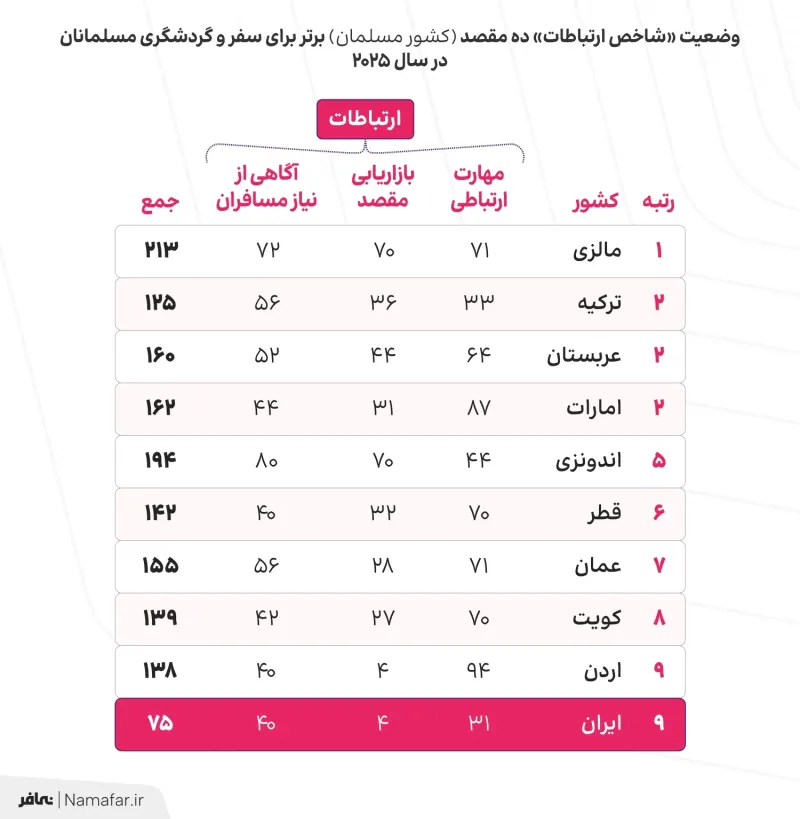
Iran's position, despite an upgrade of the overall score to 73 (6 points higher than last year), is still not satisfactory because of weakness in the "communications" indicator (including marketing, stakeholder awareness, and communication skill). Iran has obtained only a score of 75 out of 300 on this indicator, which is a stark difference from the ten top destinations, and marketing, advertising, and effective communication with foreign tourists are still considered the missing links in the country's tourism development.
Weakness in marketing and communication; the missing link in Iran's tourism
"Communications" is one of the 4 indicators for ranking the top destinations for Muslim travel and tourism. The communications criteria assess a tourism destination's ability to establish effective communication with Muslim travelers and market to them. This indicator includes three dimensions:
- Communication skill: It assesses the extent to which the destination uses the 10 languages most used among Muslim travelers.
- Destination marketing: How the destination introduces and advertises services compatible with Muslims' needs.
- Awareness of travelers' needs: It measures the awareness of government bodies, tourism companies, and local communities of the needs of Muslim travelers.
As noted, Iran on the communications indicator, with a score of 75 out of 300, has a stark difference from the ten top destinations (Muslim countries) for Muslim travel and tourism in 2025. Marketing, advertising, and communication with foreign tourists are the missing links in Iran's tourism development. This communications shortcoming has directly lowered Iran's final rank and, despite relative improvement in the areas of services and environment, has caused the country to fall behind in competition with other Muslim-friendly destinations.
Closing remarks
Although Iran in 2025 is still among the 10 top halal tourism destinations, its position is shaky because of weakness in the "communications" indicator. Despite an upgrade of the overall score (from 67 in 2024 to 73 in 2025), Iran has fallen to ninth rank jointly with Jordan, the most important cause of which is the low communications score (75 out of 300). Diagnoses show that shortcomings in destination marketing, the lack of effective multilingual communication, and the low awareness of tourism industry actors of the needs of Muslim travelers are among the main factors in this lag. With unique cultural and religious capacities, Iran has the potential for a leap in this field. Adopting new approaches in halal tourism marketing, training in multilingual communication skills, raising awareness among tourism industry actors, and an active presence in international Muslim markets can strengthen Iran's communications capacity. With such transformations, Iran will be able to reduce its gap with competitors and obtain a more fitting share of the growing Muslim travel market.
Machine-translated from Persian by Namafar; the Persian original is authoritative. Read the original in Persian