Can a destination’s being cheaper, by itself, attract tourists? This is a simple but decisive question from which one must begin in order to understand Iran’s place in the region’s tourism competition. In the geography of West Asia, where distances are short, cultural commonalities are extensive, and destinations are diverse, the choice of a travel destination no longer depends merely on the price of a ticket and a hotel. This region today hosts a set of large and growing players in the tourism industry: from Turkey, with its several-decade experience in attracting European and Arab tourists, to the UAE, Saudi Arabia, Qatar, and even the Republic of Azerbaijan, each of which, with heavy investment in infrastructure and a national brand, is seeking a larger share of the Middle East tourism market.
In the midst of this intense competition, Iran faces a unique but to some extent contradictory position. On the one hand, it is a country with unmatched cultural, climatic, and historical diversity, costs far lower than those of its neighbors, and extensive cultural commonalities with the nations of the region. On the other hand, in practice its share of regional tourism is still less than its real capacity. This is the very point at which the first question takes on importance: if Iran is cheaper, why is it still not the first destination of many of the region’s tourists? Is low cost enough, or must one look at deeper variables such as infrastructure, brand, the travel experience, and a culture of hospitality? Stay with us to examine these questions.
Comparing inbound tourists to Iran and Turkey from countries of the region
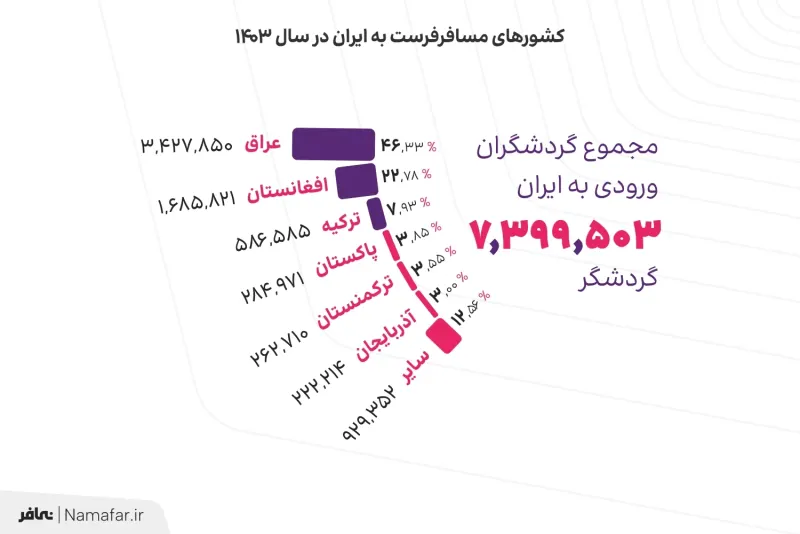
To examine this, in this note we turned to a comparison of Iran with Turkey, which over these years has activated many of its tourism capacities and, because of some similarities, can provide a good basis for comparison with Iran. In 1403 (2024/25) Iran hosted more than 7 million and 399 thousand foreign tourists. A review of the composition of this population shows that a substantial part of it, namely about 70 to 80 percent, has come from neighboring and regional countries. At the top of this list is Iraq with more than 3.4 million people (about 46 percent of all arrivals), after which Afghanistan, Turkey, Pakistan, Turkmenistan, and Azerbaijan are seen. This composition shows that the bulk of Iran’s tourism interaction takes shape with countries that have close cultural, religious, and political ties with it, especially along the country’s western and eastern geographic axis.
By contrast, in 2024 Turkey attracted more than 57 million international tourists. But the structure of Turkey’s arrivals has a fundamental difference: the share of regional countries in it is far smaller. For example, among neighboring countries, Iran with about 3.2 million people and Iraq with nearly 900 thousand people stand in subsequent ranks; whereas the bulk of Turkey’s tourists come from Europe and the West, countries such as Germany, Russia, and the United Kingdom, each of which sends millions of visitors to Turkey.
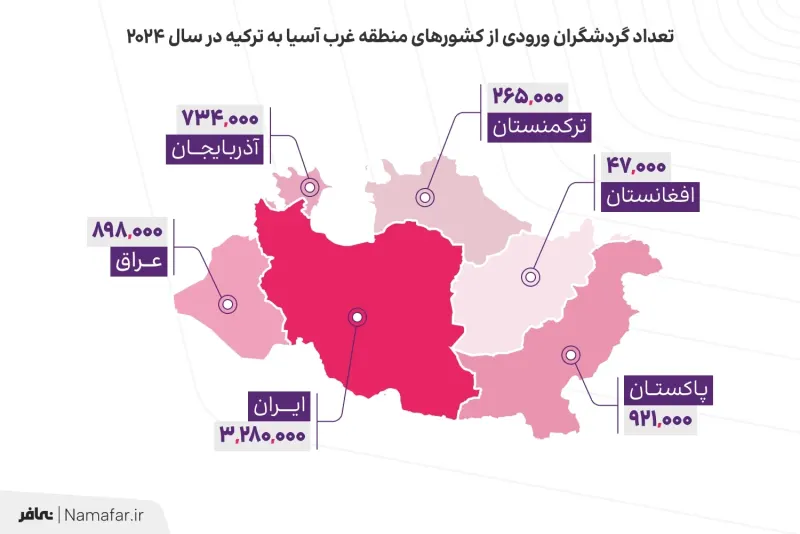
In other words, although in Iran the weight of regional tourists is dominant, in Turkey this group forms a small share of the total. Even so, Turkey has performed more successfully in attracting this same limited volume of the regional market, especially among Muslim and Middle Eastern neighbors. Differences in travel-facilitation policies, the diversity of recreational destinations, and an extensive advertising network have caused Turkey, for tourists of the region, including Iranians and Iraqis, still to appear a more attractive option.
Is travel to Iran cheaper, or travel to Turkey?
Suppose an Iraqi citizen has decided to set out from Najaf or Baghdad for a few days of foreign travel. The main options before him are usually two familiar destinations: Iran or Turkey. Both countries are accessible in a few hours, with long-standing cultural and historical ties, but the travel experience in them differs from earth to sky. The question is simple: for this Iraqi traveler, which destination is more cost-effective?
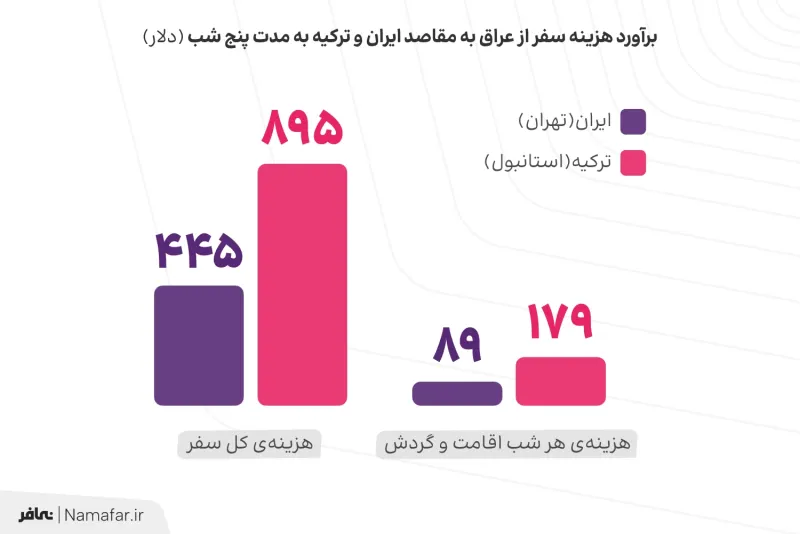
Fresh estimates of travel costs show that the difference between Iran and Turkey for regional tourists, especially Iraqi citizens, is striking. Data from specialist travel-comparison websites such as Budget Your Trip and the World Bank’s “purchasing power parity,” or PPP, indicators show that a five-day trip to Tehran for a mid-range tourist costs about 445 dollars, whereas the same level of services in Istanbul comes to about 895 dollars. If we measure these figures against the annual per-capita income of an Iraqi, 13.444 dollars (on a PPP basis), a five-day trip to Iran is equivalent to only 3.08 percent of his annual income, whereas a trip to Turkey requires nearly 6.19 percent of that same income.
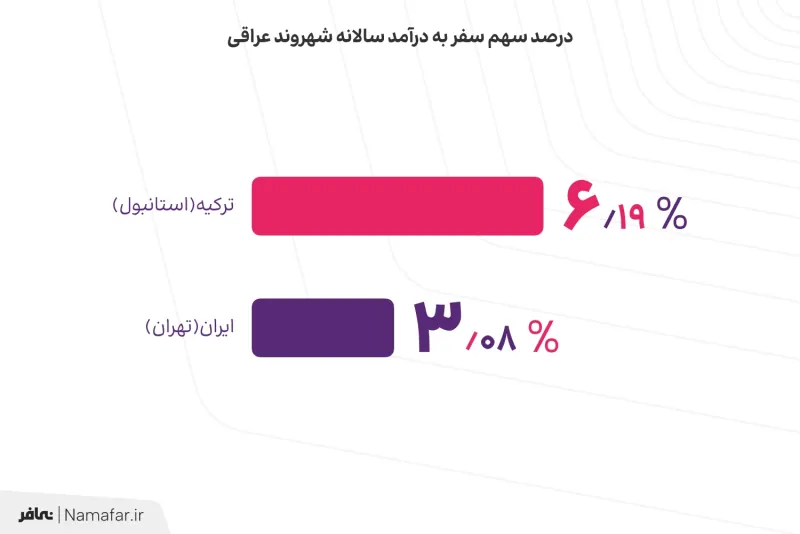
In simple language, a trip to Turkey for an Iraqi citizen ends up twice as expensive as a similar trip to Iran. This difference, when calculated as a daily cost, is still notable: in Iran each night of lodging and touring for a mid-range traveler costs on average 89 dollars, but in Turkey this figure reaches 179 dollars a night. In the chart below, the ratio of travel cost to per-capita income for the two countries clearly shows that Iran, from an economic perspective, is a destination twice as cost-effective as Turkey for Iraqi tourists.
At first glance, this notable numerical difference is to Iran’s advantage. From an economic perspective, Iran for the Iraqi tourist is a cheaper destination and, in terms of purchasing power, more accessible. But the field reality is more precise than can be explained only with numbers and percentages. A country’s being cheaper does not necessarily mean it is chosen. Last year, Turkey, despite a higher cost, attracted nearly 900 thousand Iraqi tourists, and Iran about three to three-and-a-half million people. This striking difference in the number of arrivals is apparently to Iran’s advantage, but when we examine the nature of the trips, the picture changes.
A large share of Iraqis' travel to Iran is pilgrim or medical in nature. These trips are made for pilgrimage to Mashhad and Qom or to receive medical treatment, not with a recreational motive or a classic tourism experience. The head of the Karbala province tourism board, in an interview with ILNA news agency, had noted that more than two-thirds of Iraqis' trips to Iran are for pilgrimage and that a large part of their spending goes to overland transport and short-term stays. By contrast, Iraqis' travel to Turkey often has a recreational and urban character; destinations such as Istanbul, Antalya, and Trabzon are chosen for shopping, family outings, and holidays. So ultimately, if we subtract from total inbound tourists from Iraq the population that has come to Iran for pilgrimage, the number of other tourists is lower than the same figure in Turkey. The point is that pilgrimage tourists almost always come on an annual basis, and their large volume is in most cases not evidence of a boom in the destination country's tourism (for example, Hajj pilgrims traveling to Saudi Arabia, or visitors of Imam Hussein on Arbaeen or Ashura). That is because the destination country has made little effort to attract tourists in this domain.
Why, despite Iran being cheaper, is Turkey still the more popular destination for the region's tourists?
At first glance, this question resembles a strange paradox: if Iran is more economical for many countries in the region in terms of travel cost, accommodation, and even geographic distance, why do a considerable share of Middle East tourists still choose Turkey? The easy answer is that Turkey has a "more open cultural space"; a phrase that in recent years has been repeated many times in public and analytical conversations. This claim is not unfounded, but it seems the main factor behind the difference lies not in social freedoms but in infrastructure, international image, and a culture of hospitality.
Infrastructure and national image; a difference in the roots
One must begin with the issue of infrastructure. Over the past three decades, Turkey has worked with care and continuity on developing the tourism industry; from the diversity and standardization of hotels to domestic transport, direct flights, digital reservation services, and a stable connection with regional tours. By contrast, Iran still faces serious shortages in this area. In many historic or religious cities, lodging capacity does not match demand, and direct flights from neighboring countries, especially from the Persian Gulf and northern Iraq, are limited and sometimes longer. In practice, an Iraqi or Azerbaijani traveler sometimes has to take a longer and more complicated route to reach an Iranian destination than a trip to Istanbul or Antalya.
The absence of a national brand in tourism
The second factor is national branding in tourism; a field in which Turkey has performed remarkably well. For years this country has presented its image as a tourist-friendly, modern destination that is at the same time rooted in Islamic tradition. The "Turkey Home" brand was an example of an effective national campaign that was able to build a global face for Turkey. By contrast, Iran has never built a single, coherent brand for its tourism. Western media portrayals, which often present an unsafe and tense picture of Iran, have intensified this problem. The result is that in the minds of many potential tourists, Iran is not registered as a safe and attractive destination, but as a political and unpredictable country. Changing this image is not possible without a national communications and advertising program.
Hospitality culture; from an economic view to a human view
But perhaps one of the most important and least discussed reasons goes back to the culture of receiving tourists. In Turkey, encountering a foreign tourist is part of people's everyday experience in tourist cities. From taxi drivers and local shopkeepers to hotel staff, they have often been trained to have a friendly, service-oriented manner. In Iran, however, such a culture has not yet been fully institutionalized. In many areas, the view of the tourist is formed not from the standpoint of cultural and human exchange, but from an economic and at times suspicious angle; as if the tourist is only a "short-lived source of income" and not a "cultural guest" who carries an opportunity for mutual acquaintance. This limited view, especially in smaller cities, prevents a pleasant experience from taking shape for foreign tourists.
In addition, Turkey has also been more active in tourism diplomacy and regional cooperation. Reciprocal contracts with airlines, easy visas, combined tours, and partnerships with foreign companies have made the path for tourists from the Middle East into Turkey smoother than into Iran. Meanwhile Iran still faces administrative constraints, a lack of digital support for booking, and at times strict visa policies. Overall, the gap between Iran and Turkey in attracting the region's tourists goes back not only to differences in costs or cultural freedoms, but to a set of structural, image-related, and cultural factors. Iran has potential advantages on many indicators; from nature and history to price and traditional hospitality. But without infrastructure, a national brand, and a culture of reception, these advantages do not become assets. Turkey has succeeded at precisely this point: turning capacity into experience, and experience into a lasting mental image among the region's tourists.
A way to close the gap: recommendations for Iran's tourism policymakers
What came in the preceding sections shows that Iran has clear advantages in cost, geographic location, and cultural affinities with the region's countries, but these advantages have not yet been turned into real opportunities. If policymakers want to reduce the gap between capacity and reality, a set of simultaneous reforms at several levels is needed; reforms that are neither costly nor impossible, but that require stability and continuity in decision-making.
First, Iran must update its view of tourism infrastructure. A shortage of standard lodging, limited flights, and uncoordinated transport make Iran's image unstable in the mind of the foreign tourist. Developing hotels and ecolodges in destination cities, reviewing air routes with Iraq, Azerbaijan, and Arab countries, and creating direct connections among Iran's religious and recreational destinations are among the measures that can shift the balance in the country's favor.
The second step is shaping Iran's national tourism brand. For years Turkey has built a unified identity for itself with campaigns such as "Turkey Home" or "Go Türkiye", but Iran still lacks such an image. Iran must be redefined: not merely as a religious or historical country, but as a destination with multiple experiences - cultural, natural, spiritual, and modern. For this, close cooperation among the Ministry of Tourism, domestic media, and embassies is essential. Iran's face in international media must change from the representation of an "unsafe country" to a "cultural and safe destination", and this is not possible without smart media planning.
Third, there is a need to institutionalize a culture of receiving tourists; a culture in which the presence of a foreign tourist is neither a threat nor merely a source of income. Training service staff, standardizing behavior in hotels and bazaars, and incorporating intercultural communication concepts into tourism education are basic measures on this path. Experience has shown that even a single positive encounter at an airport entrance or a traditional bazaar has a more lasting effect on building a positive impression of Iran than any advertising campaign.
Alongside these three main axes, regional tourism diplomacy must also be attended to. Iran's neighbors are not only a target market, but partners in tourism development. Bilateral agreements to facilitate visas, holding joint cultural events, combined Iran-Iraq or Iran-Azerbaijan tours, and cooperation with international agencies can take regional tourism beyond the level of pilgrimage and medical treatment. Ultimately, the condition for success in all of this is policy continuity and coherence. Unlike many industries, tourism is not the product of short-term decisions; it requires gradual trust-building, continuous advertising, and stability in foreign policy. Iran can become the region's leading tourism destination in less than a few years, if it establishes a real balance between "price advantage" and "quality of experience".
Closing remarks
Taken together, what has been said makes clear that economically Iran is one of the cheapest tourism destinations in the West Asia region. For many travelers in the region, from Iraq to Azerbaijan and Pakistan, travel to Iran costs far less than travel to Turkey or other surrounding countries. Nevertheless, this price advantage has not yet been able to become a competitive advantage. The cause of this gap lies neither in the high cost of travel to other countries nor in a lack of interest in Iran, but in a set of structural, communicative, and cultural factors that have prevented the country's potential tourism capacities from being realized.
For years, in public analyses, "cultural freedom" has been repeated as the main reason for Iran's tourism lag, but the reality is that this simple explanation points in the wrong direction. Turkey has not become a popular tourist destination solely because of its open social space, but through a regular network of infrastructure, a strong national brand, a culture of receiving tourists, and continuous planning it has been able to build its current position. As explained in this note, Iran more than anything needs to strengthen lodging and transport infrastructure, correct its image in world public opinion, and institutionalize a culture of hospitality.
The proposals presented in this piece - from reviewing flight routes and lodging to drafting a national tourism brand and teaching a culture of receiving tourists - can, if implemented in a coordinated way, start a real change in the country's tourism industry. It is hoped that by redefining priorities and changing some of the tracks of tourism policymaking, Iran in the years ahead can obtain a more fitting share of the regional and global tourism market; a share that matches its cultural and natural capacities and once again seats Iran as a thriving, hospitable, and affordable destination on the region's tourism map.
Machine-translated from Persian by Namafar; the Persian original is authoritative. Read the original in Persian