What is the Global Muslim Travel Index?
The tenth edition of the Global Muslim Travel Index report in 2025 is a reflection of a transformative journey over eleven years. From ranking ten destinations in 2011 to a comprehensive analysis of 153 destinations today, the evolution of the Global Muslim Travel Index reflects the growth of the halal tourism and travel sector. This milestone prompts the tourism industry to shape the future of global travel with purposeful leadership and management. Alongside the accessible travel framework and the responsible, inclusive, digital, and assured framework, this edition emphasizes broader inclusion. This report helps you gain insight into the advances of the Muslim travel market over the past decade and discover ways to engage with this sector.
Comparative analysis of the economies of Islamic tourism destination countries
In this section the economic-demographic situation of Islamic tourism destination countries has been analyzed and compared on the basis of the indicators of per-capita GDP and Muslim population. This infographic provides an overall review of the 30 top Muslim outbound tourism markets and maps the relationship between a destination's economic strength and its travel behaviors. By plotting each economy's per-capita GDP against its share of the world's Muslim population and outbound travel spending, distinctions can be drawn among various market patterns. This shows the considerable purchasing power of countries with high GDP such as Saudi Arabia and the United Arab Emirates, which hold a large share of the market, versus populous countries such as Indonesia and Malaysia, which have high-volume-growth markets.
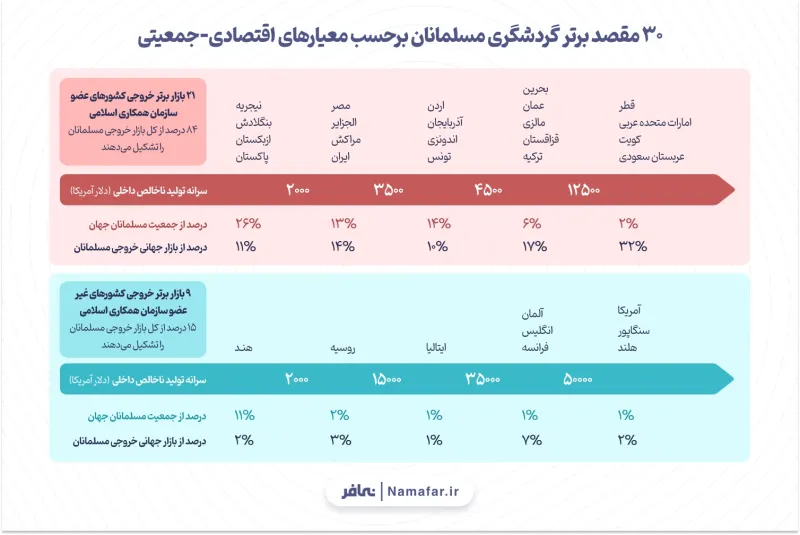
In this classification Iran has been placed among the 21 top outbound markets of member countries of the Organization of Islamic Cooperation which, together with 20 other countries, constitute 84 percent of the entire Muslim outbound market. Iran, with its considerable Muslim population and growing middle class, has significant potential in the Muslim travel and tourism market and can play a pivotal role in the tourism sector (inbound and outbound).
Revival and growth of the Muslim tourism market
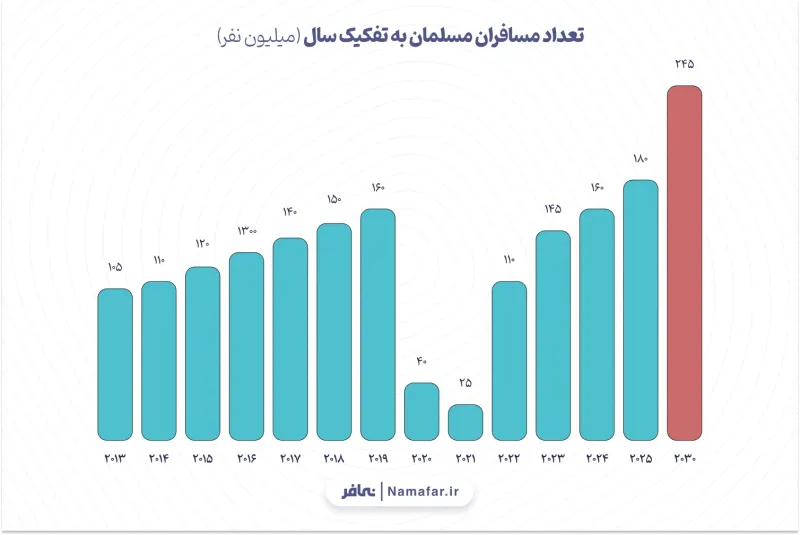
Because of the COVID-19 pandemic a considerable decline was created in the Muslim tourism market in the years 2020 and 2021. After the pandemic receded we witnessed a revival of this market, and the number of Muslim travelers in 2022 reached 110 million, in 2023 about 145 million, in 2024 160 million, and in 2025 about 180 million. It is forecast that this amount will increase in 2030 to 245 million trips, whose estimated cost is 235 billion dollars and which will have a considerable role in the economy of these countries.
Travel trend of global and Muslim tourists by region
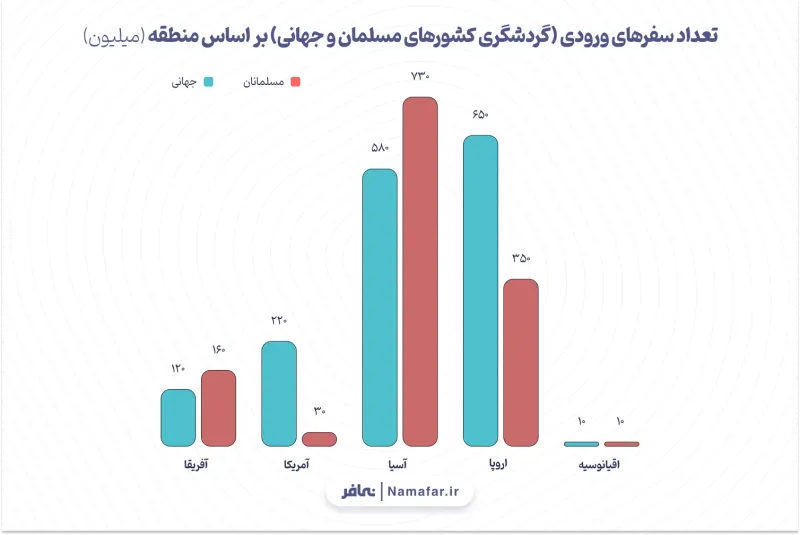
An analysis of global tourist arrivals by region shows that Europe, with more than 600 million visitors, is still in the lead, and after it is Asia with more than 500 million visitors. These two regions together constitute the major part of global tourism.
Muslim inbound travel has also shown a distinct regional dynamic. For Muslim tourists, Asia is still the main destination, which is because of the region's proximity to large Muslim populations, strong halal tourism infrastructure, and growing awareness of the Muslim travel market. The presence of destinations in member countries of the Organization of Islamic Cooperation such as Malaysia, Indonesia, the United Arab Emirates, and Saudi Arabia naturally places Asia as the main destination. At the same time, destinations that are not members of the Organization of Islamic Cooperation, such as Singapore, Japan, South Korea, and Thailand, have taken considerable steps in meeting Muslims' needs.
Top destinations in Islamic tourism
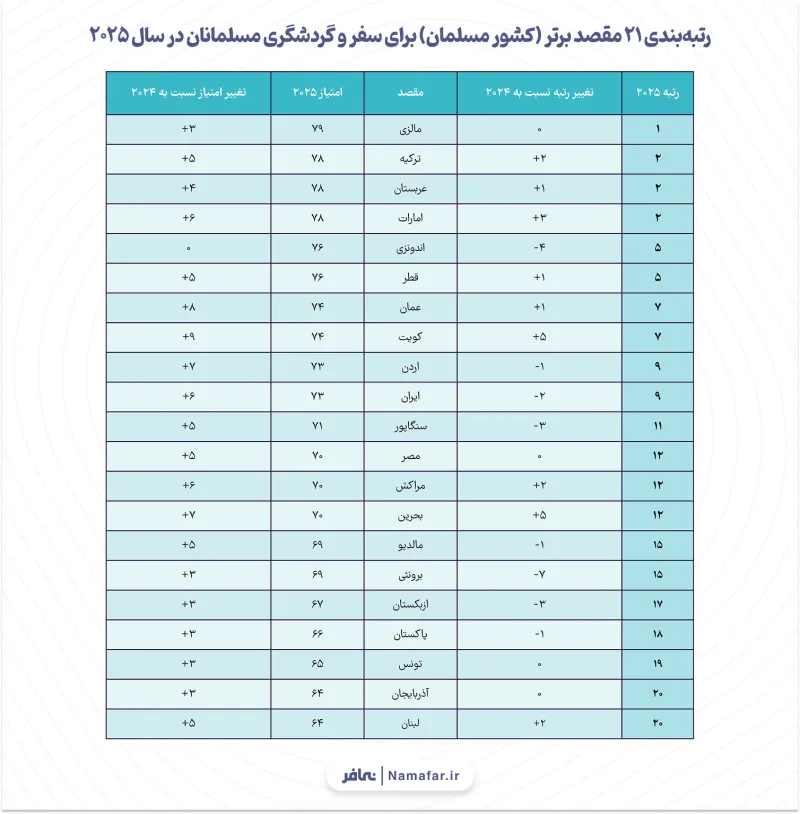
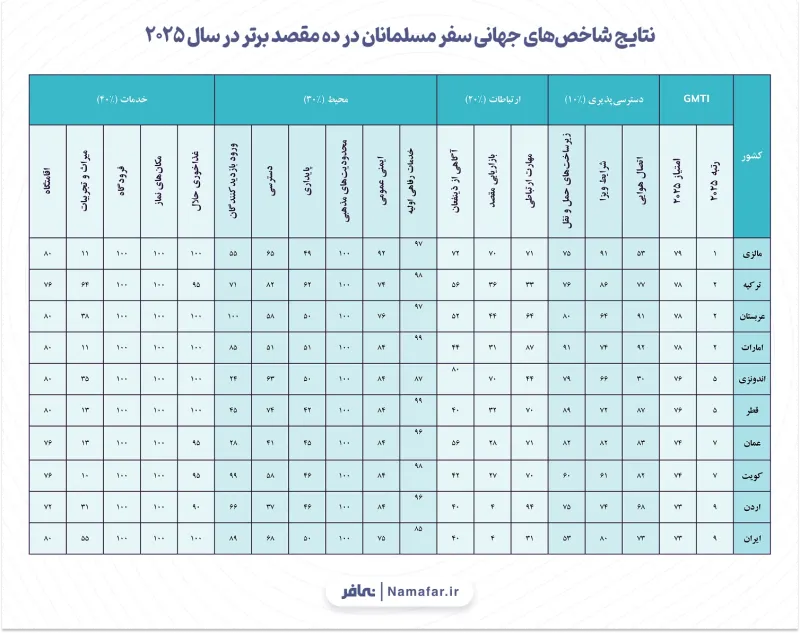
The Global Muslim Travel Index (GMTI) in 2025 shows continued progress in serving Muslim travelers, and a considerable increase in the average score of tourism destinations is observed. This improvement highlights the growing commitment of tourism destinations around the world to providing travel experiences suitable for Muslims. Malaysia, with a score of 79, which has increased 3 points relative to 2024, has kept its top place and reaffirms its leadership through continued efforts in providing accessible amenities tailored to Muslim travelers. Turkey, Saudi Arabia, and the United Arab Emirates, now by obtaining a score of 78, are in second place. Saudi Arabia continues to benefit from its religious tourism services because of the Hajj and Umrah pilgrimage, while Turkey has benefited from its rich cultural heritage, which is attractive to Muslim tourists.
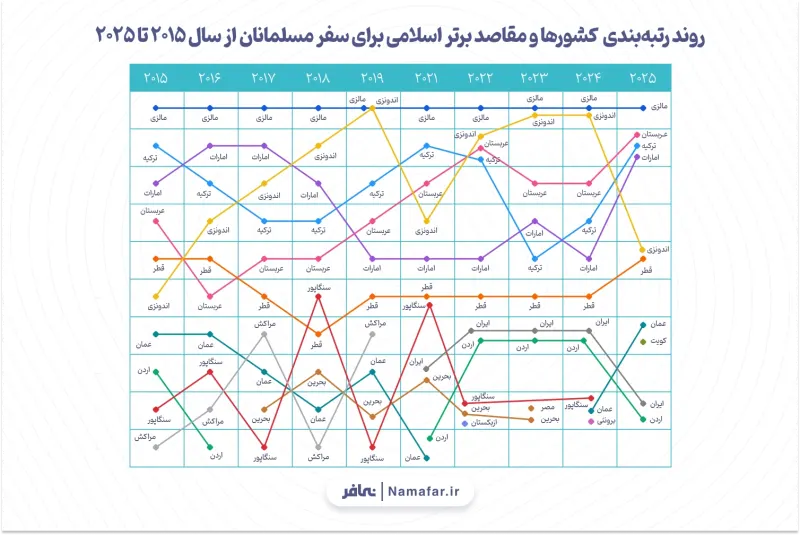
Indonesia in 2025 has fallen from its joint place with Malaysia at the top of the table in the years 2023 and 2024, which indicates an increasingly competitive landscape. Qatar has kept its place in the top ranks and shows consistent performance over time. Oman, which after the pandemic had left the group of the top 10 countries, improved in 2025, and Kuwait has also joined it, which for the first time since previous scores again places it in the group of the top 10 countries. The joint seventh place of Iran and Jordan has also been reduced to ninth place. Singapore too in 2025 has left the group of the top 10 countries, which indicates a considerable shift. These developments show the dynamic nature of the Muslim travel market, where new leaders are emerging and long-standing destinations face the challenge of adapting and innovating in order to keep their attractiveness.
Regional ranking and analysis of the Global Muslim Travel Index
Analysis of regional performance in the field of the Global Muslim Travel Index shows that West Asia and North Africa are still in the lead, which is mainly because of the combination of destinations with a Muslim majority and their understanding of Muslims' needs, including countries such as Turkey, the Persian Gulf Cooperation Council (GCC) countries, Egypt, and Morocco.
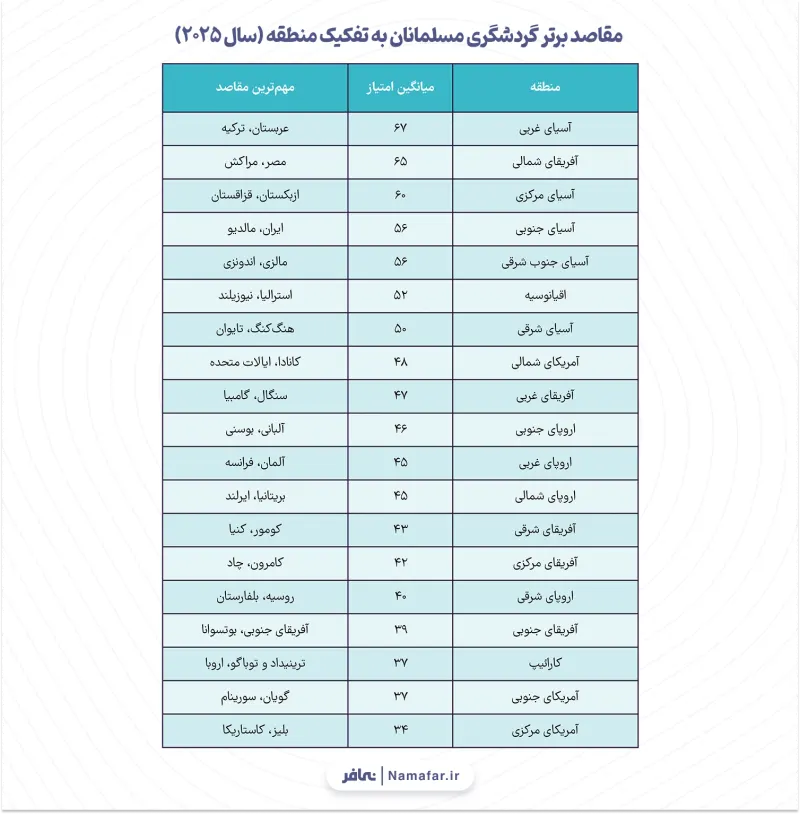
Central Asia, for reasons including its extensive Islamic heritage, has remained in third place. This year, South Asia has succeeded in equaling Southeast Asia, both of which have on average obtained a score of 56. South Asia includes the Maldives, which has become well-known for its tourism efforts, and Iran, which is a growing destination and emphasizes its rich culture and history. In contrast, the relatively small increase in the growth of Southeast Asia shows that to remain competitive in the Muslim travel market, more joint efforts and actions are necessary.
Ranking of the Global Muslim Travel Index based on access
The access criterion (ACES) evaluates the accessibility of destinations in the Muslim tourism market. The continuous increase in the average accessibility score over the past four years indicates a positive trend in the accessibility of destinations for Muslim travelers. Given destinations' focus on these areas, overall accessibility for Muslim travelers is expected to improve further and strengthen the growth of the global tourism market for Muslims. The increase in accessibility has been analyzed on the basis of three main criteria: air connectivity (direct flight connections to major Muslim outbound markets), visa conditions (simplifying and streamlining processes related to obtaining visas and effective policies in this regard), and transport infrastructure (continued focus on providing excellent transport services and infrastructure).
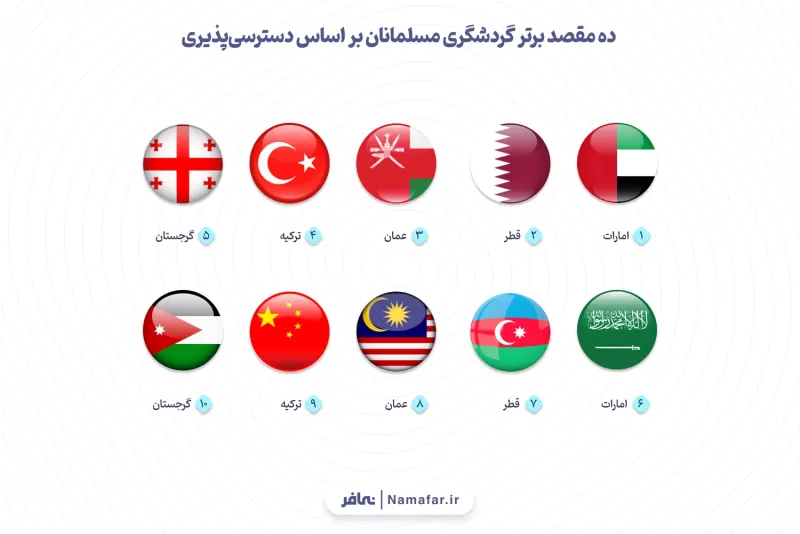
In this ranking the countries of the United Arab Emirates, Qatar, and Oman are respectively in first to third place, and our country Iran too, which last year was in tenth rank of Muslim tourism destinations based on the accessibility criterion, has now declined and left the group of the top 10 countries in this index.
Tourism destinations suitable for Muslim women
This criterion shows a picture of how various regions are progressing toward making countries' tourism destinations more suitable for Muslim women.
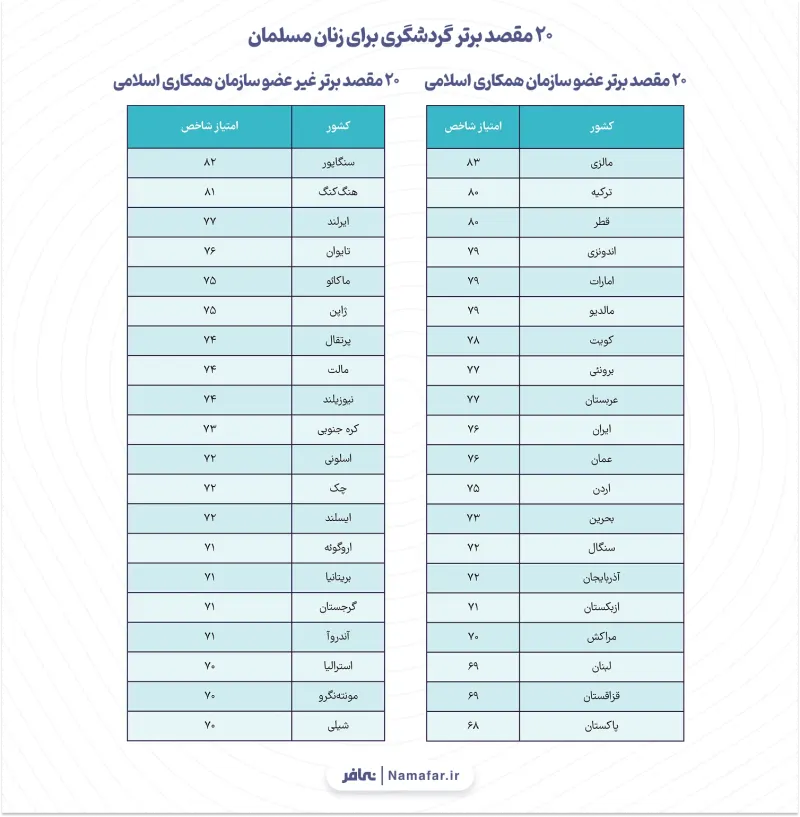
This year's scores provide valuable insights into the progress of destinations in member countries of the Organization of Islamic Cooperation in attracting Muslim travelers, especially women. Southeast Asia, including Malaysia with a score of 83 and Indonesia with a score of 79, is in the lead. This indicates these countries' strong commitment to providing safe, inclusive, and religion-compliant travel experiences. The Middle East too is still an important player, such that Turkey and Qatar have both obtained a score of 80, and alongside them the UAE, Kuwait, and Saudi Arabia stand with high performance.
Among the top destinations that are not members of the Organization of Islamic Cooperation, Singapore has established its place as the leading non-member destination of the Organization of Islamic Cooperation and, compared with 2024, shows a slight increase to a score of 82. This country is known for exceptional safety, welcoming a multicultural community, and developed infrastructure. These features, together with a highly suitable environment for Muslims, make it especially comfortable and safe for Muslim women travelers, whether individually or in groups. After it are several Asian destinations that have obtained a score between 73 and 81.
Iran too, with a score of 76, because of a combination of safety, local hospitality, and heritage infrastructure, has kept its strong place. In this ranking last year, Iran, by obtaining a score of 73 and jointly with Kyrgyzstan, was in thirteenth rank of tourism destinations suitable for Muslim women, but in 2025 it has risen in this respect and, jointly with Oman, has been placed in tenth rank.
Analysis and evaluation of the indicators in the ten top destinations
The comparative results of the Global Muslim Travel Index have been calculated in 153 destination countries, and the results related to the 10 top countries are presented in the table below. On this basis Malaysia (rank 1), Turkey, Saudi Arabia, and the UAE (rank 2), Indonesia and Qatar (rank 5), Oman and Kuwait (rank 7), and Iran and Jordan (rank 9) have been the ten top Islamic tourism destinations in 2025. This ranking has been conducted on the basis of four indicators of accessibility (with the criteria of air connectivity, visa conditions, and transport infrastructure), communications (with the criteria of communication skill, destination marketing, and stakeholder awareness), environment (with the criteria of basic amenities, public safety, religious restrictions, sustainability, access, and visitor arrivals), and services (with the criteria of halal dining, prayer places, airport, heritage, and accommodation experiences).
Comparative results of the GMTI index in Iran
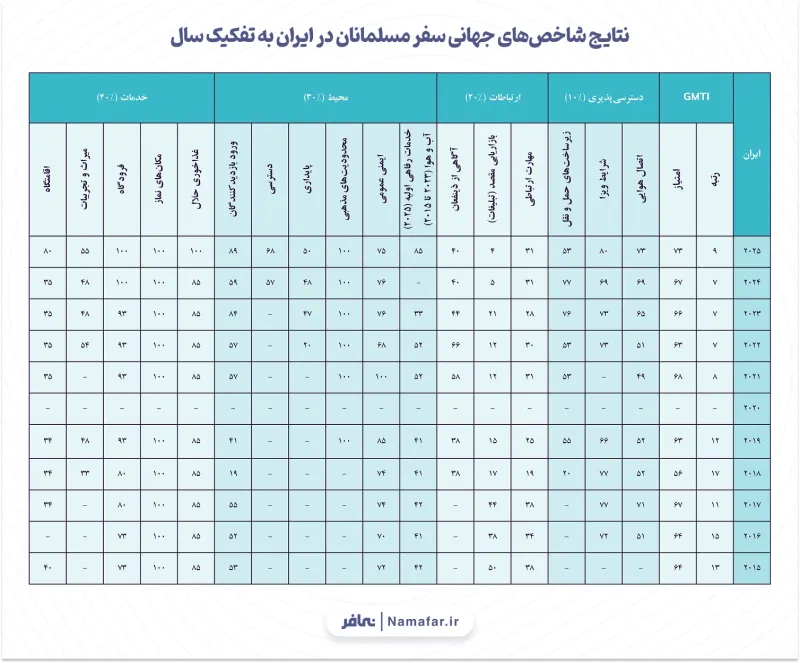
In this section the comparative results of the Global Muslim Travel Index in Iran in the time interval 2015 to 2025 are presented. On this basis our country's rank in the GMTI index in the time interval 2015 to 2025 (except for the year 2020) has respectively been 13, 15, 11, 17, 12, 8, 7, 7, 7, and 9. Iran's best place in this ranking is seventh rank in the years 2022, 2023, and 2024, and Iran's worst place in this ranking relates to 2018 with seventeenth rank.
Closing remarks
The comparative analysis of the economies of member countries of the Organization of Islamic Cooperation, the revival and growth of the Muslim tourism market, the top destinations in Islamic tourism, the ranking trend of the Global Muslim Travel Index from 2015 to 2025, the regional ranking and analysis of the Global Muslim Travel Index, the ranking of the Global Muslim Travel Index based on access, tourism destinations suitable for Muslim women, and the comparison of the tourism index of top destinations are among the items pointed to in this writing, and an effort has been made to provide a comprehensive understanding of the halal travel and tourism industry. Attention to these items enables activists in this sector to use in a desirable manner the countless opportunities existing in the Muslim tourism industry.
Our country Iran, on the basis of the statistics presented in this report, has gone from rank 14 in 2015 to rank 7 in 2023 and 2024, but in 2025 it has declined to ninth rank. This issue indicates the close competition of countries in the field of Islamic tourism and the necessity of attention to the speed of progress in this field in order not to fall behind others. Iran has abundant capacities in the field of tourism, especially Muslim-friendly tourism, which must be identified and used in a desirable manner.
Machine-translated from Persian by Namafar; the Persian original is authoritative. Read the original in Persian