Muslim travelers, on the basis of their beliefs, look for destinations, accommodations and activities that are compatible with their religious and personal beliefs and interests and that allow them to connect with local culture, traditions and people. This issue has created a large market in the tourism domain that, according to forecasts, in 2028 will reach 230 million people with a financial turnover of about 225 billion dollars.
The present report is the eighth issue (2015 to 2023) of the Global Muslim Travel Index reports. These annual reports present vital insights into the Muslim travel market. This market has shown appropriate growth and resilience in the face of global challenges.
This report is an essential resource for those who are active in the travel industry and presents important insights and strategies for tapping the Muslim travel market. The present report, given the data and information provided, offers a comprehensive understanding of the halal travel and tourism industry and enables actors in this sector to use the countless opportunities available in Muslim tourism.
A responsible tourism framework for Muslim travelers
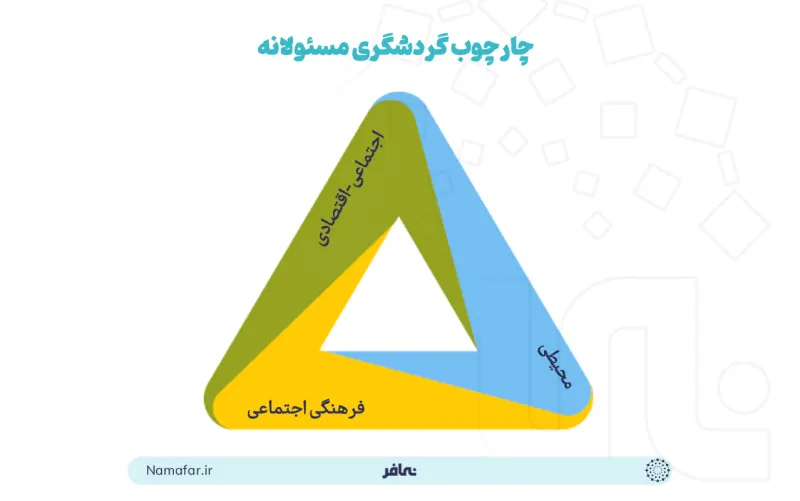
The responsible tourism framework for Muslim travelers is an initiative designed by HalalTrip to address the values and expectations of Muslim travelers within the broader framework of sustainable and responsible tourism. This framework, as a guide and reference point for all tourism industry stakeholders, from policymakers to service providers, is not only sensitive to the religious and cultural needs of Muslim travelers, but also promotes environmental sustainability, sociocultural respect and economic balance.
This framework is a starting point in ongoing efforts to refine and evolve the understanding of responsible tourism for Muslim travelers and will undoubtedly undergo new advances and changes in response to feedback, new insights and the evolving landscape of the global tourism industry.
Status and outlook of the Muslim travel market
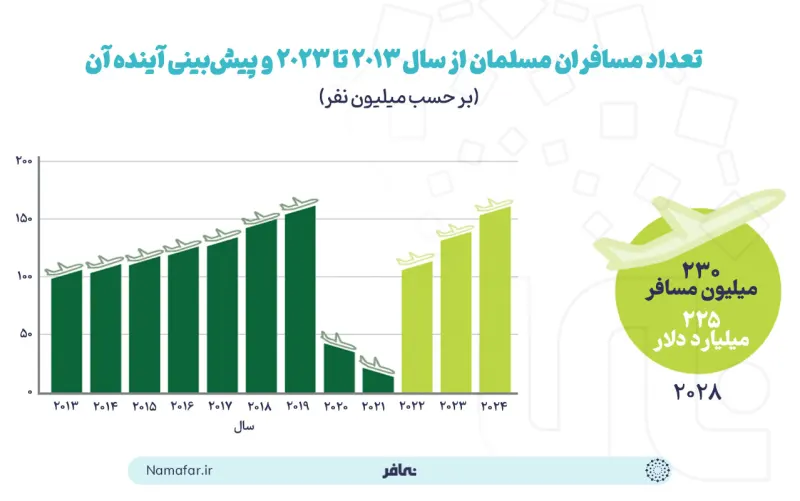
The number of Muslim travelers in 2022 was 110 million people, accounting for 12 percent of all international trips. This figure has had considerable growth relative to the decline created during the coronavirus pandemic. It is also forecast that the number of Muslim travelers will increase to 140 million people by the end of 2023, to 160 million tourists in 2024, and to 230 million people in 2028, and will bring a financial turnover of 225 billion dollars for the tourism industry.
Tracking Muslim travel destinations
Tracking the destination or intention of Muslim travelers is a metric designed to measure and monitor Muslim travelers' travel intentions over time. Tracking data are published monthly and help tourism industry actors stay informed of current Muslim travel trends, forecast future demand and identify potential growth opportunities in the Muslim travel market. The algorithm used to examine and analyze travel destinations is weighting different time intervals, which can indicate future travel plans.
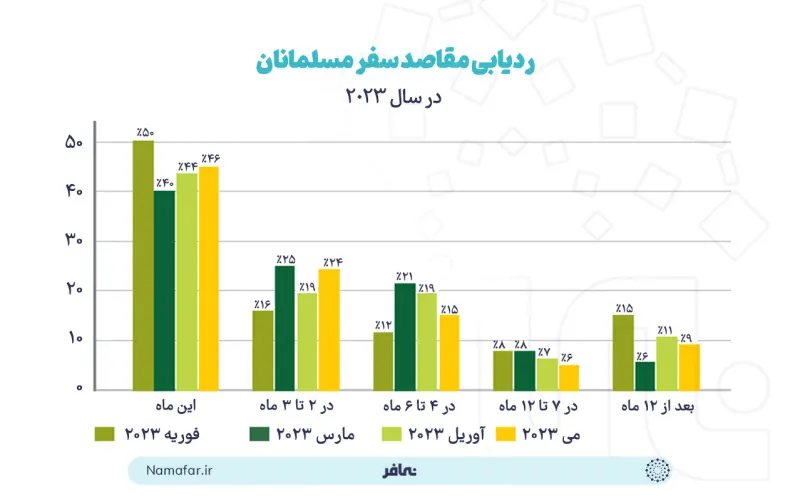
The data obtained show a constant preference for short-term travel plans, with growing interest in medium-term travel planning. In addition, travel intention after 6 to 12 months remains relatively constant, while long-term travel-intention experiences fluctuate in the months under review. Travel planning can undergo changes under the influence of factors such as global conditions, economic trends or socio-political events. By understanding these trends, businesses and destinations can adjust their offerings and marketing strategies to better respond to the evolving needs and wants of Muslim travelers.
Popular Muslim tourism destinations
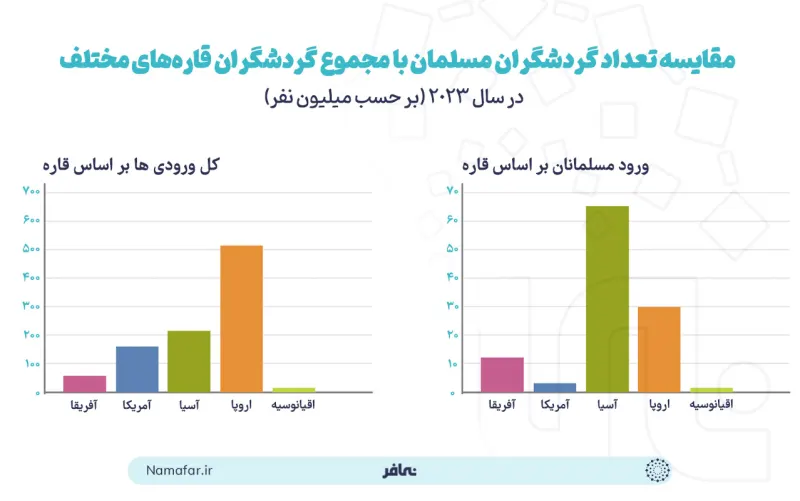
The continent of Asia leads in hosting Muslim travel, and more than 31 percent of all its travelers are Muslim (65 million Muslim tourists out of a total of 210 million tourists). This is not surprising given this continent's substantial Muslim population, especially in Southeast Asia and the Middle East, and the Muslim-friendly offerings available in this region. It is also noteworthy that after the coronavirus pandemic, travelers prefer nearby destinations for travel rather than long trips.
Africa's share of Muslim arrivals, at more than 21 percent (13 million Muslim tourists out of a total of 60 million tourists), is considerable, because this amount is lower at the international level. This shows that Africa, because of its rich cultural diversity, Islamic historical heritage and large Muslim population across this continent, especially in its north, is a key destination for Muslim travelers. Europe, the region with the most tourist arrivals in the world, has accounted for a smaller share of Muslim arrivals at about 6 percent (30 million Muslim tourists out of a total of 500 million tourists). This ratio for the two continents of Oceania and the Americas has been 7 percent and 2 percent respectively.
Overall ranking of the Global Muslim Travel Index
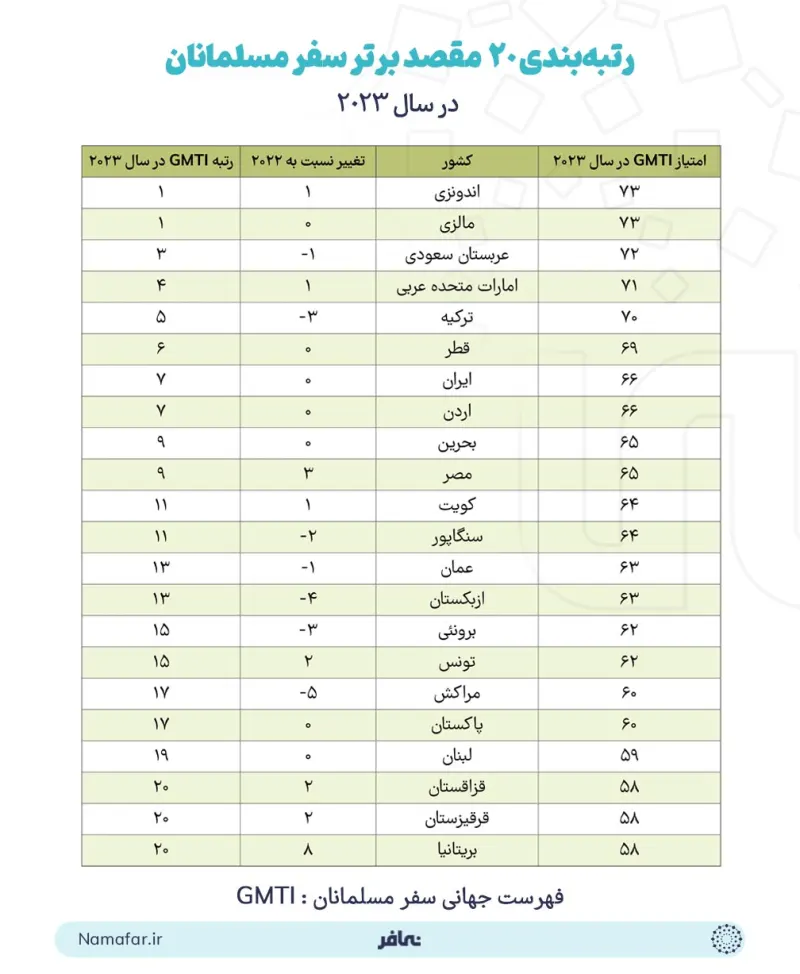
Malaysia's position in the Global Muslim Travel Index has remained unchanged over long years, which is testimony to its lasting attractiveness for Muslim travelers. Indonesia, which in 2015 stood in sixth place, with its considerable rise was able in 2019 to obtain first place jointly with Malaysia. After a brief drop in the ranking, this country this year again took back its joint top position and displayed its extraordinary attractiveness for Muslim travelers. Turkey, the United Arab Emirates and Saudi Arabia compete uninterruptedly for the next three places (third to fifth) and show their constant attractiveness for Muslim travelers. Qatar, Oman, Jordan and Singapore are countries that have usually been constantly present among the top 10 countries. Also Iran, Egypt and Uzbekistan, which in 2015 stood in fourteenth, sixteenth and twenty-seventh places respectively, have risen considerably and in 2023 have reached seventh, ninth and thirteenth places.
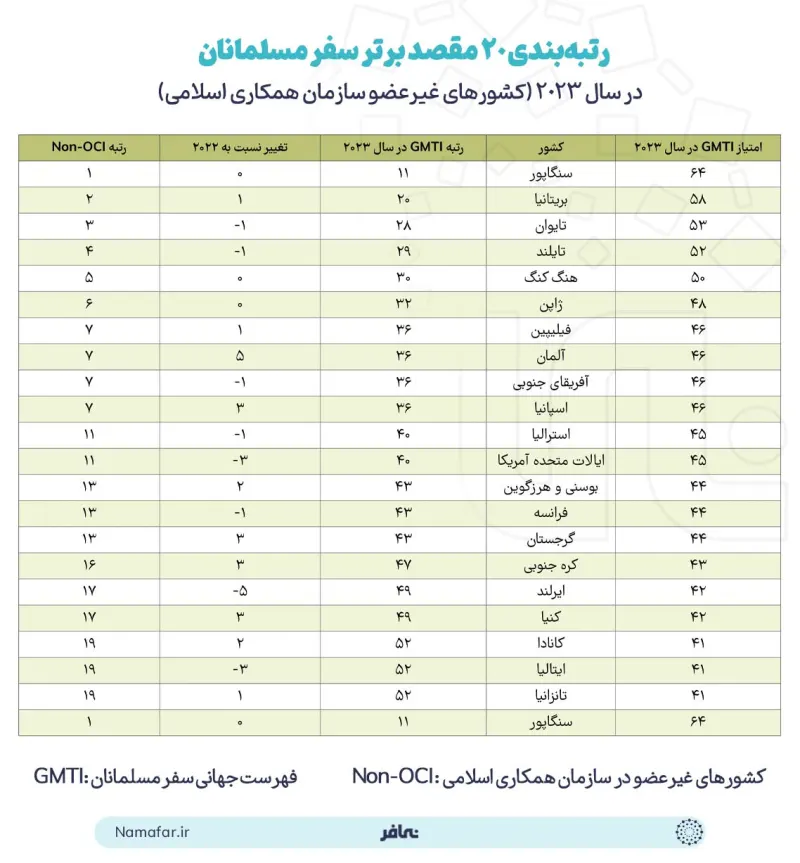
Ranking of Muslim travel destinations (countries that are not members of the Organization of Islamic Cooperation)
Singapore, as the most important destination that is not a member of the Organization of Islamic Cooperation, has regularly obtained a place in the top ranks and has considerable attractiveness in the global Muslim travel market. The United Kingdom over many years has always kept its place in the top three ranks and has displayed its unshakable attractiveness for Muslim tourists. Taiwan, starting from tenth place in 2015, has displayed a striking rise that indicates its growing prominence and success in attracting Muslim tourists. Thailand and Hong Kong too, emphasizing their lasting attractiveness for the Muslim tourist population, have been able to keep their place among the top five countries. The countries of Japan, the Philippines, Germany, South Africa and Spain have also been other popular destinations for Muslims to travel to.
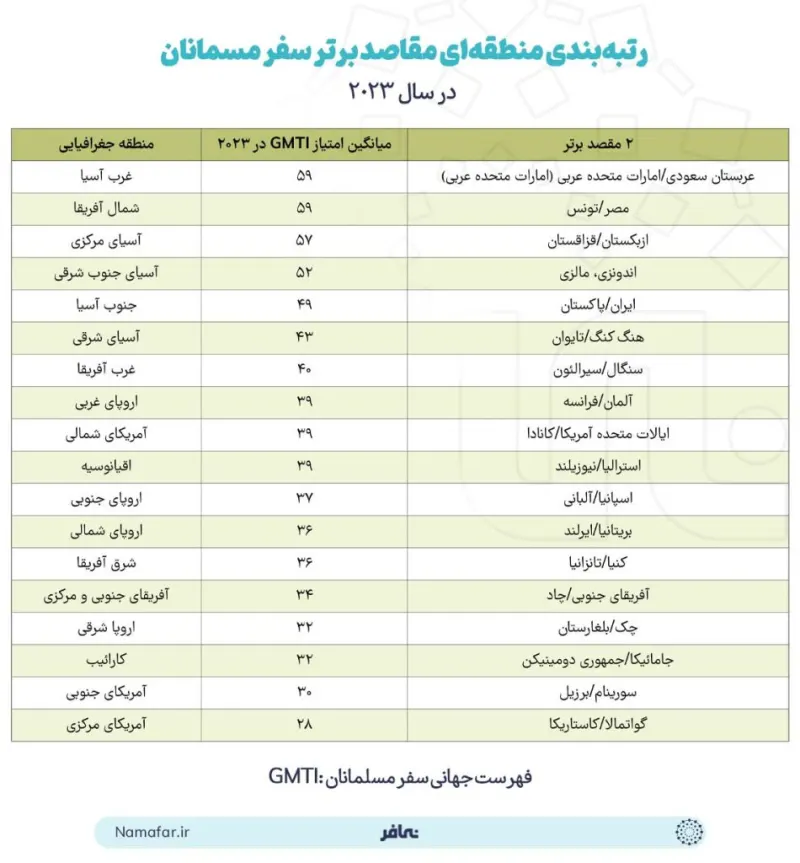
Regional ranking of Muslim travel destinations
The results of the regional ranking of Muslim tourism indicators in 2023 show that Iran, together with Pakistan, with an average score of 49, stand in fifth place. In this regional analysis, Saudi Arabia and the United Arab Emirates, with an average score of 59, have taken first place.
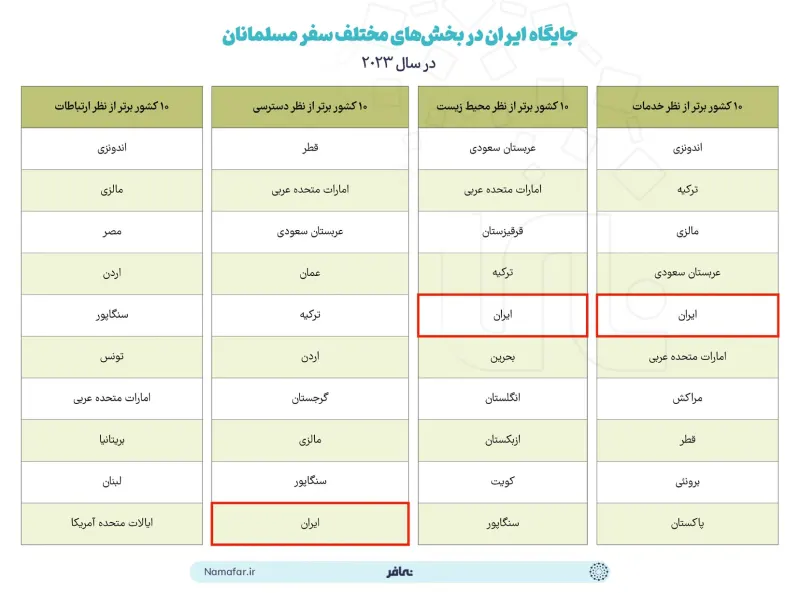
Iran's position in terms of various Muslim tourism indicators
In the various sub-sections related to Muslim tourism indicators, our country Iran has been able, in terms of environment and services indicators, to take fifth place among popular Muslim tourism destinations. Also Iran has been placed in tenth position in terms of the access indicator; but in terms of the communications indicator, it does not have a rank among the top 10 countries in this section.
Global Muslim Travel Index performance matrix
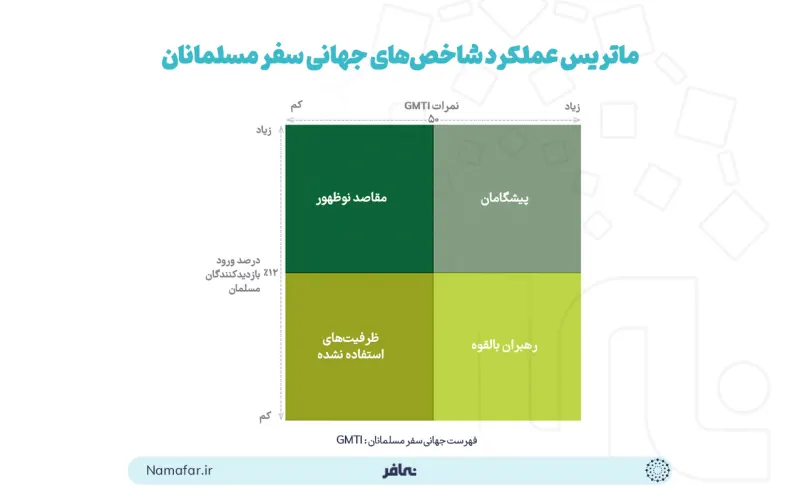
The performance matrix is a strategic analytical tool designed to evaluate the performance and potential of destinations in the Muslim travel market. This matrix, by combining Global Muslim Travel Index scores and the ratio of Muslim tourists to total tourists, presents an overview of destinations' ability to provide services to Muslim travelers and their success in attracting this segment.
The performance matrix is divided into four quadrants (emerging destinations, pioneers, unused capacities and potential leaders), each of which shows a combination of scores and the ratio of Muslim visitors. This matrix enables destinations to identify their current position in the Muslim travel market and develop targeted strategies for improvement and growth.
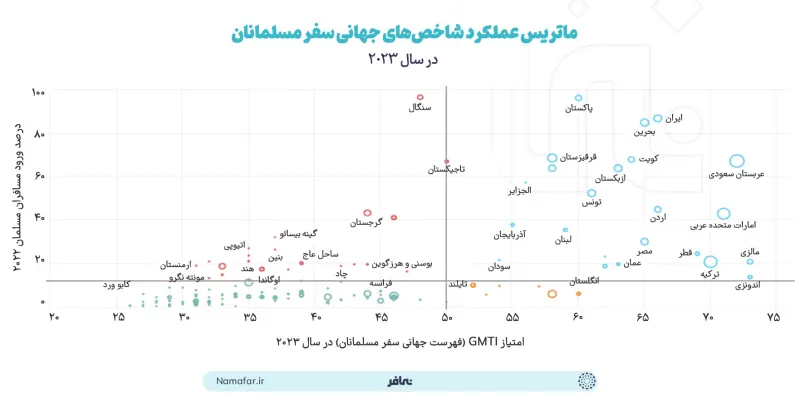
The pioneers section has 23 destinations that have been at the forefront in hosting Muslim travelers. These destinations have attracted 67 million Muslims, which constitutes about 60 percent of all the world's Muslim tourists in 2023. Iran, with a score of about 67 on the Global Muslim Travel Index and a score of about 87 on the ratio of Muslim tourists to total tourists, has been placed among the pioneer countries.
The potential leaders section includes six destinations that with their offerings and services have hosted about 4.5 million Muslims (they are 4 percent of Muslim tourists). The emerging destinations section includes 23 destinations that are in the early stages of recognizing and meeting the needs of the Muslim travelers market. These nascent destinations in 2023 have attracted about 15 million Muslims (they are 5/13 percent of Muslim tourists). Finally, the unused capacities section includes 85 destinations. Although these destinations are less used in terms of potential for attracting Muslim travelers, they have attracted about 25 million Muslims (they are 5/22 percent of Muslim tourists).
Summary
The present report has examined the Global Muslim Travel Index in 2023. This report has tried to present a comprehensive understanding of the halal travel and tourism industry and, in the same direction, enables actors in this sector to use the countless opportunities available in the Muslim tourism industry in a desirable way.
The considerable and broad capacity of the Muslim tourism market, Muslim travelers' interest in responsible tourism, the necessity of using new tools including artificial intelligence to improve the experience of Muslim travelers, and attention to Muslim travelers' target destinations are among the points that must be taken into account to achieve this comprehensive understanding.
Based on the statistics presented in this report, Iran has been among the rising and pioneering countries in the Muslim tourism industry and has gone from rank 14 in 2015 to rank 7 in 2023. Iran has abundant capacities in the tourism domain, especially Muslim-friendly tourism, that can be identified and used in a desirable way.
Machine-translated from Persian by Namafar; the Persian original is authoritative. Read the original in Persian