"Two thousand dollars one, two thousand dollars two, two thousand dollars three! Sold to gentleman number four!" For centuries, auctions, with the logic that "whoever makes the best offer will be the buyer," have found a place in people's economic way of life, especially among merchants or art-loving wealthy people, and luxury art auctions have become one of the profitable branches of the creative industries. In today's world, against the backdrop of widespread consumerism and the desires of extremely wealthy collectors, obtaining unique and one-of-a-kind artworks and objects at attractive rates is considered an emerging phenomenon. However, the auction and bidding industry is much older than one might think, because the first recorded auction took place more than 2500 years ago.
Auctions in antiquity
The first reference to the auction process in history goes back to around the year 500 BCE, when the Greek historian Herodotus first mentioned in his writings the use of auctions in Babylon. At that time, women were treated as property and were sold for marriage through auction! The auctioneer ranked them based on his assessment of the women's beauty, and this ranking determined the order of their sale. The only way to sell a daughter to another husband, according to the customs of that time, was through auction. If a couple were not satisfied with each other, a return procedure also existed for them.
In the Roman Empire, auctions were widely used to sell property and products. These auctions, known as the atrium auctionarium. Nothing, even humans, was outside the circle of sale. Enemy captives were sold as slaves at auctions, and the revenue from them was used to finance war. Also, citizens who were forced to sell their assets because of debt used auctions as a way to get rid of their debts. The word auction is taken from the Latin word "auctus," which means increase; just as in the course of auctions the price rises from low to high.
The emergence of modern auctions
Art auctions came into being in earnest from the late seventeenth century, especially in London and Paris. In the same century, one of the first major art auctions was held in Amsterdam, and gradually, with the boom of the art market in Europe, especially in the Netherlands, demand for buying and selling artworks increased, and auctions became known as a popular method for carrying out such transactions. These auctions were initially focused mainly on the works of well-known painters and artists such as Rembrandt and other painting masters of the Baroque period. In this same period, the world's oldest auction house, named Stockholms Auktionsverk, was established in 1674 in Sweden. Sotheby's, the world's second-largest auction house, held its first auction in 1744, and Christie's, the world's largest auction house, was also founded in 1766.

In the nineteenth century, auctions, especially in London, Paris, and New York, flourished greatly, and works by prominent artists such as Monet, van Gogh, Picasso, and other great artists were sold regularly at these auctions. In this period, auctions were not only places for buying and selling artworks, but also became a venue for displaying economic and cultural power.
In the second half of the twentieth century, with the emergence of new markets and a global economy, auctions became centers for the exchange of art at the international level. The increase in wealth in Asian countries and the emergence of new collectors in China, Japan, and other parts of the world had a profound effect on the course of auctions. In this period, artworks were sold at astronomical prices at auctions and became a venue for economic and cultural interaction among continents.
Auctions in the contemporary period
Art auctions in the contemporary period are held in a form completely different from the past. Auctions that once were held only in small circles of art experts and dealers have today become large events at which celebrities and actors are present. These transformations have occurred especially as a result of the advertising approaches and luxury marketing of these auction houses, especially in attracting international clients and diversity in objects and artworks. Also, with advances in technology, auction houses added services such as telephone bidding and satellite connection for their clients.
In the past two decades, art auctions have experienced major transformations with the arrival of new technologies and changes in the art industry. One of these transformations has been the entry of digital artworks and NFTs (non-fungible tokens) into the world of auctions. In 2021, Christie's put its first digital NFT work up for auction.
Today's art auctions, by using online platforms and moving the sales process into digital space, continue to operate more widely and faster than in the past. Clients can take part in auctions from around the world and purchase artworks online; for example, both Christie's and Sotheby's introduced online bidding options for their live auctions from 2011, which has so far been well received. This trend has caused the art auction industry to enter a new era of globalization and digitalization, which in turn has had extensive effects on the art market and the creative industries.
The impact of auctions on the creative industries
The first important impact of auctions on the creative industries is the expansion of the art and culture market. Auctions give artists the opportunity to offer their works to global audiences, and this is especially useful for independent and innovative artists. This process increases access to artworks and introduces artists at the international level. On the other hand, auctions, by transforming patterns of art consumption, especially with the growth of online auctions, have caused art to be easily available to new and global audiences. These changes in how art is bought and sold have not only helped facilitate access to artworks, but have also increased demand for these works in new markets.
Another prominent impact of the auction industry is the entry of digital art and NFTs into major markets. By accepting digital works, auctions have provided a setting in which digital artists can also sell their works at prestigious auctions. Although some people may still not consider some forms of digital art such as NFTs an instance of pure art, these transformations have caused works to sell at high prices and drawn attention to digital art, so that auctions such as Christie's have set new records in selling NFT works; presence at this same auction has given digital art greater standing and legitimacy to enter serious artistic arenas. In addition, auctions, with the help of sophisticated marketing strategies and the branding of artists, have been able to introduce art at the global level and increase demand for particular artworks.
The outlook for the art auction industry
If we set aside the qualitative effects of the auction industry on the art market and attend only to the staggering statistics and figures of these sales, we become all the more aware of their importance. The art auction market is considered part of the larger fine-art market, so first we examine this market more closely.
An overview of the global art market
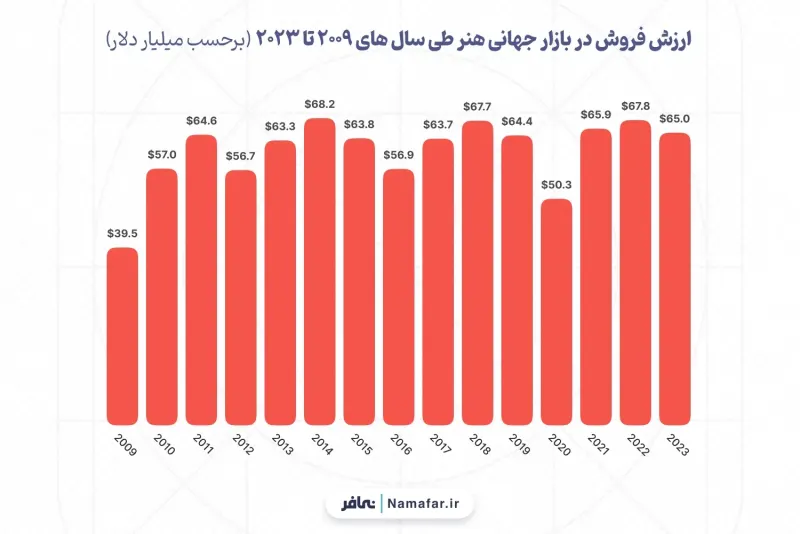
In the chart above you see sales value in the global art market from 2009 to 2023. After two years of growth, sales in the art market declined in 2023 and reached about 65 billion dollars, showing a 4 percent decrease compared with last year. But it still remained above the pre-COVID-19 pandemic level in 2019 (64.4 billion dollars).
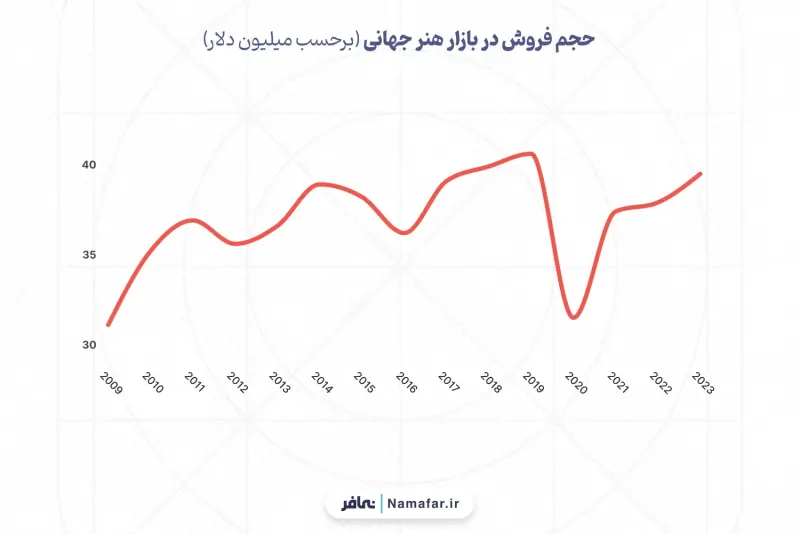
In the chart above you see sales volume in the global art market. Despite the decline in value, transaction volume grew in 2023 and reached 39.4 million transactions (a 4 percent increase compared with 2022). This growth was mainly due to the relative dynamism of transactions at lower price levels for dealers and auction houses, while a greater decline occurred in the upper segment of the market, where transaction volume is generally lower.
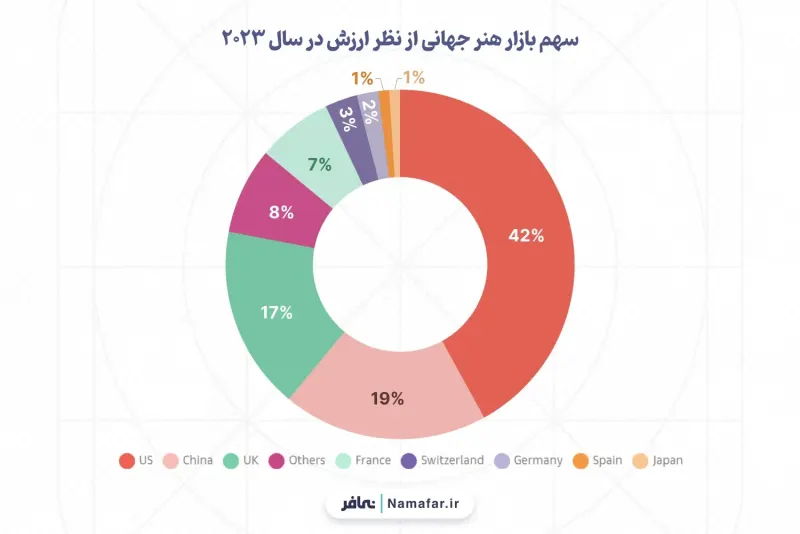
In the chart above you see the global art market's share by value in 2023. The United States retained its position as the largest global market and accounted for 42 percent of sales, which was a 3 percent decrease compared with last year. China, including mainland China and Hong Kong, became the second-largest global art market and its share reached 19 percent, while the United Kingdom, with a 17 percent share, fell to third place. France remained in fourth place with 7 percent.
An examination of the global art auction market
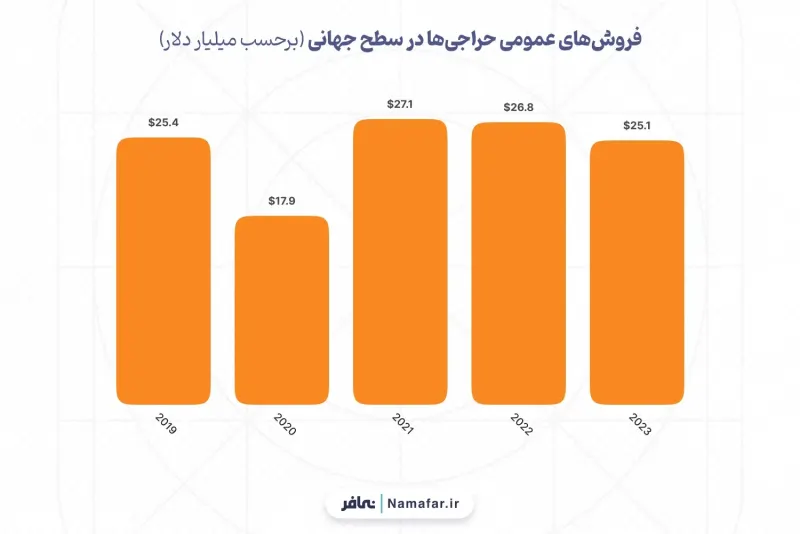
After an overview of the global art market, we turn to a closer examination of the global art auction market in 2023. In the chart below you see public auction sales at the global level. After some unprecedented sales were recorded in the upper segment of the market in 2022, public auction sales in 2023 declined by 7 percent to 25.1 billion dollars. Transactions at prices above 10 million dollars declined considerably, and this led to a sharp drop in value, while sales in some mid- and lower-price segments continued to grow.
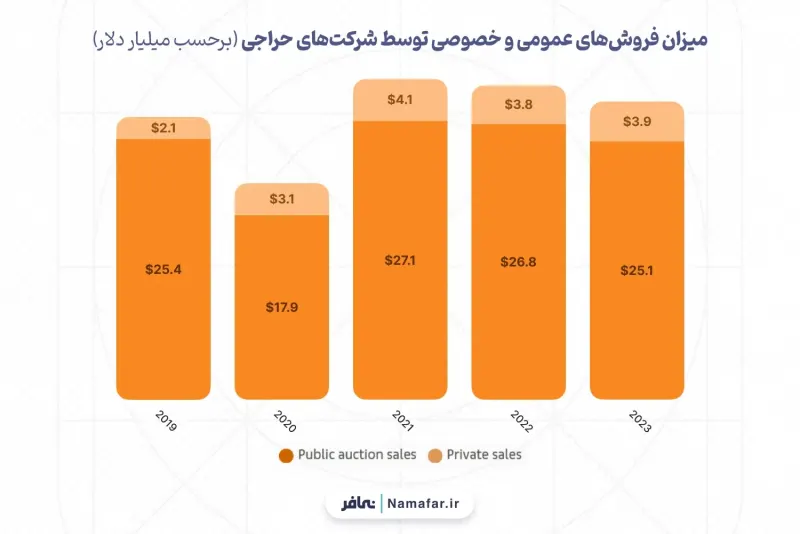
We examine the amount of public and private sales by auction companies in the chart below. Including public and private sales, total sales carried out by auction companies in 2023, with a 5 percent decrease compared with last year, reached 28.9 billion dollars, although they were still above the pre-pandemic level in 2019.
Private sales by auction houses, contrary to the downward trend, grew 2 percent and reached about 3.9 billion dollars. Taking both public and private sales into account, total sales still remained above the pre-pandemic level.
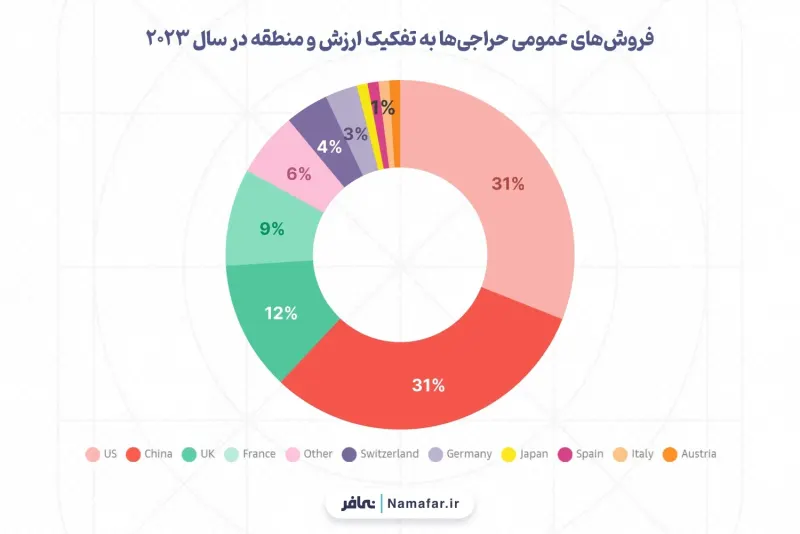
Public auction sales by value and region in 2023 are shown in the chart below. The United States, China, and the United Kingdom were still the largest global auction markets in 2023 and together accounted for 74 percent of public auction sales by value, which was a 3 percent decrease compared with last year. With an increase in a portion of sales that took place because of postponement from 2022, the Chinese market rose from second place to a level equal with the United States, and each accounted for 31 percent of public auction sales (excluding private sales). The United Kingdom remained the third-largest auction market with a stable 12 percent share.
Art auctions in China
If we want to put a finger on one of the emerging art auction markets, China will certainly be the first choice. After a challenging year in 2022, accumulated supply and demand early in 2023 caused auction sales in China to increase, and sales value, with 14 percent year-on-year growth, reached 7.9 billion dollars. These results include sales that were postponed from China's autumn 2022 auction season and held early in 2023 and caused a striking increase in activity. However, the second half of the year was considerably slower, because factors such as a weak economic growth outlook, rising debts, ongoing problems in the real-estate market, and weaker global demand negatively affected sellers' and buyers' sentiment.
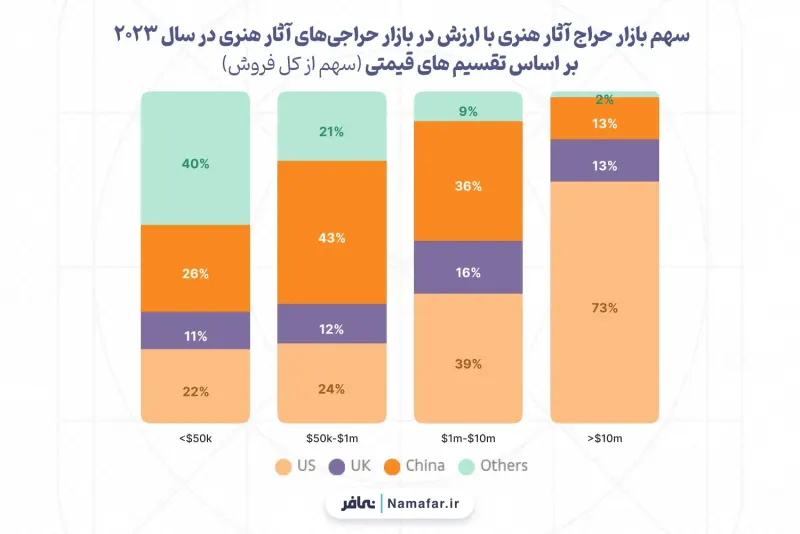
An important criterion examined in assessing art auction markets is the value of the artistic goods sold in each auction market, which in the chart below are divided into four categories from under fifty thousand dollars to over ten million dollars. Although the United States lost a considerable share of the market in 2023, it still remained the main center for selling works at the highest prices in global auctions. Of the 10 most expensive auction works, 8 works were sold in New York, and only one of the six works sold at a price of more than 50 million dollars was sold in London. 34 of the 50 most expensive auction works of the year were sold in New York, and US sales accounted for 74 percent of the value of the 50 top works.
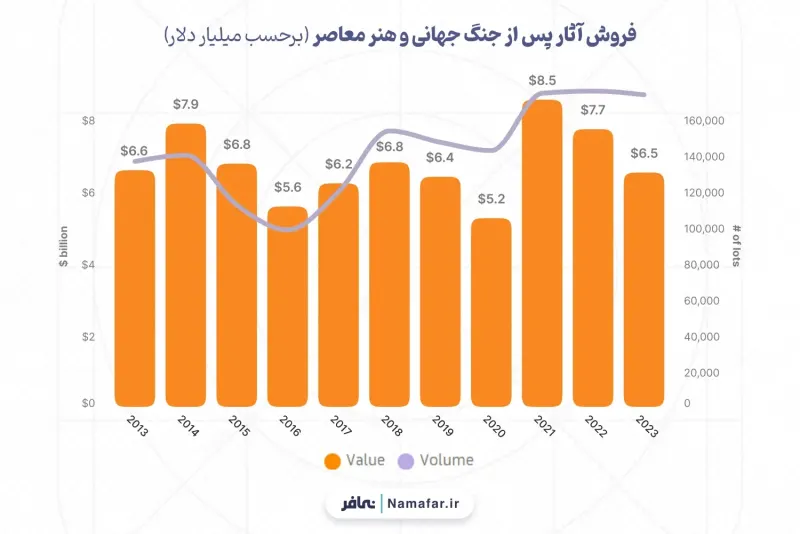
Post–World War II artworks and contemporary art form an important part of the share of auction sales, which are examined in the chart below. These works were still the largest segment of the art auction market in 2023, with a 53 percent share of the value of global sales and a 55 percent share of sales volume. Total sales in this segment reached 6.5 billion dollars, which was a 16 percent decrease compared with 2022 and the second year of decline after the peak of sales in 2021 at 7.8 billion dollars. In 2023, most sales by value (66 percent) took place in the postwar works subset, while contemporary works accounted for 34 percent of sales value. After a strong recovery in 2021, sales of contemporary works declined for two consecutive years, including a 10 percent decrease in 2023 to 2.2 billion dollars. Postwar works held steady in 2022, but in 2023 they declined by 18 percent and reached 4.3 billion dollars.
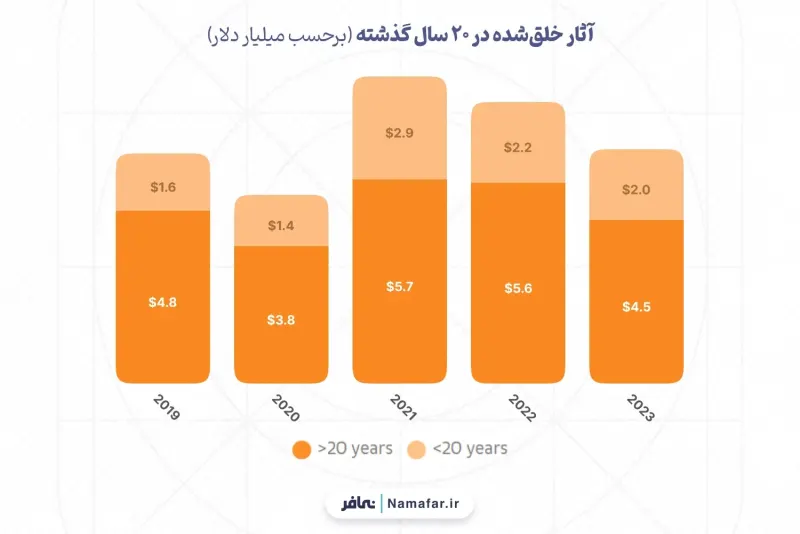
For a closer examination of contemporary works sales, works created in the past 20 years are examined in the chart below. In 2023, approximately 36,000 works that had been created in the past 20 years were sold at auctions, and these works accounted for 30 percent of the broader postwar and contemporary segment by value, an increase relative to 25 percent in 2019 (and only 17 percent in 2017).
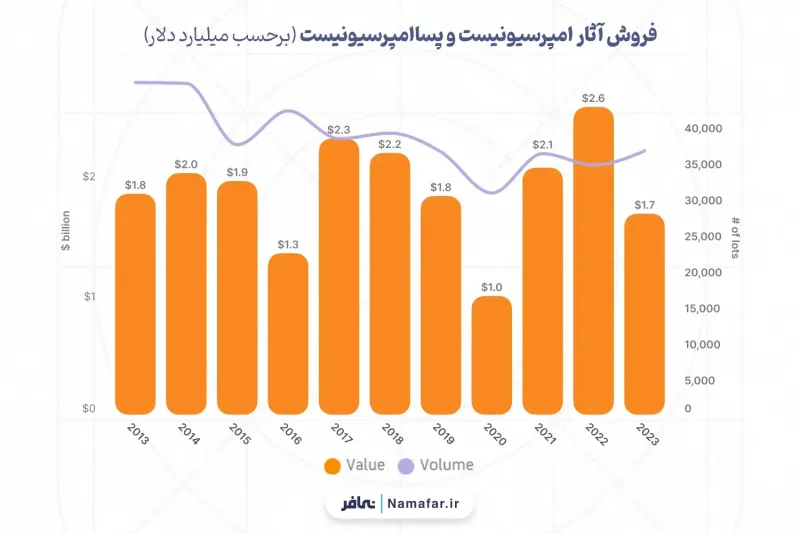
As can be seen in the chart below, Impressionist and Post-Impressionist works in 2023 accounted for 14 percent of the value of artwork sales at auctions, which was a 4 percent decrease compared with the previous year. This segment had experienced one of the strongest recoveries, with a 160 percent increase in value over two years until it reached 2.6 billion dollars in 2022, the highest recorded level. However, sales slowed in 2023 and their value, with a 35 percent decrease, reached 1.7 billion dollars, despite 6 percent more works being sold. This figure is still slightly below the pre-pandemic level in 2019.
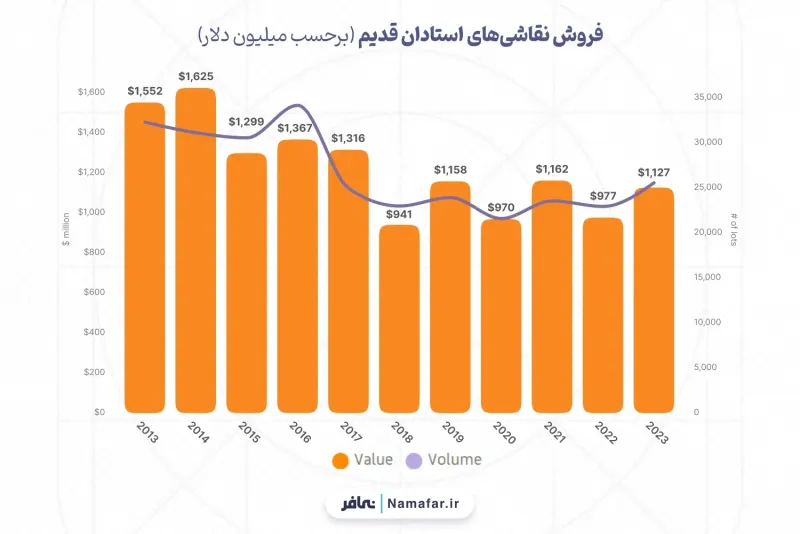
In the Old Master paintings segment, as you can see, China's market return in 2023 helped increase sales, and their value, with 15 percent growth, reached 1.1 billion dollars, which was slightly below the 2019 level. But in the European Old Master paintings segment, a 17 percent decrease to 481 million dollars was observed, which, although higher than 2019, shows a 32 percent decrease compared with the past 10 years.
Conclusion
In the end, it must be said that examining global trends in the auction industry clearly shows that this industry, beyond a place for buying and selling artworks, has become one of the important and profitable pillars in the world of the creative industries. As noted earlier, over the years auctions have gone from a specialized activity for capitalists and collectors to a global market with influence in the arena of culture and art. These transformations, especially in the use of technology and digital platforms, can help us in the creative industries, by drawing on global experiences, to create new models for interacting with our audiences. Precise analysis of global sales and consumption trends, especially in the artistic and digital segments, can play a vital role in offering innovative solutions for the domestic creative industries. In this regard, learning from these trends is useful not only for improving and developing business models, but can also open the way to a transformation in how we interact and communicate with customers in a rapidly changing world. In this piece we had a review and examination of the history and nature of this auction and also their global markets. In the next section we will analyze, in a more precise and detailed way, the sales and trends of several well-known international auctions.
Machine-translated from Persian by Namafar; the Persian original is authoritative. Read the original in Persian