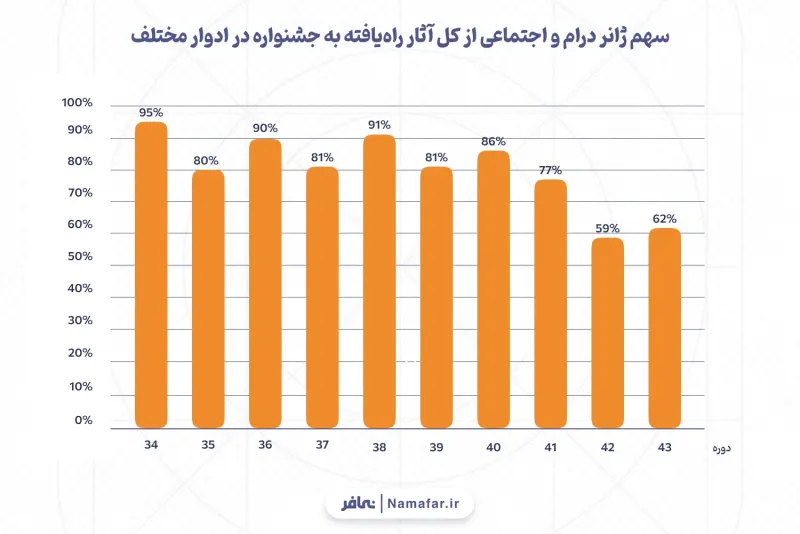
The forty-third edition of the Fajr Film Festival has begun work in circumstances in which more than 60 percent of this edition's selected works fall in the drama and social genre. The dominance of this genre over other genres has once again brought up the discussion of the lack of genre diversity at the Fajr Film Festival and has created concerns about the content uniformity of this cinematic event. Nevertheless, if we look at past editions, we observe that, with the exception of the previous edition, the number of drama and social films has been far greater than in the current edition. For example, in 1394 (2015/16) and during the thirty-fourth edition of the Fajr Film Festival, more than 90 percent of the works that reached the competition section were in the drama and social genre. This striking statistic shows that the lack of genre diversity is not only a present problem, but has been a historical challenge for this festival. The dominance of the drama and social genre over the festival, on the one hand, can indicate filmmakers' interest in addressing social and realist issues, but on the other hand, this approach may cause creative horizons to be limited and attractiveness to be reduced for audiences who are looking for different and innovative cinematic experiences.
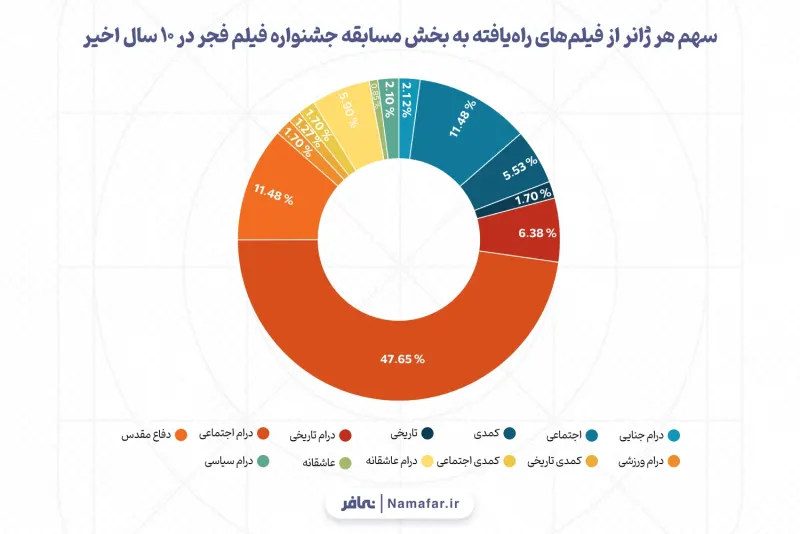
Analysis of data related to films present in various editions of the Fajr Film Festival shows that after the drama and social genre, which has taken the largest share, the Sacred Defense (Iran–Iraq War) and comedy genres have also had a notable presence at this cinematic event. The examinations conducted show that Sacred Defense films, because of this genre's particular place in Iranian cinema and the support provided for it, account for 11.48 percent of the total works participating in the festival. On the other hand, the comedy genre as well, which has always been raised as one of the high-audience and popular genres in Iranian cinema, has accounted for 5.53 percent of the festival's works. These statistics show that although the Sacred Defense and comedy genres have a smaller share compared with the drama and social genre, they still form an important part of Iranian cinema's productions and have always received attention at the Fajr Film Festival. The presence of these two genres at the festival, on the one hand, indicates the importance of Sacred Defense films in narrating the history of Iran's war and promoting a culture of sacrifice and resistance, and on the other hand, indicates the role of comedy films in attracting audiences and creating diversity among festival works.
Iranian cinema's dominant tendency to produce drama and social works, while in other countries genres such as science fiction, horror, and action enjoy particular popularity, can indicate a conservative and low-risk approach in choosing genre and film content. Iran's filmmakers and producers, most likely because of concern about commercial failures and audiences' lack of uptake of innovative or different works, prefer to use stories and genres that have a record of success and acceptance in the market.
Based on statistics and figures published by the Deputy for Technology Development and Cinema Studies of the Ministry of Culture and Islamic Guidance, in 1402 (2023/24) most of Iran's high-grossing and popular films have been presented in the social and comedy genres. These data show that in the process of choosing subject and genre, past experiences and audience tastes play an important role, so that filmmakers, to reduce possible risks, tend to focus on producing works that audiences are ready to take up.
This risk-reduction approach is observable not only in Iran but also at the global level. For example, in 2024 the majority of highest-grossing box office films in the international market were sequels or prequels of prominent franchises. This trend, which is known as a strategy for ensuring commercial success and attracting audiences, results from major Hollywood studios' tendency to use proven templates and reduce financial risks. In other words, by relying on franchises and previously successful stories, studios try to benefit from a sure and interested audience, because audiences generally show a positive reaction to known and accepted works.
Therefore, Iranian cinema's tendency toward producing films in the drama and social genres can be a reflection of a market-oriented and conservative approach; an approach that, by relying on audience tastes and previously successful experiences, tries to minimize possible dangers arising from presenting new and different works. This strategy, although from a financial and commercial standpoint it can be successful, may in the long term cause a limitation in innovation and an ever-increasing reduction of genre diversity in Iranian cinema.
In addition, the absence of an advanced and integrated cinema industry in Iran, together with a very large focus on commissioned and conservative productions, has caused filmmakers and directors to refrain from expanding artistic horizons and experimenting with new and different genres. In other words, the existing conditions in the cinema market in Iran, which have been designed mostly on the basis of economic guarantees and sure, risk-free approaches, have caused creative people in the field of filmmaking not to be able to freely explore innovative genres and subjects.
On the other hand, the investment structure in this field, with a method in which there is not sufficient transparency and return on capital is not prioritized as an economic requirement, is considered an important factor in the reduction of innovation. This investment model, because of the absence of financial and economic pressures to present innovative works, helps repetitive and stereotypical production, because filmmakers tend to use sure and proven methods so that the risks arising from producing different and innovative works are minimized.
Also, the institutional and cultural support that is provided by government authorities and related organizations has been allocated mainly to the production of social films. This causes the production of this type of work to appear more economically justifiable, because greater financial support and appropriations are placed at their disposal. As a result, these policies have implicitly steered the culture of film production in Iran toward social stories and content related to everyday issues and in a way limit the space for experimenting with and experiencing different genres.
Therefore, the combination of the lack of development of a comprehensive cinema industry, opaque investment models with no requirement of return on capital, and the intense concentration of institutional support on social films have all joined hands to cause the repetition of stereotypical patterns and a reduction of innovation in Iranian cinema. This situation leads to a reduction of genre diversity and ultimately to the limiting of the space for creativity in the production of Iranian films, while on the one hand this approach is economically justifiable and on the other it prevents the emergence of artistic innovations and fresh experiences in the cinema arena.
Machine-translated from Persian by Namafar; the Persian original is authoritative. Read the original in Persian