From the need for a realistic look at the performance of public libraries to the necessity of a functional reconfiguration of them
Libraries are among the most important cultural and social centers of any country, which have an important role in the formation and generation of dynamic and creative thought, the socialization of individuals, and the development of societies. Among libraries, public libraries have a special role and function in society and in public service. According to the "Vision Document of the Public Libraries Institution on the Horizon of 1404 (2025/26)," public libraries are a cultural institution with an Islamic-Iranian identity, influential and effective on society, which has awareness-raising, educational information, and guidance functions. This institution must lay the ground for the promotion of useful reading, have committed, specialist, and trained human resources, and, while preserving the country's first place in the region, succeed in bringing the country among the fifteen leading countries of the world in terms of per-capita space, members, resources, and library loans.
Now the question is this: with 22 years having passed since the establishment and activity of public libraries in the country, to what extent has this institution carried out its duties and mission. In this regard, this note, with a data-driven approach and by enumerating the number of public libraries in the country, geographic dispersion, the number of public-library members, the costs of the Public Libraries Institution, the number of books in public libraries, and so on, tries to give a well-founded answer to this question. Most of the data of this note are drawn from two products, the "Iran Public Libraries Institution Dashboard" and the "Public Libraries Management System Dashboard," of Namafar's policy research and data analysis group. These dashboards, by extracting, processing, and visualizing the data of the "Iran Public Libraries Institution website" and the "Integrated Public Library Management System," have made interactive examination of the data possible.
The number of public libraries in Iran
The existence of infrastructure (the library) can be considered a precondition for any talk and discussion about the culture of reading and book-reading in society. Because before cultural work for greater use of the library, one must first see whether there is infrastructure for this culture or not. One of the most important infrastructures is the number of libraries, a matter that in the "Vision Document of the Public Libraries Institution on the Horizon of Iran 1404 (2025/26)" too has been considered by the board of trustees of public libraries under the title "per-capita space."
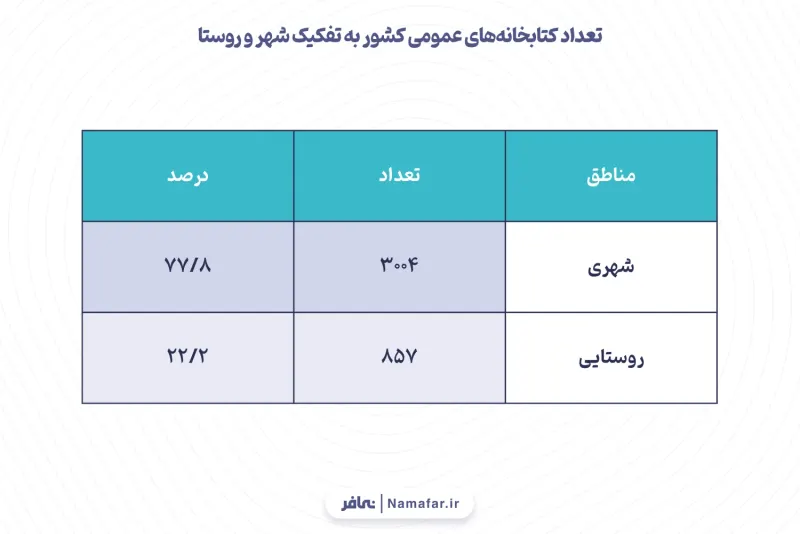
According to statistics announced by the Iran Public Libraries Institution, by the end of Bahman (January–February) 1403 (2024/25), there are 3,861 public libraries in the country, of which 3,004 (77.8 percent) are urban libraries and 857 (22.2 percent) are rural libraries.
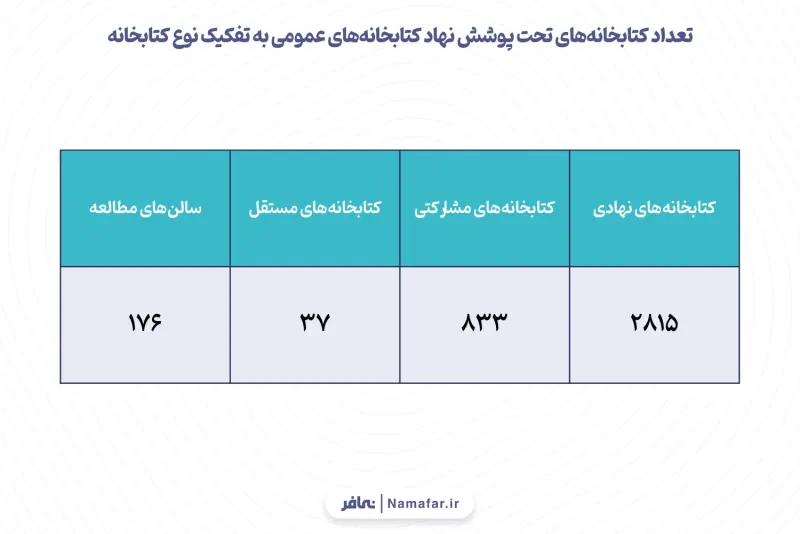
Also, an examination of the number of libraries covered by the Public Libraries Institution by type of library shows that 2,815 institutional libraries, 833 participatory libraries, 37 independent libraries, and 176 reading halls in total have formed the 3,861 public libraries.
Which province has the largest number of public libraries?
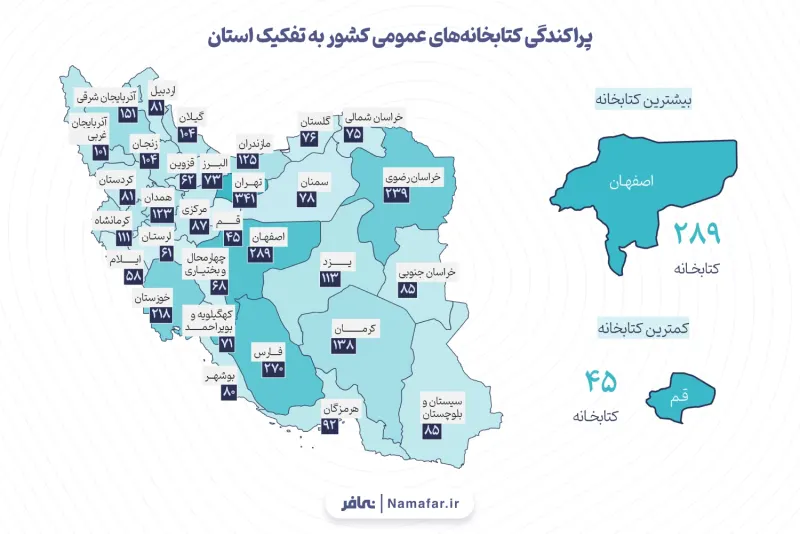
An examination of the dispersion of the country's public libraries by province shows that Tehran Province, with 341 public libraries, has the largest number of libraries in the country. The provinces of Isfahan, Fars, and Razavi Khorasan, respectively with 289, 270, and 239 public libraries, are in the next places. This is while, on the other side, the provinces of Qom with 45 public libraries, Ilam with 58 public libraries, and Lorestan with 61 public libraries respectively have the smallest number of libraries among the country's provinces.
Tehran; the country's poorest province in terms of public libraries!
An examination of the number of libraries of each province relative to population (per hundred thousand people) indicates each province's index of access to public libraries. According to the findings, the index of access to public libraries in the country is 4.62 libraries per 100 thousand people. Semnan Province, with 11.4 libraries, has the greatest access to public libraries. Also, the provinces of South Khorasan and Yazd, respectively with 10.9 libraries and 10.2 public libraries per hundred thousand people, are in the next places. This is while, if we calculate the number of libraries relative to population, Tehran, with 2.7 public libraries per hundred thousand people, is the country's poorest province in terms of the number of public libraries.
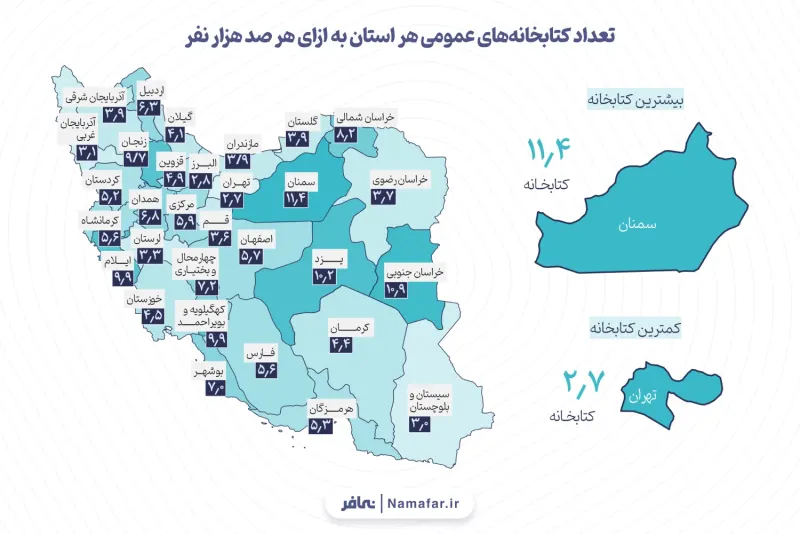
In provinces such as Tehran, Isfahan, Fars, and Razavi Khorasan, where the need for libraries is high, the level of access to them is low. Also, the provinces in which the per-capita number of libraries is low are populous provinces, and this means that a large part of Iran's population faces a challenge in access to libraries.
How many members do public libraries have?
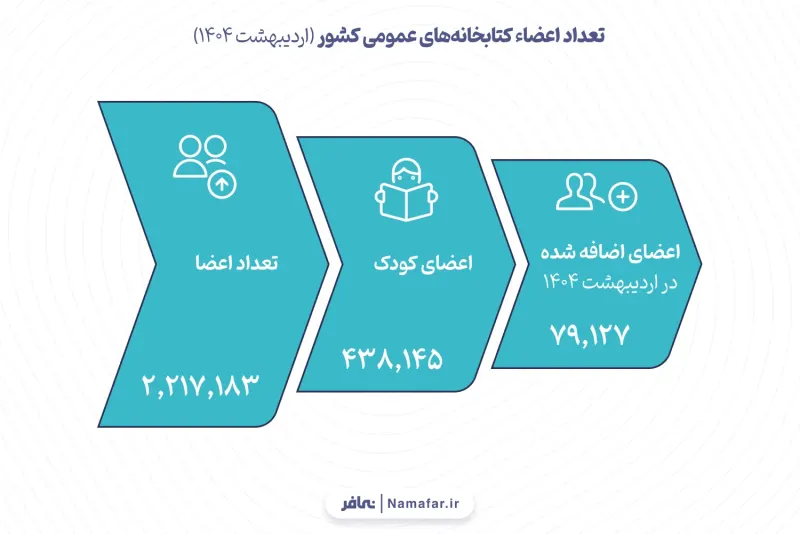
The Public Libraries Institution has brought the number of its members, by the end of Ordibehesht (April–May) 1404 (2025/26), to 2,217,183 people. According to statistics announced by the institution, 438,154 members of this number are child members. Also in Ordibehesht 1404 (2025/26), which coincided with the days of the Tehran International Book Fair, 79,127 new members were added to public-library members.
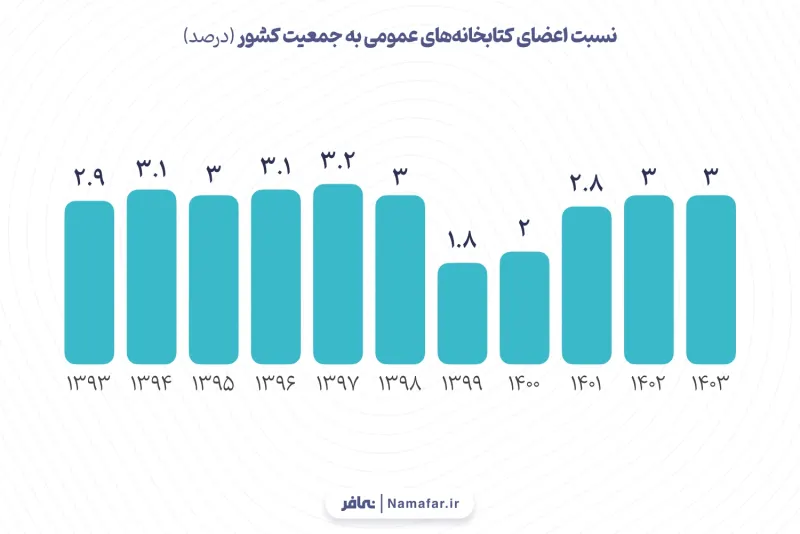
Only 3 percent of the country's people are members of public libraries!
As stated at the beginning of the note, the existence of infrastructure (the library) can be considered a precondition for any talk and discussion about the culture of reading and book-reading in society, but do public libraries and buildings have meaning and function without the presence of people and members? The immediate answer is negative. Public libraries have meaning with their members; because the more the number of members increases, visits, book loans, and cultural activities also increase. Now is a good time to raise the question and the main aim of the present note: are public libraries really hosts to the general public? The best answer is in the language of statistics and data. The reality is that in past years and in the best case, only about 3 percent of Iran's people have been members of public libraries. This is while in leading and pioneering countries more than 50 percent of people are members of public libraries. Also the "Useful Reading Movement Document," which was approved in 1389 (2010/11), had targeted membership of 35 percent of Iran's people over a 15-year interval, which has not been achieved and possible and has a large distance from today's realities. Given that the entire budget of public libraries is provided from the public budget, the number and range of their members and users is a suitable measure for judging their performance. Therefore it is expected that a broader spectrum of Iran's people benefit from the services of this public institution.
Less than one volume of books; each Iranian's share of public-library books
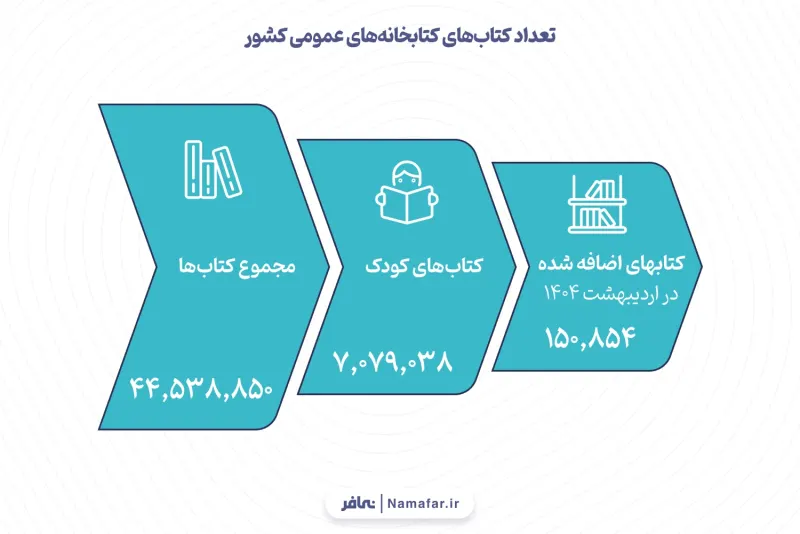
By the end of Ordibehesht (April–May) 1404 (2025/26), the total books of the country's public libraries were 44,538,850 volumes of books. In other words, the "per-capita public-library books" index in the country is less than one. This is while, on the basis of the "Useful Reading Movement Document" approved in 1389 (2010/11), this index for 1404 (2025/26) (15 years later) had been targeted at the figure 4. On the basis of the latest statistics announced on the country's population by the Statistical Centre of Iran, one can put forward the proposition that, in accordance with the aims of the "Useful Reading Movement Document," a place for about 311 million copies of books in public libraries is empty. Comparing the country's "per-capita public-library books" index with other countries makes the critical status of this matter more apparent. The per-capita books index in countries such as the United States of America, Japan, France, and Canada is between 2 and 3. A look at countries of the region as well, such as Georgia and Azerbaijan, indicates the existence of 5 books per person in these countries. It appears that the shortage and lag of per-capita books in the country's public libraries cannot easily be made up and requires a program and considerable budgetary support.
The public-libraries budget; enough to pay staff salaries and nothing else!
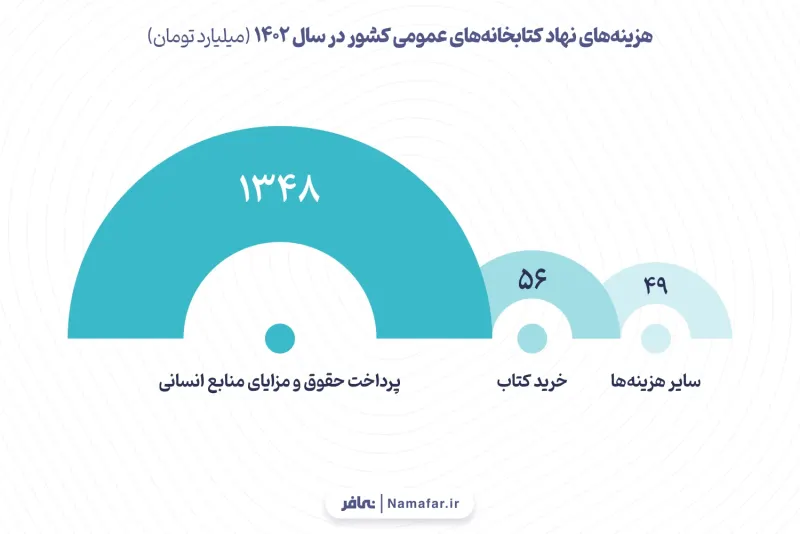
According to the "List of expenses of the Iran Public Libraries Institution in 1402 (2023/24)" announced by this institution, more than 92 percent of public-library expenses, equivalent to 1,348 billion tomans, has been spent on paying human-resources salaries and benefits. This is while in 1402 (2023/24) only 56 billion tomans was allocated to buying books, and the share of the institution's other expenses was also 49 billion tomans. These statistics well show that strengthening the resources of the country's public libraries is in practice not possible with its organizational structure and human resources and the current budget. This is while a look at the status and performance of public libraries in neighboring countries, such as the public libraries of the United Arab Emirates, shows that in only one case and simultaneous with the holding of the Sharjah International Book Fair, the amount of 4.5 million dirhams, equivalent to 85 billion tomans, was allocated to Sharjah's public and government libraries for buying books.
The necessity of a functional reconfiguration of public libraries
An examination of the status and performance of the country's public libraries in terms of components such as infrastructure, members, resources, structure, and so on shows that public libraries have a considerable distance from suitable conditions and, citing the statistics and data raised, are in a critical situation. This is while public libraries in other countries, in addition to the conventional and traditional role and function they have, in step and in line with the status and needs of society, have accepted and implemented diverse and useful functions. For example, Australia's public libraries have become a place for public service on a broad scale. Such that 1,412 public libraries in Australia hold more than 1.4 million cultural-social programs such as language-education workshops, financial-counseling sessions, handicrafts training, film and documentary screenings, and so on, and have been able to host one-fourth of Australia's people in these programs. Also in Scotland the circle of public-library services has expanded to an unimaginable extent; public libraries in Scotland have become a place for supporting public health and providing services such as support for pregnant mothers, distribution of essential vitamins, cancer counseling, free distribution of related and necessary items for the elderly, creating educational and skills opportunities such as job guidance and counseling, media and digital literacy workshops, and so on.
Final word
Given that public libraries have a special role and function in society and in public service, this note has addressed an examination of the status and performance of the country's public libraries in terms of components such as infrastructure, members, resources, structure, and so on. The statistics and data related to the performance of public libraries in all the aforementioned components show that public libraries have a considerable distance from suitable conditions and are in a critical situation.
On the basis of the findings, it appears that in the first place it is necessary that policymakers, decision-makers, and those involved in this field have a realistic look at the performance of public libraries and free themselves from the bind of the aims, duties, and requirements of documents of more than a decade ago. Then, by enumerating existing limitations and challenges and taking them into account, they should undertake an organizational and functional reconfiguration.
Machine-translated from Persian by Namafar; the Persian original is authoritative. Read the original in Persian