An examination of the effect of the war on the performance of Iranian cinema
The market, economy, and revenue of industries and businesses are among the most prominent and tangible concerns of people and of business actors in wartime. The economy and market of the cultural and creative industries are not only no exception to this matter, but are among the most vulnerable industries. In this regard, the Namafar Center for Policy Research and Data Analysis, with a data-driven examination of the effect of the war on the cultural and creative industries, tries to present a precise picture of the status of each industry during and after the war. Iranian cinema is one of the organized and leading cultural industries in the field of sales infrastructure and the possibility of monitoring the market, for which the possibility of a precise and data-driven examination of its performance and market by extracting and analyzing the statistics and data related to it is operational. On this basis, to begin we have turned to the cinema industry and the effect of the war on the performance of Iranian cinema has been examined. Data related to the market and box office of Iranian cinema indicate Iranian cinema's rapid return to the pre-war period.
Revival of the box office after the ceasefire
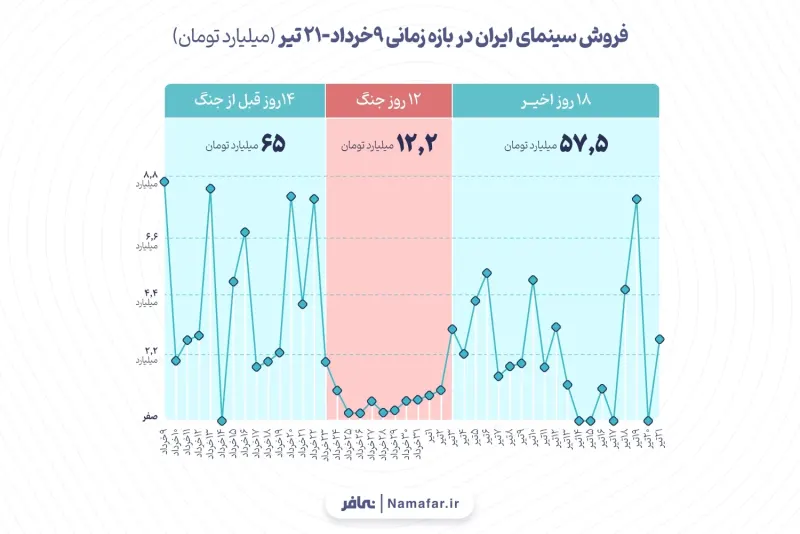
A comparison of the box office of films on screen, in three time periods before the war (9 Khordad (May–June) to 22 Khordad), during the war (22 Khordad to 3 Tir (June–July)), and after the war (4 Tir to 21 Tir) can enumerate and present a precise picture of the effect of the war on the performance of Iranian cinema. On this basis, the box-office amount of films in the 14 days before the war was 65 billion tomans. Given that on 14 Khordad cinema halls were closed, the average daily box office of Iranian cinema before the start of the war was 5 billion tomans. With the start of the imposed 12-day war against Iran in the early hours of 23 Khordad, the box office of Iranian cinema declined. But the notable point before presenting the statistics during the war is the activity of cinemas on the days of the war; so much so that the screening of films over the 12 days of war was not completely stopped. Statistics show that in the 12 days of war, the revenue of Iranian cinema was 12.2 billion tomans. With the stopping of the war and the announcement of a ceasefire in the early hours of 3 Tir 1404 (2025/26), the box office of Iranian cinema immediately went onto a path of growth and on 3 Tir films on screen reached more than 3 billion tomans. The box-office revenue of Iranian cinema, 18 days after the ceasefire, has reached 57.5 billion tomans. Given the 3-day closure of cinema halls on the days after the war, it can be said that Iranian cinema is on the path of returning to the pre-war period. In other words, the average daily box office of Iranian cinema on the days after the war has been 3.8 billion tomans.
Iranian cinema in the days before the war; from Saddadam's topping the chart to the impressive arrival of The Old Bachelor
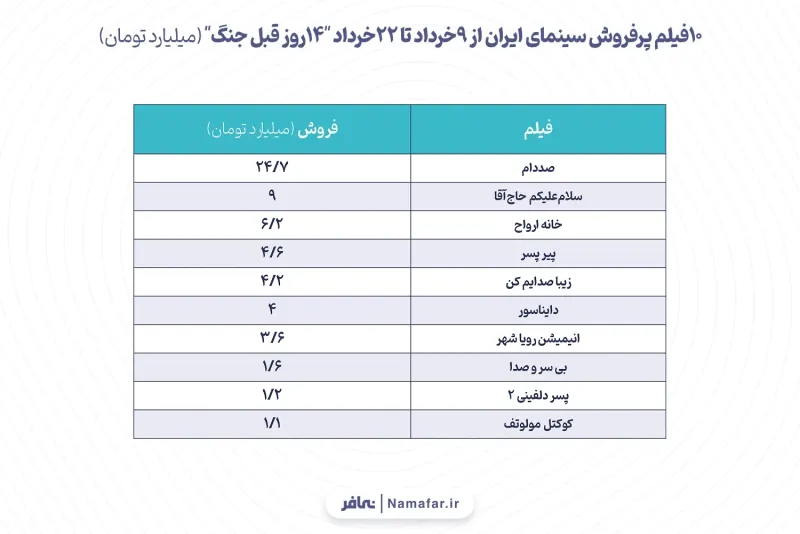
After several years of Iranian cinema's box office being occupied by comedy-genre films, from the very first days of the screening of the film The Old Bachelor it became clear that Oktay Baraheni with "The Old Bachelor" and stars such as Hassan Pourshirazi, Leila Hatami, Hamed Behdad, Mohammad Valizadegan, and others (who according to most cinema critics have given their best performances) can stop and transform this trend. A look at the 10 highest-grossing films of Iranian cinema in the two weeks before the start of the imposed war shows that the film Saddadam in this period, with 24.7 billion tomans, was at the top. This is while The Old Bachelor in the first 2 days of screening had more than 4.6 billion tomans in box office.
The 50 percent share of the film The Old Bachelor of the box office on the days of the war and after the war
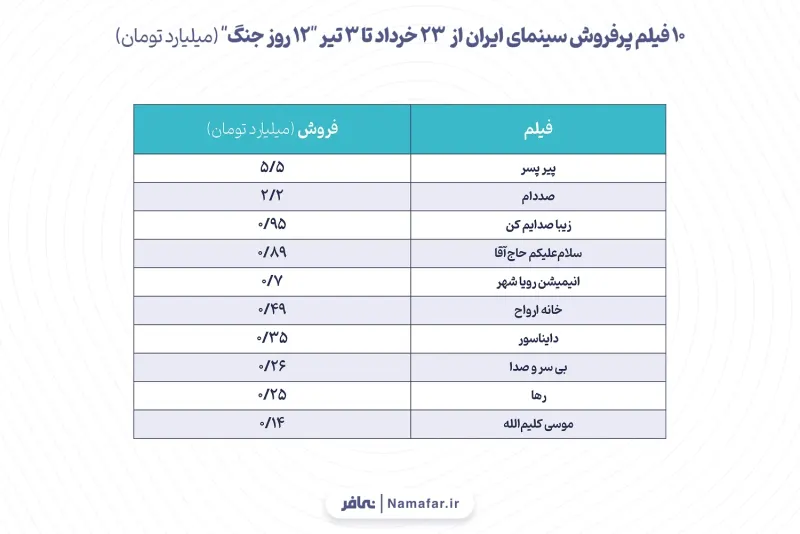
Iranian cinema, too, like most parts of society, came under the shadow of the war and the box-office amount of films declined seriously. This is while most of the country's cinemas were active on the days of the war and cinema halls on these days hosted admissions. The box office of Iranian cinema during the war was 12.2 billion tomans. The film The Old Bachelor, which had had a powerful arrival at the box office, on these days accounted for about 50 percent of the audiences and box office of Iranian cinema.
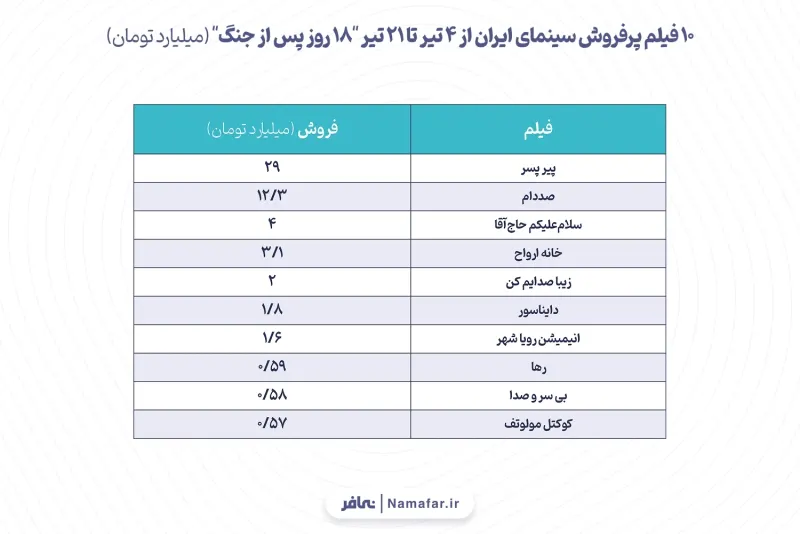
But as was said, the box office of Iranian cinema increased after the stopping of the war and the announcement of the ceasefire, and this matter is tangible from the very first days after the war. A look at the 10 highest-grossing films after the war shows that, as was expected, the film The Old Bachelor, with 29 billion tomans, is the highest-grossing film of Iranian cinema after the days of the war. In other words, "The Old Bachelor" has captured more than 50 percent of the box office of Iranian cinema in the 15 days of activity of Iran's cinemas on the post-war days. This is while films such as Saddadam, Dinosaur, Molotov Cocktail, and others have not been able to have a serious competition with Oktay Baraheni's acclaimed film.
Watching films; even on the days of the war!
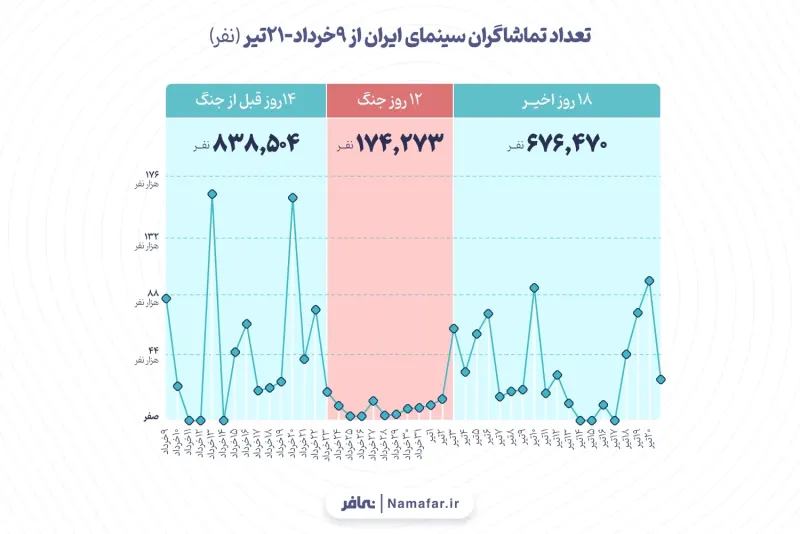
Going to the cinema and watching a film in a dark hall may be the last choice of many people for days of war. Even so, on the days of the war, 174 thousand people went to cinema halls and watched the films on screen. What is interesting is that on 23 Khordad—the day the war started—and 27 Khordad—the day tensions had reached their highest level—with 22 thousand admissions and 15 thousand admissions respectively, they accounted for the greatest presence of admissions. A comparison of the number of admissions in the 2 weeks before the start of the war and the 18 days after the war (15 days of activity of the country's cinemas) also indicates the number of admissions approaching the pre-war days.
The rising trend of screenings after the war
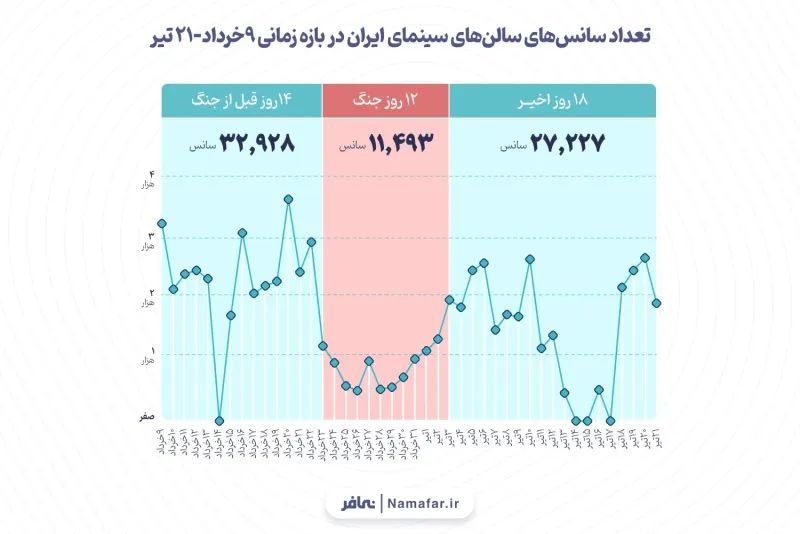
With the start of the war, the activity of some of the country's cinemas was also shut down. In the first instance this matter can be cited as one of the factors affecting the amount of box office and the number of admissions on the days of the war; because if the shut-down cinemas had been active, the box office of Iranian cinema on the days of the war might have been even greater. The number of screenings of the country's cinema halls, after the war, has had a rising trend and has gone from 11,493 screenings on the days of the war to 27,227 screenings in the past 18 days. This is while screenings after the war have still not reached the figure of 32,928 screenings in the 14 days before the war. Even so, the rising trend of screenings indicates the return of cinemas' activity to the normal routine.
Final word
Iranian cinema in the 2 weeks before the start of the war had 838 thousand admissions and 65 billion tomans in box office. With the start of the war, the box office of Iranian cinema declined to 12.2 billion tomans. But the notable point is that the activity of Iranian cinema did not stop during the war and on the days of the war, 174 thousand people went to cinema halls. The box-office revenue of Iranian cinema, 18 days after the ceasefire, has reached 57.5 billion tomans. Given the 3-day closure of cinema halls on the days after the war, it can be said that Iranian cinema is on the path of returning to the pre-war period. It appears that if in the coming days no particular and special event or crisis occurs, the box-office revenue of Iranian cinema will also surpass the days before the war.
Machine-translated from Persian by Namafar; the Persian original is authoritative. Read the original in Persian