Comedy is today the most profitable genre in Iranian cinema, but it was not always so. In the 1360s (1980s), only one in every ten cinema tickets was sold for a comedy film. In the first seven months of 1405 (2026/27) this share has reached nearly six in ten. This note follows the path of Iranian comedy from the earliest films to today's box office and, to measure the films' success, has taken the number of admissions as the criterion instead of the box-office amount, which inflation renders meaningless.
Before the Revolution: from "Abi and Rabi" to Filmfarsi
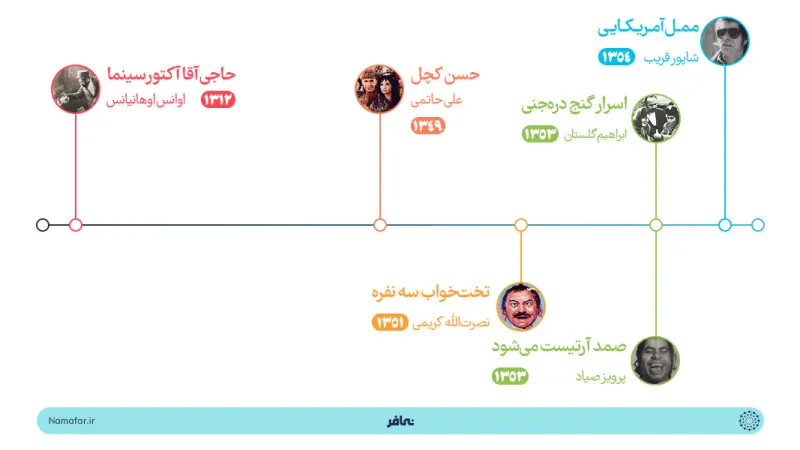
The first feature film in Iranian cinema was itself a comedy: "Abi and Rabi," which Avanes Ohanian made in 1309 (1930/31), a silent film about two friends, one tall and one short. In the 1340s and 1350s (1960s and 1970s) comedy became an inseparable part of Filmfarsi; films that were made for the box office and were a mix of song, dance, love and jokes. "Ganj-e Qarun" (Siamak Yasemi, 1344 (1965/66)) was a turning point in this current and showed that an Iranian film could break box-office records. "Hasan Kachal," Ali Hatami's first film (1349 (1970/71)), was also a musical comedy that came from folk tales.
The 1360s (1980s): comedy with caution
After the Revolution, comedy was set aside for a few years and when it returned it distanced itself from the Filmfarsi atmosphere. Ali Hatami's "Jafar Khan Has Returned from Farang" and Dariush Mehrjui's "The Tenants" are examples from this period. "The Tenants" in 1366 (1987/88) had more than three million admissions and became the decade's highest-grossing comedy. Even so, the 1360s (1980s) box office belonged to war and family films: "The Eagles," "Kanimanga" and "Khastegari." Over the decade as a whole about one-tenth of cinema admissions went to watch comedy.
The 1370s (1990s): two big records
In the 1370s (1990s) too comedy was not the leading genre, but two comedies became the highest-admission films in the history of Iranian cinema: Davoud Mirbaqeri's "The Snowman" in 1376 (1997/98) with about 4.5 million admissions, and Mohammad Reza Honarmand's "Mard-e Avazi" in 1377 (1998/99) with about 3.8 million. Both were the country's highest-grossing film in their own year. Even so, comedy's share of the decade's total admissions was still under ten percent, and "Afi," "Kolah Ghermezi" and social films held the box office.
The 1380s (2000s): comedy becomes the leading genre
The main change came in the 1380s (2000s). Comedy's share of cinema admissions rose from less than three percent in 1380 (2001/02) to seventy percent in 1388 (2009/10). From 1382–1388 (2003–2010) the highest-grossing film each year was a comedy; from "Tokyo Bedune Tavaghof" and "Coma" to "Sharlatan," "Cease Fire" and "The Outcasts." The exceptions were three years: 1380 (2001/02) ("Saint Mary"), 1381 (2002/03) ("Kolah Ghermezi and Sarvenaz") and 1389 (2010/11) ("The Kingdom of Solomon").
Masoud Dehnamaki's "The Outcasts 2" in 1388 (2009/10) with about 5.3 million admissions was, until 1401 (2022/23), the highest-admission film recorded in the cinema yearbook; a record that "Fasil" broke in 1402 (2023/24). Of the ten highest-admission films of the 1380s (2000s), six are comedies.
The comedies of this decade were more varied than those of the next: war comedy ("The Outcasts"), political comedy ("Coma"), romantic comedy ("Cease Fire") and religious-social comedy ("The Lizard"). This variety is one of the reasons critics consider the 1380s (2000s) a better period for Iranian comedy.
The 1390s (2010s): a repeated formula, a full box office
In the 1390s (2010s) comedy was the year's highest-grossing film in six years out of ten and took almost half of the decade's total admissions. See the decade's highest-admission films:
| Film | Year | Admissions |
|---|---|---|
| Hezarpa | 1397 (2018/19) | 4218793 |
| Motreb | 1398 (2019/20) | 3297138 |
| Nahang-e Anbar 2 | 1396 (2017/18) | 2674648 |
| Ayeneh Baghal | 1396 (2017/18) | 2650697 |
| Texas 2 | 1398 (2019/20) | 2406940 |
| Man Salvador Nistam | 1395 (2016/17) | 2396006 |
| Gasht 2 | 1396 (2017/18) | 2335907 |
All of these are comedies. The only non-comedy films in the decade's top ten were "Muhammad: The Messenger of God," "City of Mice 2" and "Just 6.5."
The comedies of this period mostly repeated one template: a few comedy stars such as Reza Attaran and Pejman Jamshidi, a story of money and getting rich, a trip abroad or a traditional-versus-modern confrontation, and jokes more explicit than before. Making second and third installments also became common; "Nahang-e Anbar 2," "Gasht 2" and "Texas 2" are examples.
One point should not be forgotten: total cinema admissions in the 1390s (2010s) were lower than in the 1360s (1980s) and 1370s (1990s). The highest-grossing film of 1392 (2013/14) had fewer than one million admissions, whereas in the 1370s (1990s) several films each year attracted more than three million admissions. Comedy's share went up, but in a market that had itself become smaller.
The 1400s (2020s): comedy's share still higher
"Dynamite" in 1400 (2021/22) and "Enferadi" in 1401 (2022/23), both made by Masoud Atyabi, were the highest-grossing films of their own years. In 1400 (2021/22) two-thirds of cinema admissions bought tickets for comedies.
After the slump of the COVID years, cinema filled up again in 1402 (2023/24) and 1403 (2024/25): total admissions rose from 13.5 million in 1401 (2022/23) to 28 million in 1402 (2023/24) and 35 million in 1403 (2024/25). Comedies accounted for most of this growth. "Fasil" in 1402 (2023/24) with 7.4 million admissions became the highest-admission film in the history of the cinema yearbook, and "Hotel" with 6.2 million stood second. In 1403 (2024/25), "Haftad Si," "Texas 3" and "Zoodpaz" each had more than four million admissions. In both years about three-quarters of tickets for Iranian films were sold for comedies; the highest share comedy has had to date.
1404 (2025/26) was a year of reversal: total admissions fell to about 23 million and comedy's share also reached 57 percent. "Mard-e Eynaki" with 2.4 million admissions was the year's highest-admission film, but the year's second film was a social drama: "Pir Pesar" with 2 million admissions.
SAMFA (cinema box office system) sales data for 1405 (2026/27) show the same trend. From 1 Farvardin (March–April) to 24 Mehr (September–October) about 8.6 million tickets have been sold for Iranian films and comedies' share of that is fifty-eight percent. "Khanom Valedeh" with about 1.7 million admissions is the year's highest-grossing film so far, followed by "Zendeshoor" (mystery) and "Estakhr" (comedy).
Iran's highest-grossing comedy films
This list is based on the number of admissions in the cinema yearbook (1364–1404 (1985–2026)), not the box-office amount. For that reason, comedies of the 1370s (1990s) sit alongside today's highest-grossing films.
| Film | Director | Release year | Admissions |
|---|---|---|---|
| Fasil | Karim Amini | 1402 (2023/24) | 7434635 |
| Hotel | Masoud Atyabi | 1402 (2023/24) | 6246505 |
| Haftad Si | 1403 (2024/25) | 5746361 | |
| The Outcasts 2 | Masoud Dehnamaki | 1388 (2009/10) | 5328297 |
| The Snowman | Davoud Mirbaqeri | 1376 (1997/98) | 4473277 |
| Texas 3 | 1403 (2024/25) | 4445017 | |
| Hezarpa | Abolhassan Davoudi | 1397 (2018/19) | 4218793 |
| Zoodpaz | 1403 (2024/25) | 4072444 | |
| Mard-e Avazi | Mohammad Reza Honarmand | 1377 (1998/99) | 3792033 |
| Motreb | Mostafa Kiaei | 1398 (2019/20) | 3297138 |
| The Tenants | Dariush Mehrjui | 1366 (1987/88) | 3051390 |
| Nahang-e Anbar 2 | Saman Moghadam | 1396 (2017/18) | 2674648 |
Each film's admissions are given only for its main year of release; if a film stayed on screen the following year as well, its real figure is a little higher. "Khanom Valedeh" in 1405 (2026/27) through Mehr (September–October) has had about 1.7 million admissions and is still on screen.
Old Iranian comedy films, decade by decade
The highest-admission and best-known comedies of each decade:
- Before the Revolution: "Abi and Rabi" (1309 (1930/31)), "Ganj-e Qarun" (1344 (1965/66)), "Hasan Kachal" (1349 (1970/71)) and Ali Hatami's "Baba Shamal" (1350 (1971/72)).
- The 1360s (1980s): "The Tenants," "Rooz-e Bashkuh-e Shahr-e Kuchak," "The Bus," "Hey Joe," "The Bells" and "Jafar Khan Has Returned from Farang."
- The 1370s (1990s): "The Snowman," "Mard-e Avazi," "Jibborha be Behesht Nemiravand," "Do Nafar va Nimeh," "Leily Is with Me" and "Eynak Dudi."
- The 1380s (2000s): "The Outcasts" and "The Outcasts 2," "Coma," "Cease Fire," "Towfigh-e Ejbari," "The Lizard" and "Mum's Guest."
Comedy's share of cinema admissions, year by year
| Year | Comedy films' share of admissions | The year's highest-admission comedy |
|---|---|---|
| 1366 (1987/88) | 11% | The Tenants |
| 1376 (1997/98) | 16% | The Snowman |
| 1377 (1998/99) | 19% | Mard-e Avazi |
| 1380 (2001/02) | 3% | Eynak Dudi |
| 1384 (2005/06) | 22% | Sharlatan |
| 1388 (2009/10) | 71% | The Outcasts 2 |
| 1392 (2013/14) | 38% | Rasvaei |
| 1396 (2017/18) | 63% | Nahang-e Anbar 2 |
| 1398 (2019/20) | 54% | Motreb |
| 1400 (2021/22) | 66% | Dynamite |
| 1401 (2022/23) | 48% | Enferadi |
| 1402 (2023/24) | 74% | Fasil |
| 1403 (2024/25) | 76% | Haftad Si |
| 1404 (2025/26) | 57% | Mard-e Eynaki |
The year 1399 (2020/21) has been left out of the table because of cinemas being closed in the COVID pandemic. Every film that has the "comedy" tag in the yearbook (even alongside another genre, such as "social, comedy") has been counted as a comedy.
Why did comedy take the box office?
There is no single explanation, but several factors are repeated more than the others. For most admissions, cinema has become a collective weekend entertainment, and comedy is the best option for this kind of viewing. Genres such as action and horror that compete with comedy worldwide are little made in Iran because of cost and production constraints. Investors also see less risk when they repeat the formula of a successful comedy with the same stars. The result is that genre diversity in Iranian cinema has remained low and comedy has filled the gap left by the rest.
To learn about other genres and their place at the Iranian and world box office, see types of film genre.
Sources
- Number of admissions 1364–1404 (1985–2026): Statistical Yearbook of Iranian Cinema (full text of the 1401 (2022/23), 1402 (2023/24), 1403 (2024/25) and 1404 (2025/26) yearbooks in the reference reports), in the cinema yearbook dashboard: halls and admissions.
- Sales in 1405 (2026/27): weekly data from the SAMFA (cinema box office system) system, Iranian cinema, nationwide, through 24 Mehr (September–October) 1405 (2026/27), in the SAMFA (cinema box office system) dashboard: cinema and theater ticket sales.
Machine-translated from Persian by Namafar; the Persian original is authoritative. Read the original in Persian