In recent years, the video game and digital-content industry in our country has grown significantly. But entering international markets and securing a lasting position is a major challenge for those active in this field. Anu is one of the successful pioneers in this arena; it began operating in 1388 (2009/10) and, relying on Iranian specialist talent, has taken effective steps in the global space.
In the interview that follows, Mostafa Keyvanian, founder and CEO of Anu, has spoken about the beginning of the journey, the challenges, the achievements, and the development outlook of this group, and has revealed experiences that map the path of an Iranian company's entry into global markets.
Please start by telling us a little about Anu and its field of activity.
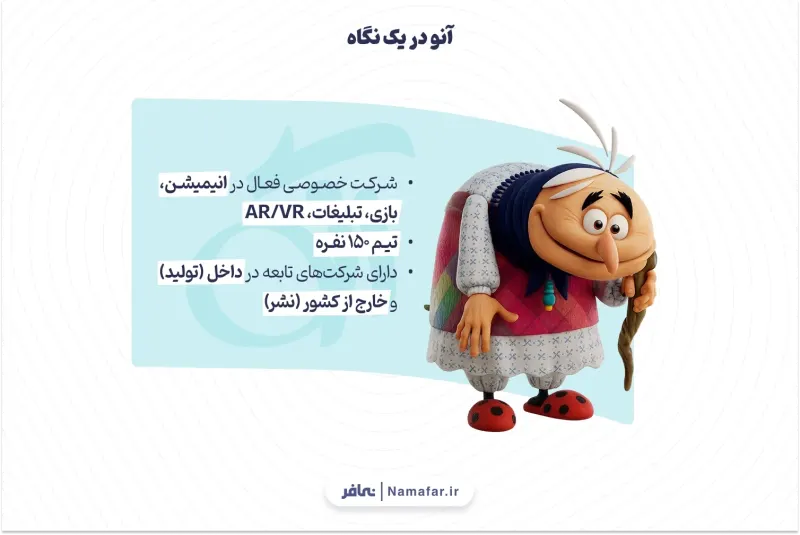
Anu began operating in 1388 (2009/10) and has been focused mainly on the creative industries. The company's main areas of activity include animation, video games, advertising teasers, augmented reality (AR), and virtual reality (VR). A large share of this group's productions has been for markets outside the country, and only a small number of its projects have been released inside Iran.
At present, Anu comprises several subsidiaries, some located in Iran and some abroad. The companies based in Iran focus more on production processes, such as producing animation, games, teasers, and other similar content. By contrast, the foreign companies are responsible for international affairs such as publishing and international campaigns.
What is the management structure of these companies?
The parent company is Anu; but each of the subsidiaries has an independent structure and management. Each of them has its own CEO and business model and operates independently.
What is the composition of the company's shareholders? What fields have they studied?
At present, Anu has four shareholders (besides myself). Three of them are the company's original cofounders, with whom we have worked from the beginning, and the fourth is the group's investor. The cofounders are mainly graphics graduates, and the other members have also mostly studied computer science and related fields. I also hold a bachelor's degree in computer science and a master's degree in business administration.
Were you also the founder of the company?
Yes.
Please tell us about the starting point of your own professional activities. Where did the idea of launching Anu take shape?
Interestingly, I first worked in architecture. The reason for this also goes back to my high-school education and my interest in computer science. At that time, my brother introduced me to the 3dmax software and familiarized me with 3D design. Given the market's need for 3D images of architectural projects, this skill became a commercial opportunity and led me, over several years, to design more than 130 building and urban projects in 3D in Tehran and other counties.
Later, given my command of 3D software and at a friend's suggestion, I began working in game development. Graphic design was my responsibility, and he handled the programming. This collaboration led to the production of a game that was well received inside the country. That success, together with prior familiarity and interest, paved the way for my more serious entry into games and animation.
After that, I founded a company as a partnership that grew over time and came fully under my management. Today this group, with more than 150 specialist staff, carries out numerous projects in digital-content production at the national and international levels and is recognized as one of the active players in this industry.
Is your focus at present more on the domestic market or the foreign market?
Over the past ten years we have put our main focus on foreign markets, and the bulk of our activities relates to outside the country.
In which countries are your foreign clients mainly located, and how is cooperation with them carried out?
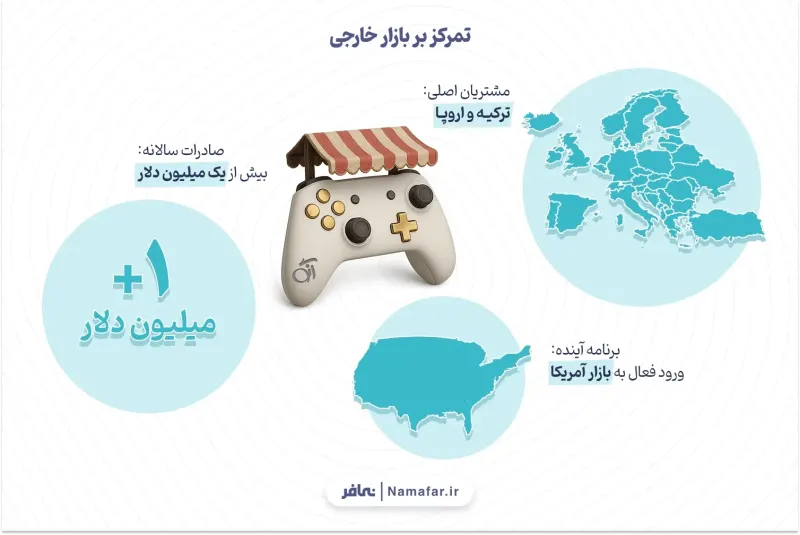
Because of limitations in international relations, we conduct a large share of our dealings through two foreign companies under our management. In such a way that our clients know us not as Anu, but by the names of those companies. At present, most of our working relationship is with Turkey; although we have also had collaborations with European countries and even the United States.
Do you also have a plan to enter new markets?
Our target is to enter the United States market, which is one of the most attractive global markets in this field. We also intend to work with international partners to distribute our products in various markets.
How much is your annual export?
The value of our annual exports is more than one million dollars.
Let us talk about problems as well. What obstacles and challenges do you face in exporting services and products?
Our main challenge is the issue of moving money. Because of the existing conditions, it is not possible for us to transfer money officially into the country. Therefore, we have to bring it in unofficially. As a result, on the one hand we have to pay tax abroad; and on the other hand we cannot declare this income officially inside Iran, because in that case the domestic legal channels would also demand tax. Such a process means that part of our income (about 40 to 50 percent) is lost along the transfer path, and this issue will reduce our competitiveness on projects.
Does your company benefit from government support, whether special facilities or workspace?
Our company operates on a fully private basis and so far we have received no special support from government institutions. Of course we have a space of about a thousand meters at the University of Tehran; but this location has not been granted to us as a facility. Rather, we pay about 400 million tomans a month in rent for it, and this cost is covered entirely by the company.
What sets Anu apart in the competitive international market?
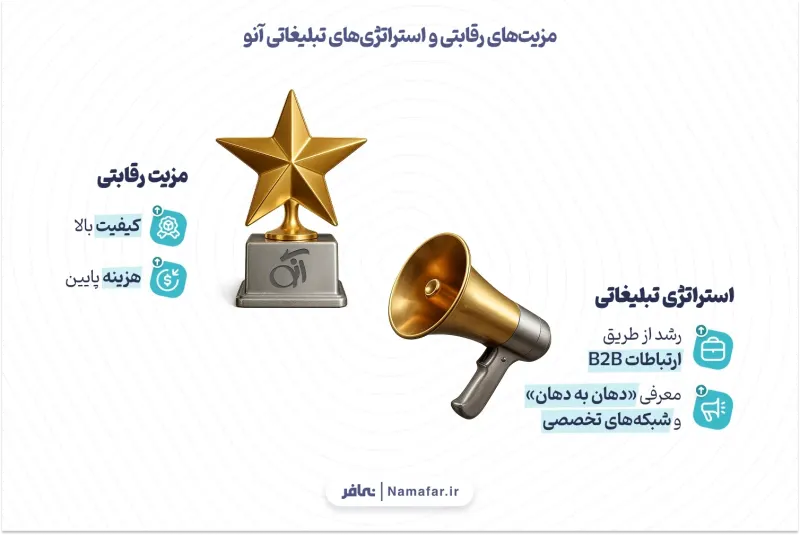
Our main distinguishing feature in the international market is the optimal quality-to-cost ratio. The fees we charge for carrying out projects are much lower than those of foreign competitors. At the same time, the quality of the output is at a level that produces high client satisfaction. For that reason, they prefer to entrust their projects to us rather than have them carried out in other countries at higher cost and lower quality. In fact, we compete in the market by combining high quality and low cost.
What have been your most important national and international achievements and honors over these years?
Inside the country, we have received almost all of the prominent awards in video games, including "Best Game of the Year," "Best Graphics," and other leading titles. At the international level we have also had notable successes. Among them, at Gamescom in Germany, we were selected as one of the honorees in the Indie Developers section. We have also had collaborations with major global publishers; but our most important international achievement so far has been this selection at Gamescom.
Are you focused on a particular age or social group as your target audience?
Our target audience differs depending on the commission we receive, and this is not in our control, except in cases where production has been carried out by us from the start. Even so, in general our work is concentrated more in the children and adolescents field.
Do you offer the products as a bundle?
No, our products enter the market separately and independently. Of course, in some cases, for companies that have multiple IPs, it is possible to offer them as a bundle. But our current focus is more on commissioned projects, and we operate mainly in the form of providing services (servicing).
What advertising strategy do you use for international marketing?
If I want to answer frankly, I must say that the bulk of the recognition of us at the global level has come through introductions and connections from companies we have worked with. In other words, we have mainly been introduced by word of mouth and through professional networks. So far we have not taken any particular action in the area of broad marketing.
What plans do you have for developing your activities?
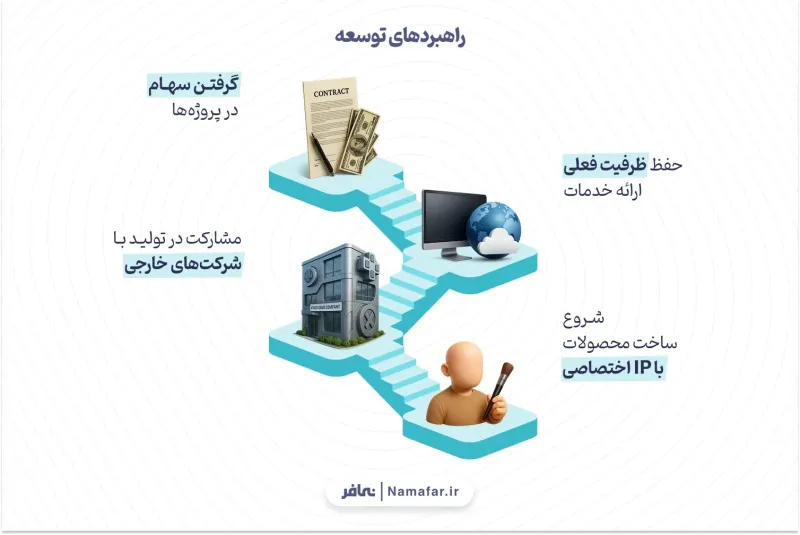
At present, we have no plan to expand servicing. Our priority is producing independent IPs so that we can have a share in product sales. In the current situation, we only provide services and receive a fixed profit that is without risk. But since last year, we have begun steps either to take equity in projects; or to start making products with IPs that belong to us; or to participate with foreign companies in producing projects. Therefore, we have no plan for further development in the services segment, because our production capacity has also currently reached saturation.
In your view, what impact will artificial intelligence have on the production process? Tell us about your experiences in this area.
The arrival of artificial intelligence in various fields, including the games industry, is inevitable. The claim that animation or video games will lose their place because of artificial intelligence is, in my view, not correct. But the reality is that work processes have been facilitated using AI. For example, previously designing a concept by an artist might take one week; but today, with the help of AI tools, the same output is obtained in two days. As a result, in executing projects we save about four to five days.
For that reason, we too are moving toward using this technology. We have accepted this change and have also required our colleagues to learn how to work with artificial intelligence and use it in projects.
Has artificial intelligence been able to replace human labor anywhere?
No. At present, artificial intelligence has only played a facilitating role and has not yet reached the point where it can fully replace human labor. Even if one day it reaches that level, we will still need operators who can adjust and personalize the outputs to match our needs. Therefore, in my view, humans will still play the main role.
Machine-translated from Persian by Namafar; the Persian original is authoritative. Read the original in Persian