The animation industry today has become an important cultural consumption for all groups, especially children and adolescents. Technically this industry is advancing and being updated every day. Most of the animation consumption basket in Iran is filled with foreign works. For the animation industry in Iran to become a productive, strong and dynamic industry, training in making animation needs to be pursued more widely, more professionally and at a more advanced level. Although the educational side of this culture-making, profitable industry, rich in creativity and art, is growing in Iran in some areas, can this amount of animation-making education carry the load of building an industry?
The animation program in Iranian universities
In Iranian universities the animation program is known as "animation" and admission at the bachelor's level is through the art experimental group of the national entrance exam. In this program the student learns character design, screenplay and storyboard, two-dimensional and three-dimensional animation, sound and editing. At the master's level there are also animation concentrations.
The best-known universities that offer this program:
- Tehran University of Art: Faculty of Cinema and Theater, Animation Department; the oldest and best-known center of university animation education.
- University of Tehran: College of Fine Arts, especially at the master's level.
- Isfahan University of Art
- Soore University
- IRIB (Islamic Republic of Iran Broadcasting) University
- Branches of Islamic Azad University and the University of Applied Science and Technology in several provinces.
The exact list of universities and each year's capacity is in the National Organization for Educational Testing (Sanjesh) entrance-exam booklet and may change each year. The data below show how these capacities have changed in recent years and how they are distributed among the provinces.
Falling admissions to animation programs in Iran
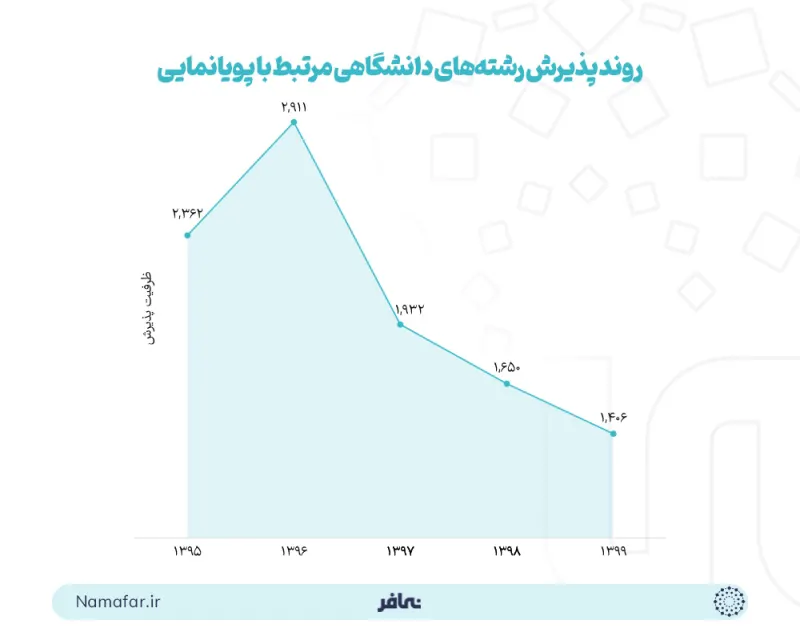
According to the chart below, the trend in admissions to university programs related to animation is downward. This trend was rising through 1396 (2017/18). But admissions to animation programs from 96 to 99 fell sharply by half. This is while attention to animation-making as a field overall has increased. So the drop in animation program capacity at universities may be due to a lack of interest in academic training in this field.
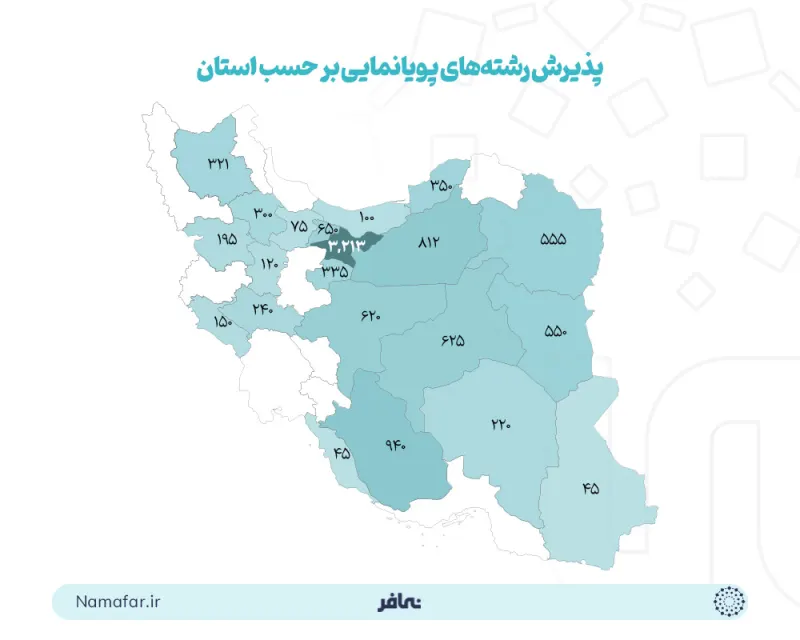
Uneven distribution of animation program capacity across universities
As can be seen, training in animation-making is concentrated in Tehran, but it also exists in most other provinces of Iran. Only in the provinces of Kermanshah, Ardabil, West Azerbaijan, Gilan, North Khorasan, Hormozgan, Chaharmahal and Bakhtiari, Markazi, Kohgiluyeh and Boyer-Ahmad and Khuzestan is there no capacity for student admission in programs related to animation. These ten provinces are mainly border provinces. Apart from these ten provinces, Sistan and Baluchestan and Bushehr have the least capacity for animation-making programs. After Tehran, Fars province has the most capacity for this program.
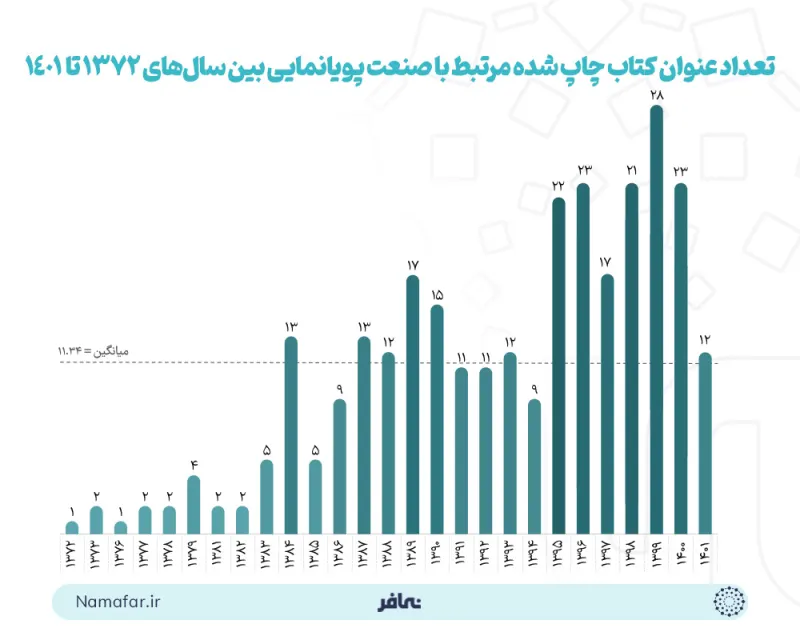
The state of book publishing in animation-making education
As noted, animation education overall is on the rise. One sign that this statement is correct is the sharp increase in books printed on making animation from 95 onward.
Various organizations publish books on animation. Among them the IRIB (Islamic Republic of Iran Broadcasting) Faculty, Soore Mehr Publishing and the Farabi Cinema Foundation hold first to third place. So the organizations active in book publishing in animation-making in Iran are IRIB (Islamic Republic of Iran Broadcasting), the Howzeh-ye Honari under the Islamic Development Organization, and the Ministry of Culture and Islamic Guidance. In light of these figures it can be said that in recent years, state and governing bodies have shown extra attention to education for the animation industry.
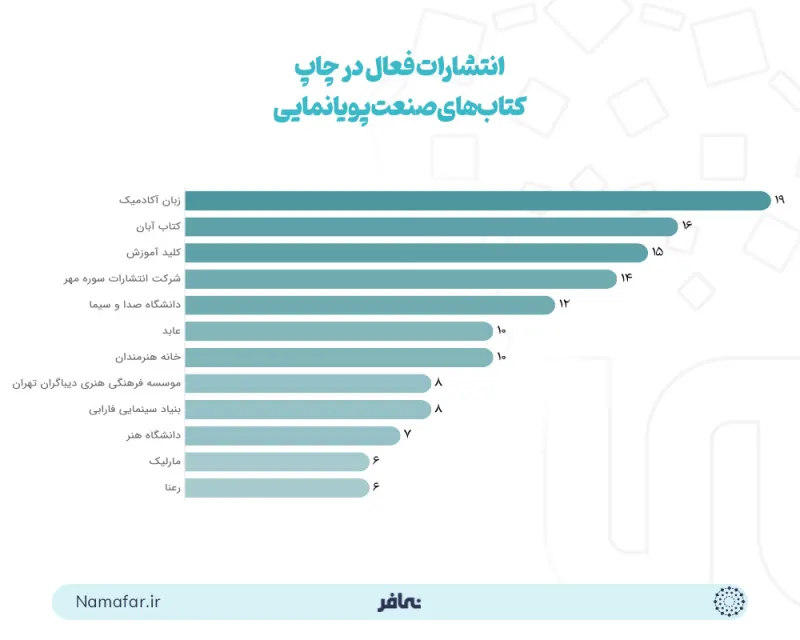
As shown in the image, the IRIB (Islamic Republic of Iran Broadcasting) Faculty is at the top of this table. But coming first in a group where only 6 books on animation-making education can put an organization at the top is not a source of pride for Iranian writers and organizations. In light of these figures, education for the animation industry has still not reached the necessary level. This situation will also show itself at the stage of making and producing works. Naturally the same path will reach audience consumption, and in people's animation consumption basket there will be no place left for Iranian works.
Growth in the number of articles about animation
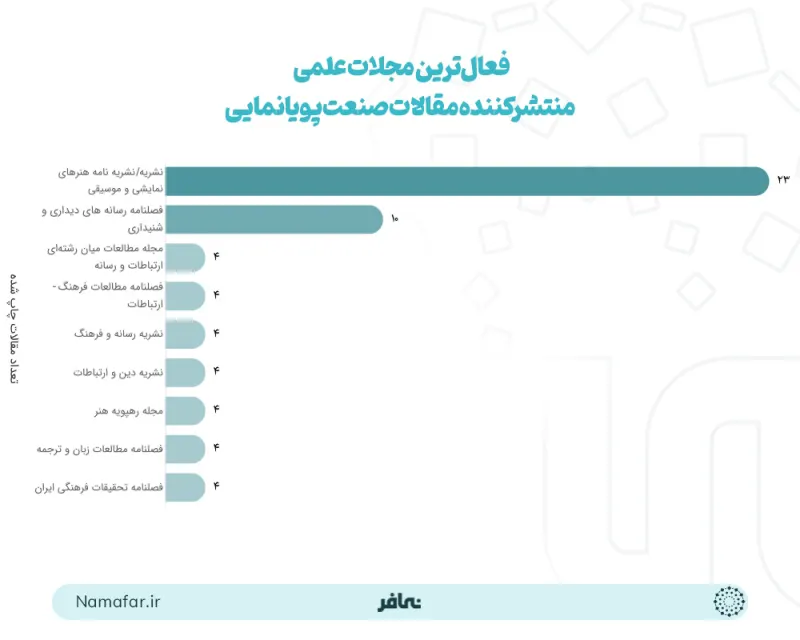
The figures show that especially in the animation-making industry, scholarly articles are growing and expanding. This means scholarly intermediaries have entered this field and have devoted effort to producing articles related to animation. Although these articles are low relative to the global average. But if one looks at the trends in a historical genealogy, these figures can be seen as understandable and encouraging. As with books about animation, in publishing articles too the IRIB (Islamic Republic of Iran Broadcasting) Faculty ranks first. The Audiovisual Media Quarterly belonging to the IRIB (Islamic Republic of Iran Broadcasting) Faculty has published the most articles in animation. Next is the College of Fine Arts at the University of Tehran, which through the Honar-ha-ye Ziba (Fine Arts) journal has produced the most articles on this field. Third on this list is the Culture and Communication Studies Quarterly, which belongs to the Research Institute for Culture, Art and Communications.
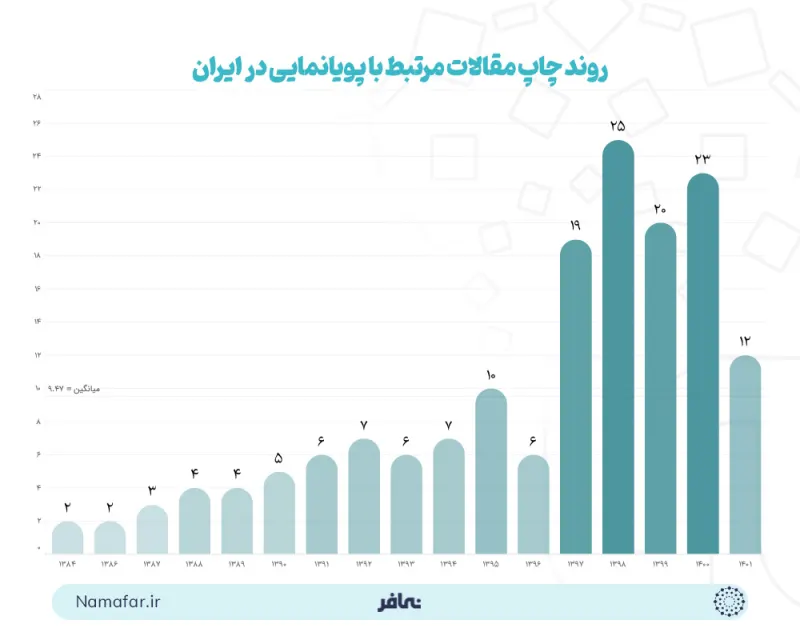
For these figures to have meaning, they must be set beside the world's scholarly output.
As shown on the map, the world's most active researchers in publishing articles on the animation industry and field are from China, the United States, England, Spain and Canada.
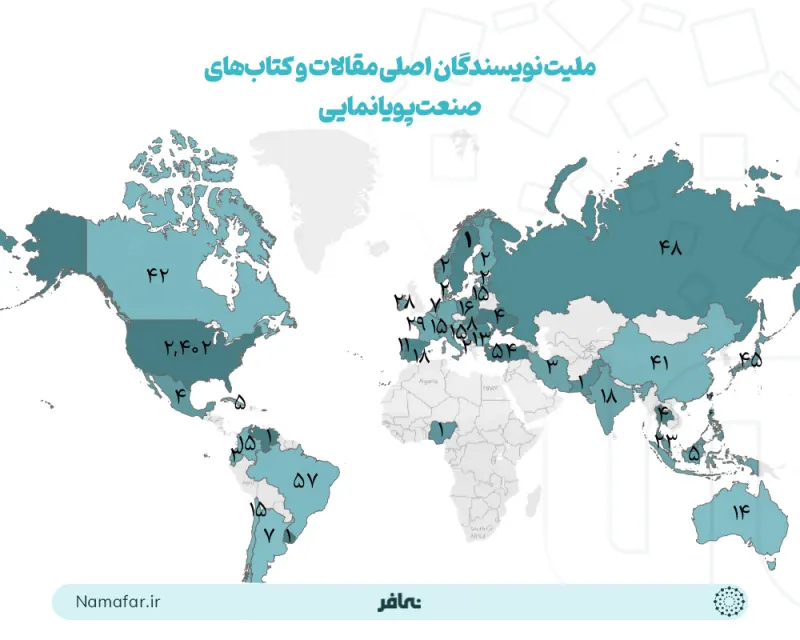
Iran also stands in 44th place in the world. This place was obtained with only 7 scholarly articles, and to thank these 7 people and to read their scholarly articles, all these articles on animation are introduced in the table in the figure below:
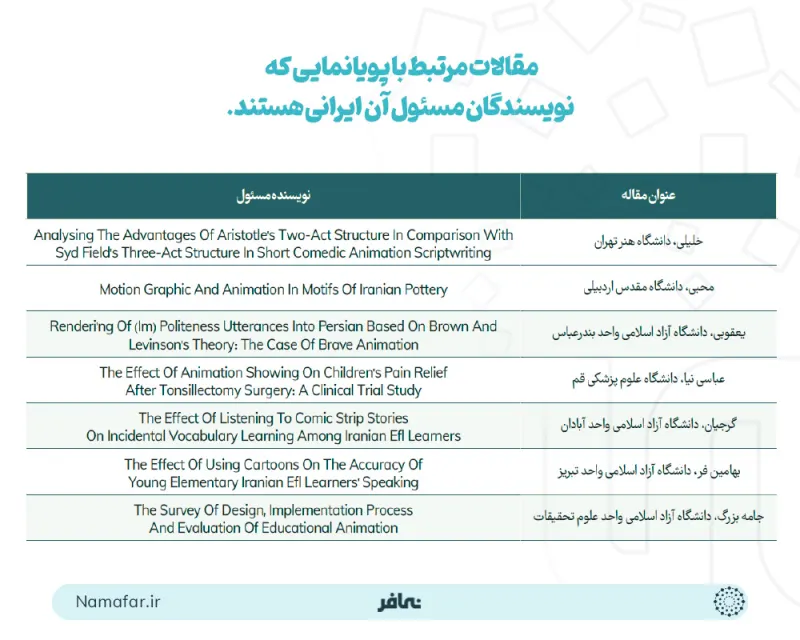
Animation is placed among the leading media because it is a combination of all the arts. For this reason animation is considered interdisciplinary. To make animation, various sciences and techniques must work hand in hand. From literature for producing a screenplay to music, engineering, computer sciences and other scholarly and artistic fields. But the question is, how much attention does each of these sciences in Iran pay to this important interdisciplinary industry?
Fields related to the animation industry
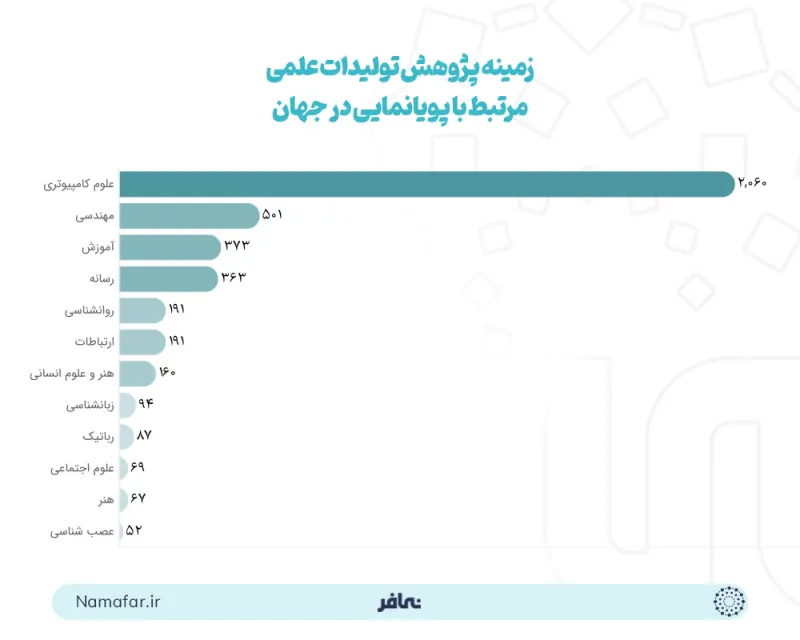
Among the sciences listed in the table below, as can be seen, computer science and media have had the most scholarly engagement with the animation industry. This chart shows that academic and university settings, and researchers in other fields, should welcome the training and entry of students and newcomers into this area and expand its scholarly base more and more. The specialization of knowledge and at the same time its becoming interdisciplinary defines a redefinition of the sciences, for focusing and working in various industries, especially the nascent animation industry, as a new necessity.
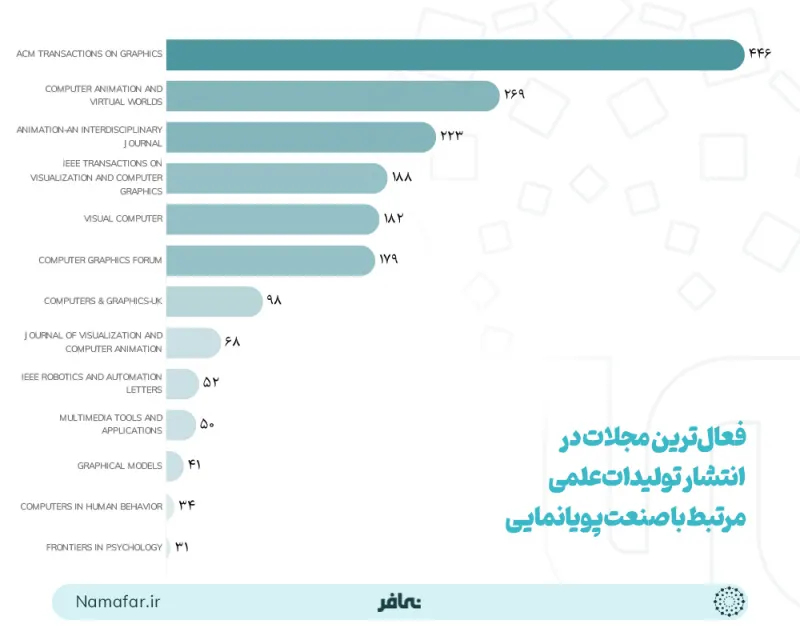
In the same vein, the world's most active journals publishing scholarly output on animation can be, in this report, an important and noteworthy source for readers. Which is shown in the table below. Also the top journals publishing articles by the number of citations they have received; which undoubtedly shows the quality and innovations in animation articles.
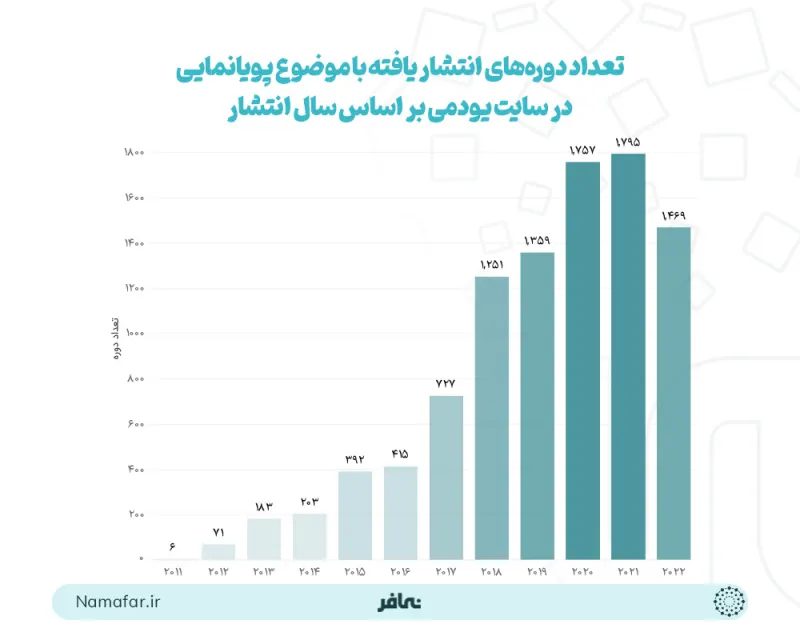
Academic and university settings and various educational centers, in order to remove time and place from their teaching, have turned to online animation education. The internet as a tool on which, as it happens, this same development and expanding trend of animation depended, and the necessity of broad socialization and being seen in the world has taken place with this same internet tool. It has now come to the aid of educational settings and has given attention to pupils and students regardless of a particular time and place. For example, one of the largest online platforms, at whose courses 35 million students sit, is the Udemy site, which can be a very good case study for greater clarity on the animation field. In the monitoring that was done, the Udemy site has held 2800 animation training courses related to animation-making. In the table below, the volume of publication of these courses is shown broken down by year. Which shows how much increasing attention has been given in recent years to online animation education in the world. Especially in 2020 CE, when 1067 online animation courses were held on this site. Fresher data on all 191 thousand Udemy courses, broken down by topic, are in the Udemy dashboard: online education.
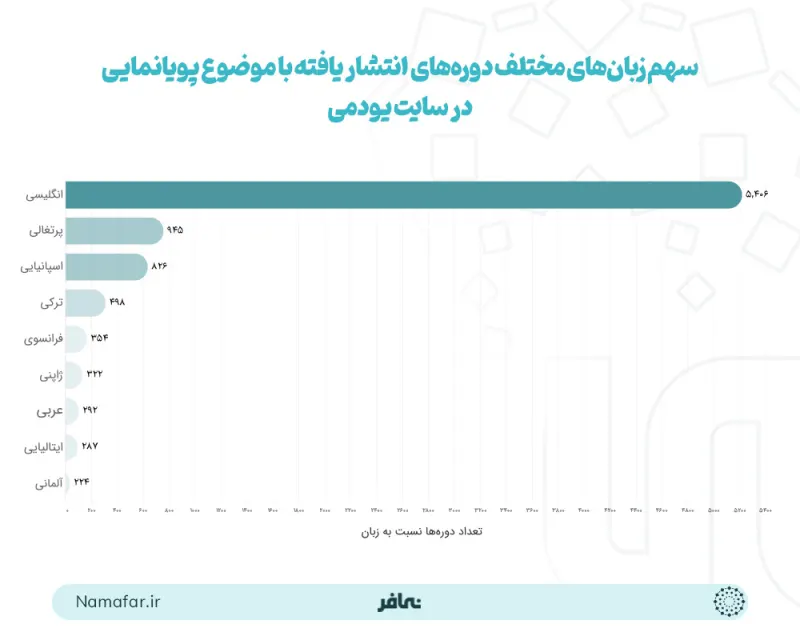
If the agency of language in the Udemy site's training courses is taken into account; and on the basis of this agency a description of the world and the state of attention to this animation industry is studied. English-speaking people and then Spanish-speaking people have had the highest attention and eagerness to introduce and teach in the animation field, and in the table below these figures are shown broken down by language.
Final word
Animation is a technical, expertise-driven industry and the element of education has a key effect on its progress. Attention to the science of animation in Iran jumped from the years of the 1370s (1990s) and in the 1390s (2010s) reached its peak. This fact can be grasped by examining books published about animation. Training in making animation in the world is also growing every year. Especially from after 2010, animation-making education has been rising on an exponential slope. This is a fact that examining the statistics of the Udemy online education site makes clear. Animation program education in Iran is not in a good state. Meaning that most border provinces have no capacity for student admission in this program. But if someone intends to use international online courses to learn the techniques of making animation, they must learn English well. Because most books and courses on animation-making are in English.
Machine-translated from Persian by Namafar; the Persian original is authoritative. Read the original in Persian