Some of the first modern international art fairs, such as Art Brussels and Art Cologne, began operating in Europe in the 60s and still hold annual exhibitions. Although most large fairs are still held in Europe, the geographic diversity of where these events take place has increased in recent years.
The holding of art fairs is increasing rapidly. From about 55 international art fairs in 2000, the figure had reached about 300 international fairs in 2019 in fine art, decorative arts and antiques, as well as hundreds of smaller regional and local fairs. These fairs cover broad areas of the art and collectibles markets.
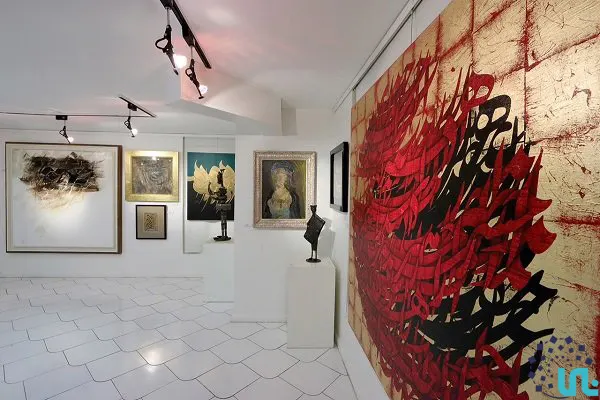
Buying and selling art products
Art fairs do not provide a consistent report on sales of artists' works, and an estimate of art sales can be reached only from the level of sales and by using global surveys of dealers. Estimated total sales in the dealer sector in 2019 are put at 16.6 billion dollars, showing an increase of about one percent compared with the previous year.
Dealers' share of annual sales rose from less than 30 percent in 2010 to 45 percent in 2019 (a one percent drop compared with 2018). This amount is almost equal to the sales generated through galleries, which rose by 2 percent compared with the previous year to 50 percent, but has seen a sharp decline over the past decade, because event-based markets gradually increased their share of sales through fairs.
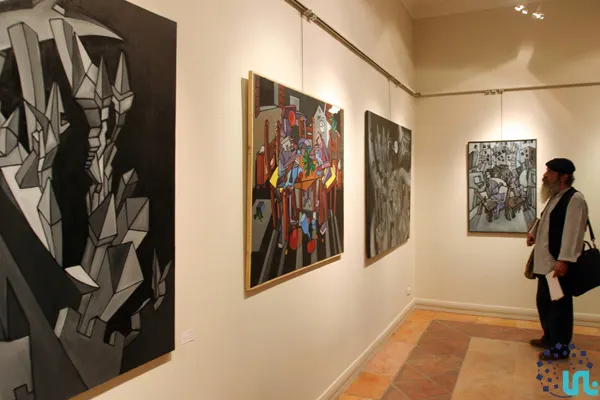
Many galleries have noticed that newer collectors are now more loyal to fairs than to the galleries' own exhibition spaces, because sales have recently been concentrated on these new global events. Although not everyone views this phenomenon positively, many believe it gives them greater opportunities to meet new clients who were not previously in the flow of their galleries or programs.
How art products are sold
One of the problems in analyzing the volume of dealers' sales is the wide number of handmade art-product outlets. Because dealers' sales take place before, after and also during the art fair, there may be a problem in precisely identifying "fair sales". Alongside sales arising from the events themselves, art fairs also play a central role in reaching new clients and in developing future businesses. Although many galleries attach importance to fair sales in order to cover the costs of holding a fair, fairs are increasingly used as a platform for reaching a larger audience.
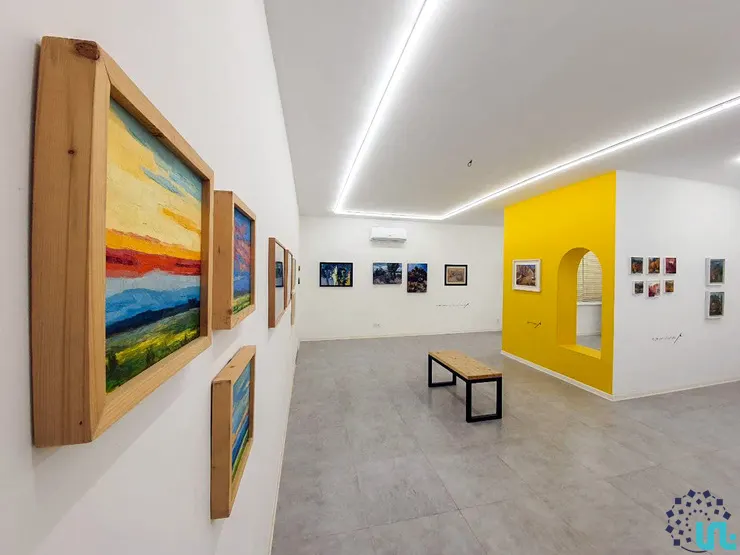
Some sales take place after events end, as a direct result of contact with new and existing clients at fairs; these are called "post-fair sales". These sales are directly linked to the display of works at the fair and arise from sales of works shown at the fair, or from other works by an artist who was shown at the fair, and without participation in the fair this sale would not have happened. In addition, a substantial volume of sales takes place through galleries' participation before the fair is held. Dealers often inform their VIP clients about upcoming fairs weeks before the fair is held.
Art events around the world
The figure below shows that 51 percent of art events are held in Europe. The United States with 28 and the United Kingdom with 13 percent have the largest shares of art-fair hosting. Asia holds 10 percent of the world's fairs annually. It should be noted that many of China's domestic fairs and other small areas in Asia are not included in this chart.
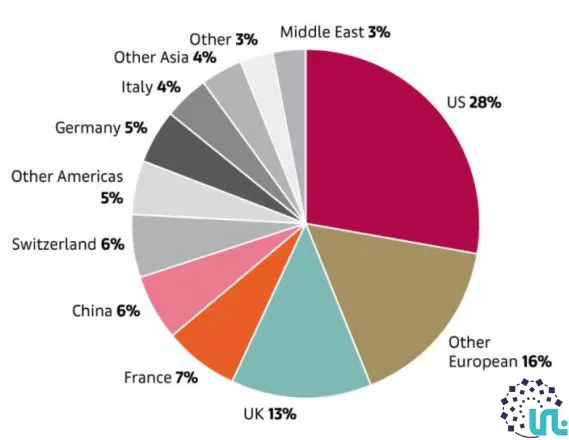
To examine the trend of fairs worldwide, Artfacts has considered only those fairs that have at least 20 exhibiting galleries. According to this review, the number of fairs in 2019 fell 7 percent compared with the previous year. Despite this decline, the number of fairs held in 2019 is higher than in the years before 2018. The number of galleries at these large events in 2019 fell to 12588 galleries compared with 2018.
The number of exhibiting galleries rose in the third millennium until 2008. But in 2010, after the global financial crisis and the slump in art-market sales, it reached its lowest level in the new millennium. After that, the number of exhibitors fluctuated until, from 2016, it experienced two years of sharp growth and reached a historic 12614 in 2018, a 30 percent increase over the previous 10 years.
The figure below shows the number of fairs and the total number of galleries on an annual basis. The number of galleries is shown in two ways; the silver line does not count a gallery's repeated appearances at different fairs in a year (single-exhibition galleries).
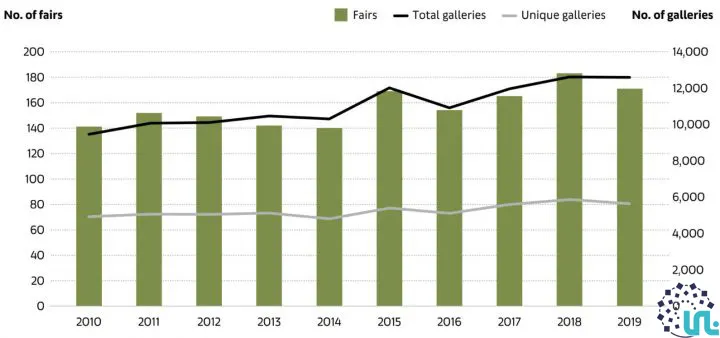
The number of single-exhibition galleries has grown more slowly over the past 10 years (14 percent through 2018) and in 2019 fell by 4 percent. According to the chart, the decline in the annual number of galleries is smaller than the decline in single-exhibition galleries. This indicates that although fewer galleries overall were exhibited at all fairs in 2019, some of those that did exhibit appeared at more fairs.
The share of different channels in sales of art products
While many dealers of more luxurious and expensive items have said that often more than half of the exhibition items are sold or reserved before the fair is held, surveys showed that the average amount across all levels is considerably lower. When dealers were asked how the distribution of sales related to their art fairs was, they replied that 15 percent of fair sales came from the pre-fair sales segment (more than 2.5 billion dollars). 64 percent of sales took place during the fair (10.6 billion dollars). 21 percent of sales took place after the fair and as a direct result of displaying items at the fair (3.5 billion dollars). Thus, about 10.6 billion (29 percent) of dealers' total sales in 2019 were generated at art fairs, and 6 billion dollars (16 percent) also materialized directly through the display of items at the fair, but before or after the fair was held.

The number of participants in local and international events in 2019 was the same as in 2018 (on average two local art fairs and two cross-border or international art fairs). Although there was a considerable difference between personal businesses and specialist fairs, this means that, on average, dealers obtain 30 percent of the value of their total annual sales through only two international events during the year.
The share of sales value generated at cross-border fairs (fairs other than galleries' domestic market) has been relatively stable and has fallen by only one percent compared with the previous year; even so, this share has risen sharply over the past five years and has formed a large share of sales value.
Machine-translated from Persian by Namafar; the Persian original is authoritative. Read the original in Persian