The book Moving in the Fog; writing instruction
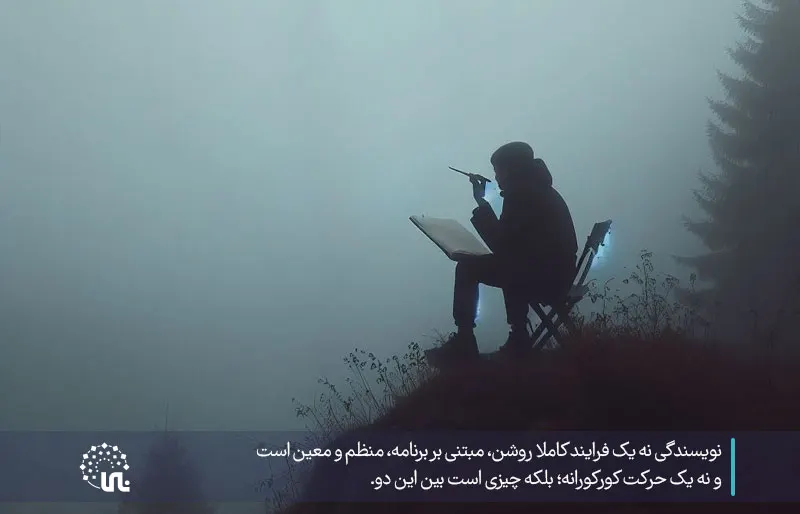
Mohammad Hassan Shahsavari is one of the accomplished contemporary writers. He has a book about writing instruction and what young writers would do well to know. Shahsavari has named his book "Moving in the Fog." What this title means is that writing is neither a fully clear process, based on a plan, orderly and definite, nor a blind movement; rather it is something between the two. To write you must see a few steps ahead of you, but not be so clear and confident about the continuation of your story that no room remains for your creativity and artistic taste and inspiration. Like someone who walks in a fog-filled space; they see in front of their feet but do not have a fully clear horizon ahead of them.It appears that in Iran this recommendation of Mohammad Hassan Shahsavari, the author of the book "Moving in the Fog," is observed more by actors in the printing and publishing industry, such as publishers and print houses. Of course reluctantly and under compulsion. Unlike writers who are in the process of writing a story, they would like to have specific and clear horizons and, with peace of mind, make long-term plans. Something that for now is impossible for them.
The impact of paper-price instability on the printing and publishing industry
To produce a book, various raw materials are needed, but the most important raw material is paper. Such that 60 percent of the finished cost of a book relates to the cost of paper. In Iran, paper itself is imported and so are the raw materials for producing it. That is, even in the event of self-sufficiency, although its relationship with the dollar may decrease, it is in any case affected by the dollar's price. Overall, 80 percent of the raw materials of Iran's printing and publishing industry are imported.From the mid-1390s (2010s) onward, the dollar's price has constantly been accompanied by instability and currency shocks. An event that has caused the price of paper and books also to be in utmost instability and unrest. In this situation a publisher may, in the time they have prepared the book and want to send it to the print house, face an increase in the price of paper. Or the printing of the book may be postponed and its price may increase. The print house also does not know whether to accept a printing project or not, because with an increase in the price of paper it may make a loss.
The unpredictable situation of the printing and publishing industry in Iran
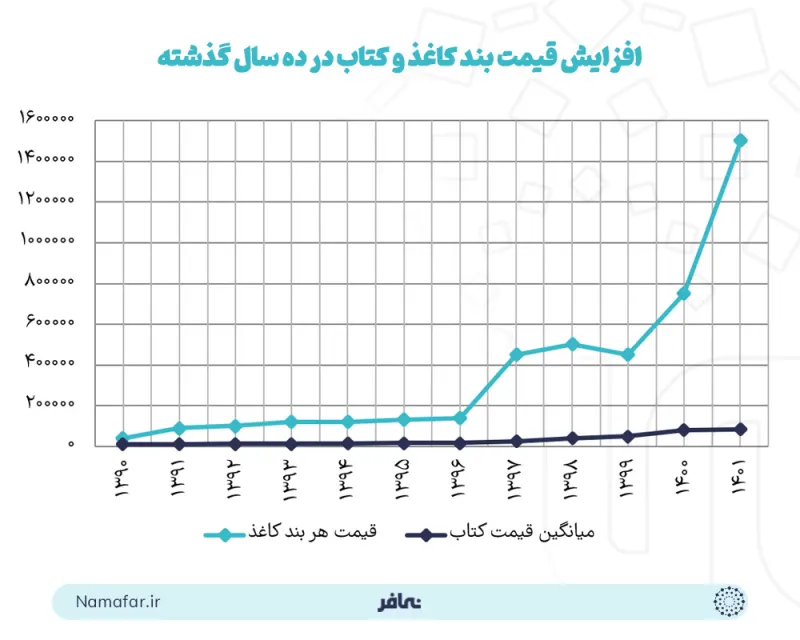
In a business environment in which its actors can operate well, 28 survey or statistical components and indicators must be measured. These 28 components have been identified in the national business survey published in 1401 (2022/23). One of these components is the degree of "unpredictability and changes in the prices of raw materials and products." Given what was said above about the price of paper in Iran and its dependence on the dollar, the publishing industry does not have a good situation on this indicator. In 1401 (2022/23) the dollar rate was stable in only one month and in all the other eleven months it had an upward trend. The dollar went from 27 thousand tomans in Farvardin (March–April) of this year to 45 thousand tomans in Esfand (February–March) of this year. In the same proportion, the price of each ream of white writing paper went from 600 thousand tomans to 1 million and 600 thousand tomans. (Each ream of paper according to the global standard is a bundle of five hundred sheets of paper.) The jump in the price of paper in Iran's publishing industry begins exactly from the year 96, 1396 (2017/18), that is, simultaneously with the start of dollar turmoil. From 96 to 99, 1396–1399 (2017–2021), it is almost stable and from 99, 1399 (2020/21), it again has an uninterrupted jump.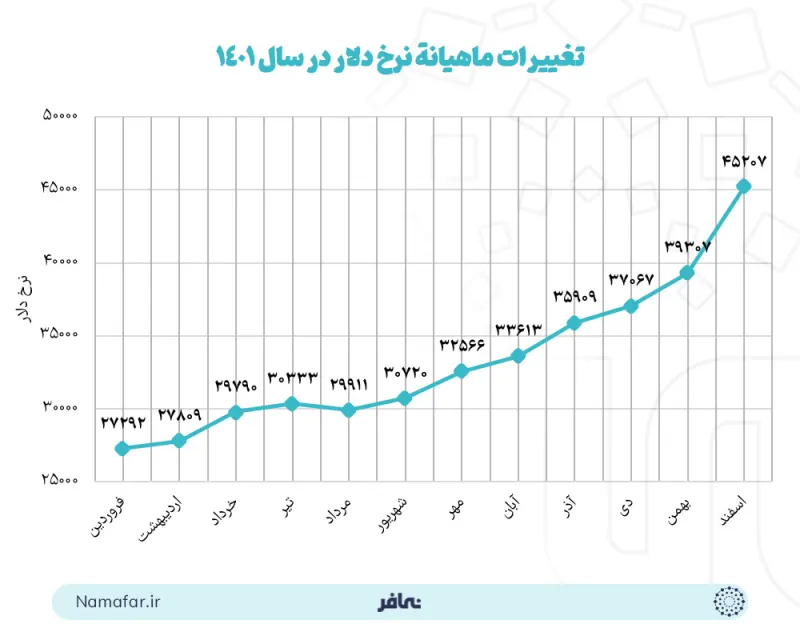
The impact of the price of paper on the price of books
In Iranian society the book has always been considered expensive. This notion can have various reasons. One reason is that book audiences are generally from the middle or lower deciles of society. Perhaps another reason goes back to the fact that in Iranian society, a cultural and content good such as a book is not expected to have an exorbitant price. But the most important factor in this notion is low purchasing power. Without considering purchasing power, it appears that the price of types of books in Iran, compared with the world, has a middle level. Because the average price of a book in the world is 17.63 dollars and the average price of a book in Iran is 1.94 dollars.The book is a good that, if its price increases, is very quickly removed from individuals' and households' shopping baskets. Because per-capita reading time in Iran is not particularly high and the book is in any case not considered an essential good. The possibility of buying and reading e-books has also made the book's place in people's shopping basket more unstable. Also, as was said, book audiences are more from the middle or weaker stratum of society and lose the ability to buy books sooner. In this among, the books that are removed more and sooner are those that readers usually read for their personal interest; not, for example, exam-prep or university books.
It appears that the increase in the price of paper is one of the main suspects in the increase in the price of books and the decline in buying and reading them. Of course, as we see in the first chart, the increase in the price of books, although it keeps pace with the increase in the price of paper, is not exactly at the same intensity. Because the price of paper is determined by the dollar, but book pricing in Iran's publishing industry is in rials. Also, government policies to moderate the price of books are effective. Therefore the most destructive impact that the instability and runaway price of paper has on the printing and publishing industry is disorder in this industry's business environment. That is, this industry's producers and actors suffer from this instability more than consumers do.
Government policies to control the price of paper in Iran
The Ministry of Culture and Islamic Guidance from the beginning of the 13th government supported paper self-sufficiency in slogan and in action. It is said that the publishing industry has annual paper consumption of 60 thousand tons, but at the beginning of the 13th government only 5 thousand tons of paper were being produced. But in Aban (October–November) 1401 (2022/23) one thousand tons of paper a month were reaching publishers from the Mazandaran wood and paper factory alone. In Aban 1402 (2023/24) Mohammad Mehdi Esmaeili, the minister of culture and Islamic guidance, announced that "the celebration of paper self-sufficiency is near" and said paper production had reached 80 thousand tons. According to Esmaeili this means self-sufficiency in writing paper and the paper needed for publishing. But it remains to be seen how far publishers are satisfied with the quality of these papers and whether in the end they prefer Iranian papers to foreign papers or not.Final word
Paper is the most important raw material of the publishing industry, and both it itself and the raw materials for producing it are imported; therefore paper in Iran's printing and publishing industry has a strong dependence on the dollar rate. From the second half of the 90s, the 1390s (2010s), onward, when the dollar rate has been accompanied by instability, the printing and publishing industry has also become caught in instability. Instability in the business environment confronts its actors with great difficulty and discouragement.The price of paper also has an important effect on the finished cost of a book. With an increase in the price of books the consumer quickly removes it from their shopping basket. The high cost of books both deals another blow to the publishing industry and comes at a high cost for the country's public culture.
The 13th government's main strategy for controlling the price of paper was self-sufficiency in Iranian paper, and in that it was almost successful. Such that paper production in Iran, which at the beginning of the government's work was 5 thousand tons, has today reached 80 thousand tons.
Sources
- Namafar / Map of issues in the book industry
- Mohammad Mehdi Esmaeili, Minister of Culture and Islamic Guidance of the 13th government / IRNA: After paper self-sufficiency we took a step toward exports / news code: 85282867
- Ahmad Abolhassani, head of the Tehran Printers' Union / IBNA: The increase in the price of books is a function of multiple factors
Machine-translated from Persian by Namafar; the Persian original is authoritative. Read the original in Persian