Technological progress, digitalization, and innovation have transformed the global economy, and the role of intellectual creativity and creative goods and their share in the global economy have increased. Such that today intellectual capital plays an important role in the formation and development of the world's new economic paradigm.
Creative industries based on cultural values, cultural diversity, creativity, skills, and individual talents have the potential to generate wealth and create jobs through the creation of social and economic value—especially through intellectual property—and have taken a share of the global economy called the creative economy. The creative economy is a growing sector of the global economy that has significant potential to create jobs, encourage innovation, and promote economic growth. On this basis, and given the importance of the creative economy, Ryabov and Ryabova, using different strategies such as statistical analysis, comparison, and the analysis and synthesis of information, have examined the state of the creative economy and its impact on economic development.
Growth of the creative sector in the global economy
Although the scope of the cultural and creative industries is broad and there is no single classification of them in different countries, in general activities whose main characteristic and defining feature is creativity have been considered creative sectors. The global market for creative goods and services is growing in a sustained way and has created new opportunities for countries' integration into the global economy and for them to benefit from new trends. A look at the share of the creative economy in the national GDP of different countries in 2020 shows that the United Kingdom, with a 5.8 percent share that the creative sector has created in value in its economy, is the leader among the world's countries. After the United Kingdom, the United States of America, with a 4.7 percent share, is in second place, and a 3.4 percent share has placed France in third place. Also, the creative sector has accounted for more than 3 percent of GDP in South Korea and Germany.
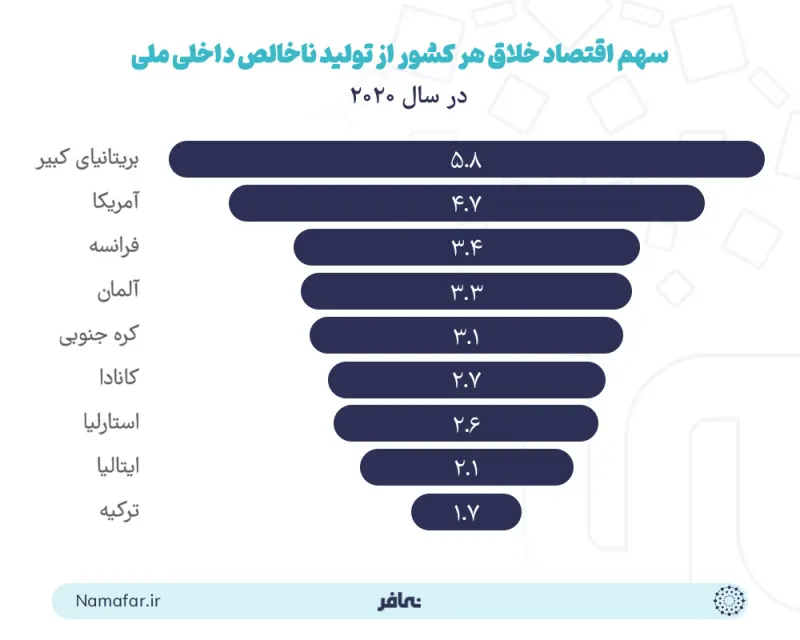
Analysis of the aforementioned data shows that there is a direct relationship among creativity, innovation, and economic flourishing. Countries such as Germany, the United States of America, the United Kingdom, and South Korea that rank high on innovation indicators tend to have a larger creative-sector share in GDP and employment. As a result, developed economies are best able to produce and benefit from creative talent and ideas.
Increase in the labor-force share in creative sectors
With the growth of the creative economy and the increase in its share of global markets, the number of jobs and people employed in these sectors also increases. According to European Union statistics, the cultural and creative industries account for 7.5 percent of the labor force. The largest organizations of the creative economy are located in European Union countries, and these countries have formed an important part of the world's creative market. For example, six European Union countries (Italy, Spain, France, Sweden, Germany, and England) have more than 600 creative businesses.
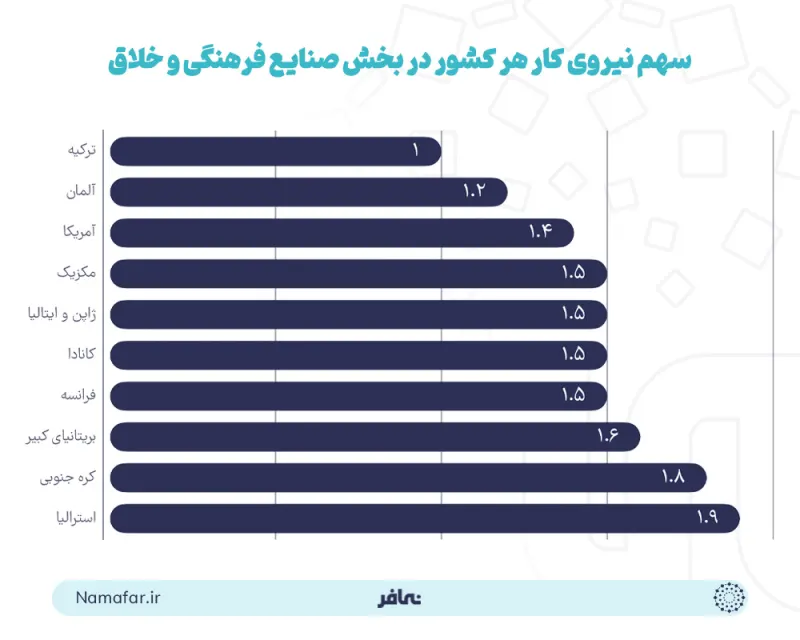
Also, a look at the ratio of the share of the labor force employed in jobs related to the cultural and creative industries to each country's total labor force shows that Australia, at 1.9 percent, has the highest amount, and after Australia come South Korea and the United Kingdom, at 1.8 and 1.6 percent respectively.
Occupational skills forecast for 2025
Technological advances and changing skill needs require a creative, adaptable, and participation-oriented labor force centered on learning. In these conditions both hard skills such as programming and soft skills such as creativity, empathy, communication, and flexibility will be very important.
The findings show that the 5 skills of analytical and innovative thinking, creativity, critical thinking, the ability to solve complex problems, and active learning strategies are the most important characteristics of creative jobs in 2025. The highlighted skills indicate the growing importance of human creativity, cognitive abilities, and social-emotional intelligence, because automation is changing many routine and manual jobs. Investing in these creative capacities through educational programs and a focus on the arts and humanities is vital for individual and national economic success in the decades ahead.
Actions for the growth and development of the creative economy
However, making full use of the opportunities of the creative economy requires attention and actions, the most important of which include improving access to markets and global distribution networks, supporting intellectual property rights, access to financial resources to foster current growth, coordinating activities and monitoring progress in various sectors of the creative industries, and managing the effects of digitalization on business models. Addressing these actions is vital for using creativity and innovation, employment growth, and strategic economic goals.
Summary and conclusion
The creative economy is a growing sector in the global economy that has taken shape on the basis of creativity, innovation, and individual skills. Countries such as the United Kingdom, the United States, and France have the largest share of the creative economy in GDP, and the number of people employed in the creative sector is also increasing. In line with the foundations of the creative economy, analytical and innovative thinking, creativity, critical thinking, the ability to solve complex problems, and active learning strategies are the most important skills needed for the labor market in the future.
The creative economy is a major opportunity for economic growth, job creation, and innovation. On this basis, countries must move toward developing creative skills, supporting intellectual property rights, and creating the necessary infrastructure for access to global markets so that they can make the best use of the opportunities of the creative economy.
Machine-translated from Persian by Namafar; the Persian original is authoritative. Read the original in Persian