China is the intersection of tradition and innovation. A place where ancient arts combine with advanced technologies and shape China's creative industries. China's cultural sectors—from fashion and design to film and games—have for more than two decades been on a path of exponential growth and have turned this country into one of the world's bases of creativity. In this note, relying on statistics, we will review the state of China's creative industries and then examine the Chinese government's strategy for developing these industries.
The state of China's creative industries
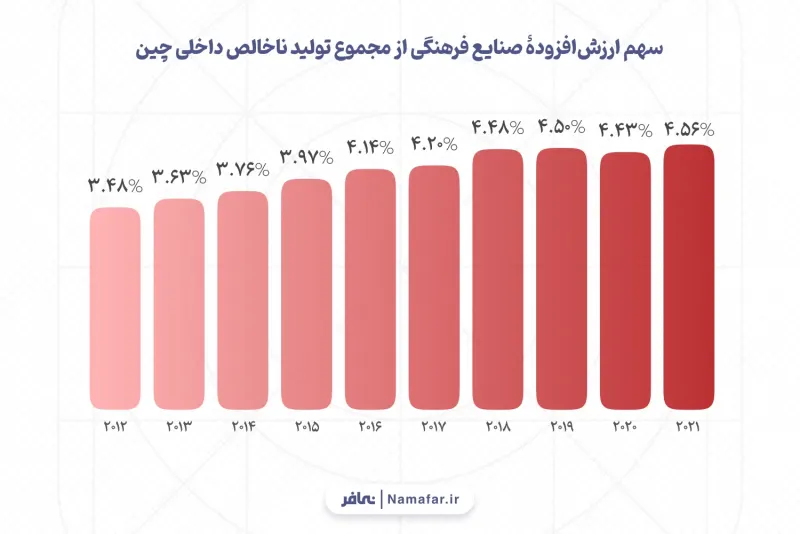
Creative industries in China include sectors that focus on content and intellectual property. These industries encompass a wide range of fields such as film, music, video games, architecture, design, fashion, publishing, and cultural heritage. National culture and its related industries constitute a substantial share of China's GDP, which is also growing rapidly.The chart below shows the share of cultural industries' value added in China's total GDP, which increased from 3.48 percent in 2012 to 4.56 percent in 2021.
The top sectors of China's creative industries
Film, music, esports, and design and fashion can be named as China's top cultural sectors, which have been a driver of the growth of China's creative industries and have brought them sustainable growth.Film:
China's film industry is one of the world's fastest-growing industries. China's box office in 2020 sold more than $2.3 billion and turned this country into the world's second-largest film market after the United States. The share of domestic films' box office as a percentage of total annual revenue has risen from about 54 percent in 2014 to about 84 percent in 2023, which indicates the growing popularity of Chinese cinema. Foreign collaborations are also on an increasing trend. Hollywood studios are seeking partnerships to tap the lucrative Chinese market.Music:
The music industry has also experienced rapid growth in recent years. In 2022 China's recorded music revenue grew 28.4 percent. This increase, for the first time, brought China into the world's top five markets. In this year China also rose to sixth place in IFPI. China's music industry now leads in Asia after Japan.Esports:
In 2023 the size of China's esports market was estimated at $445.18 million, which placed it below the United States and above all other countries. This industry in China has a base of more than 480 million people, which has turned China into the world's largest consumer market for esports.Fashion:
China has a significant place in the global fashion industry. For more than a decade this country has been the world's largest producer and exporter of apparel. China's fashion industry revenue in 2023 was $207, which declined slightly relative to the previous year. Nevertheless, this industry is expected, because of the growth of the middle class, to rise again at the end of 2024 and reach $236.80 billion.
China's strategy for developing creative industries
The statistics extracted in the lines above clearly show that over the past two decades China's creative industries have grown significantly and have become an important part of China's cultural and economic development strategy; to the point that China is now considered the second-best creative economy among developing countries. Domestically as well, China's household consumption pattern has changed, such that more than 7 percent of Chinese households' total spending is allocated to cultural and creative products and services. But the question is how the Chinese government has been able to achieve such growth for its creative industries at the domestic and international levels.The Ministry of Culture: the agent of China's creative industries
One of the Chinese government's most important strategies for creating strong, comprehensive focus on creative industries has been to assign these sectors to the Ministry of Culture as the dedicated steward and agent of this field. From the 1990s the Chinese government began efforts to recognize the capacity of cultural sectors in order to strengthen economic growth and increase cultural influence. This effort was a set of policy measures aimed at fostering creativity and innovation in culture and the arts. The Twelfth Five-Year Plan (2015–2011) was a turning point in recognizing cultural industries as a pillar of China's economy. This plan emphasized the necessity of developing cultural and creative sectors including film, television, publishing, digital content, and traditional arts, which the Ministry of Culture was charged with leading by creating a regulatory framework, providing funding, and strengthening innovation.The Thirteenth Five-Year Plan (2020– 2016), with the characteristic of "cultural flourishing" as a national goal, consolidated the Ministry of Culture's role in this arena. This plan was more focused on modernizing cultural infrastructure, supporting creative talent, and expanding international cultural exchanges. In what follows we examine the Ministry of Culture's measures in this direction.
The Ministry of Culture of China's most important measures for developing creative industries
Legal and regulatory support
Looking at the measures taken by China's Ministry of Culture, one essential component can be inferred: designing a legal and regulatory framework. This ministry has presented and implemented various laws to protect intellectual property rights, create a competitive environment, and encourage innovation in cultural sectors.The "Cultural Industry Promotion Plan" in 2009 was among this category of legal measures. This plan included a set of financial incentives, tax exemptions, and the provision of loans to small and medium-sized enterprises (SMEs). This plan also focused on the importance of protecting intellectual property, which is an important factor for fostering creativity and innovation.
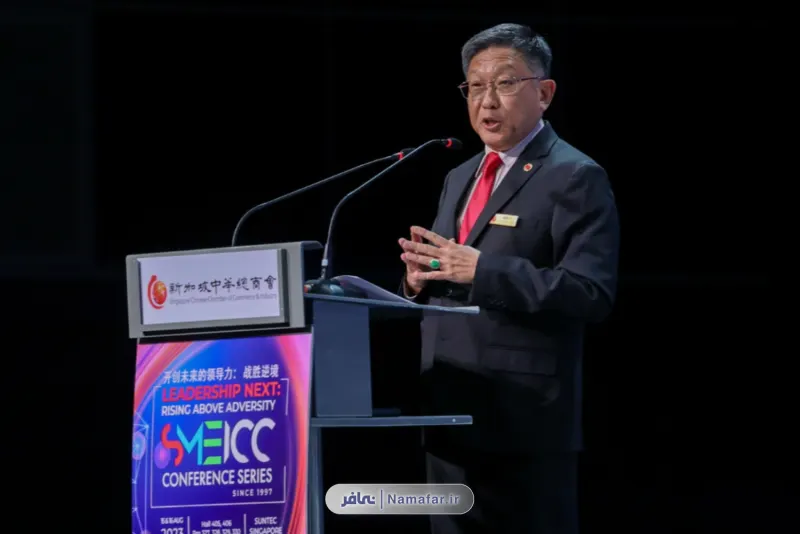
In addition to national policies, the Ministry of Culture cooperated with local governments to implement some regional regulations that have covered the specific cultural conditions of each city. For example, the city of Beijing has presented a set of policies aimed at supporting the development of the film and television industry, whereas Shanghai has focused on promoting the design and fashion sectors.
Financial and institutional support
Financial support is also among the other vital factors in the development of creative industries. China's Ministry of Culture has implemented various programs to help creative enterprises, artists, and cultural organizations. The "Cultural Industries Investment Fund" is among the Ministry of Culture's most important financial measures, established in 2011. This fund provides financial support to creative companies—especially small and medium-sized companies—so that they can expand their activity and invest in new technologies.In addition to the Cultural Industries Investment Fund, this ministry has partnered with other bodies to provide specialized loans to creative enterprises. Such programs provide the capital needed for businesses in sectors such as film, publishing, and digital content production and remove the financial barriers that are among the greatest challenges on the path of such businesses.
From an institutional standpoint as well, the Ministry of Culture has created a number of research centers, incubators, and cultural industrial parks across China. These institutions provide the resources and facilities needed for creative professionals. Beijing's 798 Art Zone is a notable example. This area was formerly an industrial complex that has now been turned into a cultural center and has attracted artists, designers, and entrepreneurs from around the world.
Education and talent development
Given the importance of a skilled workforce in creative industries, the Ministry of Culture has also paid special attention to this matter. Among the ministry's most important measures has been providing educational programs in universities and schools across China. The ministry offers courses in fields such as film production, graphic design, animation, and digital media and places advanced technologies at their disposal for practical training. In addition to formal education programs, internship programs are also arranged in cooperation with creative companies. Providing grants and scholarships to emerging talent is among the ministry's other measures, which help young artists, filmmakers, and designers pursue their creative projects without the burden of financial constraints.International cooperation and cultural exchange
One of the ministry's fundamental strategies for expanding the reach of Chinese creative content and increasing China's cultural influence is holding international cultural festivals and exhibitions. Events such as the Beijing International Film Festival and the China International Cartoon and Animation Festival have provided platforms for Chinese creators to present their works to global audiences and find more opportunities for foreign collaboration.The Ministry of Culture's other most important measure in this direction is establishing Chinese cultural centers abroad. This work provides a platform for promoting Chinese culture and China's creative industries in foreign markets. Such centers host exhibitions, performances, and workshops that showcase China's creative industries and strengthen cultural interaction and understanding.
Digital innovation
One of the main drivers of growth in China's creative industries has been digital innovation, in which the Ministry of Culture has also played an effective role.This ministry has supported the development of online platforms that are a venue for distributing creative content such as film, music, and digital art. The development of these platforms has not only expanded the reach of China's creative content but has also created new revenue streams for artists and content producers. For example, streaming platforms such as iQiyi and Tencent Video have become the main venues for distributing Chinese films and television programs—both domestically and internationally.
The "Digital Culture Industry Development Plan" has been among the ministry's measures for developing creative industries in the digital economy. This plan has presented specific programs in fields such as online entertainment, digital publishing, and mobile applications to help accelerate the growth of China's digital content industry.
Conclusion
China is the second-best creative economy among developing countries, which over the past two decades has had remarkable growth in creative sectors, such that it has now become one of the branches of China's economy. Rising market demand on one side and government strategies on the other have brought about this growth. The government's most important strategy for creating comprehensive focus on creative industries has been to assign this sector to the Ministry of Culture as a steward and agent. In the note we first reviewed the state of China's creative industries, then examined the role and measures of China's Ministry of Culture in developing creative industries.Machine-translated from Persian by Namafar; the Persian original is authoritative. Read the original in Persian