One of the reasons given for low per-capita reading time and Iranians reading little is that the price of books has always been excessive, especially for the social groups and deciles that are the audience of this medium. This problem is intensified when it seems that Iranian readers have a strong inclination to buy books; whereas they can, instead of buying the book they want, obtain it from local libraries. By using library facilities one can be a professional reader and not have a large cost either. Also, many of the books used by students do not need to remain forever in their personal library, and their need for many of their books is entirely temporary.
This note examines the infrastructure of the culture of using libraries. That if a library is to meet readers' need, whether Iran's current libraries can carry this load or not. To examine this component, issues such as the number of libraries, their per capita, how up to date the books in libraries are, and their distribution in the country are examined.

The present note is drawn from the book "Map of Issues in the Book Industry in Iran". In this booklet, prepared and compiled by the "Namafar Data Mining and Policy Research Group," one of the issues of the book industry in Iran is stated as "public libraries in the country not being updated in proportion to book production." Under this issue in "Map of Issues in the Book Industry in Iran" one can see an outline of the status of libraries in Iran.
The number of public libraries in Iran
We said that book-reading individuals and audiences who need books mostly include the middle or lower deciles of society. For this reason it is necessary that libraries receive more attention both from the government and from the people. Because for the deciles involved with books, the price of this product is in any case high. But before cultural work for greater use of libraries, one must first see whether there is infrastructure for this culture or not. One of the most important infrastructures of the culture of reading is the number of libraries.
Namafar's Map of Issues in the Book Industry writes: "According to the information website of the Iran Public Libraries Foundation, based on the latest statistics presented in the Atlas of Cultural and Artistic Spaces of Iran, the total number of public libraries in the country at the end of Farvardin (March–April) 1402 (2023/24) was equal to 3.730 branches, of which 2.792 branches (77.8 percent) are urban libraries and 796 branches (22.2 percent) are rural libraries.
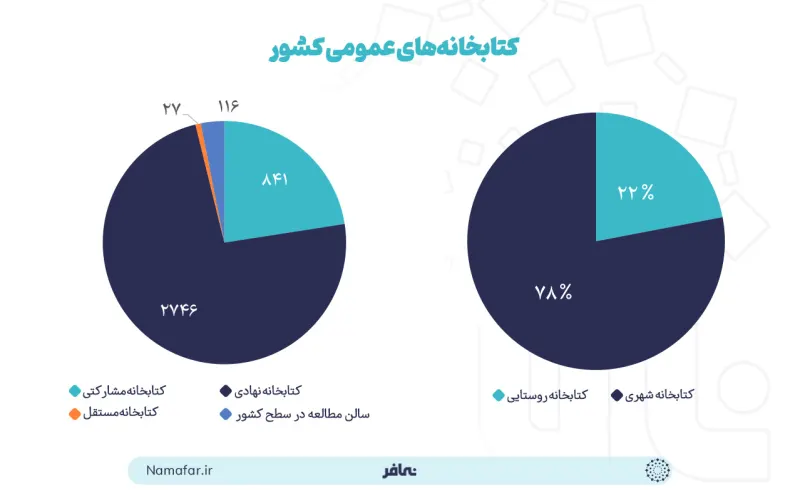
The indicator of access to public libraries nationwide is only 4.27 branches per 100 thousand people, among which South Khorasan Province, with a figure equal to 10.15, has the most access to public libraries. Semnan and Kohgiluyeh and Boyer-Ahmad provinces, with the figures 10.04 and 9.66 respectively, have been placed in the next ranks. Also the number of public libraries of Alborz, Tehran and Sistan and Baluchestan provinces, with the indicator figures 2.46, 2.48, 2.5 respectively, have been recognized as the least-endowed provinces in terms of the level of access to public libraries. This is while, without considering population, Tehran Province's share of the number of public libraries in the country is equal to 9.7 percent. Isfahan and Fars provinces too, with a share of 8.9 percent and 6.97 percent respectively, are in the next ranks."
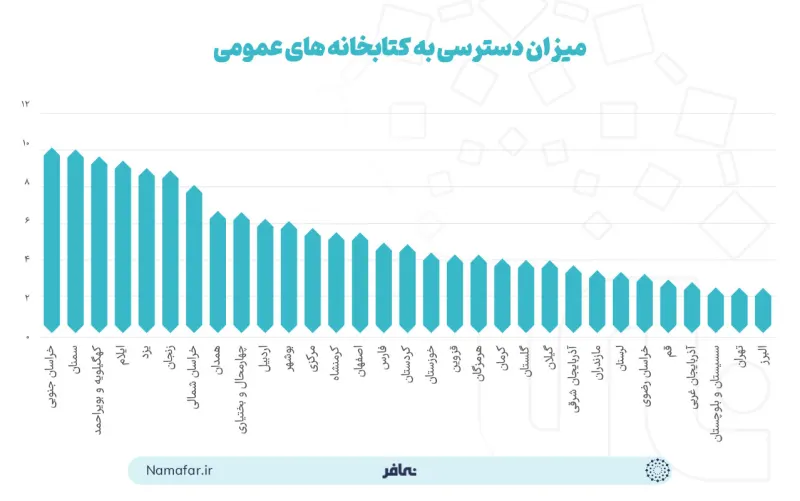
It seems that in provinces such as Tehran, Alborz, Qom and Razavi Khorasan, where the need for libraries is high, the level of access to them is low. These provinces are counted among the country's most important scientific centers. Also the middle class, which more than other classes is the audience of books and reading, has a strong presence in these provinces. The provinces in which the per-capita number of libraries is low are populous provinces, and this means that a large part of Iran's population is poor with respect to access to libraries.
The number of books in the country's public libraries
But the quantity and quality of libraries are not the same as one another. Some are larger and some are smaller. For this reason, for a more precise examination of provinces' level of access to books through libraries, one must also consider the number of books in the public libraries of each province. From this perspective, the public libraries of Isfahan Province with 3.870 thousand volumes of books, Razavi Khorasan Province with 3.182 thousand volumes of books, and the public libraries of Tehran Province with 2.904 thousand volumes of books are in first to third place respectively. The smallest numbers of books also belong to the public libraries of Kohgiluyeh and Boyer-Ahmad Province and finally to the public libraries of Qom Province with 515 thousand volumes.
The largest number of public libraries in the country
The per-capita level of access to the books of public libraries, given population, in Yazd Province is 1.77 per person, which is considered the most endowed province on this indicator. Semnan and Zanjan provinces, with the figures 1.48 and 1.46 respectively, are in the next places. Golestan, Tehran and Sistan and Baluchestan provinces too, with the indicator figures 0.36, 0.21, 0.21 respectively, are the least-endowed provinces from the dimension of the level of access to the books of public libraries.
How up to date public libraries are in Iran
According to Mehdi Ramezani, Secretary-General of the Iran Public Libraries Foundation, updating libraries and purchasing new resources is very costly. In an interview with IBNA news agency in Khordad (May–June) 1402 (2023/24) he says: "Every year the Iran Public Libraries Foundation must purchase 100 billion tomans of books, and of course we now have a large distance from this ideal figure. This year the Ministry of Culture and Islamic Guidance placed 10 billion tomans of the books that the Deputy for Cultural Affairs of the Ministry of Culture and Islamic Guidance had purchased at the disposal of the country's public libraries, but the need is certainly more than this statistic."
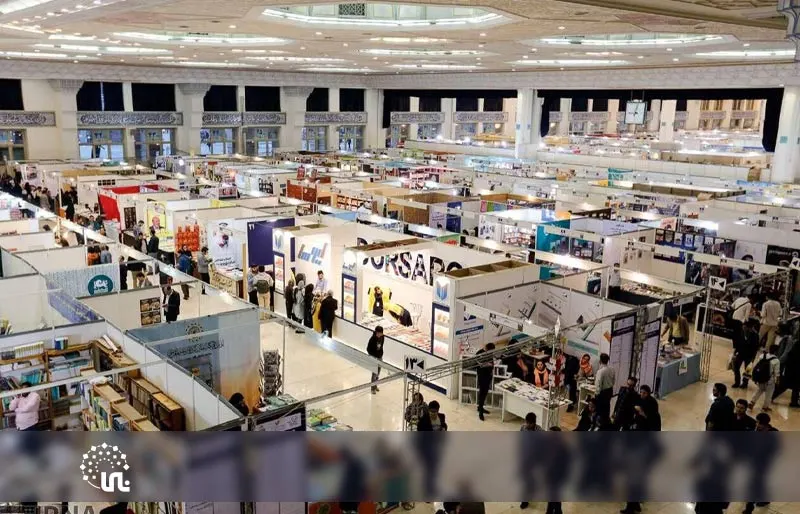
Namafar's booklet "Map of Issues in the Book Industry" also considers the comparison of books offered at the Tehran International Book Fair with the per-capita level of access to books in the country's libraries as evidence of the country's libraries not being up to date. According to this product: "At the 34th Tehran International Book Fair more than 200 thousand book titles were displayed, but the per-capita level of access to books in the country's public libraries is above one in only 4 provinces, meaning that most provinces do not have access to many of the titles of books produced."
In this way one of the most important reasons for buying books instead of going to a library can be the absence of the audience's desired book in the library, or its being an old printing. Whereas in many cases each edition of a book is different from the previous version.
Conclusion
The price of a book, even if it is entirely reasonable, is still considered expensive for the social groups and deciles that are readers. For this reason libraries are an irreplaceable channel for promoting the culture of reading and access to books. The number of libraries in Iran is not sufficient, and for every 100 thousand people there are only 4 library branches. In this regard, in terms of the number of public libraries, provinces such as Tehran, Alborz, Qom and Razavi Khorasan have the lowest level of access to libraries. Provinces that appear to be the country's scientific and cultural poles and ought to have appropriate access to books.
Also the country's public libraries are not up to date, and this reduces book audiences' motivation to go to libraries. Updating library resources needs an appropriate budget. According to the secretary of the country's libraries institution, this work costs 100 billion tomans annually.
Sources
- Map of Issues in the Book Industry / Namafar
- Mehdi Ramezani; Secretary-General of the Iran Public Libraries Foundation / IBNA news agency: Updating library resources requires 100 billion tomans in appropriation annually
Machine-translated from Persian by Namafar; the Persian original is authoritative. Read the original in Persian