The book market in recent years has undergone changes and transformations under the influence of the emergence of digital technologies, which can be observed in readers' culture and consumption behavior. For example, you have probably, by now, experienced hesitation over buying and reading a book between its print and electronic versions. The trend toward digitization has created a situation in which a large number of people turn the pages of books on electronic devices such as tablets and smartphones. Electronic books, besides increasing access and the possibility of becoming acquainted with new authors and genres, are often cheaper than their print counterparts. Even so, print books still appear to be popular, and a group of readers still prefer the tactile experience of reading print books.
But if we want to speak with greater certainty and precision about the state of the book industry, we first of all need data and statistics on its market. Book-market data provide a firm foundation for analysis and insights into its various aspects, offering greater reliability and closer proximity to reality. On this basis, we have turned to Statista's report on the global book-industry market, which over three chapters has narrated the story of this industry using data.
Scope of the book market
What is meant by the book-industry market in this report is revenue from the sale of print and electronic books, which have been sold respectively through distribution channels such as bookstores, libraries and online retailers, and online stores and online publishing platforms. Personal and private transactions between individuals, free digital subscriptions, and print newspapers and magazines and digital copies fall outside this scope.
Growth of global book-industry revenue in 2023
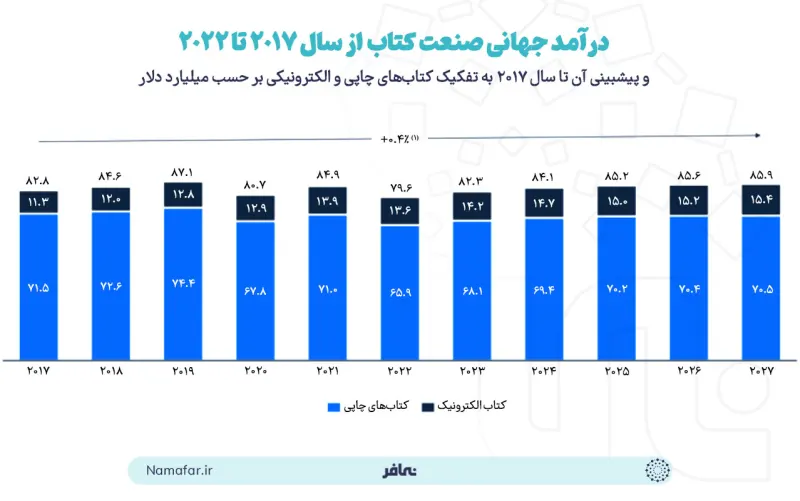
Global book-industry revenue in 2022 was 79.6 billion dollars, the lowest figure since 2017. But according to the book-industry revenue forecast from 2017 to 2027, which estimates 0.4 percent compound annual growth, by the end of 2023 this figure will reach 82.3 billion dollars, indicating 2.7 billion dollars of growth in the book market in that year.
Given the trend drawn through 2027, after 2023 we will consistently see an increase in book-industry revenue, and in the four-year period from 2024 to 2027 we will see a total increase in revenue of 3.6 billion dollars. Examination of book-market revenue—in the above time period—broken down by print and electronic books also shows that print editions have, by a wide margin, accounted for most of the market share; for example, in 2023, of the book industry's 82.3 billion-dollar market, 68.1 billion dollars belongs to print books and 14.2 billion dollars to electronic books. Even so, each year the share of print books has increased with a slight slope, and a significant part of the increase in book-industry market revenue is related to growth in the electronic segment.
Now, given the data and the discussion presented, it can be said that electronic technologies have not had much effect on print books, and they have held on to their share of the book market. In general, while the popularity of electronic books will probably increase, print books remain popular, and it is possible that in the future the two formats will continue to coexist.
Leading countries in the book market in 2022
According to available statistics, the United States, with 18.8 billion dollars, had the highest book-market revenue in 2022, and China, with 13.2 billion dollars, is in second place. If we look at the United States' 18.8 billion-dollar book market broken down by print and electronic books, 13.5 billion dollars belongs to print books and 5.2 billion dollars to electronic books. By contrast, only 1.6 billion dollars of China's 13.2 billion-dollar book market belongs to electronic books, and the share of print books is much more pronounced.
The size of the book market on the European continent in 2022 was also 22.8 billion dollars, only 2.1 billion dollars less than the size of the book market in the rest of the world's countries (excluding the United States and China).
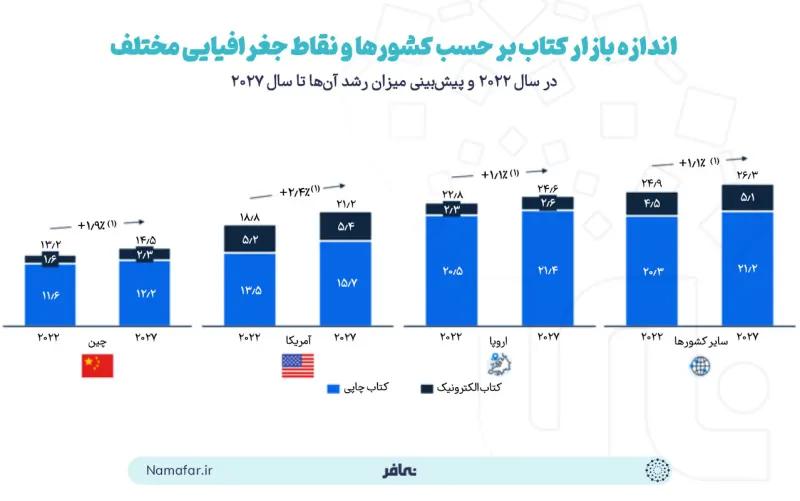
The compound annual growth forecast for book-market revenue from 2022 to 2027 also shows that the United States, with 2.4 percent growth relative to 2022, will have the highest growth through 2027, and China, with 1.9 percent, ranks next. The European continent and the rest of the world's countries will also experience 1.1 percent growth.
Continued growth in the number of readers
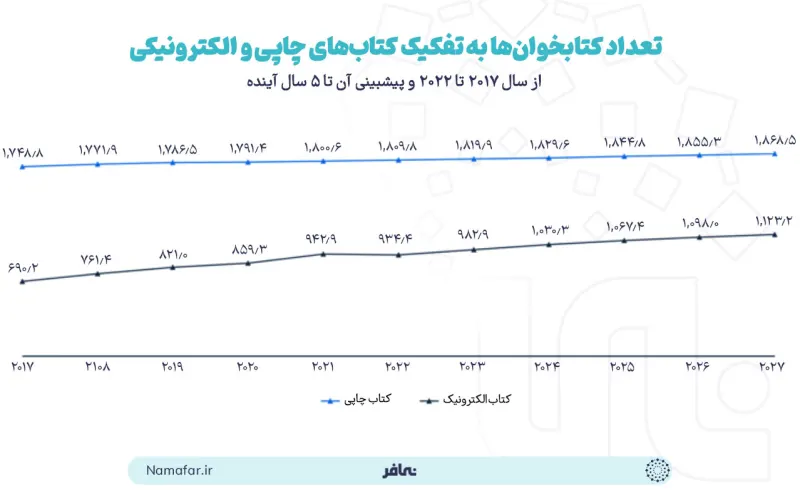
In 2022, the number of readers interested in reading print books reached 1.81 billion people, and the number of readers who favor electronic books was 934 million. Based on the forecast of the number of readers from 2017 to 2027, the number of readers in both print and electronic formats has for the most part grown (except for the number of digital readers in 2022). At the same time, growth in the number of readers who favor electronic books is, by a considerable margin, greater than that of people who read print books. According to this forecast, by 2027 the number of readers will reach 2.97 billion people, of whom 1.86 billion will be readers of print books and 1.12 billion will be readers who favor electronic books.
The largest number of readers is in China
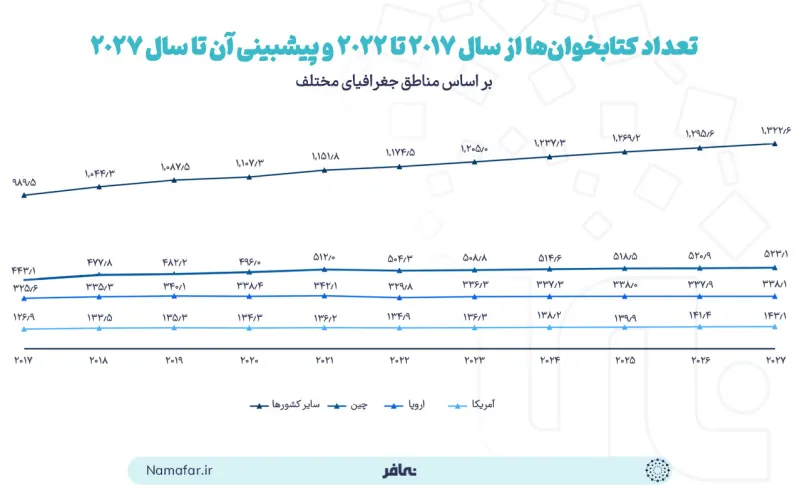
China, with 329 million readers, has the most book readers in 2022, and after it the United States, with 134 million people, is in next place. Also in that year, 504 million readers belong to the European continent, of which the United Kingdom, with 36.2 million people, had the largest share, and Germany with 31.2 million people and Italy with 27 million readers are in second and third place. There are also 1.17 billion readers in the rest of the world's countries.
Amazon and Pearson, key players in the book industry
Amazon is a key player in the world of electronic books, with more than 6 million electronic books and 60 thousand audiobooks in its online store called Kindle. In addition to electronic books, Kindle has created very suitable infrastructure, including electronic e-reader devices, reading applications and easy-purchase solutions. Pearson is also a British publisher that operates in print books and in more than 70 countries around the world. In the past few years Pearson has also adopted comprehensive programs for the electronic format of its products, and in 2021 its electronic segment's revenue grew 71 percent.
Summary and conclusion
Statista's report on the global book market has presented data and key insights about market size, leading countries, the number of readers and its key players. According to this report, global book-market revenue in 2022 was 79.6 billion dollars, the lowest figure since 2017. This is while, based on forecasts, by the end of 2023 this figure will reach 82.3 billion dollars and we will see 2.7 billion dollars of growth in the book market.
In 2022, the number of readers interested in reading print books reached 1.81 billion people, and the number of readers who favor electronic books was 934 million. China, with 329 million readers, also has the most book readers in 2022, and after it the United States, with 134 million people, is in next place. Given the data and the discussion presented, it can be said that despite the rising popularity of electronic books, digital technologies have not had much effect on print books, and they have held on to their share of the global book market.
Machine-translated from Persian by Namafar; the Persian original is authoritative. Read the original in Persian