Qatar was a small, quiet and low-profile country that made its living from fishing and pearl diving. But the discovery of oil and gas in 1940 transformed this land. Qatar had the world's third-largest natural gas reserves and, on the basis of exports of this same oil and gas, began its development path. Until today, because of a small population and very large oil and gas revenues, in terms of per-capita income Qatar is recognized as the fourth most powerful country on the basis of per-capita GDP, and the sixth country on the basis of per-capita GNI. Qatar also has the third-best Human Development Index rank in the Arab world in the United Nations classification.
Despite all these brilliant statistics, however, this country was still behind other Arab countries of the Persian Gulf in one of the most important sources of revenue, and that was the tourism industry in Qatar. Qatar, unlike Saudi Arabia, did not enjoy religious tourism attractions or Hajj ceremonies, and unlike Turkey it could not rely on its historical attractions and build its tourism industry. So it had to, like the UAE and the port of Dubai, build its tourism industry from nothing.
An outlook on the tourism economy in Qatar
Development of the tourism industry in Qatar had a harder path relative to some countries of the region, but it also had a comparative advantage: high income and a small population. Qatar channeled this huge income of its from oil and gas into the cycle of investment in the tourism industry. An important part of this work required creating tourism attractions in Qatar, among the most important of which one can point to hosting and holding sports competitions. Qatar's share of investment in the tourism field is forecast at more than 21 billion Qatari rials through 2028.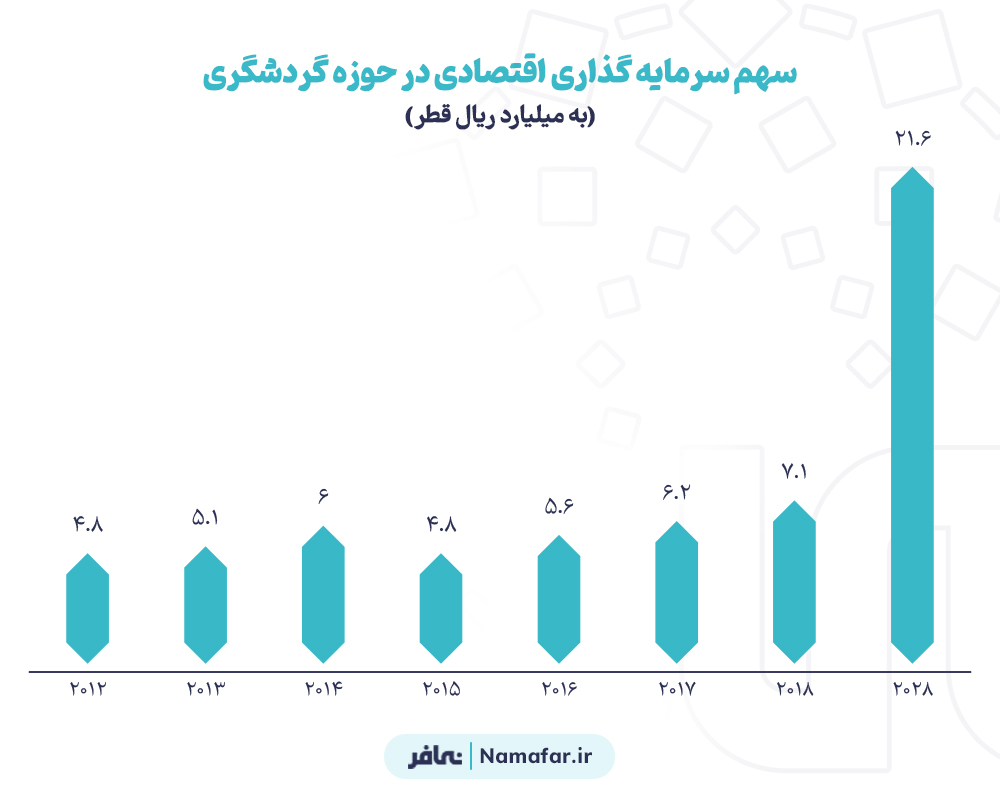
These investments in Qatar's tourism industry, alongside the creation of infrastructure, led to an upward trend from the late 2000s. This trend through 2016 moved in a fully increasing shape, until in later years it experiences some decline. COVID-19 also lays its dreadful effect on Qatar's tourism industry. From 2022, with the lifting of restrictions and of course the holding of the FIFA World Cup competitions, Qatar's tourism revenue again comes into boom, and 2023, with the arrival of four million tourists in Qatar, this country breaks a record.
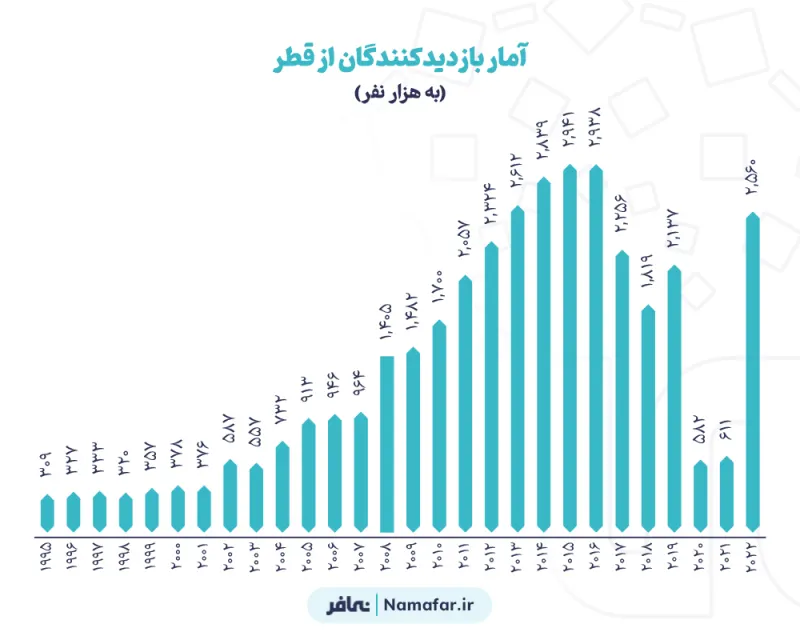
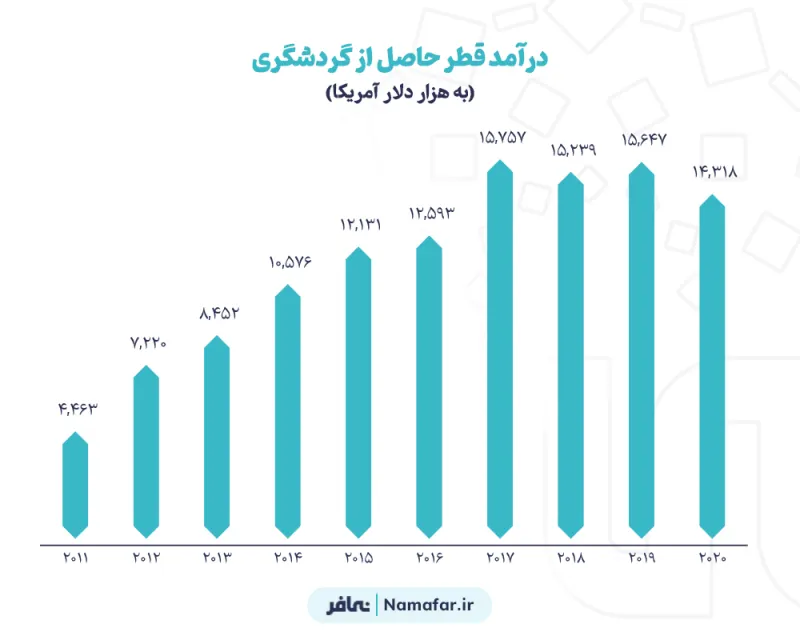
Qatar's tourism revenue had a growing trend in the years of this country's tourism boom in the interval 2011 to 2017, which in the continuation was accompanied by a decrease. Of course this occurrence, given the decrease in inbound foreign tourists to Qatar in that interval, is not very surprising. But COVID-19 did not impose a severe drop on this country's tourism revenue in 2020.
In the continuation we turn to examining Qatar's investment in sports tourism, with emphasis on the two disciplines of football and motorsport.
Qatar MotoGP competitions
Among the most important sports disciplines in the world with high growth are the disciplines under the motorsport subset (auto racing and motorcycle racing). Qatar, in its sports-tourism field, pays special attention to these sports. For the development of these disciplines, infrastructure is needed of which the most elementary is having a professional auto-racing circuit with grade one of the automobile federation (FIA). Qatar in 2003 started construction of the Lusail circuit in the north of Doha. This circuit was the host of the opening of the MotoGP competitions in Qatar in 2004. Qatar, with a 58-million-dollar investment and the employment of a thousand workers, completed this huge project in less than a year.In 2007 this circuit was equipped with extensive lighting so that it could hold competitions at night. This work not only helped better sporting performance on nights with cooler temperature, it also added to the attractiveness of the race. The lighting project of Qatar's Lusail circuit was the world's largest outdoor sports lighting project until that time. From 2004 until today the Lusail circuit has been the holder of all the MotoGP season-opening competitions and has become one of the popular events of this discipline among fans. It is interesting that until the end of the current season of competitions in 2024, still the only nighttime MotoGP race is held in Qatar.
The Lusail circuit became one of the motorsport centers in West Asia and numerous competitions were held at it. Until Qatar succeeded in taking on the hosting of a Formula One race in Qatar for 2021. These competitions are considered the fastest, most professional, most expensive and of course most-watched motorsport. The spread of the coronavirus in 2020 caused severe disruption of the Formula One competitions table, because many countries had strict health protocols for entry and exit, so many competitions were canceled and other circuits were substituted. Qatar, amid the turmoil, made good use of this opportunity and with a long-term contract entered itself into the competitions table.
Qatar host of Formula One competitions | a 10-year hosting
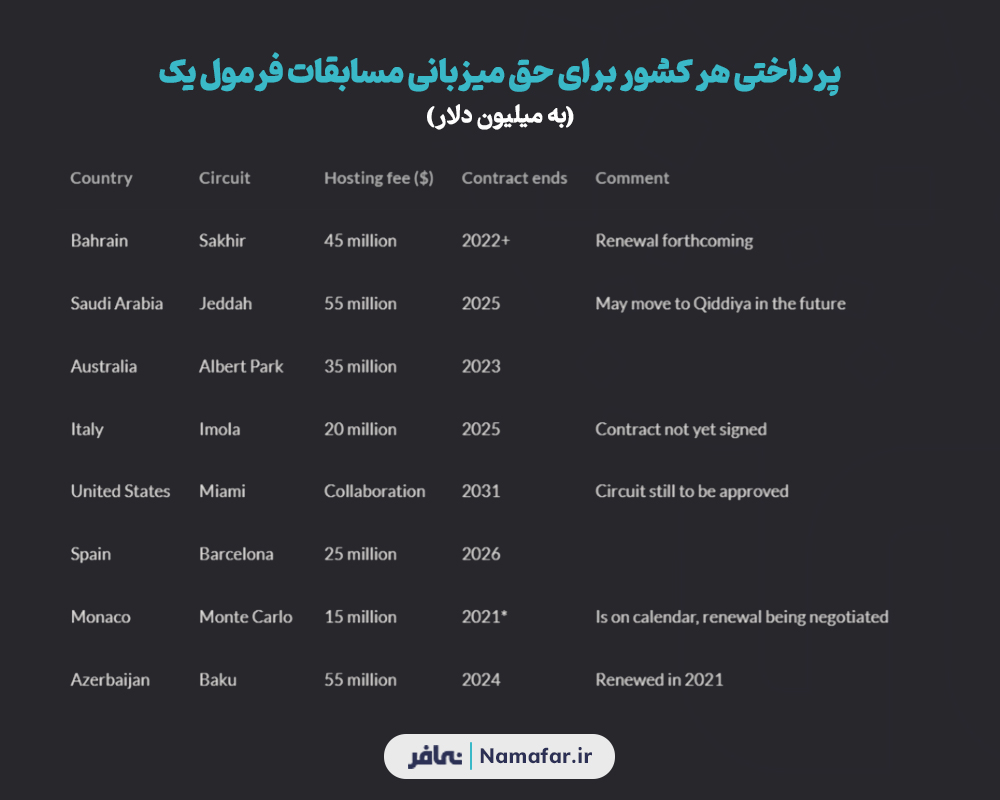
Qatar obtained a long-term ten-year hosting in a astronomical contract, which it is said pays 55 million dollars annually for this hosting to the Formula One group (FOM). In the chart below you see the duration of the contract of each of the present Formula One circuits for hosting these competitions. The table below also shows the amount of hosting-right payment of each circuit, and the countries of West Asia pay a more huge cost for this hosting relative to European countries.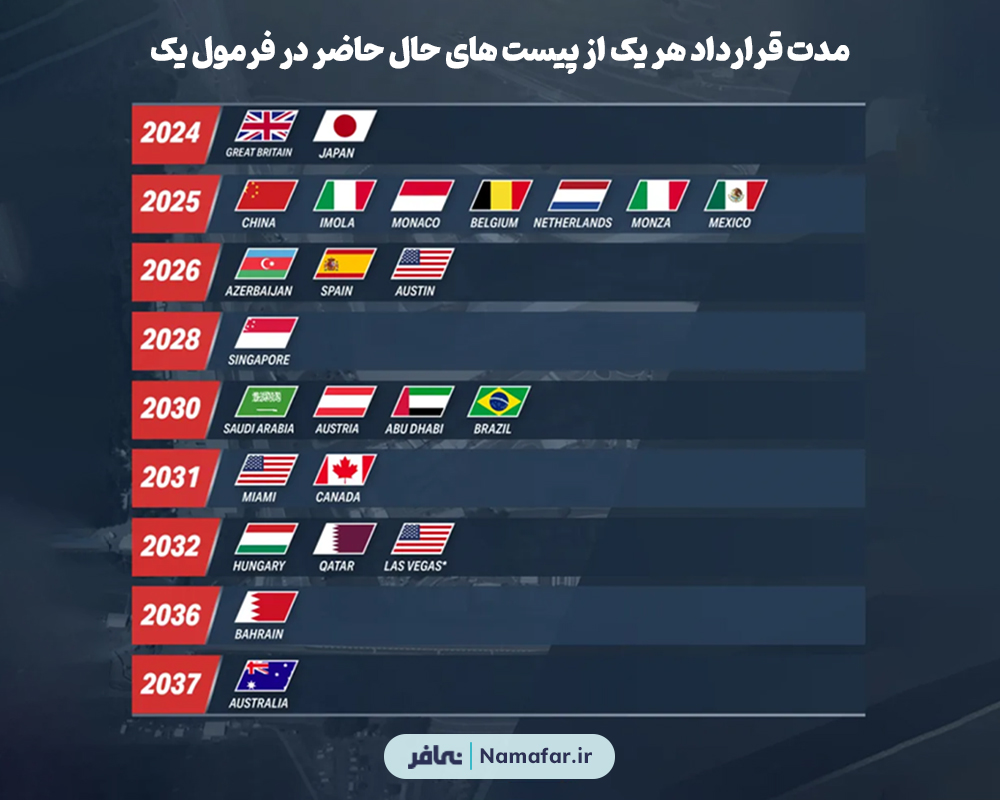
Qatar host of the World Cup; Qatar's big strike in the tourism industry
The largest sporting event after the Olympic Games is considered the FIFA World Cup. Hosting the World Cup not only during the holding of this event but also in the long term makes a notable contribution to the development and progress of tourism in the host country. Qatar made a long run-up from 2009 to obtain this hosting. Finally in February 2010 Qatar, from among four other rivals of itself, namely the United States, South Korea, Japan and Australia, was selected as the host of the 2022 World Cup. This selection of course was accompanied by numerous controversies, because FIFA members believed that Qatar, owing to not having a rich football culture and also not having suitable infrastructure, was not a suitable option. But this controversial selection was repeatedly subjected to severe criticism by the media and football experts, and even accusations of FIFA members taking bribes in order to take this decision, and also sportswashing on the part of Qatar, are still raised.
The cost of the most expensive World Cup in football history in Qatar
Qatar spent an enormous budget for the 2022 World Cup, a figure that is estimated at up to 220 billion dollars. This World Cup turned Qatar into the most expensive World Cup in the history of these competitions.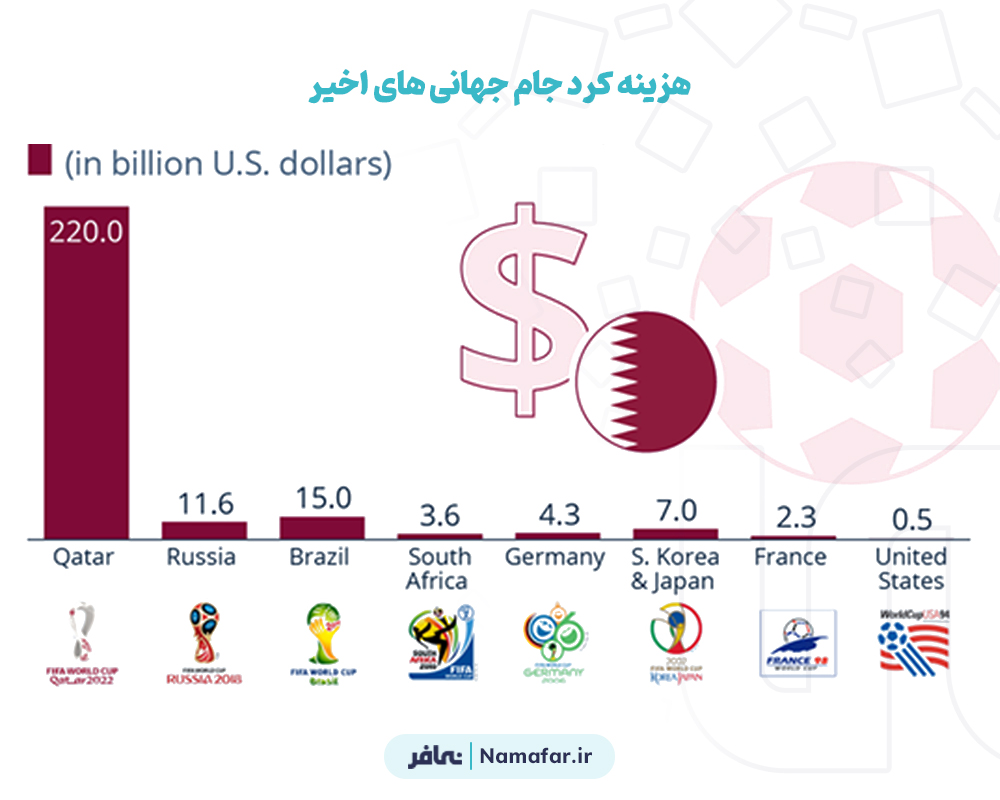
But the question is this: has all of this large budget been spent solely for holding the 2022 World Cup in Qatar? The answer of Qatar's official authorities is negative. According to what Qataris have said, the net cost of holding the competitions themselves has been only eight billion dollars, which compared with the two past World Cups in Brazil and Russia is a smaller figure. So what has this cost been spent on?
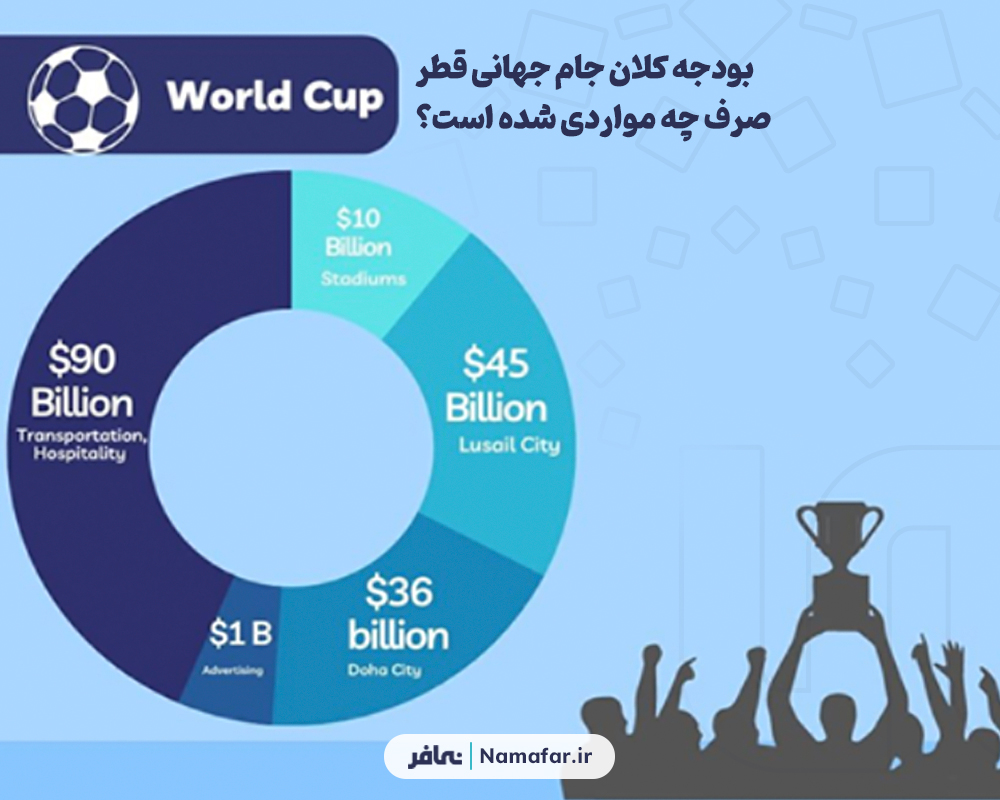
The greatest spending has been devoted to huge infrastructure that after the World Cup as well remains for this country. Huge projects such as the construction of new airports, the creation of new roads and ports, and also a light rail line system. According to the statements of Qatari authorities, these costs were part of this country's long-term development program on the 2030 horizon, which was approved in 2008 and before obtaining the hosting of the World Cup in Qatar. In the chart below you observe that the estimated figure for the price of the most expensive World Cup in history, apart from the construction of infrastructure, has been spent on the cost of building Qatar's stadiums, advertising, and the two cities of Lusail and Doha.
Among the most important infrastructure requirements of holding large events such as the World Cup from a tourism perspective is the accommodation of tourists. In the development of accommodation infrastructure, attention was also paid to the point that not all tourists and visitors of the World Cup are at one welfare level that they would only want four-star and five-star hotels. So the construction of one-star, two- and three-star hotels, and also the creation of camps for accommodating fans who do not stay in hotels, was also given attention.
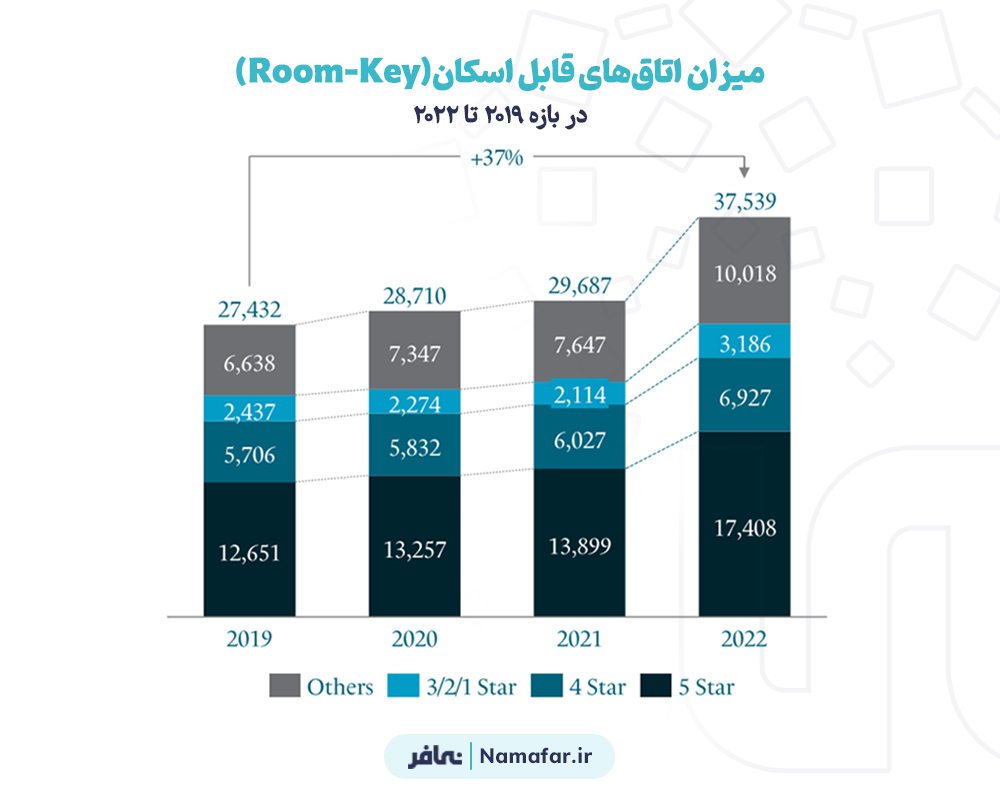
In the chart below you observe the number of bookable rooms (Room-Key) in the interval 2019 to 2022. In the said interval, altogether 37 percent room growth has taken place, of which the greatest growth has belonged to accommodations with a use other than hotels.
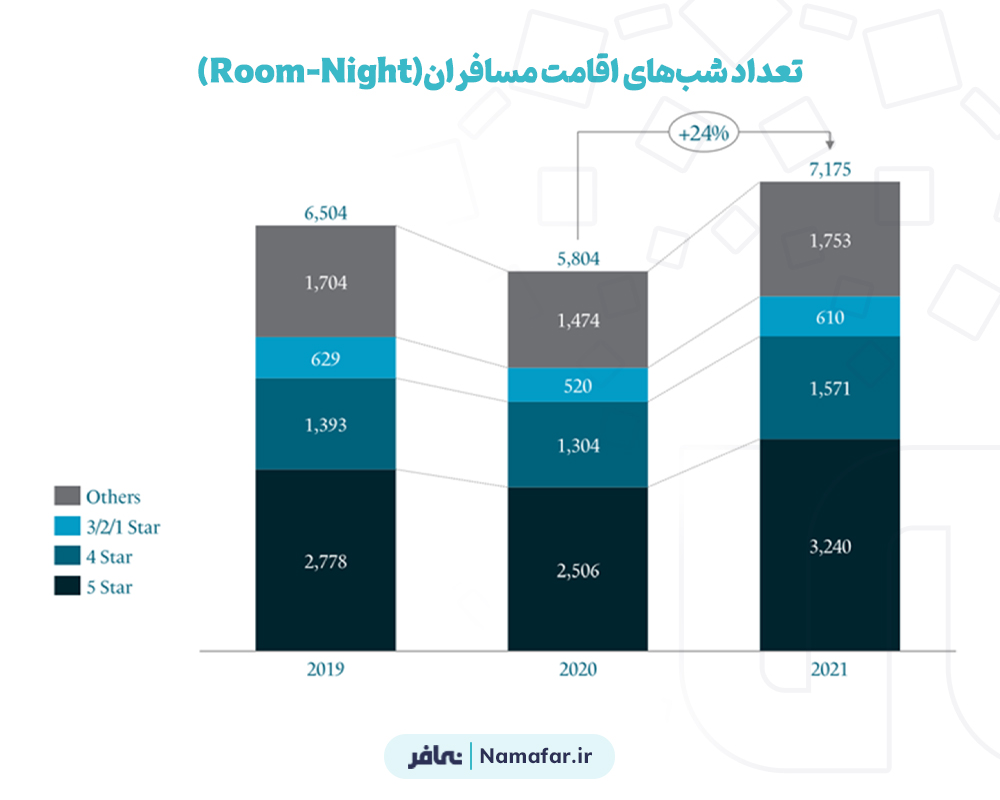
In the tourism industry, constructing infrastructure is one matter and the degree of utilization of it is another matter. How much these rooms built for accommodating tourists have performed successfully for tourism development should be measured in other indicators such as the occupancy rate and fullness of rooms (occupancy) and also the number of guests' nights of stay (Room-Night). Measuring the indicator of the number of nights of stay shows us how many nights a traveler has stayed in a country. In the chart below we see the increase of this indicator in 2021 after the coronavirus restrictions in 2020.
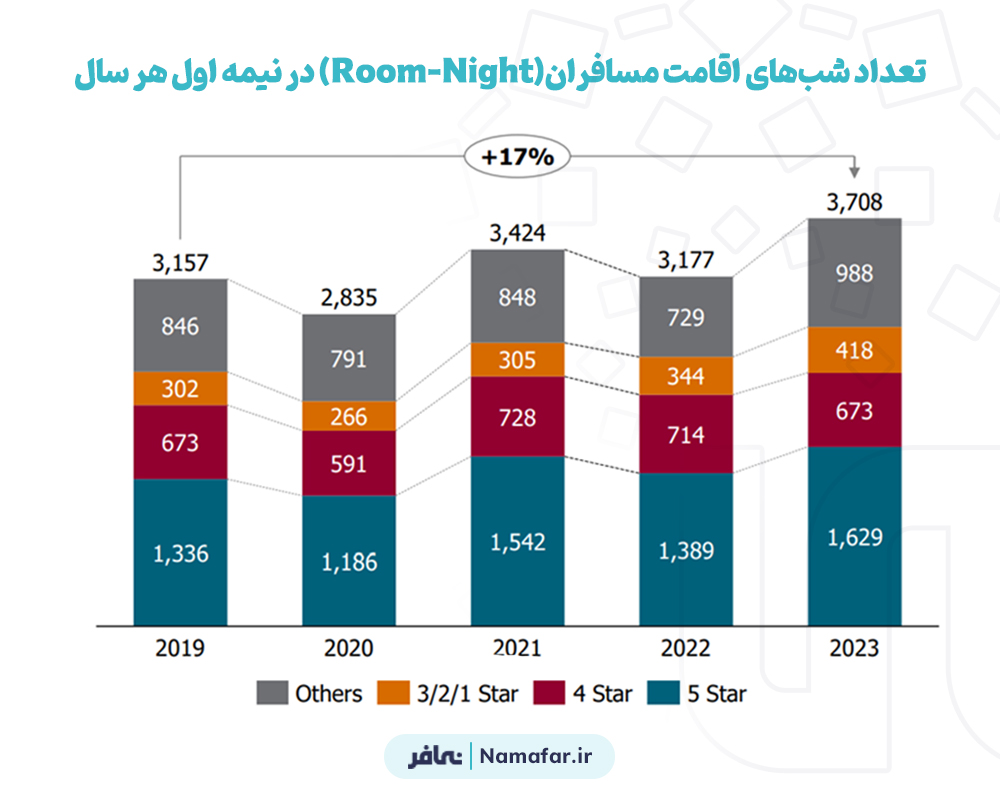
In the next chart we see this statistic in the interval of the years 2019 to 2023, which of course, for comparison with the recent year, only the statistics of overnight stays up to the first half of the year have been reported. According to this statistic we are witnessing a 17 percent increase from the pre-COVID era to the post-World Cup era. Also the greatest growth is again for Qatar's non-hotel accommodations in the World Cup. Among the causes of this unprecedented growth one can point to these items: the effect of the World Cup in Qatar becoming known, global trade market activities, Qatar's global advertising campaigns such as "Feel more" and "Pirlo," and advertising campaigns in the field of the Persian Gulf countries.
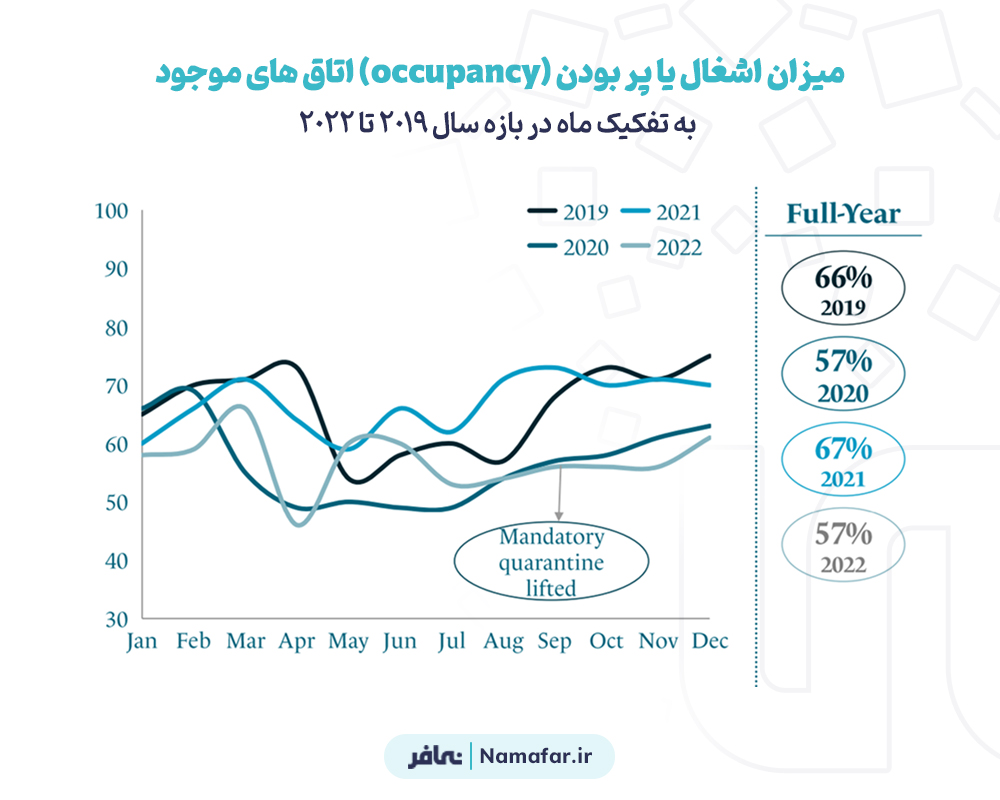
Another important indicator in examinations of the success of Qatar's tourism industry is the occupancy or fullness (occupancy) of existing rooms. In the chart below you see the changes of this indicator in a four-year interval broken down by each month. If we do not pay sufficient attention to the other data, analysis of this chart may be very misleading for us. Because for example, despite the tourism statistics of Qatar being better in the years 2022 and 2019, the years 2020 and 2021 in this chart have seized the lead in the occupancy rate.
In 2020, because of the continuation of hotel construction for more rooms and also the decrease in inbound tourists to Qatar because of COVID, this statistic has accounted for the low percentage of 57 percent. In 2021 the number of inbound tourists became much greater and this occurrence increased the occupancy percentage of rooms. In 2022, however, this percentage increased in the interval of the World Cup in Qatar, but the lifting of COVID health restrictions in the month of September caused the addition of numerous empty rooms, which naturally reduce the occupancy percentage.
The positive effect of holding the World Cup on Qatar's tourism industry
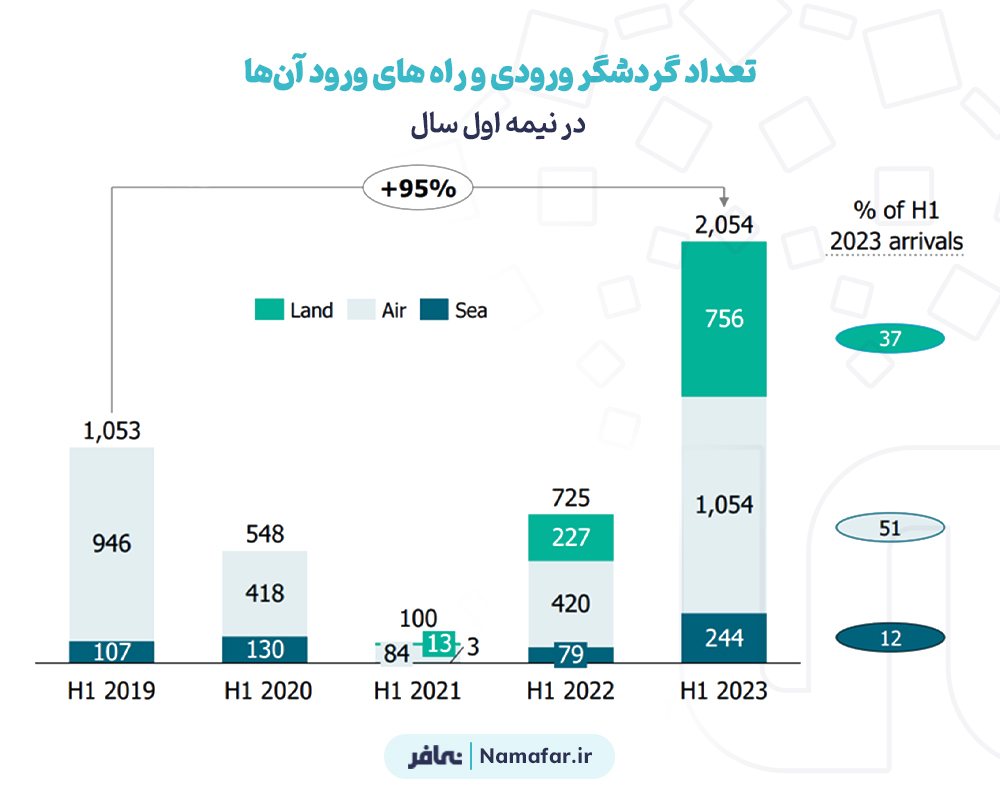
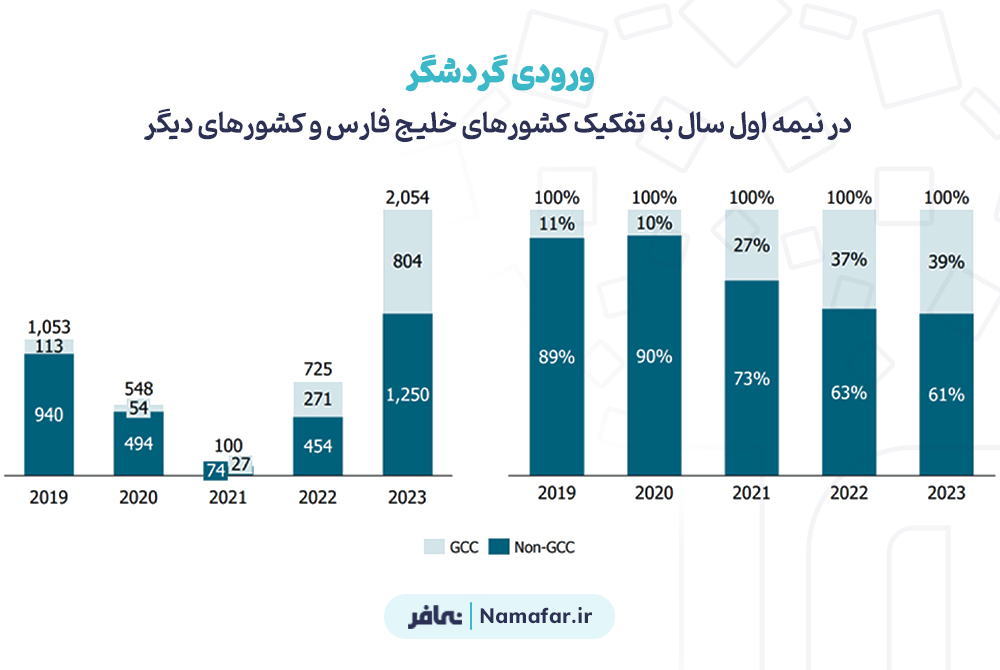
Among the most important aims of hosting international competitions for the host has always been the development and progress of tourism. To measure the success of this matter we must, on the basis of indicators, measure the boom in tourism before and after that hosting. A comparison of the number of tourists entered, the routes of entry and their origin can be suitable criteria.In the chart below you see that compared with the first half of past years the statistic of the number of inbound tourists to Qatar has increased to a very large extent; for example from 2019, which was the last pre-COVID year, to 2023 the number of inbound tourists has increased 95 percent. Also, in addition to air and sea entry routes, we are witnessing the addition of a land route as well. Air arrivals have not changed much, but at the time of holding the World Cup in Qatar tourist arrivals by sea have almost doubled.
By comparing the nationality of foreign tourists in Qatar during the first half of the years before the World Cup and after it as well, we arrive at the conclusion that the effect of the World Cup in Qatar on attracting foreign tourists of the Persian Gulf area has been very positive. In the table below you observe that the percentage of tourist arrivals from the Persian Gulf area has had considerable growth, which means that the foot of tourists neighboring Qatar has been opened into this country. This, given the presence of two tourism giants in the region such as the UAE and Turkey, is an important occurrence.
The future of Qatar's tourism industry
As was said above, Qatar from 2008 has undertaken policymaking for its 2030 horizon. It has also held the World Cup in Qatar in line with this same macro development program. In the chart below we see Qatar's tourism revenue share of this country's gross domestic product (GDP). After the fall of this indicator in the COVID days, after one year and in 2022, thanks to holding the World Cup in the country of Qatar, this indicator reached its pre-COVID amount. Forecasts show that this indicator, with a mild growth trend through 2028, will reach a figure of more than 25 billion dollars a year.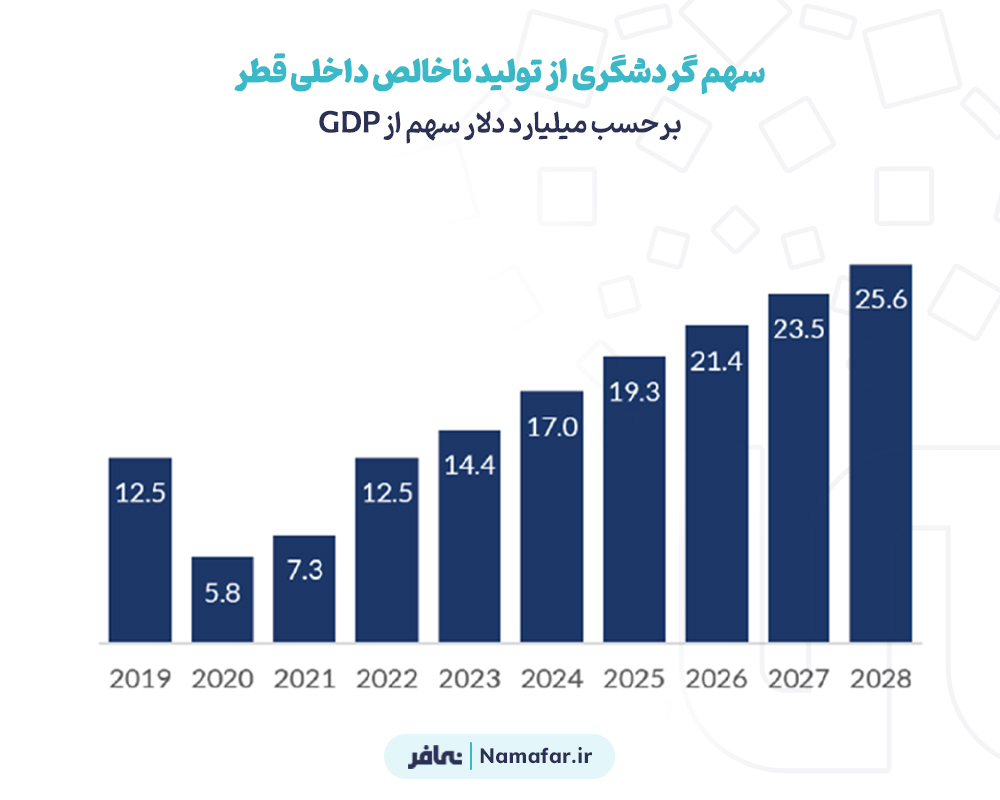
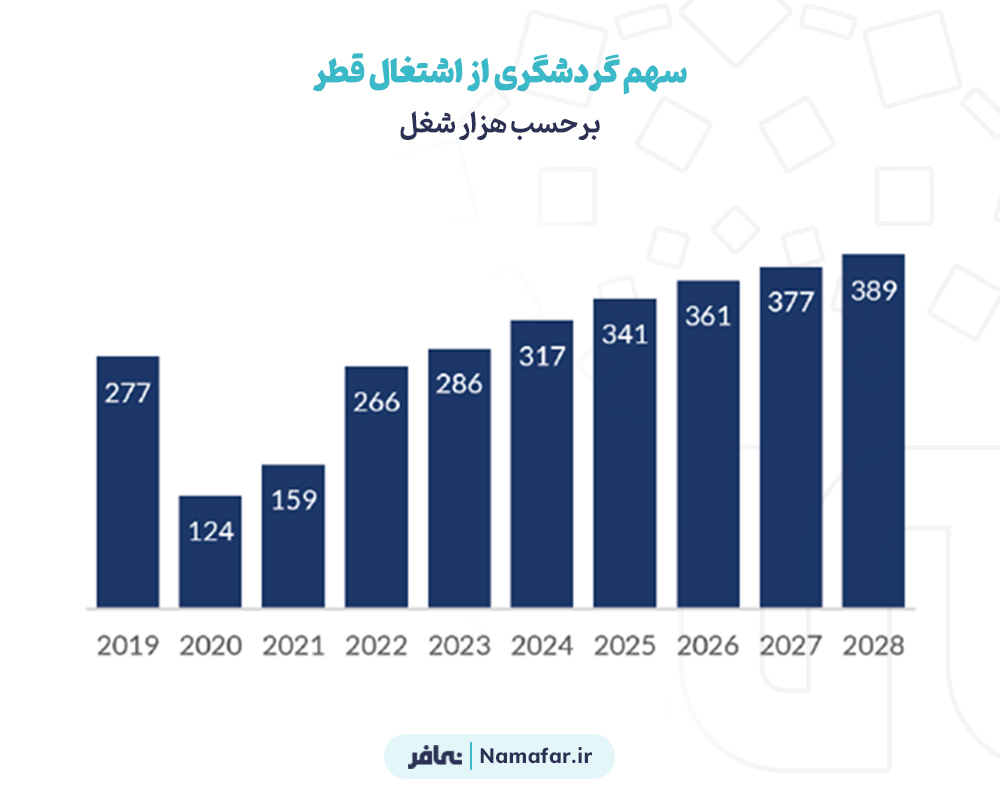
In the next chart you observe the share of the tourism sector of Qatar's job creation. Here as well the effect of holding the World Cup event in making this indicator positive after its fall in the COVID days is seen. It is forecast that this upward trend will continue through 2028 and in that year more than 380 thousand jobs will be created through tourism in Qatar.
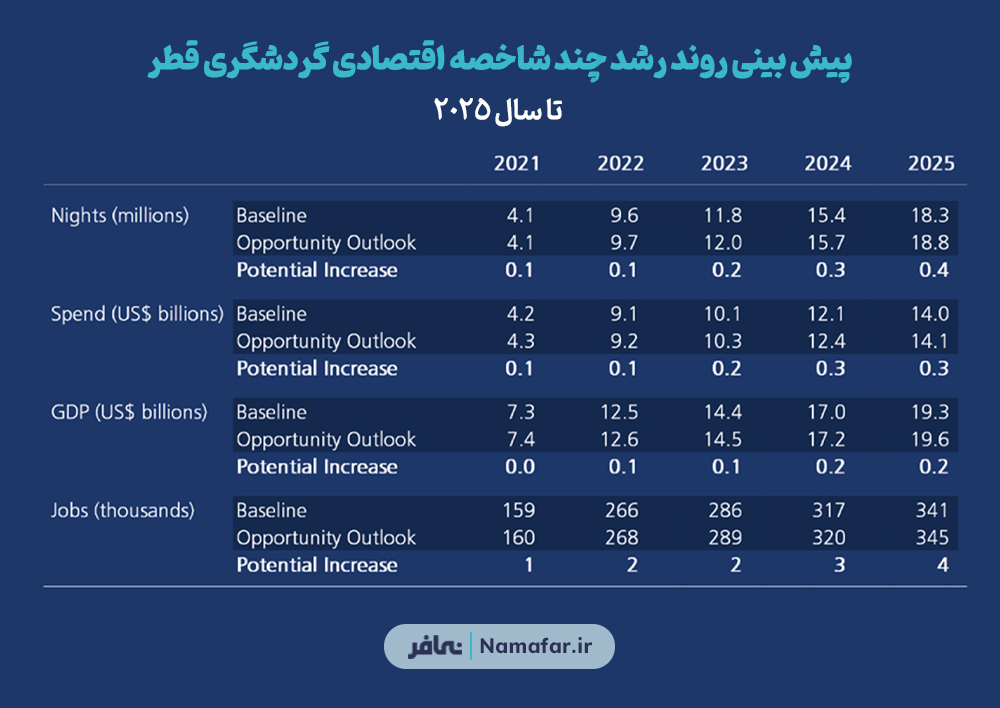
In the last chart as well you observe the statistics of several other indicators and also the forecast of their growth through 2025, together with the outlook of their possible increase. For example it is forecast that in 2025 about 18.3 million guest-nights will be spent in Qatar, which also has the potential of reaching 18.8, and between these there is about half a million of incremental opportunity.
Summary
By examining the tourism industry in Qatar we can take lessons to apply in our own economy. Tourism in the country of Qatar is a good example for observing the principle of comparative advantage in the economy. The country of Qatar geographically is located in a region in which, given the presence of the most tourist-oriented countries of the Middle East such as the UAE and Turkey, the development of international tourism has become very competitive and hard. But Qatar uses its comparative advantage, that is high income and a small population, to create tourism attractions for its country, such as sports tourism attractions.Another lesson we can take from Qatar is correct policymaking in the field of sports tourism. Qatar, by obtaining the hosting of the World Cup, placed infrastructure development for holding this event within its long-term development policies, so as in practice both to benefit from the World Cup as an expander of tourism in Qatar, and to use it as a driving engine for reaching those same long-term development policies.
In the end it must be said that these were only a part of the examination of a successful economic experience, and many other points will be obtained in more precise multilateral examinations, and one of the master keys of economic progress as well is using the experiences of others.
Machine-translated from Persian by Namafar; the Persian original is authoritative. Read the original in Persian