Today Pakistani clothing is seen as attractive apparel in the windows of the world's modern boutiques. Pakistan's clothing industry plays an important role in the global textile market, for which various reasons can be listed. Among these reasons one can point to sewing quality, competitive price and a diverse range of products. Skilled labor, access to raw materials and a modern production process have all come together in Pakistan's textile industry so that quality clothing is produced. Although this country faces numerous challenges such as infrastructure and global competition, Pakistan's clothing industry continues in production, job creation and supplying its goods, which has a considerable share in Pakistan's economy.
Pakistan's clothing industry constitutes a major part of production and exports in this country. Large clothing manufacturers in Pakistan carry out production vertically. This means that all stages of producing a product take place inside this country. In fact Pakistan, as one of the largest cotton producers, often uses cotton fabrics to produce clothing. The brands "Gul Ahmed" and "Nishat Linen" are among the best-known Pakistani clothing brands that have successful exports.
The growth of the clothing industry in Pakistan has a story of its own. The revenue of Pakistan's clothing industry has been accompanied by ups and downs, but the volume of this country's production has relative stability. The development model in the industry is multifaceted, and the government of Pakistan plays a prominent role in the upward movement of the clothing sector. Platforms for growth in the educational, economic and production fields are being updated, and through 2028 planning has been done for each of these platforms.
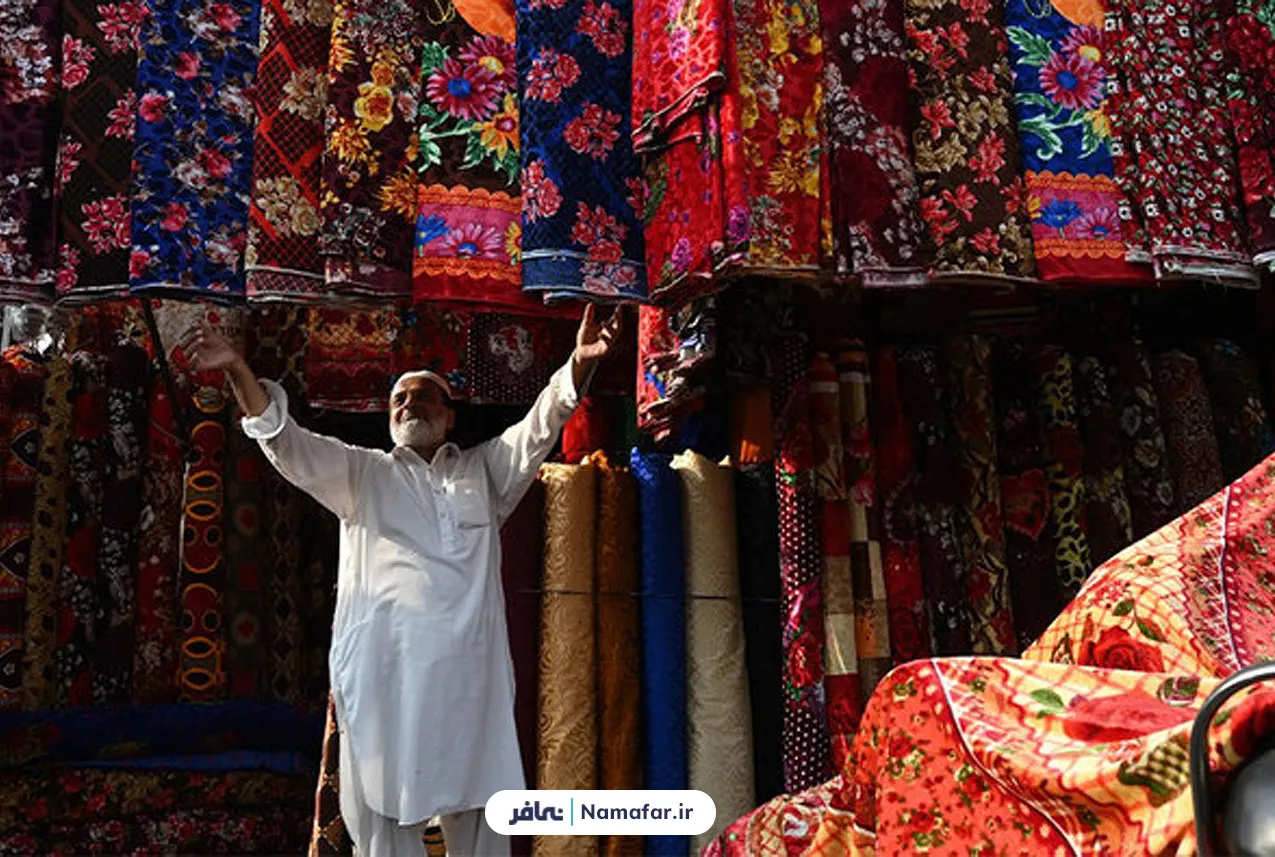 The power of Pakistan's clothing industry
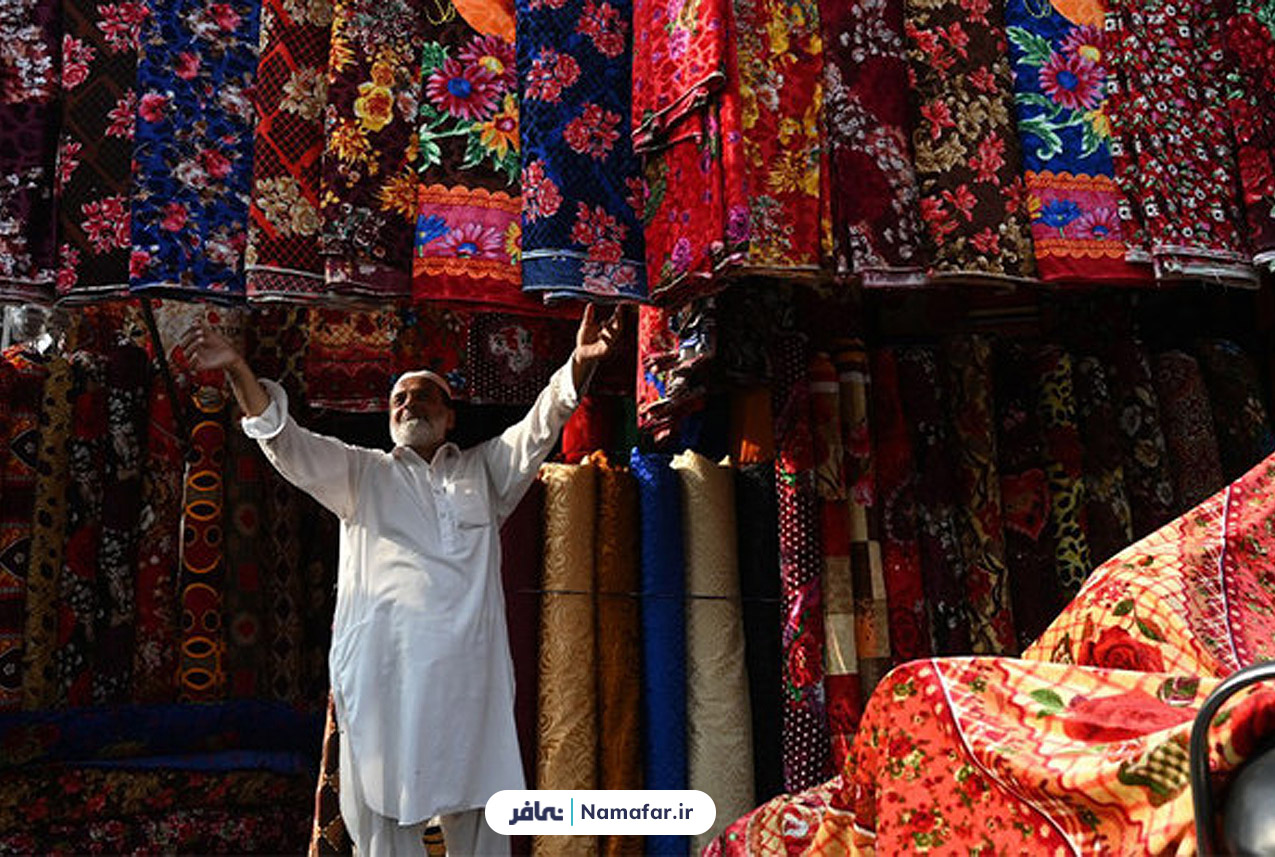
Various factors play a role in reducing the production costs of Pakistani clothing. For this reason this country, compared with countries such as Bangladesh, India and China, benefits from these factors. These factors are: access to cotton in abundant amounts and skilled and affordable labor, which helps its comparative advantage in Pakistan's textile production. Pakistan, as the world's fifth-largest cotton producer, has a considerable domestic source that reduces the initial cost for the clothing industry. Pakistan is an exporter, consumer and producer in the clothing sector; for this reason it consumes some of cotton production and converts a considerable part of it into yarn and exports it. For this reason this country is among the top fabric exporters. This shows the industry's scale of superiority and its integration into the global supply chain.
Skilled labor in this country is supplied from the large population it has. Government skill-training programs and the help of private sectors increase access to skilled workers at competitive rates. Pakistan's clothing industry benefits from a strong supply chain that is supported by companies involved in various stages of production. This industry has an intra-regional process that includes ginning and spinning through to weaving, processing and finishing. Among the interesting aspects of Pakistan's textile and clothing industry one can point to its strong connection with agriculture. Thousands of farmers are engaged in cotton cultivation, and there is a considerable connection between agriculture and this country's clothing manufacturing sector. Industrial sustainability and the strengthening of economic and social position are the result of this unique connection.
The story of the development of Pakistan's textile industry
The country of Pakistan, for the growth of the clothing industry in its country, first turned to capacity-building. To this end it created two schemes to provide better financial support, which included the Long-Term Financing Facility (LTFF) and the State Bank of Pakistan (SBP) facility. In the second step it built new industrial cities for producing apparel and Pakistani clothing, in which micro and small enterprises were also allowed to operate. Then it prepared the e-commerce platform for marketing and sales, which greatly facilitates the process of selling the enterprise's products. This industrial updating brought Pakistan's apparel and clothing into the global chain, and in this way, in the heart of the world's Fourth Industrial Revolution, it was able to have something to say with its technical textiles. With timely and appropriate policymaking such as eliminating tax on the textile sector in Pakistan, it increased the possibility of this industry's growth. It placed the two important and needed resources for an industry, which include labor and raw materials, at the disposal of the Pakistani clothing producer by providing a platform of extensive supply. In such a way that the focus of agricultural production was directed to producing cotton and natural fibers, and by expanding education and technical and vocational institutes it was able to supply the needed labor to the Pakistani clothing industry. The government of Pakistan, as a final measure, like a kind father, supported its children, which were the micro enterprises producing Pakistan's clothes, in numerous fields such as commercial disputes or creating trade associations and so on.Revenue of Pakistan's textile and clothing industry
The chart below shows the clothing industry in Pakistan in three segments: men's, women's and children's clothing. The revenue of Pakistan's clothing industry has gone from a total of 8.5 billion dollars in 2018 to revenue equivalent to 5.8 billion dollars in 2024. In fact the amount of revenue of Pakistan's clothing industry has always experienced a downward path with small ups and downs. Forecasts show that the revenue of Pakistan's clothing and textile industry until 2018 will have relative stability.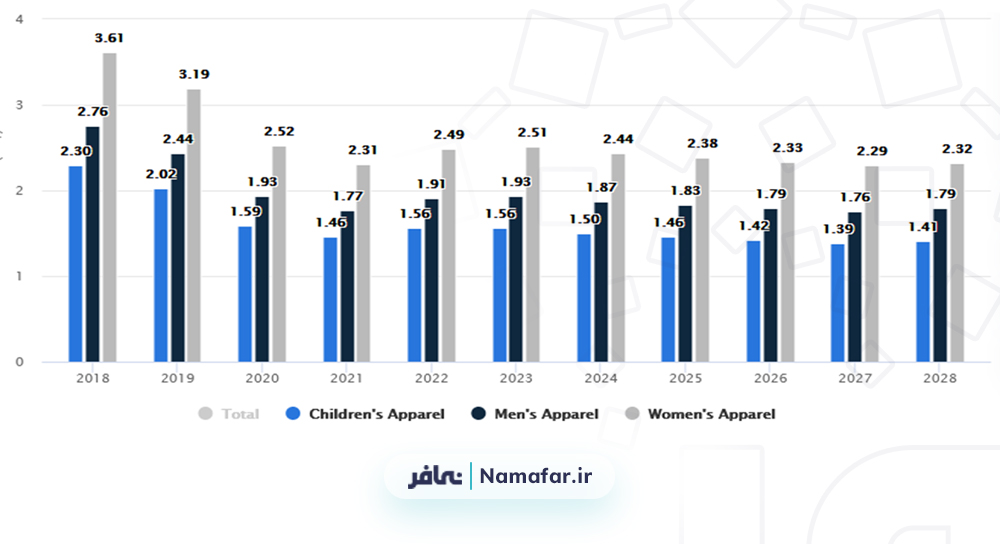
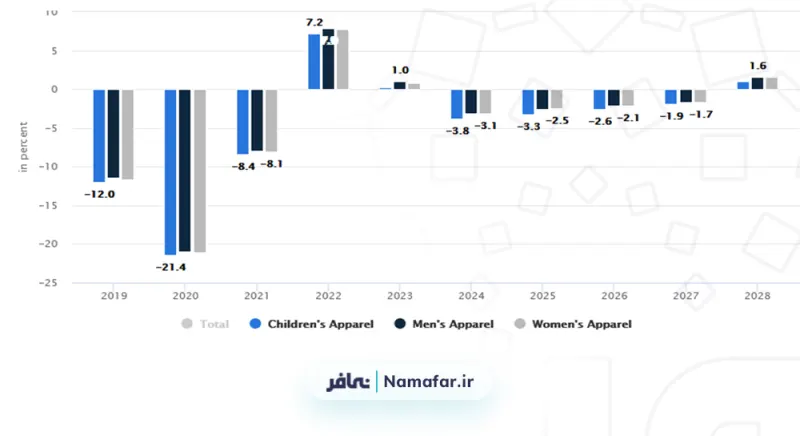
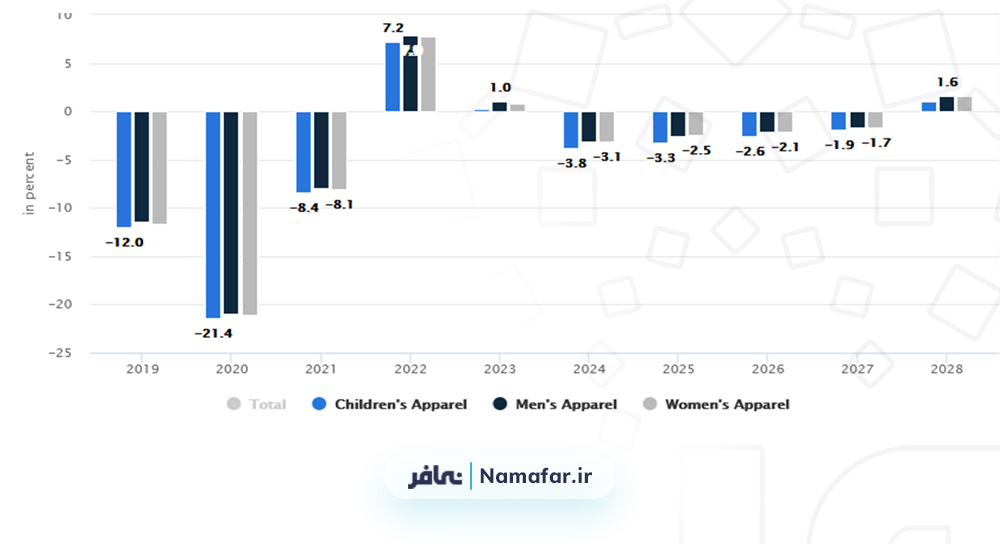
The chart below shows the amount of revenue decline in each segment of clothing production. The question is why this growing industry, after its peak years, has faced a decline in revenue. The answer is that developing industries, after going through a period of extraordinary growth, encounter a temporary drop. One of these reasons is the costs related to industry development, but after passing through this period they reach stability and again begin their upward path. Forecasts indicate that Pakistan's clothing and textile industry from 2028 will return to its revenue growth trend.
 The volume of online and in-person sales of Pakistan's clothing
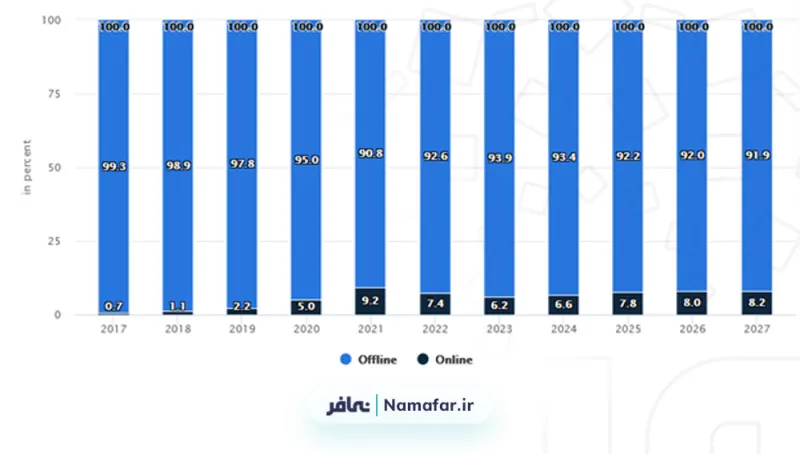
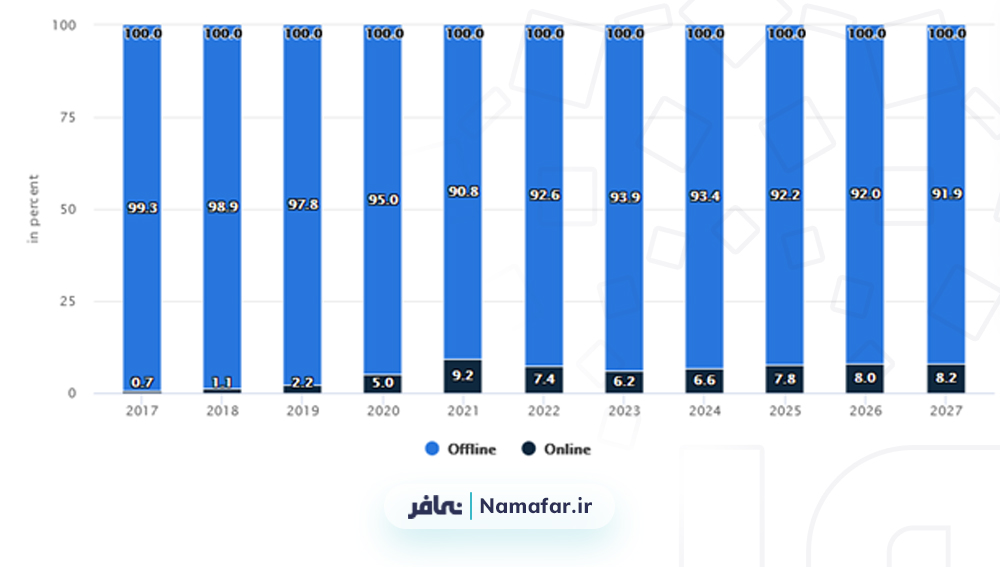
In the chart below, the volume of sales in Pakistan's clothing industry is divided into two categories, online and in-person sales. The chart's percentages well show the effect of employing e-commerce in Pakistan's clothing industries. From 2020 online sales play an important role in Pakistan's clothing industry, which is the result of policymaking whose aim is connecting Pakistan's industry to the global chain.
 The volume of goods produced in Pakistani clothing factories
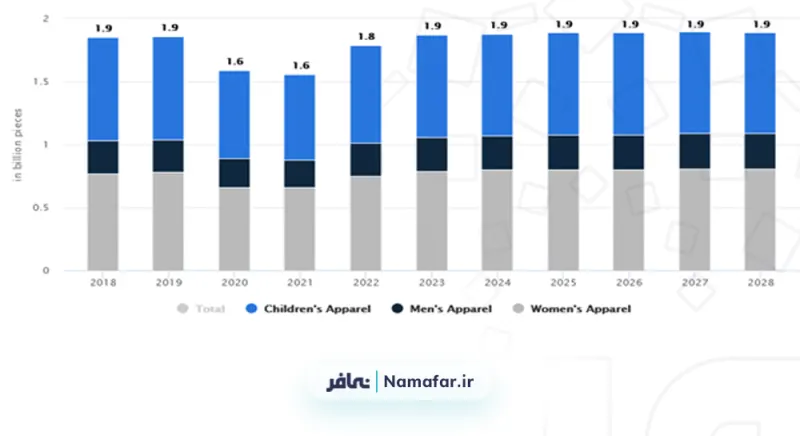
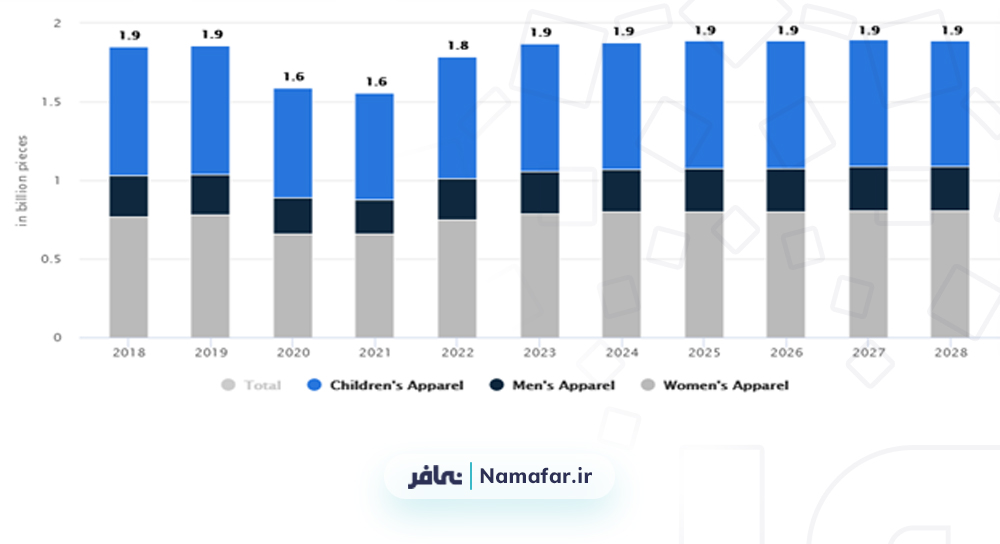
The chart below shows the volume of Pakistani clothing production on the basis of the figure billion. In 2018 the number of products in the three clothing segments was equal to 1.9 billion pieces of clothing. During the two years of the critical outbreak of the coronavirus this figure declined. It was not only Pakistan's clothing industry that encountered this situation; rather the clothing industry in COVID affected most countries. But after that the volume of Pakistan's clothing production has returned to the same previous figure and will also continue through 2028. With this interpretation these clothing industries in Pakistan do not intend to stop and continue to supply their products.
 Employment in Pakistan's clothing industry
The apparel and clothing sector in Pakistan plays a significant role in creating job opportunities. Employment in Pakistan's textile and clothing industry has the second place in the choice of occupation for this country's people. 38 percent of Pakistan's total labor force are employed in this country's clothing industry. Because of the employment of 15 million people in Pakistan's clothing sector, this sector has helped to a considerable extent in reducing unemployment and poverty. The interesting point here is that the job opportunities that are not concentrated in the clothing industries and Pakistani clothing factories and have spread in different regions of Pakistan and this country's provinces, with more widespread distribution, have been able to bring greater economic benefits.
The role of policy in the growth of Pakistan's textile and clothing industry
Duty-free access is one of the most important and most effective factors in the growth of clothing industries in Pakistan, which is under the special Generalized Scheme of Preferences (GSP) in the import market of the European Union (EU). Through an agreement in 2002 this scheme was established between Pakistan and the European Union. The European Union, which is the largest trading partner for Pakistan, has received more than 28 percent of Pakistan's exports and has a share of 14.3 percent in Pakistan's total trade. GSP allows Pakistan to benefit from a preferential tariff rate on a range of products. More than 78 percent of Pakistan's exports to the European Union is that, along with it, benefits from preferential tariff advantages. One of the programs of the government of Pakistan for the period 2020-2025 is the Pakistani Textiles and Apparel Policy (TAP). The aim of this policy is to strengthen exports and create a country in the field of clothing supply and global supply chains. This leads to improving competition, increasing productivity, promoting innovation in clothing production and value added, and ultimately creating an active business environment that is focused on Pakistan's textile and clothing industry.Conclusion
Pakistan's clothing industry can be referred to as an industrial phenomenon. Pakistan has been able, for the growth of its clothing sector, to identify its advantages and shortcomings and always tries to use them in the direction of elevation and progress. Having raw materials, cheap labor, skills and innovation together with economic support and precise planning has caused Pakistan's textile and clothing to enter the global arena. The revenue of Pakistan's apparel and clothing industry, at about 5 billion dollars, has transformed Pakistan's economy. A high volume of this country's exports takes place on the basis of the clothing and apparel sector. Among other effects of the development of the apparel and clothing industry in Pakistan one can point to the employment of 38 percent of this country's labor force in the clothing industry, and also prosperity in the agricultural sector which has helped produce the requirements of the textile industry. Overall, the great transformation in the clothing sector with the cooperation of the private sector and government track-laying has brought a flawless example of industrial development.Machine-translated from Persian by Namafar; the Persian original is authoritative. Read the original in Persian