Cultural goods and services, as tangible manifestations of culture, have been made available for public access. These goods not only affect the preservation and promotion of values, customs, and traditions, but also strengthen national identity. On the other hand, consumption of these goods can lead to the creation of job opportunities and the prosperity of businesses related to the field of culture. For this reason, the expenditure that individuals pay to receive cultural goods and services is of particular importance and indicates a direct link between culture and the country's economic development.
Cultural spending refers to the set of expenditures that individuals incur to purchase or benefit from cultural products and services such as books, handicrafts, music, travel, recreation and entertainment, cinema and theater, and so on. These expenditures not only indicate society's attention to culture and the arts, but also bring positive economic and social effects that can help the country's sustainable development. On the other hand, the level of cultural consumption of Iranian households in various fields and in past years also reflects changes in the taste and preferences of the Iranian audience in the arena of culture and the arts.
Every year, numerous data and reports with various research methods are published on cultural spending in Iran that can lead to a deeper understanding of the cultural consumption patterns of Iranian households. Namafar's policy research and data analysis group has presented the present report with the aim of analyzing the cultural spending of Iranian households, including urban and rural households, in the years 1396 (2017/18) to 1402 (2023/24), on the basis of reports and data published by the Statistical Centre of Iran. In other words, this research has used the codes of the Statistical Centre's household income and expenditure questionnaire, meaning that all of an Iranian household's expenditure codes in various spending domains over these seven years have been studied and examined in detail, and those codes that counted as instances of household cultural spending have been identified and extracted. The result has been categorized in 14 sections, including 324 expenditure codes, under the heading of Iranian households' cultural spending.
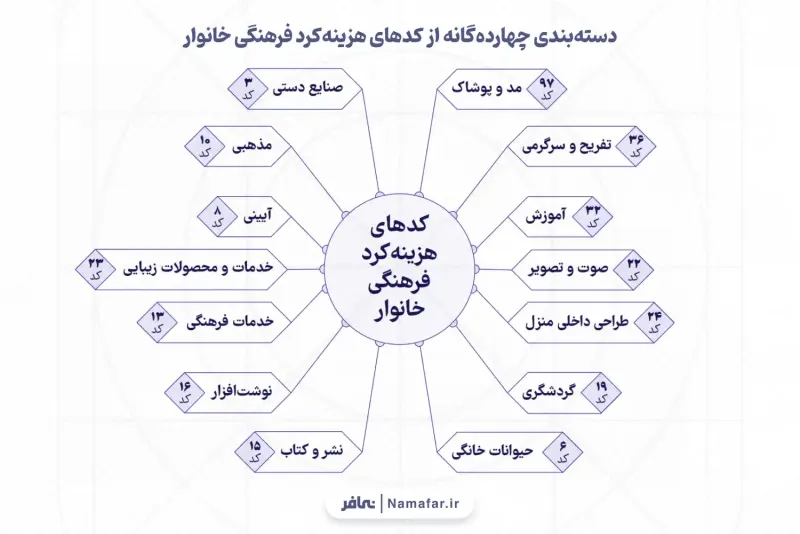
This data-driven report seeks to examine various dimensions of cultural spending on the basis of income deciles, gender, age, place of residence, housing tenure, type of occupation, marital status, and level of education over the years 1396 (2017/18) to 1402 (2023/24) and, on that basis, to provide researchers, policymakers, and actors in the field of cultural and creative industries with a better insight into Iranians' spending pattern. Also, in this research the codes that fall under cultural spending have been studied and enumerated in detail, and the instances of cultural consumption have been made more up to date and more comprehensive than in the previous report.
A look at some of the report's data
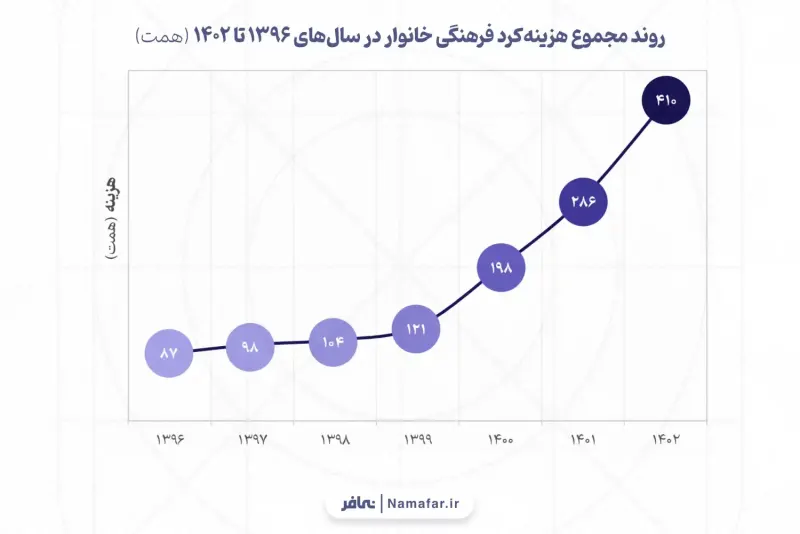
The examinations show that the share of urban and rural households' cultural spending in their total spending declined over the years 1396 (2017/18) to 1402 (2023/24), and in 1402 (2023/24) the share of cultural spending was estimated at 7.5 percent for urban households and 10.3 percent for rural households, both of which declined relative to the previous year. Also, in terms of total cultural spending, the trend over the seven years has been upward. However, calculating the average spending adjusted on the basis of inflation and people's purchasing power shows that the average trend from 1396 (2017/18) to 1399 (2020/21) was downward, and in 1400 (2021/22), with an increase of about 12 percent, it reached 151 million rials. After that, from 1400 (2021/22) to 1402 (2023/24) this spending remained almost unchanged and had no significant change. Adjusting average cultural spending on the basis of inflation makes the real value of average spending transparent for researchers and policymakers.
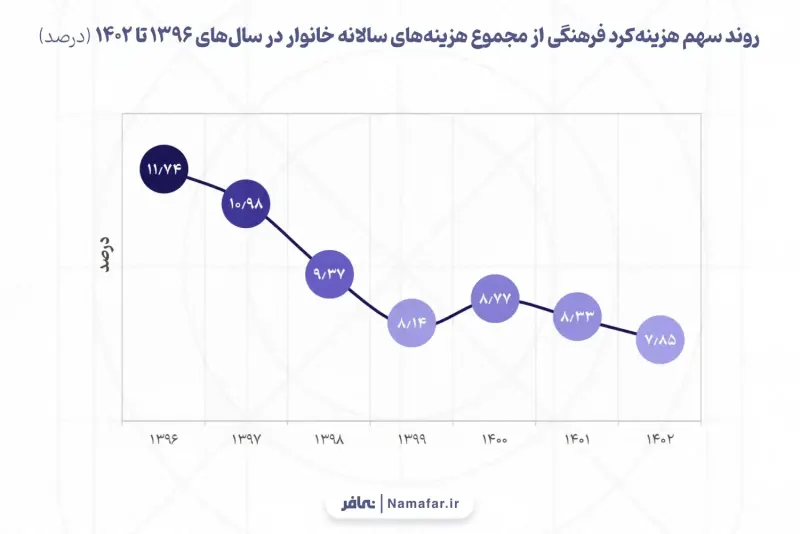
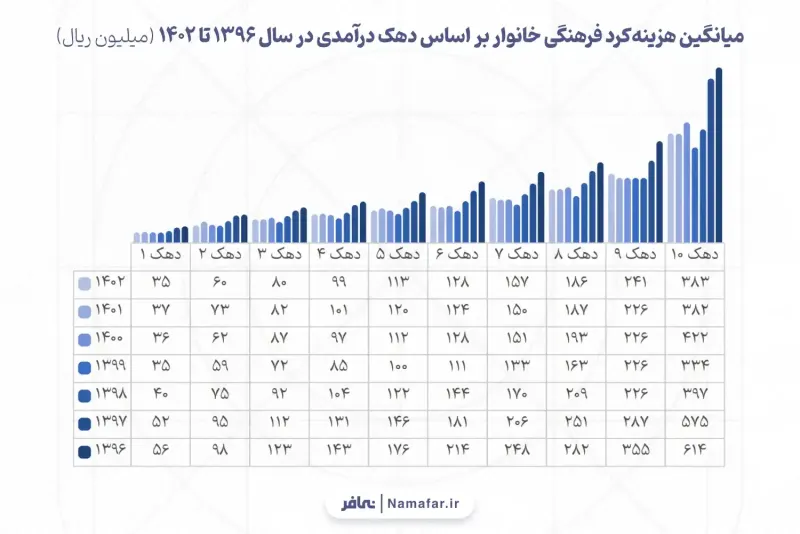
The decline in the share of cultural spending of most deciles in their total spending in 1402 (2023/24) relative to the previous year is evident, with the exception of decile 7, which had a slight increase relative to the previous year. The tenth decile, too, despite a decline relative to last year, has the highest amount of cultural spending as a share of total expenditures compared with the other deciles. In contrast, the first decile, with 5.49 percent, has the smallest share. Another noteworthy point is the trend of average spending of the various income deciles from 1396 (2017/18) to 1402 (2023/24). So that tenth-decile households have had, on an annual average, cultural consumption equivalent to 614 million rials, and in 1402 (2023/24) average cultural consumption of 383 million rials. The average cultural spending of the other income deciles can be seen in the chart below:
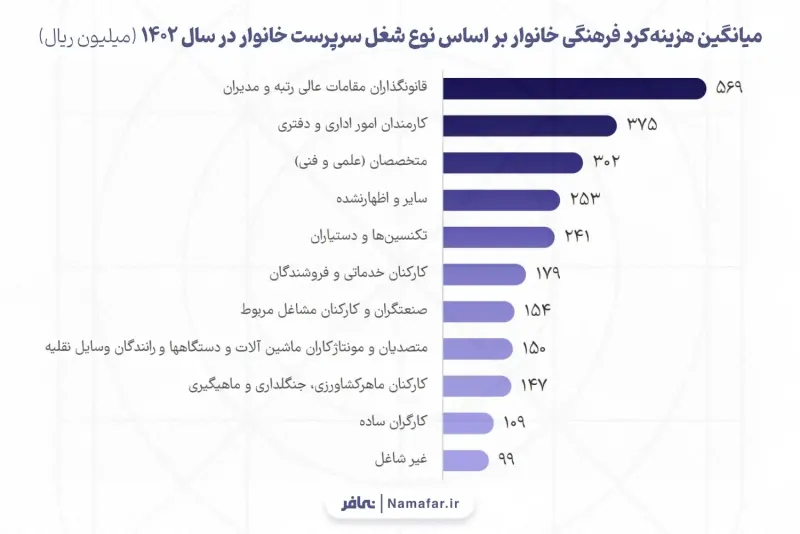
Examining the share of cultural spending on the basis of the household head's type of occupation shows that the student group has the smallest share and households whose head is employed have the largest share. Also, examining the share of cultural spending on the basis of the household head's occupational status shows that the greatest spending in the field of culture belongs to legislators, senior officials, and managers, at 14.51 percent of the household's total annual spending. This group in 1402 (2023/24) spent, on average, 569 million rials in the field of culture.
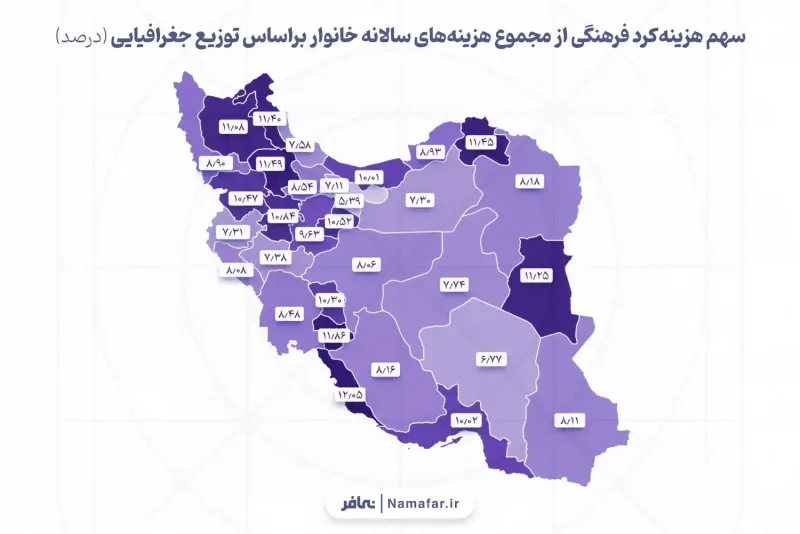
The share of household cultural spending on the basis of geographic distribution shows that the share of the western and southern parts of the country is notable relative to other parts. The most prominent province whose households have the largest share of cultural spending in their total spending is Bushehr Province, at 12.05 percent. Tehran, at 5.39 percent, has the smallest share of cultural spending. However, in terms of total spending, Tehran, with 86 hemt (trillion tomans) spent, ranks first by a wide margin relative to other parts of the country.
Machine-translated from Persian by Namafar; the Persian original is authoritative. Read the original in Persian