Cultural diplomacy, as one of the most important instruments of soft power in the international system, possesses particular capabilities for influencing global perceptions and attitudes. This type of diplomacy today is implemented extensively and with the use of diverse instruments such as art, cinema, online media, and cultural projects.
The BRICS group (Brazil, Russia, India, China, and South Africa), as an emerging economic and political coalition, is trying to play an active and influential role in the international system. This group, by developing cultural diplomacy and using instruments such as cinema and online cultural projects, is trying to present a positive image aligned with its national interests.
The BRICS member countries (Brazil, Russia, India, China, and South Africa), together with the new members (Egypt, Iran, the United Arab Emirates, and Ethiopia), in total account for 37% of global gross domestic product and include nearly half of the world's population.
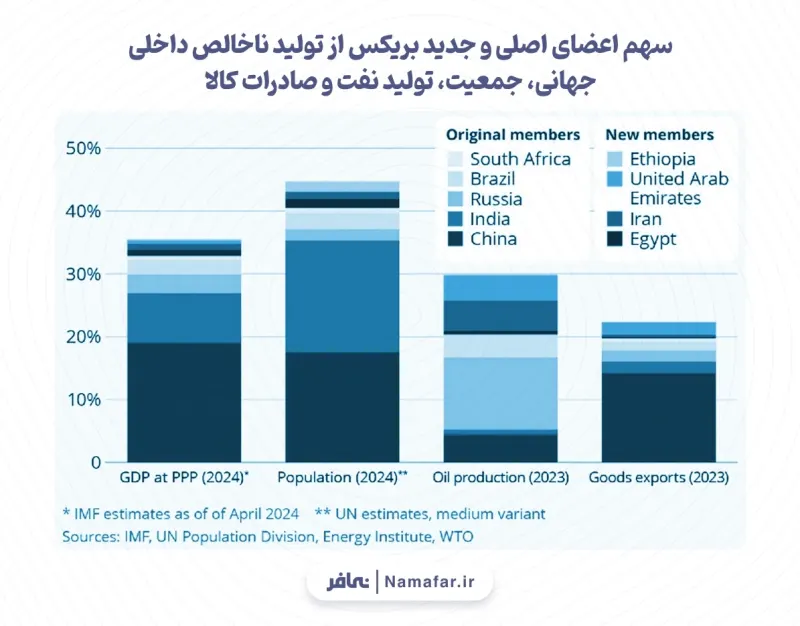
This group, which was initially known as an economic union, now challenges the dominance of Western narratives in cinema and draws on its film industries to introduce national cultures and expand global influence. Each of the BRICS countries has a unique cinema that has been able to attract global audiences and expand its cultural influence.
The strategic role of cinema in the BRICS countries: from Hollywood to the Rainbow Nation
China, with its emergence as a global economic power, has obtained a special place in the film industry and has now become the world's second-largest film market. Forecasts indicate that this country will also overtake the United States in the near future. The rapid growth of China's cinema market has forced Hollywood to include Chinese elements in blockbuster films. Examples such as Transformers: Age of Extinction and The Martian express this influence. China's strategy in the cinema industry is not limited only to hosting Hollywood films, but also includes the purchase of American cinema chains such as AMC and the signing of co-production agreements. These actions have turned China into one of the key players and important producers in global cinema. However, the government's strict control over film content has limited creative freedom and reduced the ability to produce attractive global narratives. For example, films "such as The Founding of a Republic" have been used more as an instrument for domestic national branding than for expanding the international market.
The growth of China's cinema industry has been notable and has even overtaken this country's traditional industries. Experts believe China is on the path to attaining the world's largest film-audience population, and estimates show that this may occur soon. Chinese films earn notable revenues. For example, the American film Avatar has had about 760 million dollars in sales in China. However, China's cinema market is not yet fully saturated, and expanding the screening of films to smaller cities (tier two, three, and four) can increase box office revenue substantially. At present, large cities are fully saturated, and attention to these smaller cities is of particular importance. As a result, film stars now travel to more than 20 cities to promote films and have expanded their advertising from large urban centers to broader regions.
India, too, with its cinema industry, Bollywood, is considered one of the world's largest film producers. This industry produces more than 1,000 films annually and is regarded as the main pillar of India's soft power. Bollywood, by attracting domestic audiences and the extensive Indian diaspora, has acted as a cultural bridge between India and the world. Films such as Ek Tha Tiger represent India's efforts to display its global aspirations while preserving this country's cultural essence. India's cinema, with a decentralized and commercial structure, in addition to attracting extensive domestic audiences, has also been influential in the international arena. However, challenges such as inadequate infrastructure and regional inequalities remain obstacles on the path of this industry's growth. This industry, which produces films in more than 20 different languages, accounts for the largest number of films per year. India's cinema from its early period until independence experienced a notable transformation. The pioneering efforts of individuals such as Dadasaheb Phalke in the silent era laid the foundations of this country's filmmaking.
In the early years, short films or "topicals" served as educational resources and documentation. The emergence of film studios, which served as centers for attracting talented artists and technicians, paved the way for the growth of the filmmaking business. Films of this period often carried undercurrents of patriotism, social reform, support for democracy, and eagerness for independence. India's cinema today still, by using music, dance, and celebrated stars, has preserved its place in the hearts of audiences, while being raised as one of the main pillars of India's soft power on the global stage.
The approach of Russia to soft power through cinema indicates a delicate balance between state control and artistic freedom. For example, the film Leviathan, in addition to critiquing Russian institutions, has sparked important cultural conversations and indicates Russia's high capacity for cultural influence. However, Russia's cultural sector faces challenges such as excessive bureaucracy and the absence of transparent policies. Despite supports such as the "Russian Cinema Fund" for the production of domestic films, the unequal distribution of resources has limited the full exploitation of these capacities.
Russia's cinema industry has growth three times faster than this country's real economy. The development of film screening in Russia has a decentralized structure. Five main cinema chains hold 30 percent of the market, while the remaining 70 percent consists of independent cinemas or small chains in various regions of the country. This diversity indicates extensive opportunities for the growth of the filmmaking industry across Russia.
The cinema of Brazil, although smaller compared with China and India, plays an important role in this country's soft-power strategy. Brazilian films, focusing on subjects such as social justice, identity, and cultural diversity, have been able to attract audiences of the Global South. In addition, Brazilian telenovelas, as one of this country's prominent cultural exports, have strengthened Brazil's place at the global level. The BRICS Film Festival and co-production agreements have also solidified Brazil's position as a cultural leader in the Global South.
Since the mid-1990s, Brazil's film industry has shown striking dynamism. The growth of this industry has mainly been due to the government's supportive policies, which play an important role in the performance of this sector. Film production in Brazil is mostly carried out by small production companies that strive to secure funding to make feature and short films.
Films, similar to the music and literature industries, form an active part of Brazil's cultural economy. Brazil's filmmaking industry includes four main sectors: production, infrastructure, distribution, and exhibition. However, this industry faces challenges such as a long production process, such that producing a film, from the beginning to distribution in cinemas or release in stores, on average takes three years.
Even so, Brazil's cinema has been able, through the production of rich cultural content and the display of its national identity, to play an important role in introducing Brazil to the world and to become one of the pillars of this country's soft power.
The film industry of South Africa reflects this country's identity after apartheid. The concept of the "Rainbow Nation," which emphasizes diversity and inclusion, has found expression in this country's films and indigenous media. Films such as "A Good Report" display the tension between state censorship and creative freedom. However, economic inequality in BRICS has limited South Africa's ability to compete with countries such as China and India. South Africa, at the same time, is an example of dynamic cooperation between civil society and national authorities. This country's policies focus on attracting foreign film productions and promoting local talent.
South Africa's filmmaking industry, with its dynamism and striking growth, is recognized as one of the most competitive cinema industries at the international level. This country, having diverse and unique locations, low production costs, and a favorable exchange rate, has provided an ideal environment for film production that has made it a more attractive destination than Europe or the United States for local and foreign filmmakers.
One of the prominent successes of South African cinema is the science-fiction film District 9 (District 9), which in 2010 was made about a group of aliens in the slums of Johannesburg and was nominated for four Oscars, including Best Picture. This success indicates the ability of South African cinema to produce creative and high-quality content.
Cape Town, with 57 different filming locations, has become one of the main centers of international film production. In addition, the existence of highly skilled film crews and technicians, advanced technical infrastructure, and suitable weather have increased this country's attractiveness for filmmakers, advertising, and other media productions.
Countless opportunities exist in South Africa's filmmaking industry, and given past successes and existing capacities, this country is increasingly becoming an ideal destination for cinema productions.
Opportunities and challenges and the growth outlook of the BRICS cinema industry
The BRICS countries have recognized the potential of their collective cultural initiatives to strengthen global influence. The BRICS Film Festival, launched in 2016, has provided a platform for displaying this group's cinematic diversity. Co-production agreements have created the possibility of sharing resources and access to larger audiences. In addition, China, Russia, and Brazil, by establishing international media networks such as CCTV, RT, and Rede Globo, have displayed their narratives at the global level. The rise of digital platforms has also provided new opportunities for BRICS films, but these countries still must face the challenges of the competitive space of global media.
At the same time, the BRICS countries face numerous challenges. Economic inequality among the members of this group has affected the ability of some countries, such as South Africa and Russia, to invest in film industries. State control over film content in China and Russia has limited these countries' creative potential and hindered the production of attractive global narratives. In addition, Hollywood's dominance in global cinema creates a major challenge for the international distribution of BRICS films.
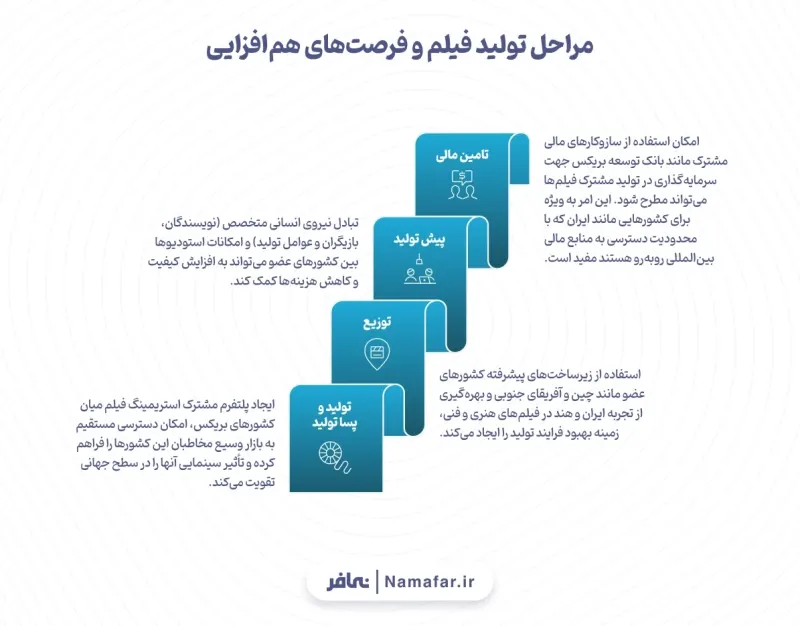
The idea of launching a joint streaming service among the BRICS countries could, drawing inspiration from Netflix but tailored to the strength of these countries' national film industries, be an innovative and global project. This service, because it represents four continents (Europe, Asia, Africa, and South America), could operate in global markets without cultural barriers.
The BRICS countries benefit from professional human resources, outstanding talent, and reputable educational institutions in the film industry, such as the Gerasimov Institute of Cinematography (Russia), the Beijing Film Academy (China), and the Satyajit Ray Film Institute (India). Also, these countries have extensive experience in digital technologies, artificial intelligence, and data analysis, which is vital for the success of streaming media.
The BRICS film market, given population and high consumption of digital content, is becoming the world's largest market. In 2019, China was the second, India the seventh, and Russia the tenth largest theatrical film market in the world. With the expansion of consumers' turn toward digital entertainment, which intensified with the restrictions of the COVID-19 period, immediate access to this vast market creates a competitive advantage for a BRICS streaming service.
The cinema ticket market in the BRICS countries in 2024 is forecast with revenue of about 8.31 billion dollars. It is expected that this market, with a compound annual growth rate of 2.21% (CAGR) in the period 2024 to 2028, will reach a market volume of 9.07 billion dollars in 2028. The number of users, too, by 2028 will reach about 326.5 million people, and average revenue per user (ARPU) is forecast at about 26.72 dollars. In global comparison, the highest revenue in this segment relates to China, with 6.963 billion dollars in 2024. These statistics indicate the sustainable growth of the cinema ticket market in the BRICS countries, which can lead to investment opportunities and the development of the cinema industry in these countries.
Ultimately, by embracing the diversity of cinematic traditions and strengthening collective cooperation, the BRICS countries can offer alternative narratives to overcome the dominance of Western-centered media. Cultural diplomacy, as one of the pillars of soft power, plays a fundamental role in consolidating BRICS's presence in a multipolar world. By developing joint programs and cultural synergy, these countries have a unique opportunity to redefine the global cultural order.
The capacity of Iran and new BRICS members for synergy in the cinema industry
With the addition of Iran, Egypt, the United Arab Emirates, and Ethiopia to the BRICS group, new opportunities for synergy in cinema have emerged. Each of these countries has distinctive capabilities that they can use to play a more active role in BRICS cultural diplomacy.
Iran, with a distinguished historical record in cinema, especially in art and festival films, has very high potential to expand its cultural influence internationally. Iranian cinema is known for prominent directors such as Abbas Kiarostami, Asghar Farhadi, and Majid Majidi, who have won major global awards including Oscars, Cannes, and Berlin. Films such as "A Separation," "The Salesman," "Children of Heaven," and "A Separation" are successful examples of Iranian cinema that have gained global prominence and drawn international audiences' attention to Iranian culture and values.
On the other hand, with its ethnic and cultural diversity and unique capacities in historical tourism sites and attractions, Iran can be an attractive destination for co-producing films with other BRICS member countries. Iran also benefits from reputable cinema education centers such as the Iranian National School of Cinema and Tehran University of Art, which can provide a suitable platform for transferring technical knowledge, exchanging talent, and co-producing cinematic works.
Despite these capacities, Iran's cinema industry still faces challenges such as limited access to global markets due to sanctions, as well as weak digital infrastructure for international distribution. To fully use the potential for synergy with BRICS countries, policies such as strengthening digital infrastructure, developing co-production, creating alternative financial mechanisms, and facilitating cultural exchanges need to be placed on the agenda.
Countries such as the United Arab Emirates, with the rapid development of media infrastructure and international cultural-artistic events such as the Dubai Film Festival, have also become an important hub for cinematic production, distribution, and marketing in the Middle East. Egypt, with a rich history in Arab-world cinema, has the potential to establish joint cooperation in producing and distributing films centered on the shared culture and history of countries in the region. On the other hand, Ethiopia, as a representative of Africa, can create a valuable opportunity to produce films focused on African identity and the socio-cultural issues of that continent.
Given the broad geographic and cultural diversity of the new members, expanding cinematic cooperation between Iran and these countries can lead to the production of unique works with inclusive, global themes that, while better representing each country's national culture, also succeed in global markets.
Given Iran's strategic position and existing cultural capacities, BRICS can provide a suitable platform for the growth and advancement of the country's cultural industries. One of the most important advantages of BRICS membership is access to the large and diverse markets of member countries. Countries such as China and India, with populations in the billions, have high demand for cultural products, and this can create new opportunities for Iran's cultural producers. Handicrafts, music, cinema, and Persian literature are among the fields that can receive particular attention in BRICS markets. Cultural diversity and growing demand for unique cultural products create favorable conditions for introducing and offering Iranian productions.
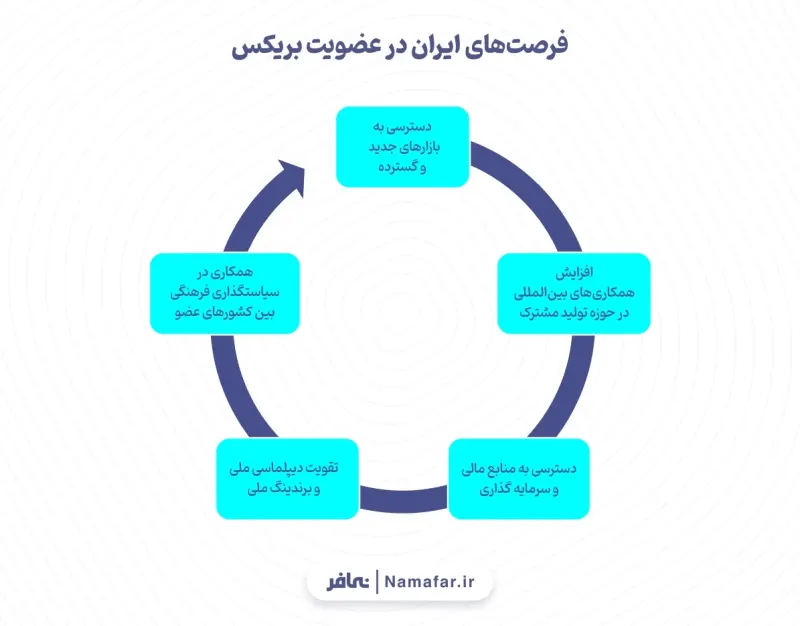
In addition to access to new markets, Iran's membership in BRICS can pave the way for joint cooperation in cultural productions. Co-producing films, series, animation, and video games using the artistic and technological capacities of member countries can lead to higher quality of domestic productions and their competitiveness at the global level. Joint cultural cooperation also brings the possibility of knowledge transfer, exchange of experience, and the creation of extensive networks for producing and distributing cultural products.
Another advantage of this membership is access to financial resources and attracting foreign investment in culture and the arts. The BRICS Development Bank (NDB), established to support member countries' economic and cultural projects, can make a substantial contribution to financing Iran's cultural projects. These financial resources can be used to develop cultural infrastructure such as building cultural centers, creating international exhibitions, and supporting digital content projects. Joint investment in cultural projects can also lead to new job opportunities and the flourishing of a culture-based economy.
Alongside these opportunities, BRICS membership also brings challenges that must be considered. One of the main challenges is competition with member countries in cultural industries. Countries such as China and India, which have powerful and advanced cultural industries, can emerge as serious competitors for Iran. For this reason, Iran must preserve its competitive advantage by focusing on its unique cultural characteristics and developing a national brand internationally. In addition, linguistic and cultural differences between Iran and member countries can be an obstacle to cultural exchanges, which must be addressed through appropriate strategies such as localizing content and creating effective communication channels.
Another important challenge is weak digital infrastructure and inadequate access to international platforms. In today's world, where the distribution of cultural content takes place mainly through digital channels, Iran needs to develop digital infrastructure and create dedicated platforms to introduce and sell its cultural products in BRICS markets. Investment in new technologies and the development of cultural digital businesses can play a key role in Iran's success in this area.
On the other hand, economic sanctions and restrictions on banking transactions are another challenge that can have a negative impact on Iran's cultural interactions within the BRICS framework. To counter these restrictions, using local currencies, bilateral trade agreements, and employing new solutions such as cryptocurrencies can be helpful.
Ultimately, Iran's membership in BRICS can be used as an effective tool to strengthen cultural diplomacy and create a positive image of Iran at the international level. Holding joint cultural exhibitions, film and music festivals, and developing educational and research cooperation with universities and cultural centers in member countries are among the measures that can help strengthen cultural relations and better introduce Iranian culture.
Overall, Iran's membership in the BRICS group provides extensive opportunities for the development of cultural industries. But taking advantage of these opportunities requires precise planning, development of cultural and digital infrastructure, and the adoption of intelligent strategies in international interactions. If managed properly, this membership can lead to the sustainable growth of Iran's cultural industries and their active presence in global markets.
Machine-translated from Persian by Namafar; the Persian original is authoritative. Read the original in Persian