Iran from the beginning of 2024 has become a full member of the BRICS group. Some have called permanent membership in this group a history-making advance and a strategic success for the Islamic Republic's foreign policy. But what advantages and opportunities does Iran's membership in the BRICS group place at this country's disposal? Answering this question requires studying the nature, the aims of BRICS and its capacities. The main question of this article is this: what capacities does BRICS provide for cooperation in the field of cultural and creative industries? In this article, by examining these capacities, we set out an approach that can make a notable contribution to the development of cooperation in the field of cultural and creative industries.
On the basis of this approach, it is recommended that the axis of joint activities and cooperation be around activities that have economic benefits. At first we address the nature of the BRICS group, its aims and its overall capacities. Then, by putting forward an economy-centered approach, we will examine the capacities for cooperation with BRICS members in the field of cultural and creative industries. Tourism, the film and music industry, handicrafts, the book publishing and printing industry, the toy industry, the food and cuisine industries, and cultural heritage are among the arenas of the cultural and creative industries for which numerous capacities exist for developing them in the BRICS framework
What is BRICS?
In 2001, Jim O'Neill, a British economist from the Goldman Sachs institute, put forward the idea of the formation of a group of emerging economic countries including Brazil, Russia, India and China, and used the title "BRIC" (the first letter of these countries' names) for it. For the first time, the foreign ministers of these countries met on the sidelines of the United Nations General Assembly in 2006, and the first official summit of the heads of these countries was held in 2009 in Russia. On 16 June 2009 the "BRIC group" was officially established, and with the addition of South Africa in 2010 its name changed from "BRIC" to "BRICS". Over this period, other countries also applied for membership in the BRICS group, and at the summit of the heads of this group in 2023 agreement was given to the joining of 6 countries — Argentina, Ethiopia, the United Arab Emirates, Iran, Saudi Arabia and Egypt — to BRICS. From 2024, with Argentina's withdrawal from joining this group, the number of BRICS members reached 10 countries.What are the aims of BRICS?
The focus of BRICS members is on economic and commercial subjects such as methods of improving the economic situation and reforming the world's financial system. The main aim of these countries in BRICS is establishing close monetary and commercial relations with one another and playing a more effective and greater role in the world's economic affairs. In their view, reforms must take place in the world's financial system so that it becomes an efficient, reliable and stable system. Also some BRICS member countries are critics of the dominance of the dollar in the prevailing currency system and have put forward the creation of a common currency as one of the aims of BRICS. Alongside these macro aims, economic subjects such as banking affairs, energy, transport, telecommunications, and social and labor subjects are also of interest to this group.The capacities of BRICS
The core members of the BRICS group are recognized as global emerging economies and in recent years and coming years play a key role in the world economy. The International Monetary Fund in 2023 estimated world GDP on a purchasing-power-parity basis at 174.47 trillion dollars. The five countries of Brazil, Russia, India, China and South Africa in 1995 held only 16.9 percent of world GDP on a purchasing-power-parity basis. But this share, in 2010 and after the formation of the BRICS group, increased to 26.6 percent, and in 2023 to 32.2 percent. In contrast, the G7's share of world GDP over this same period has decreased from 44.9 percent to 29.9 percent. The total GDP of the G7 in 2023 has been announced at about 52.16 trillion dollars, while the GDP of the five current BRICS members is 56 trillion dollars (Chart one).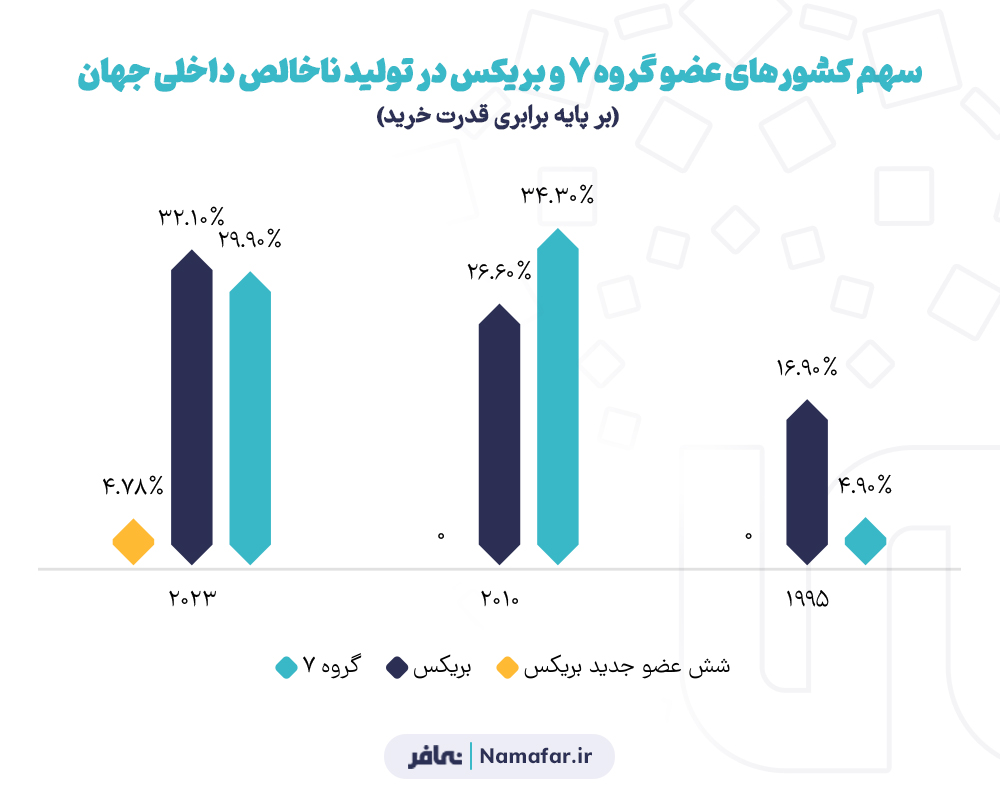
Although these statistics by themselves speak of the advantage of cooperation with these economic powers, if we follow their key role in the global economy through 2050 no doubt remains as to the economic role of BRICS in the present and future equations of the global economy.
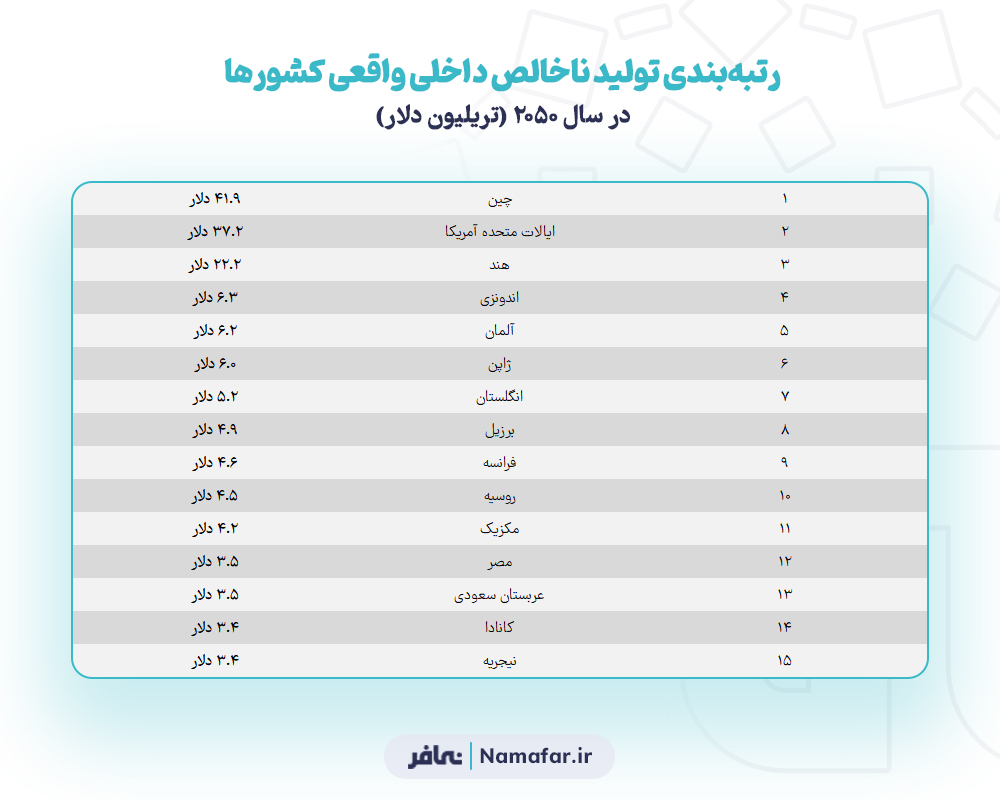
Table 1 shows the ranking of countries' real GDP in 2050. 6 countries from among BRICS members are present among the 15 top global economies, and China will have first rank and India third rank. Table 2 also shows the amount of GDP of BRICS members separately.
Among the advantages of membership in BRICS, especially for Iran which is confronting Western economic sanctions, is the financial structure of BRICS, which has two parts: the "New Development Bank" (New Development Bank) and the "Contingent Reserve Arrangement" (Contingent Reserve Arrangement). The bank of the BRICS member countries has a payment-notification system for member countries that can be a substitute for SWIFT (the Society for Worldwide Interbank Financial Telecommunication).
Among the other advantages of BRICS is the possibility of creating a single currency among the members of this group, which can put an end to the dominance of the dollar in the global economy. Even so, according to Russia's deputy foreign minister, the realization of a single currency is not something that is attainable in the near future, and the member countries of the BRICS group must move gradually on this path.
The BRICS Development Bank
The members of the BRICS group in March 2013 agreed to found the BRICS Development Bank. This bank was created operationally in 2015. Its main focus is in the loan and infrastructure-project financing sector, and in this sector it has a general financing authorization of up to 34 billion dollars annually. This BRICS group bank was established with initial capital of 50 billion dollars, which was to increase over time to 100 billion dollars. In 2020 the BRICS Development Bank had 53 projects with an approximate value of 15 billion dollars under review. In 2021, Uruguay, the United Arab Emirates, Bangladesh and Egypt were accepted as new members of the new BRICS development bank. Talks for Iran's joining the BRICS Development Bank began in 2017, and with Iran's membership in BRICS these negotiations are to be accelerated.The Contingent Reserve Arrangement
The Contingent Reserve Arrangement is a framework that BRICS member countries have adopted to protect themselves against global liquidity pressures. This protection, alongside its other functions, also covers currency pressures that other parts of the world economy exert on the national currencies of BRICS member countries. Observers generally regard this Contingent Reserve Arrangement as a rival to the International Monetary Fund (IMF) and, alongside the BRICS New Development Bank, consider it a symbol of growing South-South cooperation.Benefits of BRICS membership for the cultural and creative industries
Before examining the advantages of joining BRICS for the cultural and creative industries of member countries, several points must be noted. First, BRICS members focus on economic and commercial cooperation, and their attention is directed toward macroeconomic issues, including infrastructure. Because some classify the creative and cultural industries among cultural activities, these industries may not be among their work priorities unless their economic and commercial benefits become clear to policymakers. On this basis, for cooperation in the cultural and creative industries one must keep an eye on the economic gains of the activities. Historical experience has shown that in international negotiations agreement on economic activities is easier, and after economic cooperation takes shape, cooperation among members of an international organization can also spill over into cultural and political domains. Accordingly, our focus in this article is on BRICS's economy-oriented capacities in the cultural and creative industries.Second, some experts in the technology field classify the activity of knowledge-based companies and startups among the creative industries. Given that the ground for international cooperation in this field is already in place and a shared discourse exists, there is little felt need for discourse-building in this area. In fact, there is considerable capacity for cooperation on technology through government institutions, universities, technology parks, and the private sector. However, international cooperation in some areas of the cultural and creative industries requires discourse-building and groundwork. For this reason, this article has focused on areas such as tourism, cultural heritage, handicrafts, the cinema industry, music, publishing, the performing arts, food, and so on.
The advantage of BRICS membership for tourism
The principal BRICS capacity in the cultural and creative industries is tourism. Because the tourism industry is the most economic industry among the cultural and creative industries, and it has been and continues to be emphasized at various BRICS summits. Tourism, as an export group, ranks third worldwide after chemicals and fuels and ahead of automotive products and foodstuffs, and in some developing countries it is the top export group. Furthermore, tourism has a direct or indirect link with other cultural and creative industries, including cultural heritage, food and cuisine, handicrafts, clothing, media and advertising, music, cinema, the performing arts, and so on. A tourist who enters a country, besides needing accommodation and transport facilities, needs food and is interested in getting to know the host country's cultural heritage. They buy traditional clothing or handicrafts as a keepsake or souvenir, and if an arts festival is being held in the host country they tend to attend it.With all this, what capacity does BRICS membership create for tourism? First, nearly 40 percent of the world's population lives in BRICS member countries. Most of these countries, including China, India, Iran, and Egypt, have an ancient civilization and valuable cultural heritage, and with abundant tourist attractions they welcome many tourists. The level of general welfare in these countries rises year by year, and people will have greater financial means for foreign travel.
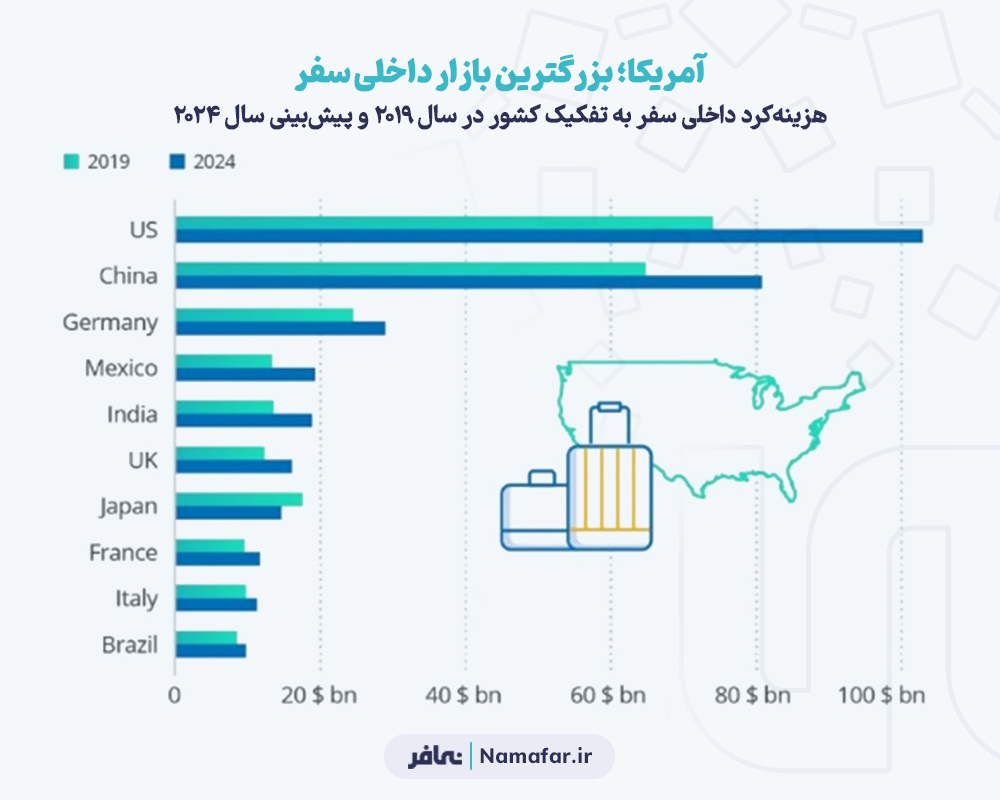
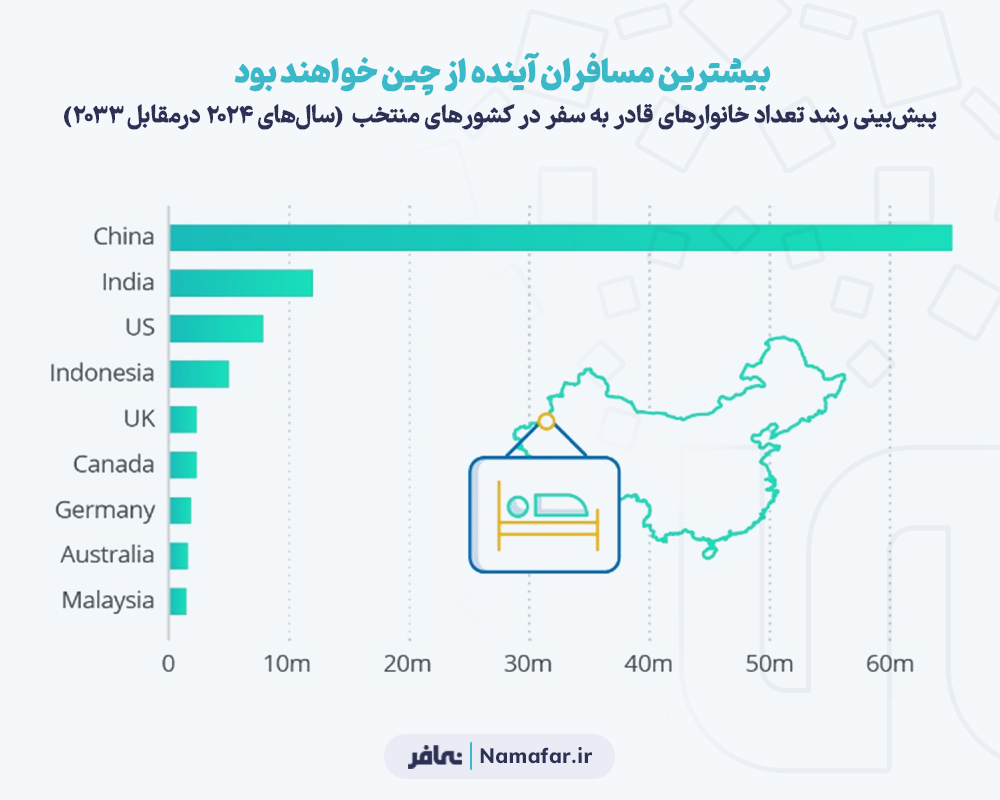
Chart 2 shows the world's top 10 domestic travel markets, of which China, India, and Brazil are among these 10 countries, and it points to the capacity of these countries' people for foreign travel in the future. Within the next 10 years, Chinese families (more than 60 million families) and Indian families (more than 10 million families) with annual incomes of more than 35 thousand dollars will have the ability to travel abroad (Chart 3). This growth will also occur in other BRICS countries and is a valuable opportunity to attract these tourists.
On the other hand, BRICS members such as China and the UAE have sufficient experience in tourism infrastructure, or, like Saudi Arabia, have launched a redoubled campaign to attract foreign tourists. These countries are also prepared to invest in the tourism infrastructure of BRICS member countries, and through the group's mechanisms, such as the BRICS New Development Bank, they can be invited to cooperate and invest. Moreover, the country's experience in tourism and related fields can be placed at the disposal of these countries, and through joint investment, capable Iranian companies can be sent to other member countries to cooperate on joint projects.
China is making a serious effort to build and develop a passenger aircraft industry and break the Boeing and Airbus monopoly, in which case Iran could equip its air fleet, and this would be possible within the BRICS framework.
Defining joint activities in this field is of considerable importance, through which other cultural and creative industries can be linked to tourism and help can also be given to the development and growth of these industries and to international cooperation in those areas. Holding joint and permanent exhibitions in each BRICS member country is one of the effective measures for marketing and offering products and services, which also greatly helps private-sector tourism practitioners become familiar with the capacities of the BRICS group.
BRICS capacities for cultural heritage
China, Egypt, and India, alongside Iran, are regarded as among the world's ancient civilizations and have extensive experience in the field of cultural heritage. Cooperation in the protection, conservation, and restoration of ancient monuments, scholarly exchanges and cooperation in archaeology and museology, holding joint academic conferences, and joint exhibitions to display cultural works in BRICS member countries so that the people of those countries become familiar with the culture of other BRICS members, are possible.Tour operations in BRICS member countries
One of the capacities for cooperation is offering joint services to tourists. Holding long-term, staged joint tourism tours can be one of these services. For example, tourists on a tourism tour would have the chance to visit several or all BRICS members. Or diverse tours held in several stages would be offered to tourists. Establishing branches of tourism agencies in BRICS countries, and establishing joint tourism offices that provide tourism services to the people of BRICS members and other countries, is another of the measures that can be taken in this field.Handicrafts and carpets
Most BRICS countries have a hand in handicrafts, which provides the ground for cooperation in this field. Holding permanent joint exhibitions in each BRICS member country, offering products at these exhibitions, eliminating tariffs, and so on, are among the measures that can be taken in this regard. This helps tourists who come to one of the BRICS member countries also become familiar with the culture of the other BRICS countries and becomes advertising for those countries.The impact of media and social networks
The role of the media in awareness-raising and marketing is unrivaled. Alongside official media such as television and radio networks, news agencies, and the press, social networks have a high capacity for marketing and informing about the cultural and creative industries. Cooperation in producing joint programs, providing the ground for the presence of professional media teams and also influencers to produce promotional programs for the tourism industry, are among the capacities that BRICS members can agree on.Benefits of BRICS membership for the food industries
The food and cuisine industry is another of BRICS's capacities for the cultural and creative industries. If we look at the food industries with an economic approach, many capacities can be listed for it. Even so, if it is looked at from the angle of the cultural and creative industries, it also includes small and micro businesses such as small producers of local and homemade food products, restaurants, street food, and so on. One of the benefits of joining the BRICS group in the country's food industries is the distribution of the value chain. This action can also take place in connection with the cultural and creative industries. For example, introducing the food products and cuisine of different countries and cultures at permanent tourism exhibitions, establishing permanent restaurants in BRICS member countries, holding permanent food exhibitions and inviting chain restaurants, and even establishing a chain restaurant in all member countries to offer the foods of the BRICS countries, are of this kind.Strengthening cultural centers through membership in the BRICS group
It is customary that a country, alongside its embassy in other countries which pursues political, consular, and economic matters, has on its agenda the establishment of cultural centers in other countries for cultural activities. Even so, developing these cultural centers, or even establishing BRICS cultural centers, can lead to the strengthening of multilateral cultural cooperation. In these centers, facilities can be provided for teaching the languages of BRICS member countries, introducing their culture, inviting cultural and artistic elites, screening films, performing music and the performing arts, exhibitions of handicrafts, visual arts, and so on.The impact of BRICS membership on the cinema and music industries
The two industries of music and cinema, which in a sense link the cultural and creative industries to the economy, also provide suitable capacities for joint cooperation to artists and practitioners in these two fields. Making co-productions among BRICS members makes it possible to screen films in the group's member countries and places a large market at the disposal of BRICS filmmakers. Holding a BRICS cinema festival can also be a venue for introducing and offering works and marketing the films of member countries. Dedicating a section to BRICS cinema at the international festivals of member countries is another way to develop international cooperation in this field.With all this, what place does cinema have in BRICS member countries?
India's Bollywood cinema produces the largest number of films in the world each year. In 2015 Bollywood filmmakers made 1,907 feature films. India's cinema gross revenue (1.2 billion dollars) may seem negligible compared with Hollywood's gross revenue (11 billion dollars), but this industry grew by an average of 5.1 percent through 2020 and over two years also saw a 10 percent annual growth rate. On the other hand, Indians, with that population of 1 billion and 400 million, are clearly among the first three countries that buy cinema tickets. China is in first place and Russia is in fourth place (Chart 4), and this points to the existence of a potential market for the cinema of BRICS countries.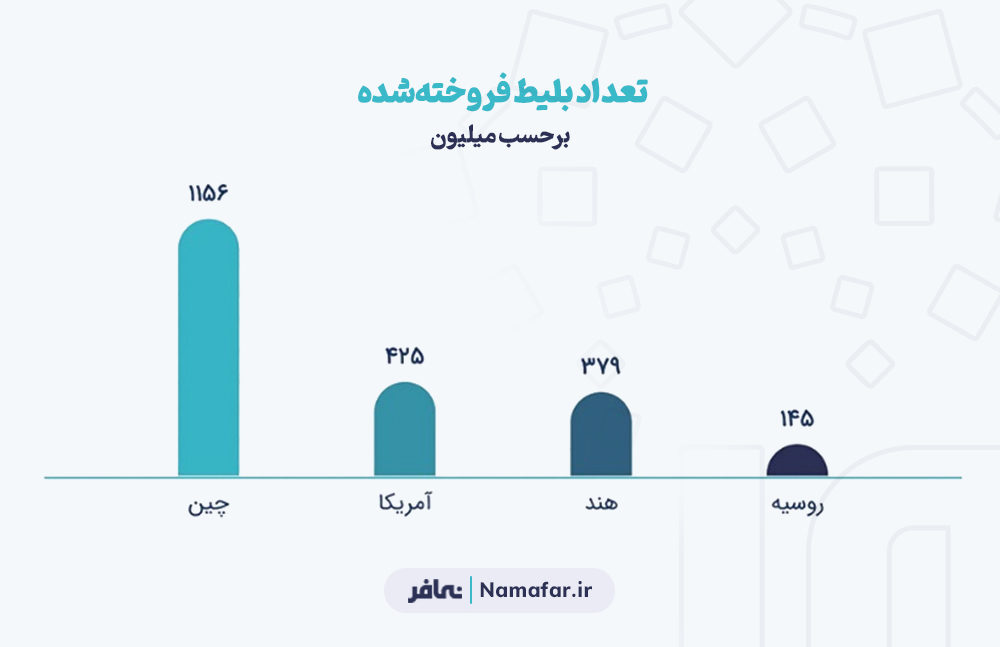
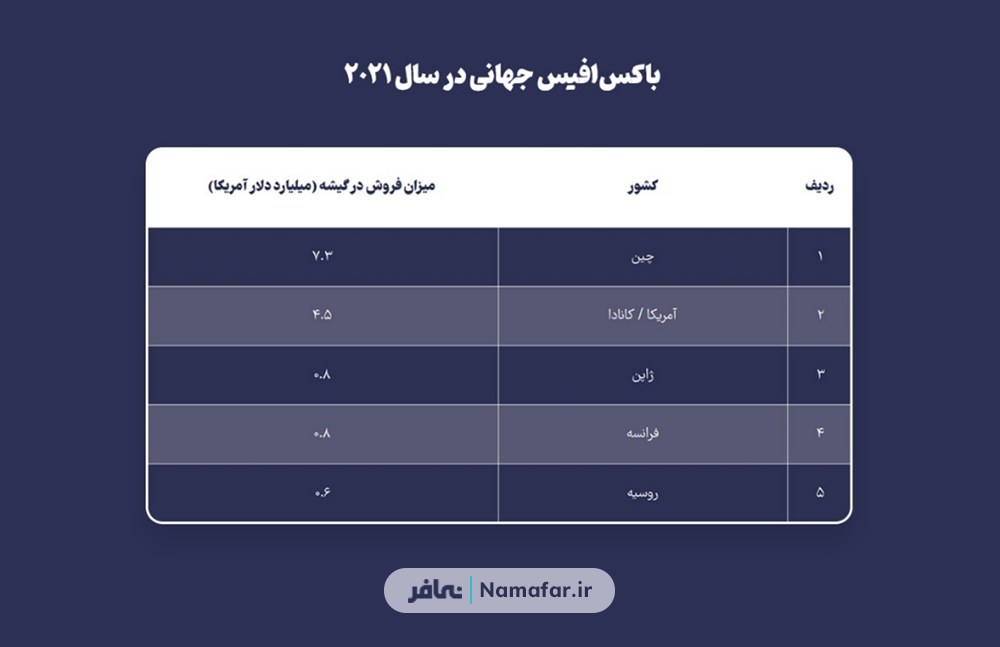
The Chinese share of the global box office rose from 7.9 percent in 2012 to 34.3 percent in 2021. With 7.3 billion dollars in revenue that year, they stood at the top, 2.8 billion dollars ahead of the United States (Table 3). On the other hand, the Chinese as a BRICS member are also prolific in the filmmaking industry, and in 2018, by producing 1,082 films, they set a new record.
Saudi Arabia's investment in the cinema industry
Saudi Arabia has also made a large investment in cinema. Increasing cinema halls, screening current world cinema works, holding the Red Sea Film Festival in Saudi Arabia with the presence of well-known films and filmmakers from around the world, and creating incentives for shooting cinematic works on Saudi soil are among the Saudis' programs to strengthen Saudi cinema. The Saudis intend to build about 350 cinema complexes in the country by 2030. These exhibition facilities will comprise more than 2,500 halls, and about one billion dollars in revenue is to be obtained annually through their activities. Investing in and participating in the production of foreign films, and also inviting foreign filmmakers to make films in Saudi Arabia, are among their other actions in this direction. Such that they are prepared to cover 40 percent of the costs of films made in this country, and they have also provided suitable technical facilities for filmmakers. Such an opportunity is rare for BRICS cinema. Filming of part of the film "Dunki," directed by Rajkumar Hirani and starring Shah Rukh Khan, the prominent Indian actor, was carried out in Saudi Arabia.Music also provides considerable capacity for international cooperation. Facilitating and providing facilities for holding joint concerts and performing joint music tours in BRICS countries and other countries (a BRICS music tour), alongside holding music festivals, is a valuable opportunity for artists from BRICS members.
BRICS's role in the toy industry
China, with 80 percent, is by volume the world's largest toy producer. This figure is so large that it leaves no room for competition. Even so, this capacity of China's is a valuable opportunity for cooperation. China delivers cheap production of the product, and this enables other countries to cooperate with this world giant that is a BRICS member in other parts of the toy products value chain, including design. The toy market in recent years has continually seen growth, and it is expected to increase from 122.9 billion dollars in 2022 to 183.15 billion dollars by 2030. BRICS members, if they cooperate in this field by reducing or eliminating tariffs and distributing the value chain across their countries at the stages of investment, design, raw materials, production, marketing, sales, and services, can take a larger share of this global toy industry market.The publishing industry in BRICS member countries
The book publishing industry is the sixty-fourth largest industry and the thirty-second manufacturing industry in the world. In 2023 the United States accounted for about 24 percent of total global sales of the publishing and book industry. After it come China with 19 percent, Germany with 9 percent, Japan with 8 percent, and India with 5 percent. In fact, China, with 329 million readers, had the most book readers in 2022. As artificial intelligence technology advances further, the possibility of offering books in other languages will become easier, and if BRICS countries focus on developing e-books, their publishing industry will have access to a wider market. In 2023, of the 82.3 billion dollar book industry market, 68.1 billion dollars belonged to print books and 14.2 billion dollars to e-books.Benefits of membership in the BRICS group for small and micro businesses
Because the nature of some small and micro businesses is of the cultural and creative industries type, BRICS has a high capacity for the international linking of these businesses. For example, in the food and cuisine industry, clothing, handicrafts, and so on, developing institutions and sectors in BRICS members that are directly or indirectly related to these businesses also in a sense helps the growth of the cultural and creative industries. One of these sectors, formed at Russia's suggestion, is the BRICS Women's Business Alliance. This alliance has on its agenda the launch of a project that is a digital working framework that unites women from 10 BRICS countries in the field of trade and the economy and includes information on joint projects, databases, and companies run by women. Content and training courses, articles, research findings, surveys, and information on the activities of working groups of women active in trade in BRICS countries will be gathered in this project.Conclusion
The Islamic Republic of Iran is under the West's unjust sanctions led by the United States, and in these conditions Iran's joining BRICS can hold many capacities for the country. A financial system independent of SWIFT, a common currency, and issues of this kind provide an opportunity for cooperation with diverse countries and open the doors of numerous markets for Iran's economy for trade and attracting foreign investors. Even so, it should not be forgotten that the goals of BRICS members are to diversify their economic relations while preserving their relations with the West. On this basis, Iran's expectations of BRICS should be realistic, and it is better to focus on shared economic subjects on which there is less sensitivity. The cultural and creative industries are the most suitable of these subjects. Great powers usually seek to impose what is particular to themselves in international and regional organizations. Iran's role becomes prominent at these junctures, when by focusing on commonalities and winning the agreement of other BRICS members it can provide the arena for cooperation.The idea that Iran's membership in BRICS is a possibility for more exports and a change in the trade balance in the country's favor will not be a way forward. Today's world is a world of interdependence, and most BRICS countries are aware of this. On this basis, the country's doors should be opened to other members and emphasis placed on distributing the value chain across BRICS member countries so that a firm and comprehensive bond takes shape among BRICS members.
Using the resources of the BRICS development bank to invest in Iran's heavy industries may be difficult, but investing with these resources in the country's cultural and creative industries will face fewer obstacles. BRICS member countries—the Chinese, the Saudis, the Emiratis, and even the Russians—have considerable capacity to invest in Iran's tourism industry. Developing hotels, Chinese, Indian, Arab, Brazilian, and African restaurants, reducing and eliminating tariffs and eliminating visas and fees, establishing permanent exhibitions of BRICS countries in the capital and tourist cities, and also encouraging and providing facilities to Iranian tourists for travel to BRICS countries are among the measures that, with an interdependence approach and within the BRICS framework, can be achieved.
Efforts to eliminate tariffs on artistic and cultural goods such as books, films, series, and especially handicrafts and carpets are among the policies that the Islamic Republic of Iran can pursue within the framework of Iran's membership in the BRICS group.
Sources:
Amirsiafi, Ali. The cinema industry in China. Namafar. 18 Mordad (July–August) 1402 (2023/24). B2n.ir/a12524Amirsiafi, Ali. A review of India's cinema industry; Bollywood in the galaxy of the seventh art. Namafar . 26 Farvardin (March–April) 1402 (2023/24). B2n.ir/w24516
Entezari, Komeil. Saudi Arabia's successful effort at nation branding through cinema. Sharif University of Technology Policy Research Institute. B2n.ir/r62573
IRNA (Islamic Republic News Agency), Iran officially became a member of "BRICS", 2 Shahrivar (August–September) 1402 (2023/24), https://irna.ir/xjNgXb
IRNA, Russia is pursuing a plan for a women's business alliance of 10 BRICS countries, 27 Bahman (January–February) 1402 (2023/24), https://irna.ir/xjPNLy
IRNA, Iran is ready to accelerate talks on joining the BRICS bank, 4 Shahrivar 1402 (2023/24), https://irna.ir/xjNhz8
ISNA. 80 percent of the world's toy production is in China; we can become the regional hub. 16 Farvardin 1401 (2022/23), isna.ir/xdLpgn
Veysi, Arsalan. An analytical look at the global book industry market. Namafar. 1 Azar (November–December) 1402 (2023/24). B2n.ir/a20109
Euronews, Three decades of economic competition with the G7; how much do new members including Iran increase BRICS GDP?, 24 August 2023, https://parsi.euronews.com/2023/08/24/brics-nations-still-trail-g7-in-per-capita-gdp
The Insight Partners. 2023. “Kids Toys Market Worth to Reach $183.15Bn Globally by 2030”. https://www.globenewswire.com/news-release/2023/11/08/2776139/0/en/Kids-Toys-Market-Worth-to-Reach-183-15Bn-Globally-by-2030-Exclusive-Report-by-The-Insight-Partners.html
Visual Capitalist, Ranked: The Top Economies in the World (1980‒2075), 21 July 2023, https://www.visualcapitalist.com/top-economies-in-the-world-1980-2075/
Machine-translated from Persian by Namafar; the Persian original is authoritative. Read the original in Persian