Iranian cinema and the opportunity of the growing Saudi and regional market
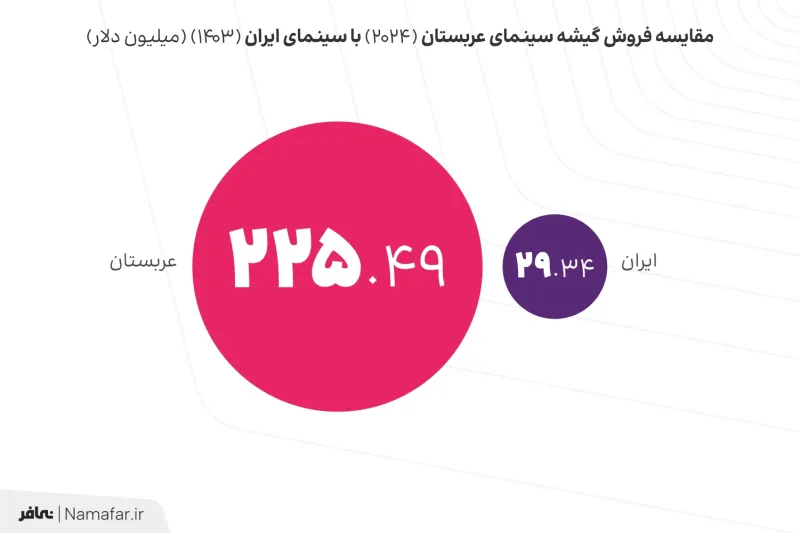
In 2024, Saudi cinema achieved sales that are almost 8 times Iran's total cinema sales in 1403 (2024/25). This striking figure (about 225 million dollars versus 29 million dollars) is at once a warning bell and a serious opportunity for Iranian cinema, because on the one hand it shows that a regional market in Iran's neighborhood is growing and flourishing rapidly, while the economic capacity of Iran's domestic cinema has remained severely low because of structural constraints and a sole focus on the domestic market. On the other hand, this is also evidence of the enormous capacity of regional markets for Iranian cinematic products. Saudi Arabia, with extensive investment in creating modern halls, attracting diverse international films, and a higher ticket price (about 14 dollars versus less than 1 dollar in Iran), has been able in a short time to become a serious market in Middle Eastern cinema. This transformation points to a strategic necessity: for growth and to benefit from this regional boom, Iranian cinema has no choice but an active presence in international markets—especially the region's growing market.
Nascent Saudi cinema versus Iran's long-established cinema!
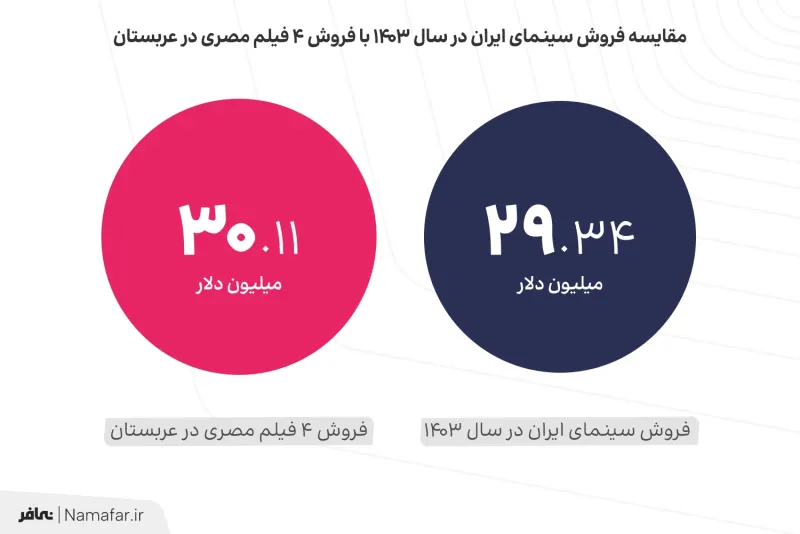
On 18 April 2018, when the first cinema hall opened in Riyadh, few would have thought that the "Saudi Film Commission" in 2024—in its annual report—would announce 225,49 million dollars in box office revenue for Saudi cinema. But respect for the intellectual property rights of international films, alongside extensive efforts to produce domestic films, was able to draw 17,5 million admissions to Saudi cinema halls. On the other side, Iranian cinema, with a history and pedigree of more than a century, has taken a different path in recent decades. The absence and lack of respect for the intellectual property rights of international films has confined Iranian cinema to domestic films. Iran's cinema box office in 1403 (2024/25) was 19,951,144, 982,000 (one billion and nine hundred ninety-five billion tomans). Given the average dollar price (68 thousand tomans) in 1403 (2024/25), Iran's cinema box office was 29.34 million dollars. Simply put, the box office and sales of Saudi cinema were almost 8 times the box office of Iranian cinema.
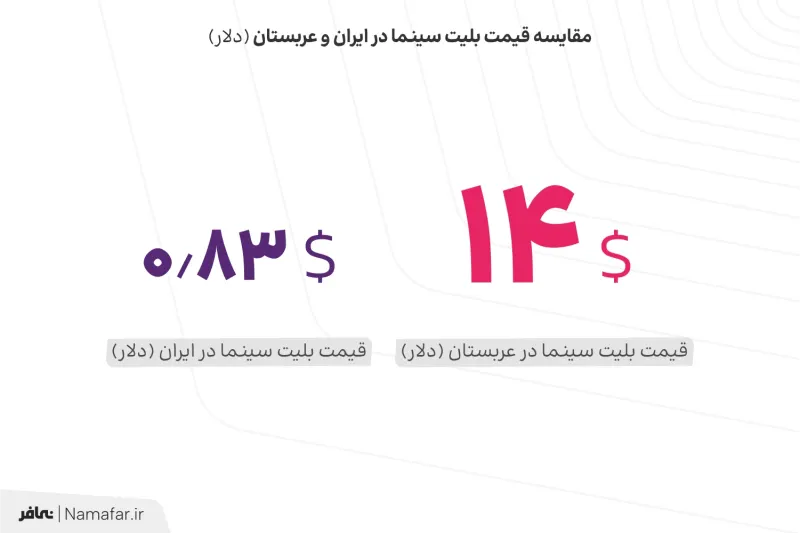
Cinema ticket prices in Saudi Arabia: 17 times cinema ticket prices in Iran
This is while the number of cinema admissions in Iran is 2 times that of Saudi cinema, and the difference in ticket prices has determined the difference in the size of the two countries' cinema box office. Iranian cinema in 1403 (2024/25) had more than 35 million admissions. Also, the average cinema ticket price in Iran in 1403 (2024/25) was 0.83 dollars (56,8 thousand tomans). This is while the number of admissions at Saudi cinemas was 17.5 million people and the average cinema ticket price in Saudi Arabia was 14 dollars. Therefore the cinema ticket price in Saudi Arabia is about 17 times a cinema ticket in Iran.
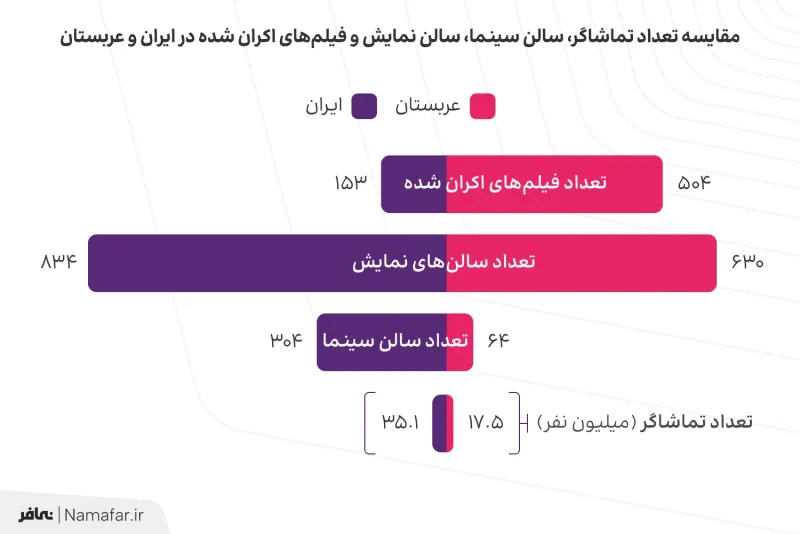
An examination of the two countries' cinema infrastructure indicates considerable growth in Saudi Arabia's infrastructure indicators relative to Iran over a short period (the past 6 years). On this basis, there are 304 cinema venues and 834 screens in Iran, while Saudi Arabia, in only the past 6 years, has provided 64 cinema venues and 634 screens. Also, in 2024, 534 films were screened in Saudi Arabia and the number of films screened in Iranian cinema was 153 films (Iranian, foreign, and Art and Experience films).
Saudi cinema: host of international films
A look at films screened in Saudi Arabia broken down into domestic films (made in Saudi Arabia) and foreign (international) films shows that of the 534 films screened in 2024, only 17 films were produced in Saudi Arabia and the remaining 517 films were international films produced in foreign countries. According to the 2024 "Saudi Film Commission" report, the diverse film landscape in Saudi Arabia remains under the dominance of American productions, which with 180 films have accounted for 58.5 percent of total Saudi box office revenue. Egyptian films, with 25.1 percent of Saudi cinema sales, are in second place, and films produced in Saudi Arabia, with a 7.8 percent share of the box office, stand in third. Indian films, too, with a share of nearly 4 percent of total Saudi cinema sales, are in fourth place.
The dance of Hollywood films and Egypt at the box office of 2024 Saudi cinema
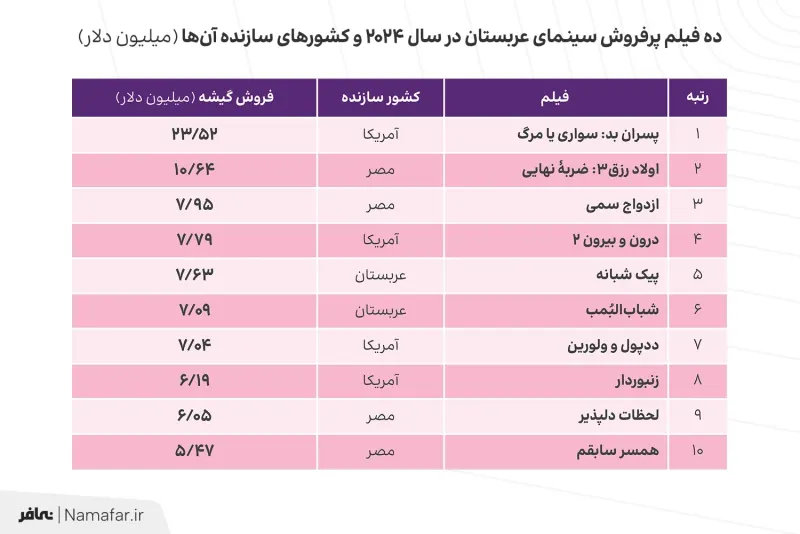
The Saudi cinema market in 2024 was in the hands of Hollywood films, Egyptian productions, and works produced in Saudi Arabia. The film "Bad Boys: Ride or Die," with sales of 23,52 million dollars, is at the top and by itself has obtained about 26 percent of the sales of the top ten films and nearly 10 percent of total Saudi cinema sales. Four American films have sold a combined 44.54 million dollars (about 50 percent of the sales of the top ten films), which indicates the appeal of mainstream action-comedies and familiar brands (Marvel, Pixar, Statham) for Saudi admissions. Egyptian cinema, with four films and 30.11 million dollars in revenue, has had a serious share of the Saudi cinema box office. The presence of 4 Egyptian films among the ten highest-grossing films at the Saudi cinema box office indicates the serious share of same-language Arabic content in the consumption basket of Saudi admissions. The film "Sons of Rizk 3: The Final Blow," with sales of 10,64 million dollars, has led Egyptian films in Saudi cinema. Also, the two films "Night Courier" and "Shabab Al-Bomb," produced in Saudi Arabia, have together sold 14.72 million dollars, which is a sign of the growth of domestic production capacity and of connection to local audience taste.
The capacity of Saudi and regional cinema for Iranian cinema
Given the size of Iran's cinema market and box office in terms of sales and earning revenue, an outward-looking approach and an export view can be the principal solution for bringing the capacities and abilities of Iran's long-established cinema to fruition. Given the history of screening Iranian films at international box offices and their being limited to festival cases that often have a particular approach, it appears that planning and focusing on emerging markets such as Saudi cinema can become the driver of an outward-looking and export approach for Iranian cinema. Just as Namafar's policy-research and data-analysis group, by data-driven monitoring of the Chinese cinema market, has explained the necessity of Iranian cinema's presence in international markets such as China, it now also points, relying on statistics and data, to the capacity of Saudi and regional cinema for Iranian cinema.
Sales of 4 Egyptian films at the Saudi box office: more than Iran's total cinema sales in 1403 (2024/25)
Egyptian cinema, with four films and 30.11 million dollars in revenue, had a serious share of the Saudi cinema box office in 2024 and, by paying attention to the newly emerged Saudi cinema market, was able to earn more than the total sales of Iranian cinema in 1403 (2024/25). Also, in addition to nascent Saudi cinema, in recent years countries in the West Asia region such as the United Arab Emirates, Kuwait, Oman, Qatar, and others have also had serious growth and have a special capacity for the entry of Iranian cinema. At first glance, given the cultural policies of countries in the region, the entry of Iranian films into their box office may seem difficult, but focusing on and paying attention to the genre advantages of Iranian cinema, such as the animation genre, as well as cultural and religious commonalities, can be a suitable window and angle of entry into these markets.
Final word
The statistics speak of a striking gap in capacities, sales, and audience numbers between Iranian and Saudi cinema. Iran, with 304 cinemas and 834 screens, attracted 35 million audience members last year, but its annual sales (about 29 million dollars) have been far lower than Saudi Arabia's 225 million dollar box office with only 64 cinemas, 630 screens, and 17.5 million admissions. Even the four Egyptian films screened in Saudi Arabia (with combined sales of 30 million dollars) have sold more than the entire annual revenue of Iranian cinema, which is evidence of the enormous capacity of regional markets for Iranian cinematic products.
Therefore, for the country's cinema policymakers, adopting an outward-looking approach is no longer a choice but an undeniable necessity. Iranian cinema, with export planning and an active presence in countries such as Saudi Arabia, the UAE, Qatar, and other neighbors, can benefit from this regional boom. A rich storytelling heritage, well-known directors, and diverse cultural content are among the advantages that, if introduced and supplied correctly, can make Iranian films appealing to new audiences in these markets. In other words, the future of Iranian cinema depends on a cross-border view; an approach that not only leads to higher revenue and return on capital, but will also strengthen the place of Iran's culture and art in the international arena.
Machine-translated from Persian by Namafar; the Persian original is authoritative. Read the original in Persian