A 31-item school stationery basket: from 900 thousand tomans to 1.5 million tomans
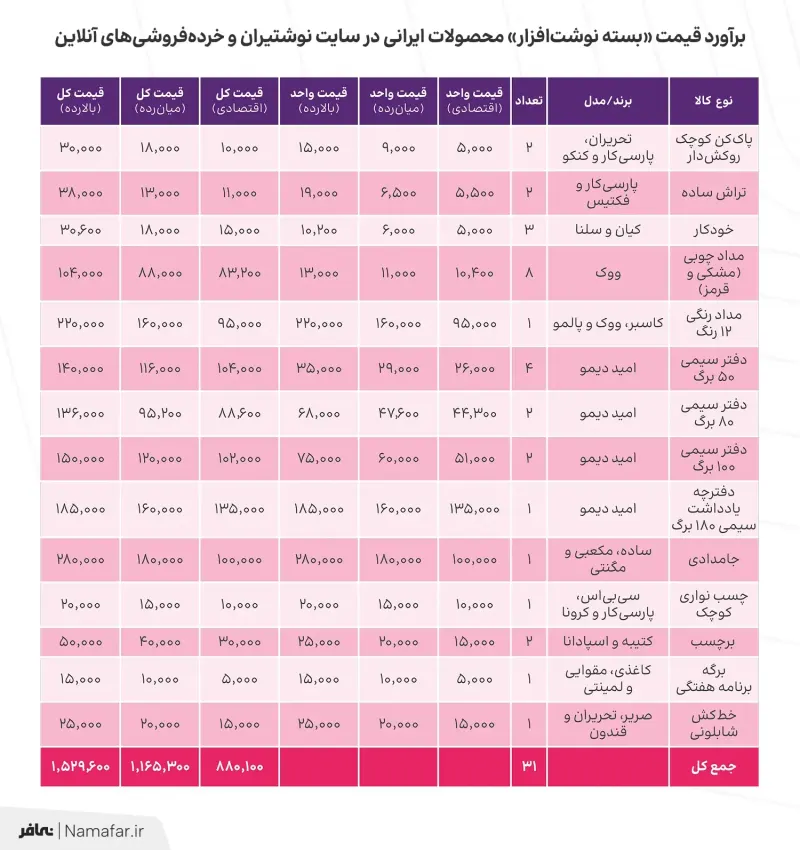
Some media have claimed in recent days that the minimum cost of obtaining stationery for an elementary-school student is between 3 and 4 million tomans. In this regard, Namafar’s policy research and data analysis group has enumerated and calculated the prices of various types of stationery by product, brand, and so on, in order both to examine the accuracy of that claim and to provide customers with a comprehensive guide to better and more cost-effective purchasing. Based on Namafar’s data mining and data-driven analysis, drawing on the Neveshtiran website (the virtual exhibition of Iranian stationery) and online stores and retailers, the cost of obtaining a pack of Iranian stationery including essential school supplies falls in a range from 880,100 tomans (economy) to 1,529,600 tomans (high-end), and its average cost is estimated at 1,165,300 tomans.
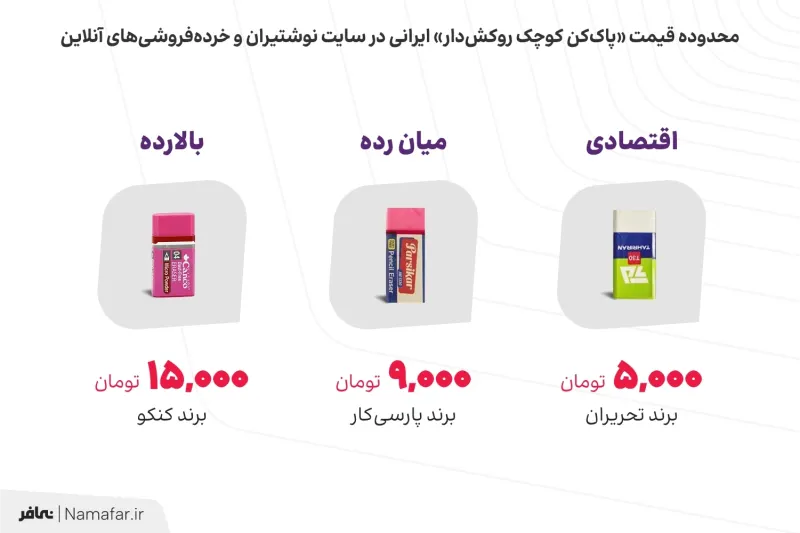
Small eraser: from 5 to 15 thousand tomans
The price of an Iranian “small sleeved eraser” is entirely transparent. The market floor is about 5,000 tomans and its ceiling is close to 15,000 tomans. The economy model “Tahriran Simple” represents the 5,000-toman price floor, an option that keeps the cost of school purchases low. In the middle of the range, about 9,000 tomans is paid for a mid-range item from a familiar brand such as “Parsikar,” a figure that has become a benchmark for everyday purchasing. In the higher tier, “Canco” stands at 15,000 tomans, which shows how a brand name and small product details can push the price higher.
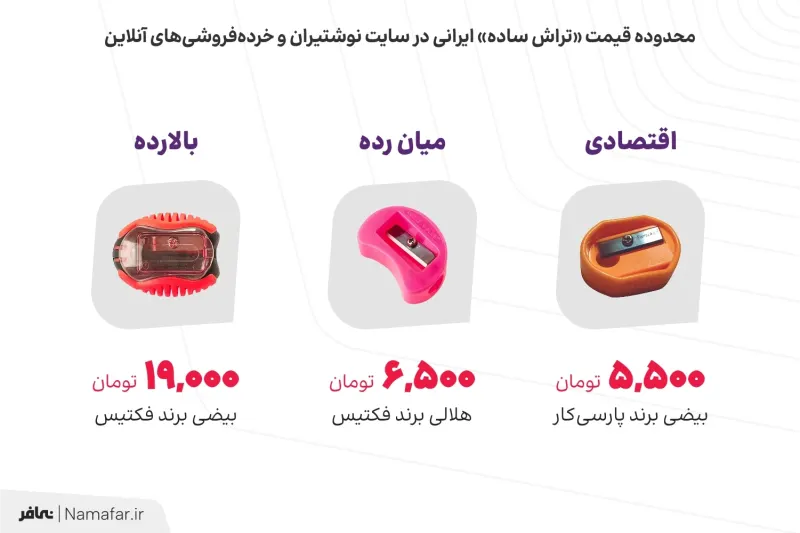
Simple sharpener: from 5,500 to 19,000 thousand tomans
The market for a simple Iranian sharpener is clearly divided into three price steps. The economy step is represented by “Parsikar Oval” at 5,500 tomans, a low-cost option for school and bulk purchases. At the market’s equilibrium point, “Factis Crescent” stands at about 6,500 tomans: the same acceptable quality with a familiar name that many buyers look for. Also, “Factis Oval” at 19,000 tomans, as the most expensive simple model (non-desktop and non-electric), has higher quality and a higher price. This price range, extracted from Neveshtiran data and online retailers, shows that even a small good, depending on brand, blade material, and body quality, has different prices. Of course, manual sharpeners with a reservoir usually have prices above this range; but the benchmark of this basket is essential Iranian goods.
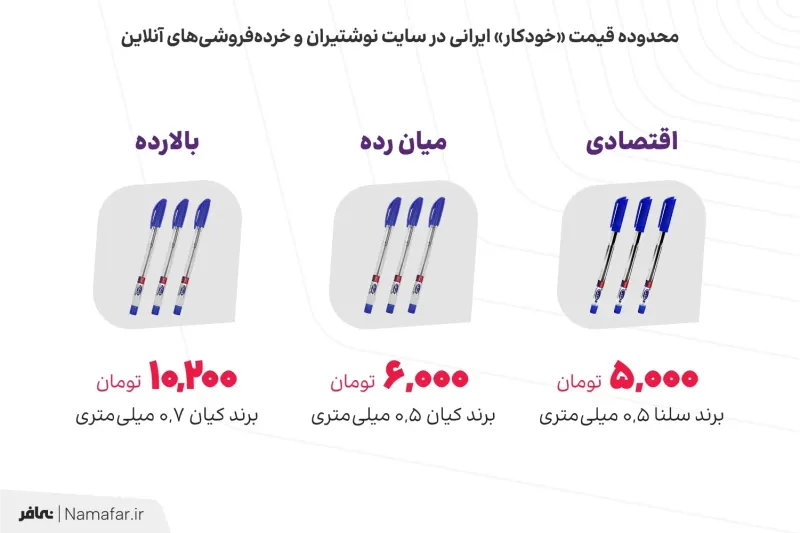
Iranian ballpoint pen: from 5 to 10 thousand tomans
What budget is needed to buy a three-pack of ballpoint pens (two blue and one red)? A review of online displays shows that we have three price options before us. At the lowest level, “Selena 0.5 mm” is offered at 5,000 tomans, a cheap choice suitable for class and bulk purchases. One step up, “Kian 0.5” is priced at about 6,000 tomans, a common and reliable figure that covers everyday use. The higher price comes out of multi-piece packs: in the 10-piece pack of “Kian 0.7,” the price of each pen reaches 10,200 tomans. This threefold difference shows how the sales channel and details such as tip thickness and ink flow can shift the price.
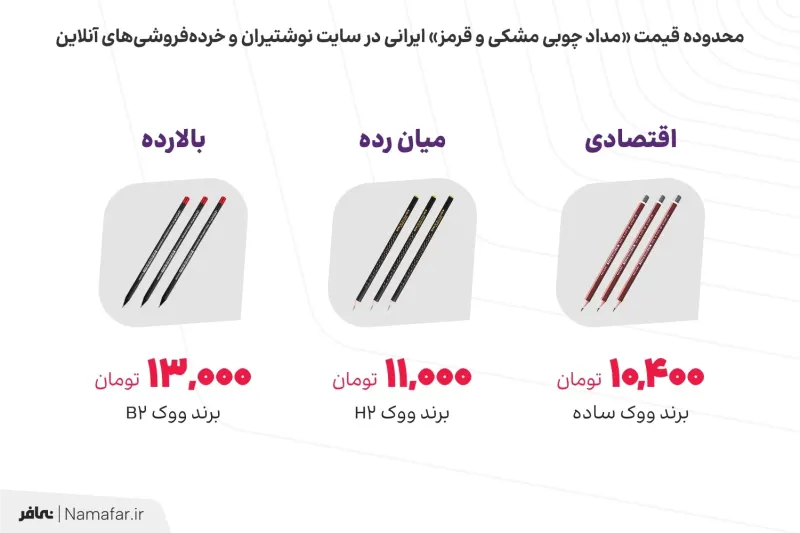
Wooden pencil: from 10,400 to 13,000 thousand tomans
Assuming a need for 8 pencils (6 black and 2 red), observation of the market shows three price ranges. If you obtain a “Wook” pencil in a 12-piece pack, the price of each comes to about 10,400 tomans, which means taking advantage of the benefit of bulk and economy purchasing. The retail price of a single black or red Wook pencil, for example with hardness grade H2, is about 11,000 tomans, which can be regarded as the everyday-purchase benchmark. Also in the high-end range, each pencil costs about 13,000 tomans, a level that represents higher-quality models such as softer B2 graphite or a more ergonomic body.
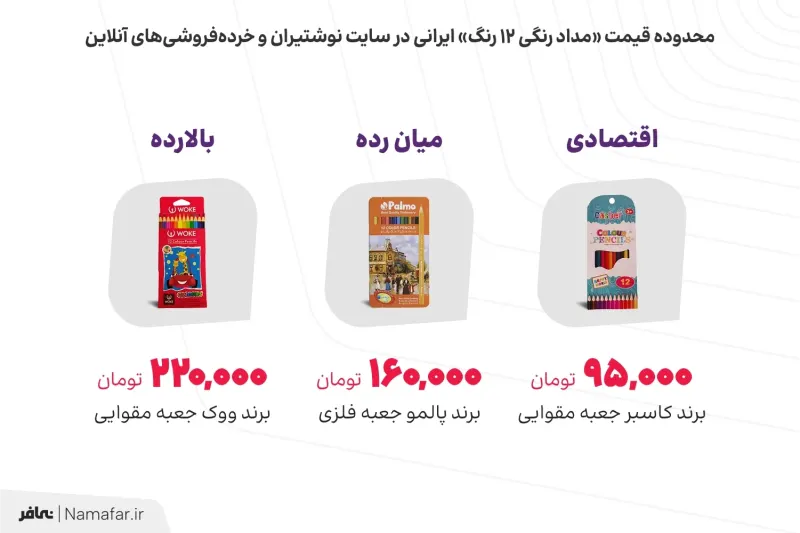
12-color colored pencils: from 95 to 220 thousand tomans
For a student 12-color colored-pencil box, three price levels are seen in the market. The entry threshold is “Casber” with a cardboard box and a price of 95,000 tomans, an economy option for school purchases. At the middle level, “Palmo” with a metal box and a price of 160,000 tomans stands; a well-known brand with more durable packaging that defines the market’s equilibrium point. Also, the higher price is set by “Wook” with a cardboard box and 220,000 tomans. This fact shows that in this category, brand name and the quality of pigment and wood can have a greater effect on price than the packaging material. Overall, if saving is the priority, the market floor of 95 thousand tomans is a suitable choice; for a balance of quality and price, 160 thousand tomans seems reasonable; and if you expect livelier colors and higher-quality construction, you must spend up to 220 thousand tomans.
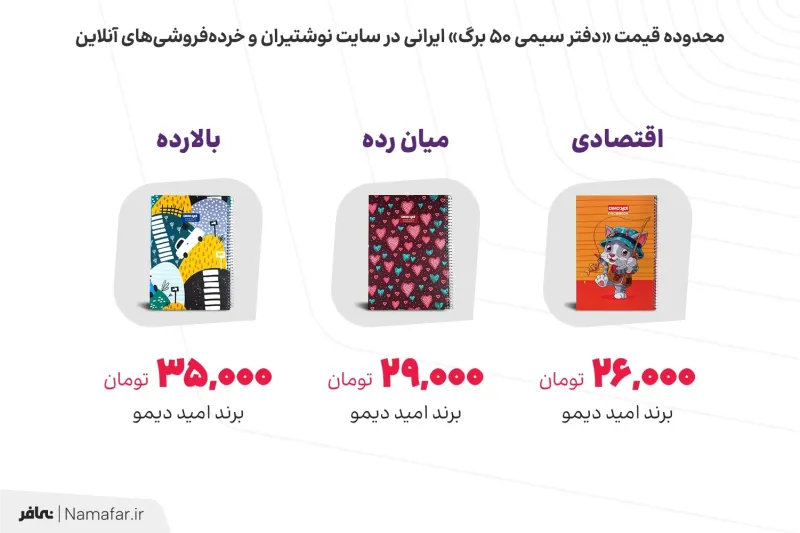
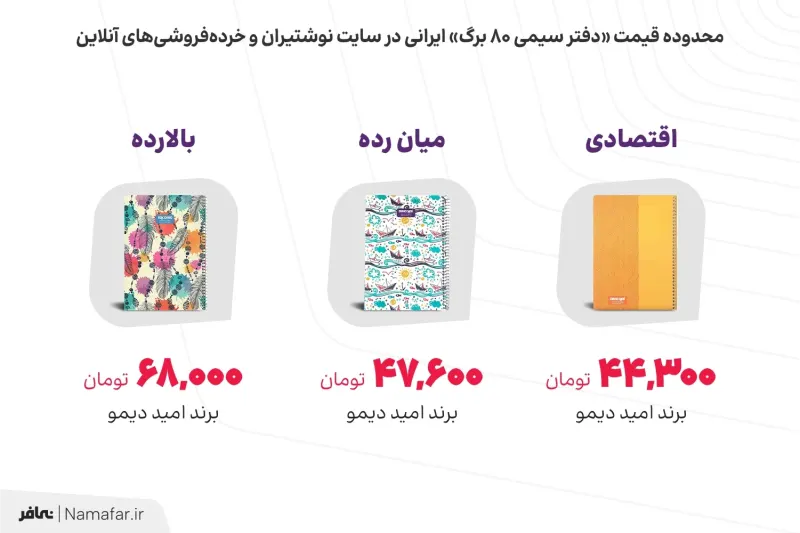
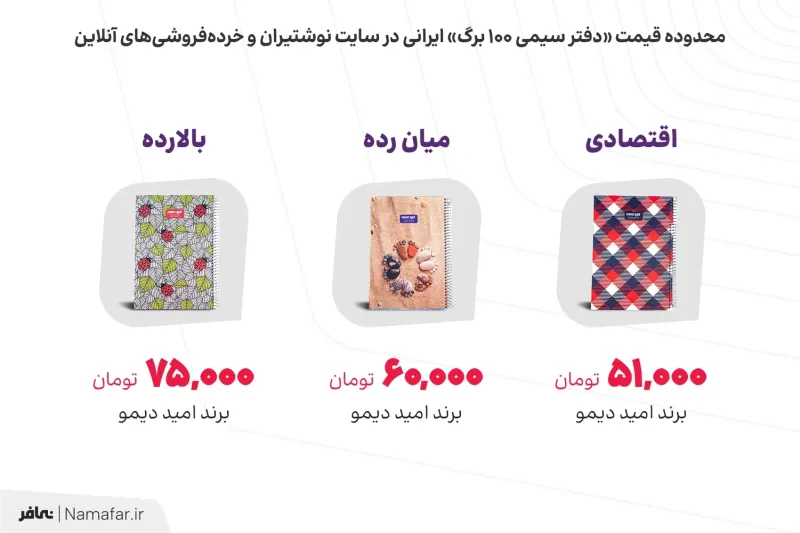
Spiral notebook: from 26 to 75 thousand tomans
The price of a “plastic-cover spiral notebook” in three common sizes has three distinct steps. In the 50-sheet size, prices start from 26,000 tomans; 29,000 tomans is the market’s equilibrium point, and the high-end 35,000 tomans is allocated to thicker versions or those with better-quality paper. In the 80-sheet notebook, the price floor is 44,300 tomans; the mid-range is priced at 47,600 tomans, and higher-quality models reach 68,000 tomans. In the 100-sheet notebook as well, prices are respectively 51,000, 60,000, and 75,000 tomans. These data give the buyer a clear picture: if saving matters to you, take the price floor of each size as the benchmark; if cover durability and paper quality are the priority, go for the middle step; and if you want a sturdier cover and cleaner printing, you can pay a higher price for that size. As a result, it appears that it is the notebook size that, more than anything else, determines its price.
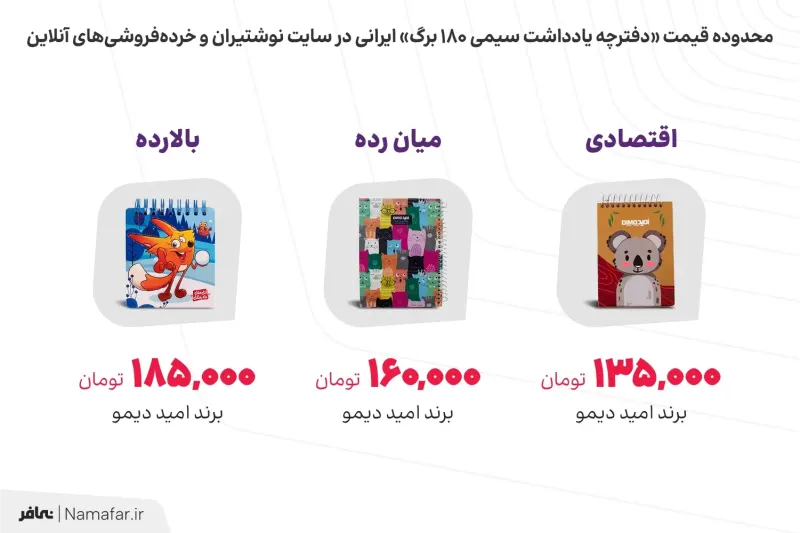
180-sheet notepad: from 135 to 185 thousand tomans
To estimate the price of a 180-sheet spiral notepad with a plastic cover, we used data on a similar 200-sheet notebook with a durable cover in order to obtain a more precise picture. The price floor is about 135,000 tomans, an economy choice for heavy but low-hassle use. The market’s equilibrium point sits around 160,000 tomans, the same “street price” for a product that offers acceptable paper and cover quality. The higher price range reaches 185,000 tomans, where a thicker cover, cleaner printing, and a more durable coil usually come first. Retail data show that smaller notepads (for example 50 sheets) are not a suitable benchmark for comparison; therefore this same 200-sheet version is the closest indicator.
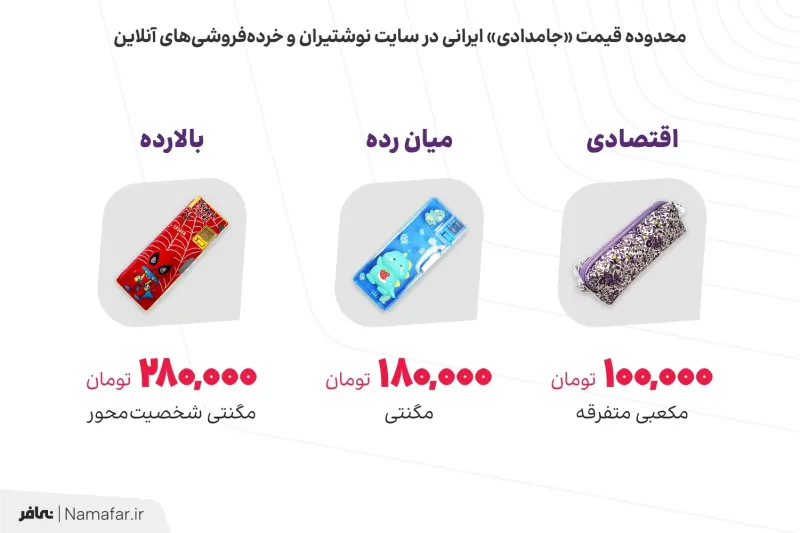
Student pencil case: from 100 to 280 thousand tomans
In the student pencil-case market, “design” determines the price more than anything else. The price floor is about 100,000 tomans and relates to a simple, unbranded cuboid pencil case that has only one zipper and one compartment. One step up, “magnetic” models sit at around 180,000 tomans; a harder body, better partitioning, and a more convenient opening-and-closing experience create this much price difference. Also, the price ceiling rises to 280,000 tomans; this territory usually belongs to character-based magnetic pencil cases in which character licenses and design details push the price up—even if size and basic function have not changed much. Therefore if you need only basic use, 100 thousand tomans is enough; for more durability and organization, 180 thousand tomans is a reasonable choice; and if visual appeal and “the good feeling of a school bag” matter to you, you can spend up to 280 thousand tomans.
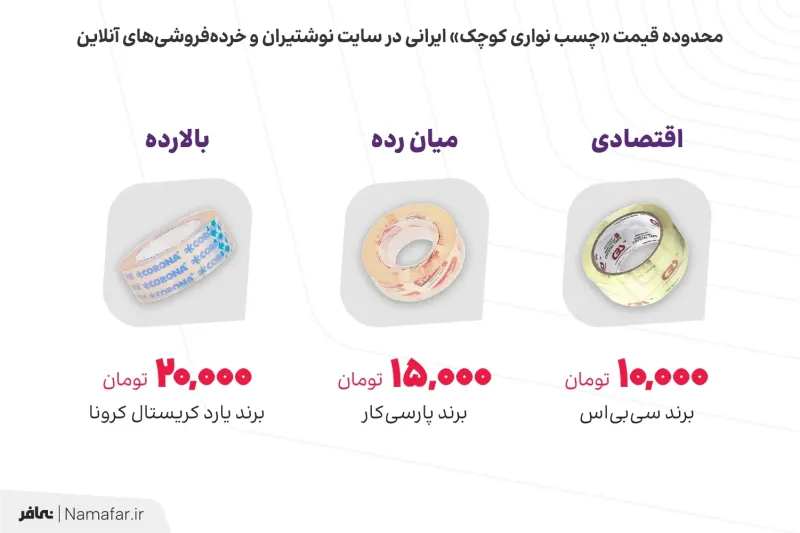
Small adhesive tape: from 10 to 20 thousand tomans
The price of a roll of “small adhesive tape” has a simple map and is summarized in three levels. The market floor is an economy option from the “CBS” brand at about 10,000 tomans, a suitable choice for everyday use and bulk purchasing. The middle step is priced at about 15,000 tomans; at this level “Parsikar,” with standard quality and acceptable durability, sets the market’s equilibrium point. “Yard Crystal Corona,” at 20,000 tomans and with more reliable adhesion and higher transparency, is also the representative of the high tier. Therefore, if saving is your priority, 10 thousand tomans is enough; for a balance of price and performance, 15 thousand tomans is a reasonable choice; and if you are looking for more transparent and more durable tape, you can spend up to 20 thousand tomans.
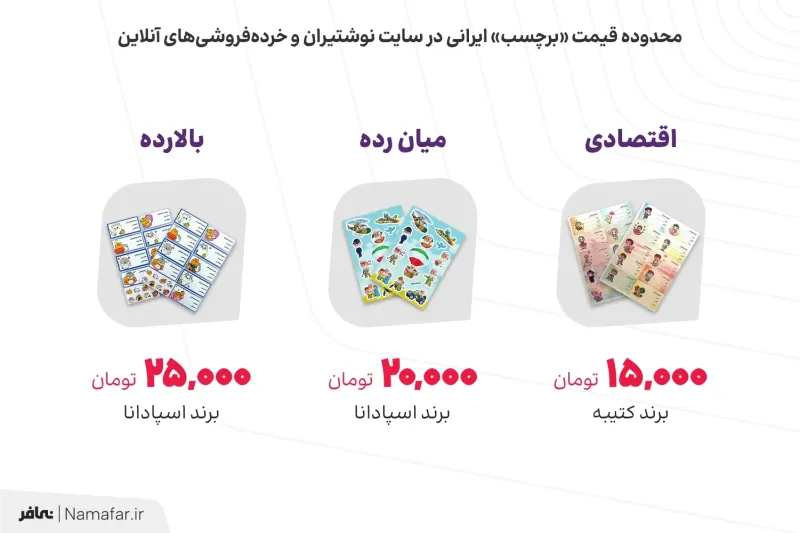
School labels: from 15 to 25 thousand tomans
For a sheet of labels for writing names on notebooks and books, the market has three distinct steps. The economy start is the “Katibeh” brand at 15,000 tomans, which has simple paper sheets and gets the job done. One step up, “Espadana” is priced at about 20,000 tomans and defines the market’s equilibrium point; better adhesion and ready-made designs, without a sharp price jump, are “Espadana’s” main advantage. Also, the durability of “Nam” waterproof labels against washing and moisture has made them, at 25,000 tomans, the superior choice. Therefore the economy option is suitable for quick, high-volume labeling, the mid-range has a cleaner and more lasting result, and the high-end comes into play when durability truly matters (for example on a water bottle or a transparent cover). In short, with 15 to 25 thousand tomans you can obtain a label exactly matched to your need and expected durability.
Weekly planner sheet: from 5 to 15 thousand tomans
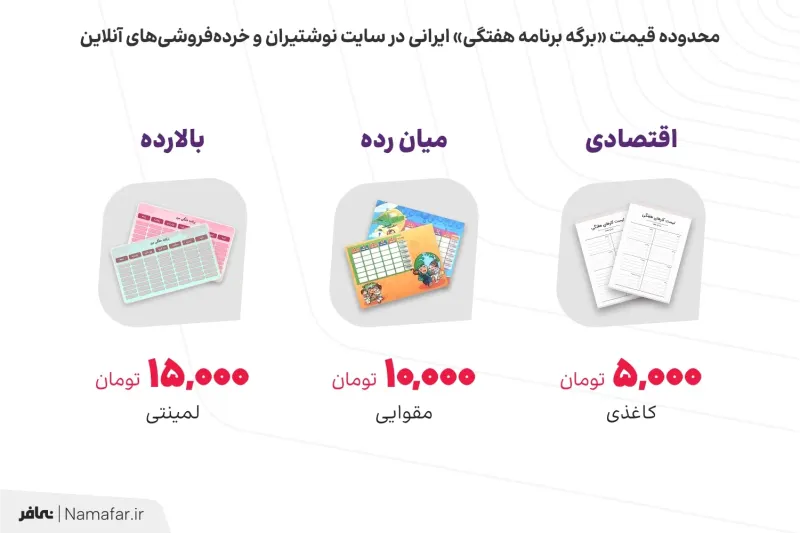
The simplest tool for organizing a student’s schedule is a weekly planner sheet. The market for this product is small but has a clear boundary. The price floor is about 5,000 tomans, a paper, single-color version that gets the job done. The middle of the market is set at about 10,000 tomans: a full-color sheet on thicker paper that has better durability in everyday use. Also, the price of laminated or cardboard versions that have a smooth, stain-resistant surface and are suitable for writing and wiping several times reaches 15,000 tomans. Because this good is often offered as a promotional gift or as an insert with notebooks, its single-sale prices are scattered. Even so, if saving matters to you, the paper model is enough; if you want more durability, go for the cardboard type; and if you are looking for a more lasting sheet, the laminated version is a reasonable choice.
Stencil ruler: from 15 to 25 thousand tomans
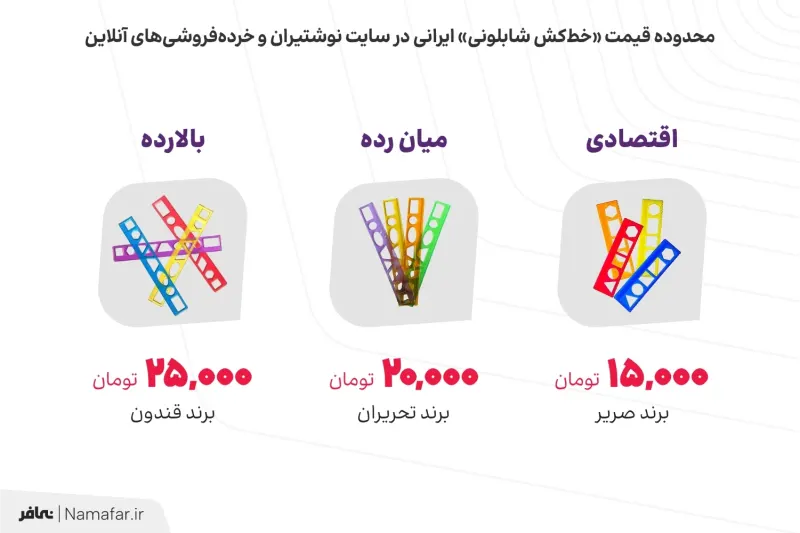
The price chart of a “stencil ruler” has three distinct steps. Market entry begins with economy “Sarir” models at 15,000 tomans, a simple and practical option for a school bag. At the middle station, “Tahriran” is priced at about 20,000 tomans; more uniform build quality and more precise cutouts justify this price difference. Also, “Ghandon,” with more flexible plastic and more complete design details, is the representative of the higher tier at 25,000 tomans. If saving is your priority, 15 thousand tomans meets your need; for a balance of accuracy and durability, 20 thousand tomans is considered a safe point; and if you want a stencil that draws a clean line and warps later, you must spend up to 25 thousand tomans.
School stationery pack: from 900 to 1,500 thousand tomans
Based on Namafar’s data mining and data-driven analysis, drawing on the Neveshtiran website (the virtual exhibition of Iranian stationery) and online stores and retailers, the cost of obtaining a pack of Iranian stationery including essential school supplies falls in a range from 880,100 tomans (economy) to 1,529,600 tomans (high-end), and its average cost is estimated at 1,165,300 tomans.
School bags and backpacks: from 450 thousand tomans to 2.5 million tomans
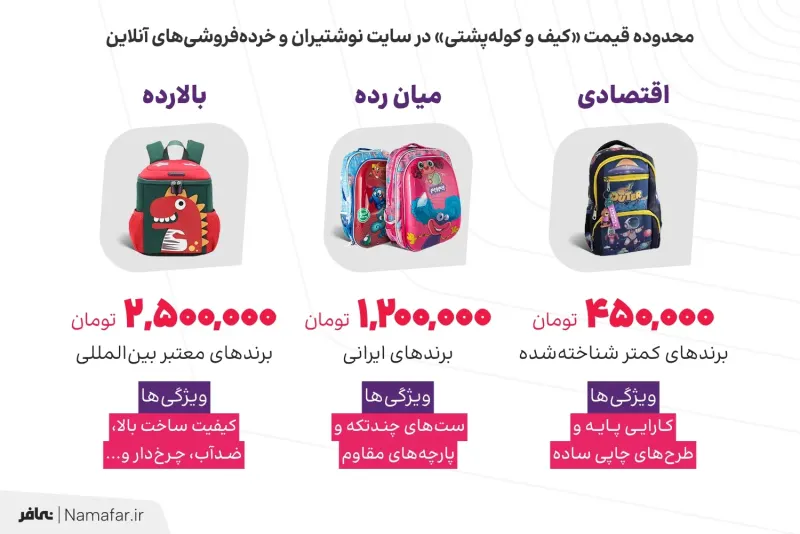
Although school bags and backpacks have been placed outside the essential school stationery pack, a review of the related data indicates that the price chart of school bags and backpacks in Iran’s market has three distinct stations. The economy entry starts from about 450 thousand tomans, lightweight models with simple printed designs that cover basic function. The market’s popular step stands around 1.2 million tomans, where multi-piece sets, durable fabrics, and practical pockets and partitioning form the shape of a “proper everyday backpack.” The ceiling of this path reaches 2.5 million tomans, which is mostly allocated to the territory of reputable international brands. High build quality, being waterproof, clean stitching, or even being wheeled and an ergonomic back panel are the reasons for these price differences. A backpack’s price is not only a function of volume and zippers; brand, character-based designs, and functional features create price jumps. Therefore a smart choice means matching these three levels with the budget, expected durability, and your child’s taste.
Final word
Based on the findings, the price difference of a complete pack of essential school stationery stems from 3 reasons: first, display items such as a pencil case (100 to 280 thousand) and 12-color colored pencils (95 to 220 thousand) that, with a different choice, shift the costs. Second, notebooks, which because of print run determine the basket price and every small change in each unit creates a large effect in the overall total, and third, basic consumables such as erasers, sharpeners, ballpoint pens, and so on, which have smaller price changes. Also, adding a bag and backpack to the stationery pack suddenly makes the stationery basket price heavy.
Data-driven monitoring of the market shows that with 880 thousand tomans to 1.5 million tomans, one can obtain a complete pack of essential school stationery for an elementary-school student that both has good performance and durability and is up-to-date and appealing. For this, it is enough to choose and swap products and prices knowingly; for example a durable cover for notebooks, reliable mid-range items for ballpoint pens, and comparing unit prices in multi-piece packs.
Machine-translated from Persian by Namafar; the Persian original is authoritative. Read the original in Persian