If we were asked to introduce only one work to the people of the world as a symbol of Iran's culture and art, which work would we choose? A Persian miniature painting? Iran's finest poetry? A few lines of Iranian calligraphy? An Iranian enamelware cup? Or a building that, with its tilework, stucco, woodcarving, and glasswork, could display Iranian architecture? And if we did not want to close our eyes to any of these arts? Is there a work that has everything the finest works have, all in one place? Fortunately, yes.
The Iranian carpet, drawing inspiration from all these branches, is not only a representation of Iran's art but a reflection of the Iranian spirit. Because the artist designs with awareness. Selects the colors and weaves warp and weft together. In this interval, inner intentions and taste blend with scientific and experiential knowledge. In the end, a valuable and sublime work is created. In fact, no work like the Iranian rug can reveal the astonishing balance between form and meaning in Iran's arts.
The various kinds of Iranian carpet have firm principles on which their beauties have been formed. If we discover them, we understand how they are bound to our country's artistic and cultural values. Now the medal of carpet capital of the world hangs around Iran's neck so that it may introduce itself to the world with this art. But has Iran been able to turn this authentic art into a profitable industry as well, or not? What place do Iran's carpet industries have in the world?
Iran's carpet industry after the Islamic Revolution
The handwoven carpet industry in Iran, as one of the country's important sources of foreign-exchange income, has seen considerable fluctuations over the past 40 years. From 1372 (1993/94) to 1368 (1989/90), handwoven-carpet exports faced unprecedented growth. This growth was the result of the abolition of the foreign-exchange surrender requirement, the import-in-return-for-export law, the lifting of export restrictions, and other export facilities.
But from 1373 (1994/95) to 1378 (1999/2000), the average annual growth of Iranian carpet exports was equivalent to -11 percent. With the reimposition of the foreign-exchange surrender requirement in 1374 (1995/96) and, at the same time, a decline in global demand for handwoven carpets, demand for Iranian handwoven carpets fell. During this period, other countries' competition increased with greater intensity. Exports of Chinese, Indian, and Pakistani carpets at a price lower than the price of Iranian carpets were another factor in the decline of Iran's carpet exports. Iranian carpet export figures over the years 1378 (1999/2000) to 1384 (2005/06) were also accompanied by a downward trend. But in the years 1383 (2004/05) to 1389 (2010/11) they had 1.82 percent growth. While the share of many competitor countries declined in this period.
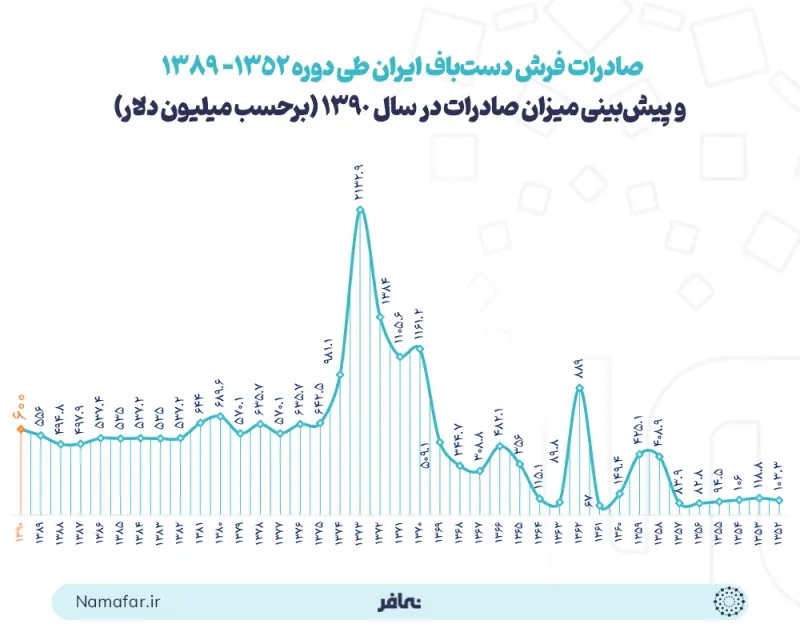
Overall, the value and profit of Iran's handwoven-carpet exports went from about 100 million dollars in the years 1357 (1978/79) to 1382 (2003/04) to above 2.1 billion dollars. That is, under the influence of some economic issues, they grew 20 times. The decline in the value of the national currency, the increase in export facilities, and the abolition of the foreign-exchange surrender requirement in the early 70s (1370s, 1990s) had the greatest positive effect on carpet exports. But figures show that with the return of the foreign-exchange surrender policy in 1373 (1994/95), handwoven-carpet exports again faced restrictions.
The state of carpet industry exports in Iran
In 1394 (2015/16), with the implementation of the JCPOA agreement and the lifting of some of the economic sanctions against Iran, Iranian rug exports improved. They went from 290 million dollars in 1394 (2015/16) to 426 million dollars in 1396 (2017/18). But with a sharp drop in carpet exports in 1398 (2019/20), this figure fell to 55 million dollars, which is considered the lowest figure in the past 20 years.
Iran's carpet industry now has an 85 percent slump by weight and, in dollar value, has seen a 90 percent collapse. The various kinds of Iranian handwoven carpet, which in the 80s (1380s, 2000s) held first rank in the world, have now fallen to fourth place and stand after India, China, Pakistan, and Turkey.
Causes of the decline in the place of the Iranian handwoven carpet in the global market
Studies show that some factors in recent years have played a deterrent role in the inclination to buy Iranian handwoven carpets. They can be grouped under a few main themes of Iranian carpet price, distribution, promotion, product, and environmental factors. Problems that relate to environmental factors are outside the control of carpet exporters. But the other problems can, to a large extent, be managed and corrected by carpet producers and exporters.
Environmental factors
- Severance of Iran's diplomatic relations with countries
- Imposition of sanctions and trade suspensions
- Negative framing against Iran in the media
- Severe exchange-rate fluctuations in Iran
- Iranian suppliers' inattention to the economic situation and developments in Europe
- The striking activity of Iran's competitors in Europe's carpet industry, especially in advertising and the pricing of handwoven carpets
- The spread of substitute products such as moquette and quality Iranian machine-made carpet
- Ineffectiveness and delay of Iran's embassies in issuing visas
- Lengthy stages of goods clearance from customs in Iran
Iranian carpet prices
- High prices that do not match global carpet markets
- Many problems in the manner of paying the price
Distribution
- Weakness in using e-commerce and ignoring new electronic business platforms
- Failure to deliver the product on time
- Weakness in the layout of carpet stores and the quality of display, such as stacking carpets on top of one another
Promotion
- Shortage of information about Iranian carpet sellers in Europe, Istanbul in Turkey, Germany, and other parts of the world
- Lack of comprehensive information about Iranian producers and their products in small cities
- Inability to converse and establish communication with Iranian handwoven-carpet producers
- Distrust in the relationship between the parties to the transaction
- The Iranian party's unreliability in providing after-sales carpet services
- Absence from specialized and general international exhibitions
- Weakness in media advertising of the Iranian carpet
Product
- Packaging, size, and design of Iranian carpets not matching the culture of people in destination countries
- Lack of innovation
- Uniformity in Iranian carpet design and pattern
Customers of Iranian carpet buying and selling
Despite all these obstacles, in 1401 (2022/23) more than 78 million dollars of exports of various kinds of Iranian carpet and floor covering were carried out to 82 different countries. This event, in weight and rial terms, saw slight growth. Although the foreign-exchange income of Iran's carpet exports declined 14 percent. Carpet exports have been carried out to Turkey, Dubai, Germany, Oman, Qatar, and so on. Germany, Japan, Iraq, Pakistan, Turkmenistan, and Afghanistan, in that order, have had the largest share of Iranian carpet exports. Other countries, including the United States, Canada, England, Italy, Germany, and France, are also on the list of buyers of various kinds of Iranian handwoven carpet. Among them, with carpet exports to Germany and purchases of more than 9 million and 700 thousand dollars, Germany is counted as the largest consumer of Iranian carpet. Ireland, with purchases of only 360 dollars, is considered the smallest consumer of Iran's handwoven carpet.
Conclusion
Iran's oil exports cannot, as in the past, be the driver of the wheels of the economy. For that reason the importance of Iran's non-oil exports is felt more than before, and among them exports of handwoven and machine-made carpet have a special place. Iran, as the carpet capital of the world, over the past forty years has seen many fluctuations in carpet exports. Overall, Iran's carpet industries over the past four decades have accounted for about one-fourth of the value of non-oil exports. In terms of job creation, value added, and foreign-exchange earnings, they have a considerable role in Iran's economy. Even so, the carpet-weaving industry in Iran has had a downward course in recent years. Such that the profit value of Iran's carpet exports has fallen from 2.1 billion in the 1380s (2000s) to 50 million dollars now. The most important cause of this is the inconsistency of foreign-exchange policies with policies for the growth and development of foreign trade, rising inflation, and international pressures and sanctions. Now, given the country's need to reduce dependence on oil revenues and observing the downward trend of Iran's carpet exports, efforts to remove the obstacles to exporting this product can help Iran's economic growth.
Sources
- Ahad Azimzadeh (1401 (2022/23)), Provinces / East Azerbaijan, https://www.farsnews.ir/azarbaijan-sharghi/news/14010130000609/farsh-irani-az-arsh-ta-farsh-soqut-farsh-dastbaf-iran-be-rotbe-4-jahan
- Mehrnoosh Heidari (1401 (2022/23)), Economic news, https://roozno.com/fa/news/549717/soqut-saderat-farsh-dastbaf-az-450-be-50-milyon-dolar
- Carpetour (1402 (2023/24)), Carpet electronic magazine / Statistics and information, https://carpetour.net/news/855/details-of-Iran-carpet-exports-in-1401
- Carpetour (1402 (2023/24)), Carpet electronic magazine / Report, https://carpetour.net/news/828/the-state-of-Iran-handwoven-carpet-exports-is-very-dire
- Camelia Nikou, Developments of Iran's carpet industry over the period 89–1352 (1973–2011), Iran National Carpet Center
- Donya-e Eqtesad (1397 (2018/19)), Industry and mining, https://donya-e-eqtesad.com/bakhsh-sanat-madan-3/3473904-details-of-carpet-trade-in-the-past-four-decades
- Akram Feizabadi (1402 (2023/24)), Production and trade, https://tejaratnews.com/saderat-farsh-iran-1402
- Siavashi, Maliheh, An examination of factors affecting the purchase decision of importers of Iranian handwoven carpet in the European Union, Iran scholarly-research biannual, no. 33, spring and summer 1397 (2018/19)
Machine-translated from Persian by Namafar; the Persian original is authoritative. Read the original in Persian